
Penny Le Couteur, Jay Burreson Books
Penny Le Couteur is a Canadian chemist and educator known for her engaging approach to science communication. Jay Burreson is a research chemist and co-author who has collaborated with Le Couteur to make chemistry accessible to general readers.
Known for: Napoleon’s Buttons: How 17 Molecules Changed History
Books by Penny Le Couteur, Jay Burreson
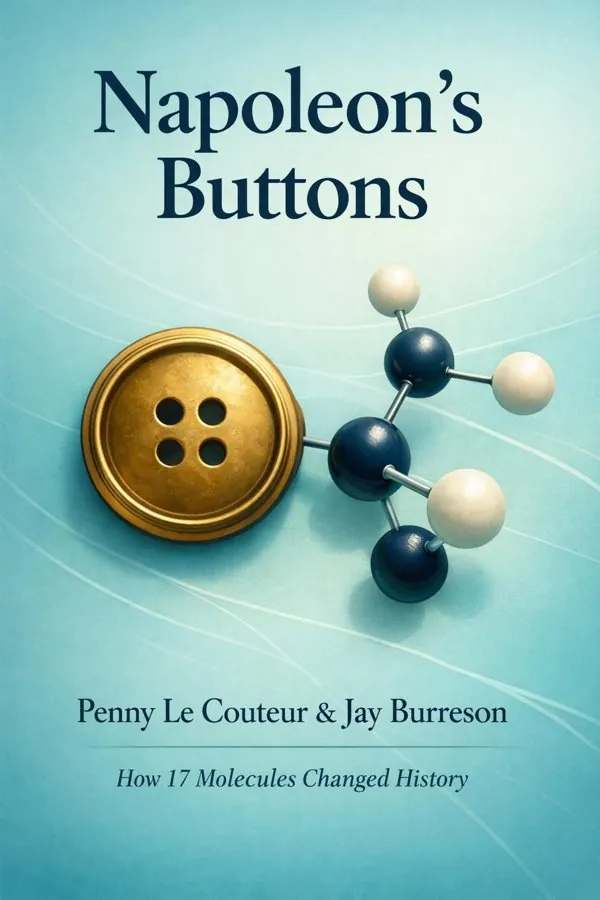
Napoleon’s Buttons: How 17 Molecules Changed History
History is usually told through emperors, wars, inventions, and revolutions. Napoleon’s Buttons asks us to look deeper—down to the molecular level. In this lively and accessible work, Penny Le Couteur and Jay Burreson show how chemistry has quietly directed the course of civilization. From the fragrant compounds in spices that launched global exploration to the proteins in silk that fueled ancient trade routes, from explosives that transformed warfare to antibiotics that redefined survival, the book reveals that small molecules often stand behind enormous historical change. What makes this book matter is its unusual perspective. It does not treat chemistry as an isolated academic subject, but as a force woven into economics, politics, medicine, fashion, empire, and everyday life. The authors connect molecular structure to human consequences in a way that makes both history and science feel immediate. Le Couteur, a chemist and gifted educator, and Burreson, a research chemist, bring scientific credibility along with a clear talent for storytelling. Their great achievement is making readers see that behind every major turning point may lie a molecule with the power to reshape the world.
Read SummaryKey Insights from Penny Le Couteur, Jay Burreson
Spices Launched Empires and Oceans
A craving for flavor helped redraw the map of the world. One of the book’s most memorable insights is that molecules responsible for smell and taste—such as eugenol in cloves and cinnamaldehyde in cinnamon—were once powerful enough to motivate dangerous sea voyages, imperial competition, and economi...
From Napoleon’s Buttons: How 17 Molecules Changed History
Silk Turned Proteins into Power
Luxury is never just cultural; it is often molecular. Silk’s beauty and prestige arise from the unique properties of fibroin and sericin, proteins produced by silkworms. Le Couteur and Burreson use silk to demonstrate how a material’s microscopic structure can create enormous social and political co...
From Napoleon’s Buttons: How 17 Molecules Changed History
Vitamin C Saved Sailors and Empires
Sometimes history turns not on military brilliance but on a missing molecule. The chapter on ascorbic acid, better known as vitamin C, shows how the absence of one essential compound caused suffering on a vast scale. Scurvy weakened and killed sailors for centuries, limiting long-distance voyages an...
From Napoleon’s Buttons: How 17 Molecules Changed History
Sugar Fueled Wealth, Slavery, and Industry
A sweet molecule helped build a brutal world. The book uses glucose, sucrose, and related carbohydrates to show that chemistry can sit at the center of both pleasure and exploitation. Sugar was not just a food; it was an energy source, a trade engine, and a driver of massive social systems, includin...
From Napoleon’s Buttons: How 17 Molecules Changed History
Cellulose Built Clothing, Paper, and Industry
Civilization depends as much on structural molecules as on dramatic discoveries. Cellulose, the main component of plant cell walls, may seem humble compared with explosives or medicines, yet it has shaped economies, communication, and daily life through materials such as cotton, paper, and early ind...
From Napoleon’s Buttons: How 17 Molecules Changed History
Explosives and Dyes Rewired Modern Chemistry
Some of the most consequential chemicals are born where war and industry intersect. The book’s discussions of nitro compounds, phenol, and synthetic dyes reveal how efforts to make stronger explosives and brighter colors helped create modern industrial chemistry itself. This is a powerful reminder t...
From Napoleon’s Buttons: How 17 Molecules Changed History
About Penny Le Couteur, Jay Burreson
Penny Le Couteur is a Canadian chemist and educator known for her engaging approach to science communication. Jay Burreson is a research chemist and co-author who has collaborated with Le Couteur to make chemistry accessible to general readers.


Frequently Asked Questions
Penny Le Couteur is a Canadian chemist and educator known for her engaging approach to science communication. Jay Burreson is a research chemist and co-author who has collaborated with Le Couteur to make chemistry accessible to general readers.
Read Penny Le Couteur, Jay Burreson's books in 15 minutes
Get AI-powered summaries with key insights from 1 book by Penny Le Couteur, Jay Burreson.