
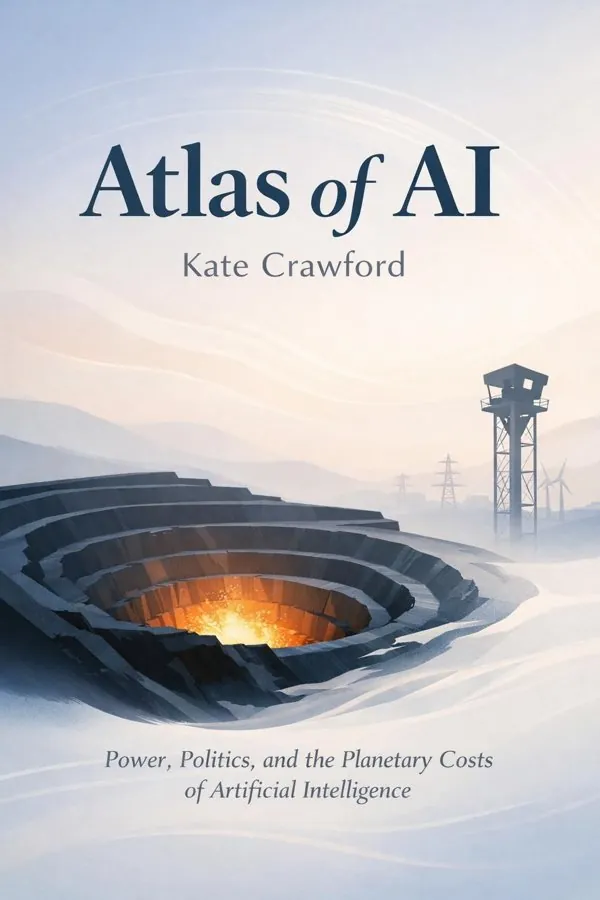
Atlas of AI: Power, Politics, and the Planetary Costs of Artificial Intelligence: Summary & Key Insights
 10 min7 chaptersAudio available
What Is Atlas of AI: Power, Politics, and the Planetary Costs of Artificial Intelligence About?
Atlas of AI: Power, Politics, and the Planetary Costs of Artificial Intelligence by Kate Crawford is a ai_ml book spanning 7 pages. Atlas of AI es un estudio crítico sobre la inteligencia artificial que explora cómo los sistemas de IA están profundamente entrelazados con estructuras de poder, explotación laboral y daños ambientales. Kate Crawford analiza la extracción de recursos, la vigilancia y las desigualdades sociales que sustentan la industria tecnológica, ofreciendo una visión amplia de las implicaciones políticas y ecológicas de la IA.
This FizzRead summary covers all 7 key chapters of Atlas of AI: Power, Politics, and the Planetary Costs of Artificial Intelligence in approximately 10 minutes, distilling the most important ideas, arguments, and takeaways from Kate Crawford's work. Also available as an audio summary and Key Quotes Podcast.
Atlas of AI: Power, Politics, and the Planetary Costs of Artificial Intelligence
Atlas of AI es un estudio crítico sobre la inteligencia artificial que explora cómo los sistemas de IA están profundamente entrelazados con estructuras de poder, explotación laboral y daños ambientales. Kate Crawford analiza la extracción de recursos, la vigilancia y las desigualdades sociales que sustentan la industria tecnológica, ofreciendo una visión amplia de las implicaciones políticas y ecológicas de la IA.
Who Should Read Atlas of AI: Power, Politics, and the Planetary Costs of Artificial Intelligence?
This book is perfect for anyone interested in ai_ml and looking to gain actionable insights in a short read. Whether you're a student, professional, or lifelong learner, the key ideas from Atlas of AI: Power, Politics, and the Planetary Costs of Artificial Intelligence by Kate Crawford will help you think differently.
- ✓Readers who enjoy ai_ml and want practical takeaways
- ✓Professionals looking to apply new ideas to their work and life
- ✓Anyone who wants the core insights of Atlas of AI: Power, Politics, and the Planetary Costs of Artificial Intelligence in just 10 minutes
Want the full summary?
Get instant access to this book summary and 100K+ more with Fizz Moment.
Get Free SummaryAvailable on App Store • Free to download
Key Chapters
When I speak of the Earth in relation to AI, I begin with the literal material on which all computation depends: the minerals, metals, and resources extracted from the planet to make circuits, sensors, and servers. The myth of AI as cloud-based or weightless dissolves when you stand on a lithium mine in Chile or a rare-earth processing plant in Inner Mongolia. Every chip begins with excavation, every neural network depends upon the carbon costs of production and operation. To create vast computational infrastructures requires enormous energy ecosystems, and with them come pollution, labor exploitation, and geopolitical tensions.
I trace the environmental footprint of AI from its roots in resource extraction to its towering data centers that demand continuous energy flows. Google’s and Amazon’s centers consume the power of small cities while promising efficiency and intelligence. What often goes unseen are the degraded landscapes left behind and the communities living amid residues of industrial consumption. The physical scale of AI infrastructures mirrors the vastness of the data they absorb, revealing a paradoxical truth: an industry seeking to predict and optimize the future is destroying its very conditions of possibility.
In seeing AI as an ecological system, we confront a crucial question: can intelligence built on destruction truly be intelligent? Recognizing this interconnection doesn’t merely evoke environmental concern—it requires rethinking ethics itself. Intelligence cannot be separated from responsibility; computing cannot be detached from ecology. AI’s planetary reach compels us to understand it as part of a continuum of extractive capitalism stretching from mining to modeling.
Behind the sleek automation that defines AI lies the labor of millions of people whose work remains hidden. In Atlas of AI, I ask readers to think about all the hands that shape and maintain machine learning systems—the clickworkers labeling images, the moderators cleaning toxic content, the engineers scripting automation routines. AI depends upon vast hierarchies of labor, particularly invisible, precarious, and underpaid forms of human work.
One striking example comes from data annotation portals in Venezuela and the Philippines, where workers tag objects for self-driving cars and facial recognition datasets. Their fine-grained attention to detail trains algorithms to perceive the world with seeming intelligence, even though that intelligence is actually borrowed human labor. The paradox of automation is that the more we celebrate systems as self-sufficient, the more invisible the human work beneath them becomes.
In telling these stories, I show that AI’s labor economy is globalized and stratified. The promise of flexibility and scale often conceals exploitation. Even within high-tech firms, the rhetoric of innovation can hide the burnout and moral distress experienced by those managing biased or abusive content. AI is not a replacement for human intelligence; it is a machine that consumes it.
By making labor visible, we gain insight into the politics of value creation in technology. The dream of automation is never purely technical; it is historical, tied to efforts to abstract and control human activity. Understanding these labor conditions allows us to ask critical questions about justice, dignity, and the future of work in the age of so-called intelligent machines.
+ 5 more chapters — available in the FizzRead app
All Chapters in Atlas of AI: Power, Politics, and the Planetary Costs of Artificial Intelligence
About the Author
Kate Crawford es investigadora y profesora reconocida internacionalmente en el campo de la inteligencia artificial y sus impactos sociales. Ha trabajado en Microsoft Research y es cofundadora del AI Now Institute en la Universidad de Nueva York. Su trabajo se centra en las dimensiones éticas, políticas y culturales de la tecnología.
Get This Summary in Your Preferred Format
Read or listen to the Atlas of AI: Power, Politics, and the Planetary Costs of Artificial Intelligence summary by Kate Crawford anytime, anywhere. FizzRead offers multiple formats so you can learn on your terms — all free.
Available formats: App · Audio · PDF · EPUB — All included free with FizzRead
Download Atlas of AI: Power, Politics, and the Planetary Costs of Artificial Intelligence PDF and EPUB Summary
Key Quotes from Atlas of AI: Power, Politics, and the Planetary Costs of Artificial Intelligence
“The myth of AI as cloud-based or weightless dissolves when you stand on a lithium mine in Chile or a rare-earth processing plant in Inner Mongolia.”
“Behind the sleek automation that defines AI lies the labor of millions of people whose work remains hidden.”
Frequently Asked Questions about Atlas of AI: Power, Politics, and the Planetary Costs of Artificial Intelligence
Atlas of AI: Power, Politics, and the Planetary Costs of Artificial Intelligence by Kate Crawford is a ai_ml book that explores key ideas across 7 chapters. Atlas of AI es un estudio crítico sobre la inteligencia artificial que explora cómo los sistemas de IA están profundamente entrelazados con estructuras de poder, explotación laboral y daños ambientales. Kate Crawford analiza la extracción de recursos, la vigilancia y las desigualdades sociales que sustentan la industria tecnológica, ofreciendo una visión amplia de las implicaciones políticas y ecológicas de la IA.
You Might Also Like
Life 3.0
Max Tegmark
10 min
Superintelligence
Nick Bostrom
10 min
TensorFlow in Action
Thushan Ganegedara
10 min
AI Made Simple: A Beginner’s Guide to Generative AI, ChatGPT, and the Future of Work
Rajeev Kapur
10 min
AI Snake Oil
Arvind Narayanan, Sayash Kapoor
10 min
AI Superpowers: China, Silicon Valley, and the New World Order
Kai-Fu Lee
10 minBrowse by Category
Ready to read Atlas of AI: Power, Politics, and the Planetary Costs of Artificial Intelligence?
Get the full summary and 100K+ more books with Fizz Moment.