
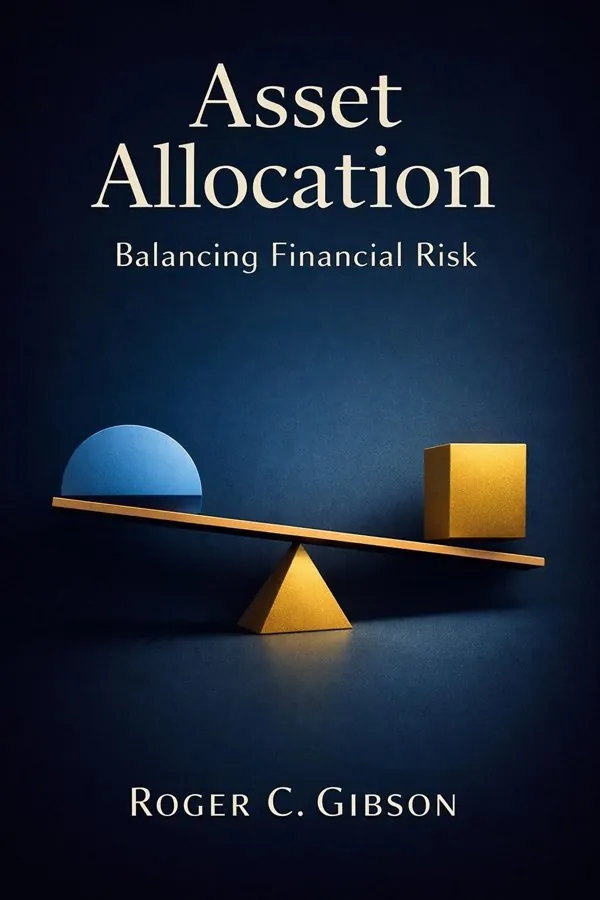
Asset Allocation: Balancing Financial Risk: Summary & Key Insights
 10 min5 chaptersAudio available
What Is Asset Allocation: Balancing Financial Risk About?
Asset Allocation: Balancing Financial Risk by Roger C. Gibson is a finance book spanning 5 pages. This book provides a comprehensive framework for constructing diversified investment portfolios that balance risk and return across asset classes. Roger C. Gibson explains the principles of modern portfolio theory, the role of asset allocation in long-term investment success, and how investors can manage financial risk through disciplined diversification strategies.
This FizzRead summary covers all 5 key chapters of Asset Allocation: Balancing Financial Risk in approximately 10 minutes, distilling the most important ideas, arguments, and takeaways from Roger C. Gibson's work. Also available as an audio summary and Key Quotes Podcast.
Asset Allocation: Balancing Financial Risk
This book provides a comprehensive framework for constructing diversified investment portfolios that balance risk and return across asset classes. Roger C. Gibson explains the principles of modern portfolio theory, the role of asset allocation in long-term investment success, and how investors can manage financial risk through disciplined diversification strategies.
Who Should Read Asset Allocation: Balancing Financial Risk?
This book is perfect for anyone interested in finance and looking to gain actionable insights in a short read. Whether you're a student, professional, or lifelong learner, the key ideas from Asset Allocation: Balancing Financial Risk by Roger C. Gibson will help you think differently.
- ✓Readers who enjoy finance and want practical takeaways
- ✓Professionals looking to apply new ideas to their work and life
- ✓Anyone who wants the core insights of Asset Allocation: Balancing Financial Risk in just 10 minutes
Want the full summary?
Get instant access to this book summary and 100K+ more with Fizz Moment.
Get Free SummaryAvailable on App Store • Free to download
Key Chapters
Every investor dreams of the perfect investment—one that offers high returns with minimal risk. But such a thing does not exist. In truth, risk and return are two sides of the same coin, inseparable partners in the investing process. The first step toward achieving balance is to accept that all investments involve trade-offs. My objective in this chapter is to help you see risk not as a threat to be avoided, but as a component to be managed. The art of investing lies in blending risky and stable assets so that their combined behavior offers a smoother, more predictable path forward.
Diversification is the investor’s primary tool for managing risk. It does not eliminate risk, but it changes its nature. When assets that respond differently to economic conditions are combined, the portfolio’s total volatility can be lower than that of its individual parts. A simple example illustrates the concept. Stocks, which represent ownership in companies, tend to soar in times of growth but suffer in recessions. Bonds, in contrast, often shine in adversity as interest rates fall. Holding both creates a balance. The key lies in correlation—how closely two assets move together. Understanding correlation is what allows us to construct portfolios that benefit from the differing rhythms of asset classes.
I want readers to internalize this: diversification means owning what is uncomfortable. The assets that perform best today are rarely the ones that safeguard you tomorrow. True risk management requires commitment to the structure when emotions tempt you to abandon it. Over time, the steady hand of a diversified allocation triumphs over short-term speculation.
Modern Portfolio Theory (MPT), introduced by Harry Markowitz, revolutionized how we think about investing. It formalized the relationship between risk and return by showing that portfolios can be mathematically optimized for efficiency—producing the highest expected return for a given level of risk. In this section, I explore how the efficient frontier, a core concept of MPT, serves as a map for building portfolios that reflect your personal comfort with uncertainty.
Imagine a graph where one axis represents risk, measured by volatility, and the other represents return. Each possible portfolio plots a point on that graph. The efficient frontier is the curve connecting all optimal combinations—those that deliver the maximum return for their volatility. Any point below that curve represents inefficiency: too much risk for too little gain. My work as an advisor has been about helping investors locate themselves along that frontier according to their goals, time horizon, and temperament.
Yet theory alone doesn’t guarantee success. Investor behavior frequently undermines it. People often move away from their efficient point in pursuit of short-term performance or flee to safety after losses. In my view, the real mastery of modern portfolio theory lies not in the equations but in the discipline it teaches. The model gives us a target allocation; our behavior determines whether we stay aligned with it. Thus, MPT is not just a mathematical tool—it is a framework for psychological discipline in investing.
+ 3 more chapters — available in the FizzRead app
All Chapters in Asset Allocation: Balancing Financial Risk
About the Author
Roger C. Gibson is a financial advisor and investment strategist known for his expertise in asset allocation and portfolio management. He has written extensively on investment theory and has advised institutions and individuals on long-term financial planning.
Get This Summary in Your Preferred Format
Read or listen to the Asset Allocation: Balancing Financial Risk summary by Roger C. Gibson anytime, anywhere. FizzRead offers multiple formats so you can learn on your terms — all free.
Available formats: App · Audio · PDF · EPUB — All included free with FizzRead
Download Asset Allocation: Balancing Financial Risk PDF and EPUB Summary
Key Quotes from Asset Allocation: Balancing Financial Risk
“Every investor dreams of the perfect investment—one that offers high returns with minimal risk.”
“Modern Portfolio Theory (MPT), introduced by Harry Markowitz, revolutionized how we think about investing.”
Frequently Asked Questions about Asset Allocation: Balancing Financial Risk
Asset Allocation: Balancing Financial Risk by Roger C. Gibson is a finance book that explores key ideas across 5 chapters. This book provides a comprehensive framework for constructing diversified investment portfolios that balance risk and return across asset classes. Roger C. Gibson explains the principles of modern portfolio theory, the role of asset allocation in long-term investment success, and how investors can manage financial risk through disciplined diversification strategies.
You Might Also Like



Browse by Category
Ready to read Asset Allocation: Balancing Financial Risk?
Get the full summary and 100K+ more books with Fizz Moment.