
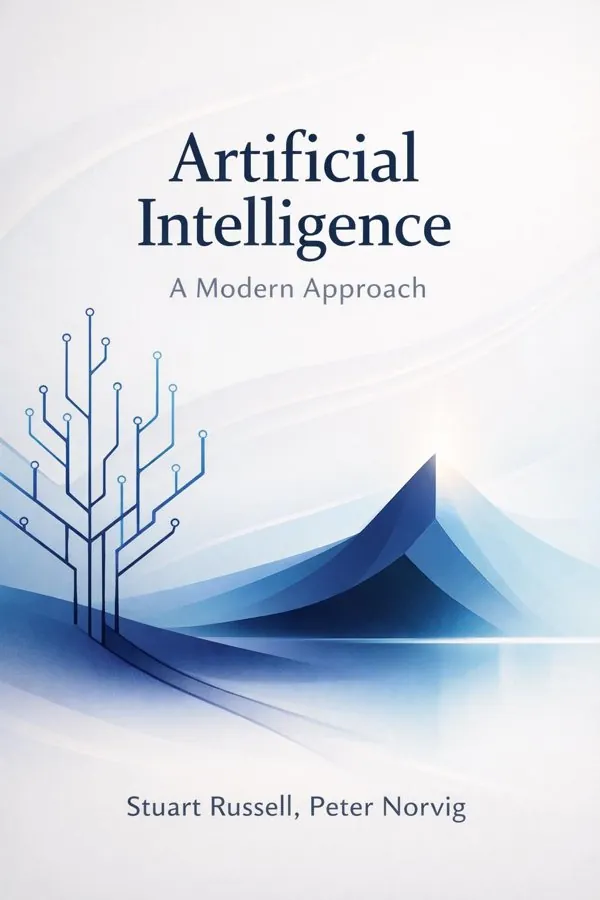
Artificial Intelligence: A Modern Approach: Summary & Key Insights
by Stuart Russell, Peter Norvig
 10 min5 chaptersAudio available
What Is Artificial Intelligence: A Modern Approach About?
Artificial Intelligence: A Modern Approach by Stuart Russell, Peter Norvig is a ai_ml book spanning 5 pages. Artificial Intelligence: A Modern Approach es un libro de texto fundamental que ofrece una introducción completa a la teoría y práctica de la inteligencia artificial. Cubre temas como agentes inteligentes, aprendizaje automático, razonamiento, planificación, percepción y robótica, proporcionando tanto fundamentos teóricos como aplicaciones prácticas.
This FizzRead summary covers all 5 key chapters of Artificial Intelligence: A Modern Approach in approximately 10 minutes, distilling the most important ideas, arguments, and takeaways from Stuart Russell, Peter Norvig's work. Also available as an audio summary and Key Quotes Podcast.
Artificial Intelligence: A Modern Approach
Artificial Intelligence: A Modern Approach es un libro de texto fundamental que ofrece una introducción completa a la teoría y práctica de la inteligencia artificial. Cubre temas como agentes inteligentes, aprendizaje automático, razonamiento, planificación, percepción y robótica, proporcionando tanto fundamentos teóricos como aplicaciones prácticas.
Who Should Read Artificial Intelligence: A Modern Approach?
This book is perfect for anyone interested in ai_ml and looking to gain actionable insights in a short read. Whether you're a student, professional, or lifelong learner, the key ideas from Artificial Intelligence: A Modern Approach by Stuart Russell, Peter Norvig will help you think differently.
- ✓Readers who enjoy ai_ml and want practical takeaways
- ✓Professionals looking to apply new ideas to their work and life
- ✓Anyone who wants the core insights of Artificial Intelligence: A Modern Approach in just 10 minutes
Want the full summary?
Get instant access to this book summary and 100K+ more with Fizz Moment.
Get Free SummaryAvailable on App Store • Free to download
Key Chapters
Everything in AI begins with the idea of the intelligent agent. In the simplest terms, an agent is any entity that perceives its environment through sensors and acts upon that environment through actuators. From thermostats to autonomous vehicles, the behaviors of these systems can be understood by examining the mapping from percepts to actions. Rationality sits at the heart of this concept—a rational agent selects actions expected to maximize its performance measure given what it knows.
In our framework, the environment plays an equally critical role. Some environments are fully observable and deterministic, making reasoning straightforward. Others are stochastic, dynamic, or partially observable, imposing fundamental limits on what an agent can infer. Understanding the diversity of environments allows us to classify agents—simple reflex agents act directly on percepts; model-based reflex agents maintain internal state; goal-based agents reason about future outcomes; and utility-based agents optimize a measure of happiness or success.
This hierarchy captures the evolution from mechanical reaction to deliberate reasoning. Imagine a robot navigating a busy street. A simple reflex agent might react to obstacles without deeper understanding, but a goal-based agent could plan routes, predict pedestrian motion, and adjust behavior accordingly. The agent paradigm forms an underlying unification: whether we are designing diagnostic systems, game-playing programs, or autonomous robots, each can be seen as a rational process interacting with an uncertain world.
The profound beauty of studying agents is realizing that this abstraction mirrors us—we, too, are information-processing entities bounded by perception, reasoning, and action. By examining how artificial agents operate, we learn about our own decision-making under uncertainty.
Once the concept of agency is clear, the next step is understanding how agents solve problems. Problem-solving in AI means finding sequences of actions that achieve the agent's goals. We begin by formalizing problem states, actions, transition models, and goal tests. Then, we ask: how can the agent systematically explore this space of possibilities?
Uninformed search techniques such as breadth-first and depth-first search represent pure exploration—they do not know where the goal lies but traverse the search space according to structure. Heuristic or informed search introduces domain knowledge—estimations of the cost or distance to the goal—enabling algorithms like A* to dramatically improve efficiency. The principle behind all search algorithms is universal: balancing exploration and exploitation, structure and intuition.
Consider the journey of a pathfinding robot or a chess engine. Both are problem solvers: one must find the shortest route to a destination, the other must find a sequence of moves leading to victory. Search spaces in AI can be astronomical; hence, the art lies in representing them wisely and navigating them efficiently. This is why we emphasize heuristics—they are the distilled wisdom of domain knowledge, enabling agents to behave intelligently in complex worlds without brute force.
Search illustrates a deep philosophical truth: intelligence often emerges not from knowing everything but from searching efficiently through what one could know. In practice, every AI system—from scheduling algorithms to game-playing agents—embodies search at its heart.
+ 3 more chapters — available in the FizzRead app
All Chapters in Artificial Intelligence: A Modern Approach
About the Authors
Stuart Russell es profesor de informática en la Universidad de California, Berkeley, y un destacado investigador en inteligencia artificial. Peter Norvig es director de investigación en Google y exdirector de la división de inteligencia artificial de la NASA Ames Research Center.
Get This Summary in Your Preferred Format
Read or listen to the Artificial Intelligence: A Modern Approach summary by Stuart Russell, Peter Norvig anytime, anywhere. FizzRead offers multiple formats so you can learn on your terms — all free.
Available formats: App · Audio · PDF · EPUB — All included free with FizzRead
Download Artificial Intelligence: A Modern Approach PDF and EPUB Summary
Key Quotes from Artificial Intelligence: A Modern Approach
“Everything in AI begins with the idea of the intelligent agent.”
“Once the concept of agency is clear, the next step is understanding how agents solve problems.”
Frequently Asked Questions about Artificial Intelligence: A Modern Approach
Artificial Intelligence: A Modern Approach by Stuart Russell, Peter Norvig is a ai_ml book that explores key ideas across 5 chapters. Artificial Intelligence: A Modern Approach es un libro de texto fundamental que ofrece una introducción completa a la teoría y práctica de la inteligencia artificial. Cubre temas como agentes inteligentes, aprendizaje automático, razonamiento, planificación, percepción y robótica, proporcionando tanto fundamentos teóricos como aplicaciones prácticas.
You Might Also Like
Life 3.0
Max Tegmark
10 min
Superintelligence
Nick Bostrom
10 min
TensorFlow in Action
Thushan Ganegedara
10 min
AI Made Simple: A Beginner’s Guide to Generative AI, ChatGPT, and the Future of Work
Rajeev Kapur
10 min
AI Snake Oil
Arvind Narayanan, Sayash Kapoor
10 min
AI Superpowers: China, Silicon Valley, and the New World Order
Kai-Fu Lee
10 minBrowse by Category
Ready to read Artificial Intelligence: A Modern Approach?
Get the full summary and 100K+ more books with Fizz Moment.