
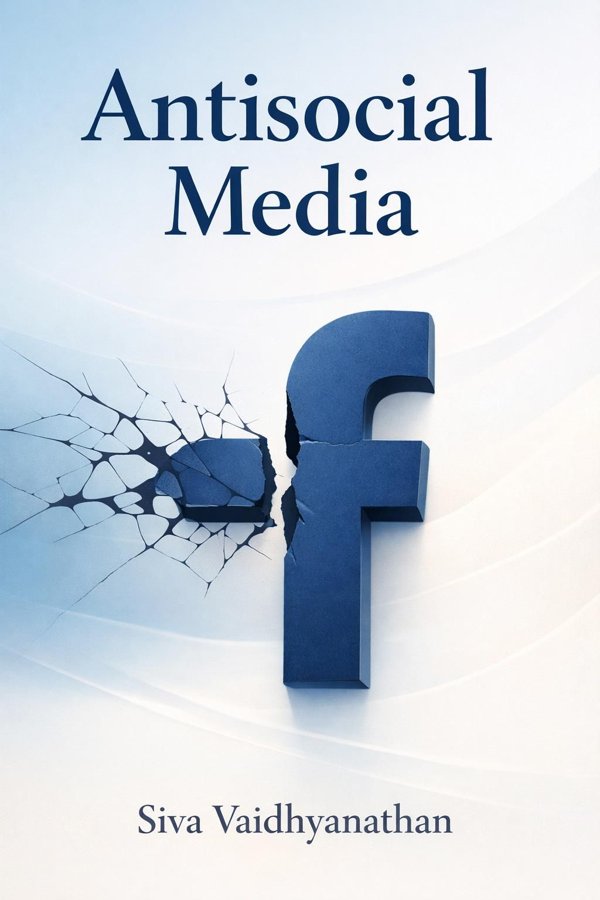
Antisocial Media: How Facebook Disconnects Us and Undermines Democracy: Summary & Key Insights
 10 min10 chaptersAudio available
What Is Antisocial Media: How Facebook Disconnects Us and Undermines Democracy About?
Antisocial Media: How Facebook Disconnects Us and Undermines Democracy by Siva Vaidhyanathan is a digital_culture book spanning 10 pages. In this incisive critique, Siva Vaidhyanathan explores how Facebook, once hailed as a tool for global connection, has instead become a powerful force undermining democracy and civic life. Drawing on extensive research and case studies, the book examines how the platform amplifies misinformation, erodes privacy, and fosters polarization, ultimately reshaping societies and politics worldwide.
This FizzRead summary covers all 10 key chapters of Antisocial Media: How Facebook Disconnects Us and Undermines Democracy in approximately 10 minutes, distilling the most important ideas, arguments, and takeaways from Siva Vaidhyanathan's work. Also available as an audio summary and Key Quotes Podcast.
Antisocial Media: How Facebook Disconnects Us and Undermines Democracy
In this incisive critique, Siva Vaidhyanathan explores how Facebook, once hailed as a tool for global connection, has instead become a powerful force undermining democracy and civic life. Drawing on extensive research and case studies, the book examines how the platform amplifies misinformation, erodes privacy, and fosters polarization, ultimately reshaping societies and politics worldwide.
Who Should Read Antisocial Media: How Facebook Disconnects Us and Undermines Democracy?
This book is perfect for anyone interested in digital_culture and looking to gain actionable insights in a short read. Whether you're a student, professional, or lifelong learner, the key ideas from Antisocial Media: How Facebook Disconnects Us and Undermines Democracy by Siva Vaidhyanathan will help you think differently.
- ✓Readers who enjoy digital_culture and want practical takeaways
- ✓Professionals looking to apply new ideas to their work and life
- ✓Anyone who wants the core insights of Antisocial Media: How Facebook Disconnects Us and Undermines Democracy in just 10 minutes
Want the full summary?
Get instant access to this book summary and 100K+ more with Fizz Moment.
Get Free SummaryAvailable on App Store • Free to download
Key Chapters
Facebook began as a digital utopia, animated by Mark Zuckerberg’s belief in radical openness and the power of networks to bring people together. I once admired this idealism—it seemed perfectly aligned with the internet’s early promise of liberation and equality. But as I examined the company’s expansion, I saw a devastating irony: the network designed to unite humanity was dismantling the very structures of deliberation and trust that sustain societies.
The illusion of Facebook lies in its claim of connection. Yes, it multiplies our contacts and broadcasts our emotions, but it does not nurture understanding or empathy. Communication flattened into likes, shares, and emojis produces a shallow mimicry of conversation. What appears as community often becomes an echo chamber, where users encounter reflections of themselves rather than true diversity of thought.
Facebook’s promise of openness also masks an unprecedented enclosure of personal data. Every interaction—every friendship, every photograph, every political preference—is absorbed into a complex system of behavioral profiling. Users feel empowered, yet they are rendered transparent to an entity that remains opaque. This asymmetry of visibility is not accidental; it is the foundation of Facebook’s business model. What it sells is not content, but confidence in its ability to predict and influence human behavior.
As I reflected on these contradictions, it became clear that the “Facebook illusion” is not mere hypocrisy—it’s structural. The company depends on the appearance of community to sustain a system that thrives on surveillance. The more we share, the more the illusion deepens; and the less we question, the more powerful the system becomes.
At the core of Facebook’s operation lies a sophisticated machinery of observation. Every post, click, and pause in scrolling feeds carefully into a data apparatus built to anticipate desire and manipulate attention. I call this the architecture of surveillance—a model that transforms our digital gestures into marketable signals.
This architecture emerged not as a nefarious plan, but as the logical result of advertising-driven capitalism operating at planetary scale. In such a system, engagement equates to revenue, and observation becomes both the method and the product. Facebook engineers perfected this logic to the point where the company now knows more about social dynamics and emotional patterns than perhaps any institution in history.
But what does it mean for a society when one corporation is tuned so finely to the rhythms of our private lives? Surveillance here is not overt policing; it’s subtle conditioning. Algorithms weight our experiences, prioritize outrage, and amplify whatever keeps us online. The result is a form of behavioral governance that requires no state coercion. We obediently participate, feeding the system that predicts our actions.
As I came to see, this structure poses profound threats to autonomy. When a company interprets and monetizes every expression, even our free will becomes a variable in its predictive calculus. The architecture of surveillance erodes the very concept of the private self, replacing it with what I call a data self—the sum of quantifiable traits stripped of context. In this way, Facebook’s technical design reshapes not only markets but human identity itself.
+ 8 more chapters — available in the FizzRead app
All Chapters in Antisocial Media: How Facebook Disconnects Us and Undermines Democracy
About the Author
Siva Vaidhyanathan is a cultural historian and media scholar, currently serving as the Robertson Professor of Media Studies at the University of Virginia. His work focuses on the social and political impact of digital technologies and media systems.
Get This Summary in Your Preferred Format
Read or listen to the Antisocial Media: How Facebook Disconnects Us and Undermines Democracy summary by Siva Vaidhyanathan anytime, anywhere. FizzRead offers multiple formats so you can learn on your terms — all free.
Available formats: App · Audio · PDF · EPUB — All included free with FizzRead
Download Antisocial Media: How Facebook Disconnects Us and Undermines Democracy PDF and EPUB Summary
Key Quotes from Antisocial Media: How Facebook Disconnects Us and Undermines Democracy
“Facebook began as a digital utopia, animated by Mark Zuckerberg’s belief in radical openness and the power of networks to bring people together.”
“At the core of Facebook’s operation lies a sophisticated machinery of observation.”
Frequently Asked Questions about Antisocial Media: How Facebook Disconnects Us and Undermines Democracy
Antisocial Media: How Facebook Disconnects Us and Undermines Democracy by Siva Vaidhyanathan is a digital_culture book that explores key ideas across 10 chapters. In this incisive critique, Siva Vaidhyanathan explores how Facebook, once hailed as a tool for global connection, has instead become a powerful force undermining democracy and civic life. Drawing on extensive research and case studies, the book examines how the platform amplifies misinformation, erodes privacy, and fosters polarization, ultimately reshaping societies and politics worldwide.
You Might Also Like
An Ugly Truth: Inside Facebook’s Battle for Domination
Sheera Frenkel, Cecilia Kang
10 min
Cyber Citizens
Ian Goodfellow
10 min
Digital Minimalism: Choosing a Focused Life in a Noisy World
Cal Newport
10 min
E‑Books & Beyond
Various Authors
10 min
The Future of Media
Various Authors
10 min
This Is Why We Can't Have Nice Things
Whitney Phillips
10 minBrowse by Category
Ready to read Antisocial Media: How Facebook Disconnects Us and Undermines Democracy?
Get the full summary and 100K+ more books with Fizz Moment.