
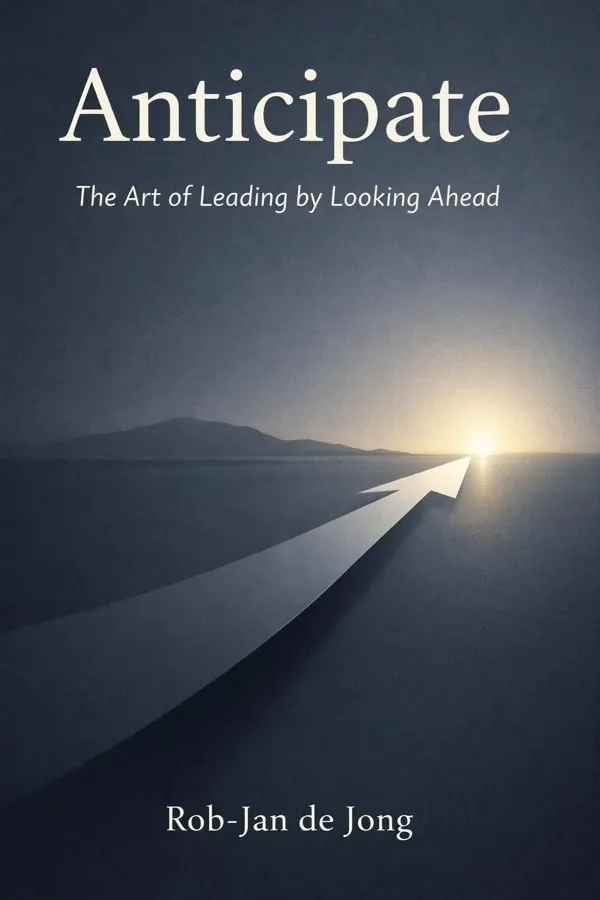
Anticipate: The Art of Leading by Looking Ahead: Summary & Key Insights
 10 min6 chaptersAudio available
What Is Anticipate: The Art of Leading by Looking Ahead About?
Anticipate: The Art of Leading by Looking Ahead by Rob-Jan de Jong is a leadership book spanning 6 pages. Anticipate: The Art of Leading by Looking Ahead explores how leaders can develop visionary thinking and foresight to guide their organizations effectively. Rob-Jan de Jong provides practical frameworks and exercises to help readers cultivate long-term vision, challenge assumptions, and make strategic decisions in uncertain environments.
This FizzRead summary covers all 6 key chapters of Anticipate: The Art of Leading by Looking Ahead in approximately 10 minutes, distilling the most important ideas, arguments, and takeaways from Rob-Jan de Jong's work. Also available as an audio summary and Key Quotes Podcast.
Anticipate: The Art of Leading by Looking Ahead
Anticipate: The Art of Leading by Looking Ahead explores how leaders can develop visionary thinking and foresight to guide their organizations effectively. Rob-Jan de Jong provides practical frameworks and exercises to help readers cultivate long-term vision, challenge assumptions, and make strategic decisions in uncertain environments.
Who Should Read Anticipate: The Art of Leading by Looking Ahead?
This book is perfect for anyone interested in leadership and looking to gain actionable insights in a short read. Whether you're a student, professional, or lifelong learner, the key ideas from Anticipate: The Art of Leading by Looking Ahead by Rob-Jan de Jong will help you think differently.
- ✓Readers who enjoy leadership and want practical takeaways
- ✓Professionals looking to apply new ideas to their work and life
- ✓Anyone who wants the core insights of Anticipate: The Art of Leading by Looking Ahead in just 10 minutes
Want the full summary?
Get instant access to this book summary and 100K+ more with Fizz Moment.
Get Free SummaryAvailable on App Store • Free to download
Key Chapters
Every day, leaders face immense pressure to deliver immediate results. Quarterly earnings, operational performance, and rapid responses to unpredictable challenges all seem urgent. But urgency is deceptive—it can create a false sense of effectiveness while quietly narrowing our field of vision. I realized, through years of consulting with executives, that most organizations are not suffering from a lack of intelligence or talent; they are suffering from a deficit of foresight.
Visionary leadership is about expanding that field of vision. In the book, I emphasize that vision is not just a lofty statement framed on the wall—it is a lived orientation that influences how you interpret information and make choices. When leaders neglect to nurture long-term perspective, strategic innovation declines. They begin cycling through the same decisions repeatedly, unable to see beyond incremental adjustments.
The short-term mindset stems from habit. Our brains resist uncertainty; familiarity feels safe. Many leaders rely on performance metrics that measure immediate success, which reinforces the illusion that short-term responsiveness equals proper leadership. I argue that this mindset constrains creativity and limits resilience. Real leadership begins when you challenge this comfort zone and start exploring the unknown—for example, asking: ‘What will our customers expect five years from now?’ ‘How might evolving technology redefine our market?’ These questions open the mental space necessary for foresight.
Visionary leaders accept ambiguity as fertile ground, not as danger. They cultivate curiosity and ask unconventional questions. To do that, you must slow down enough to reflect. One of my favorite exercises in *Anticipate* invites you to imagine yourself ten years ahead and look back. What will you wish you had started sooner? This reversal of perspective reveals overlooked opportunities. It forces the mind to break free from reactive urgency and embrace proactive creation.
Visionary leadership is not innate—it is learned. Once you understand how short-term thinking limits potential, you begin to see that cultivating foresight is not about ignoring the present but about leading it toward a better tomorrow.
Vision, as I define it, is a mental picture of a desired future. It articulates purpose and direction—it gives people a reason to act beyond routine targets. Yet, many leaders confuse vision with strategy. Strategy answers the question of how to get there; vision answers the question of where to go. Without vision, strategy lacks meaning—it becomes mechanical navigation without a destination.
In *Anticipate,* I introduce a framework for developing both personal and organizational vision. It begins with reflection—understanding your values and what future you want to help create. Then it expands through imagination—visualizing possibilities beyond present constraints. Finally, it matures through articulation—expressing that vision in a way that others can understand and share.
To train this capacity, I propose exercises that challenge habitual thinking. One method involves ‘stretching time horizons.’ Instead of planning for next quarter, imagine making decisions that shape outcomes ten years ahead. Another method draws from scenario-building: describe alternative futures based on current trends. What would your organization look like if automation accelerated faster than expected? What if societal values shifted toward sustainability more radically? These reflections awaken foresight.
Vision provides stability amid disruption because it connects decisions to higher meaning. Consider how companies like Patagonia built enduring success by pursuing a vision grounded in environmental stewardship. Their strategy evolved in response to change, but their vision remained constant—it guided innovation and inspired loyalty. This anchor is what foresight gives you: clarity of direction when circumstances are chaotic.
Through this framework, I show that cultivating vision is both a cognitive discipline and an emotional practice. It requires courage to imagine beyond practicality and conviction to persist when the path is uncertain. The process transforms leadership from mere management into stewardship of possibility.
+ 4 more chapters — available in the FizzRead app
All Chapters in Anticipate: The Art of Leading by Looking Ahead
About the Author
Rob-Jan de Jong is a Dutch leadership expert, speaker, and consultant specializing in visionary leadership and strategic foresight. He has taught at various business schools and advised global organizations on leadership development and future-oriented strategy.
Get This Summary in Your Preferred Format
Read or listen to the Anticipate: The Art of Leading by Looking Ahead summary by Rob-Jan de Jong anytime, anywhere. FizzRead offers multiple formats so you can learn on your terms — all free.
Available formats: App · Audio · PDF · EPUB — All included free with FizzRead
Download Anticipate: The Art of Leading by Looking Ahead PDF and EPUB Summary
Key Quotes from Anticipate: The Art of Leading by Looking Ahead
“Every day, leaders face immense pressure to deliver immediate results.”
“Vision, as I define it, is a mental picture of a desired future.”
Frequently Asked Questions about Anticipate: The Art of Leading by Looking Ahead
Anticipate: The Art of Leading by Looking Ahead by Rob-Jan de Jong is a leadership book that explores key ideas across 6 chapters. Anticipate: The Art of Leading by Looking Ahead explores how leaders can develop visionary thinking and foresight to guide their organizations effectively. Rob-Jan de Jong provides practical frameworks and exercises to help readers cultivate long-term vision, challenge assumptions, and make strategic decisions in uncertain environments.
You Might Also Like

Extreme Ownership
Jocko Willink
10 min
Dare to Lead
Brene Brown
10 min
Leaders Eat Last
Simon Sinek
10 min
The 21 Irrefutable Laws of Leadership
John Maxwell
10 min
Start With Why
Simon Sinek
10 min
How to Lead When You're Not in Charge
Clay Scroggins
10 minBrowse by Category
Ready to read Anticipate: The Art of Leading by Looking Ahead?
Get the full summary and 100K+ more books with Fizz Moment.