
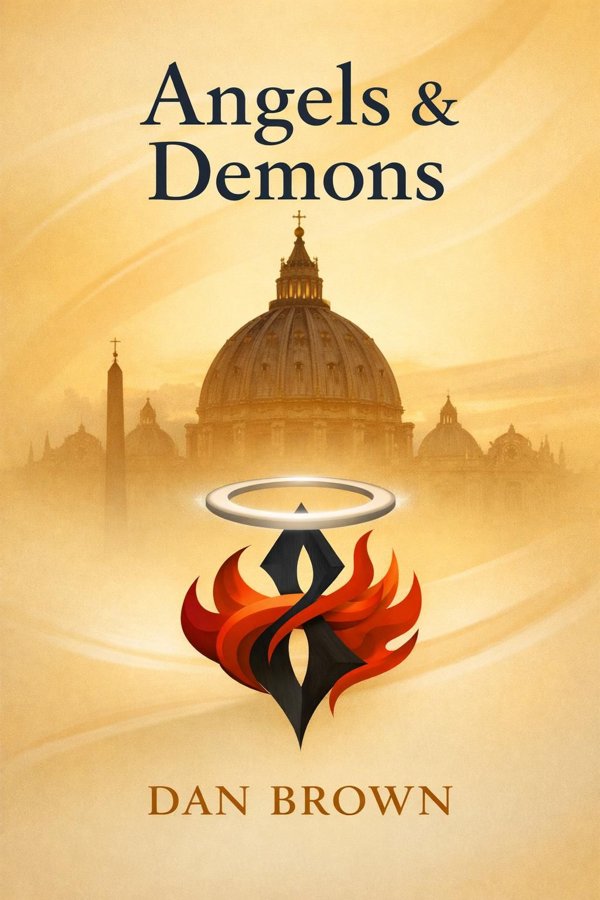
Angels & Demons: Summary & Key Insights
by Dan Brown
 10 min3 chaptersAudio available
What Is Angels & Demons About?
Angels & Demons by Dan Brown is a bestsellers book spanning 3 pages. A fast-paced thriller that follows Harvard symbologist Robert Langdon as he investigates a murder at CERN and uncovers a secret society’s plot involving the Vatican. The story intertwines science, religion, and conspiracy in a race against time through Rome’s historic landmarks.
This FizzRead summary covers all 3 key chapters of Angels & Demons in approximately 10 minutes, distilling the most important ideas, arguments, and takeaways from Dan Brown's work. Also available as an audio summary and Key Quotes Podcast.
Angels & Demons
A fast-paced thriller that follows Harvard symbologist Robert Langdon as he investigates a murder at CERN and uncovers a secret society’s plot involving the Vatican. The story intertwines science, religion, and conspiracy in a race against time through Rome’s historic landmarks.
Who Should Read Angels & Demons?
This book is perfect for anyone interested in bestsellers and looking to gain actionable insights in a short read. Whether you're a student, professional, or lifelong learner, the key ideas from Angels & Demons by Dan Brown will help you think differently.
- ✓Readers who enjoy bestsellers and want practical takeaways
- ✓Professionals looking to apply new ideas to their work and life
- ✓Anyone who wants the core insights of Angels & Demons in just 10 minutes
Want the full summary?
Get instant access to this book summary and 100K+ more with Fizz Moment.
Get Free SummaryAvailable on App Store • Free to download
Key Chapters
Robert Langdon’s journey begins in the depths of CERN, the world’s most advanced research facility—a cathedral of science where human intellect seeks to touch the origins of the universe. When Langdon is summoned to Switzerland, it is to view a scene so grotesque it seems to defy both logic and faith: physicist Leonardo Vetra has been murdered, his chest branded with the ambigram of the Illuminati.
Here, I wanted to root the reader in the duality of awe and horror. CERN represents humankind’s summit of discovery, yet on its floors lies a sign from an ancient brotherhood supposedly extinct. The juxtaposition is deliberate. Leonardo’s death becomes more than a crime; it is a message—a bridge between the rational and the mystical. And through Langdon’s eyes, the reader encounters the first thread of the book’s symbolism: that perhaps light itself, the very substance science seeks to decode, is inseparable from the divine mystery.
When Langdon meets Vittoria Vetra, Leonardo’s adopted daughter and fellow researcher, her grief becomes a moral engine for the narrative. Vittoria embodies the synthesis I wished to explore: a scientist who sees no contradiction between her laboratory work and her faith. It is she who reveals the stolen antimatter canister—an experiment designed to recreate the moment of creation, now capable of annihilating an entire city. In that capsule rests modern science’s greatest miracle and its greatest curse.
I wanted the reader to feel the unease of potential catastrophe born of good intentions. The Illuminati’s believed involvement raises ancient ghosts of persecution and revenge: science once hunted by religion now returning to judge it. From this moment, the story pulses with the rhythm of a ticking bomb, both literal and metaphorical, as Langdon and Vittoria set out to reconcile the clues of a long-dead brotherhood with the impending apocalypse threatening the Vatican.
+ 1 more chapters — available in the FizzRead app
All Chapters in Angels & Demons
About the Author
Get This Summary in Your Preferred Format
Read or listen to the Angels & Demons summary by Dan Brown anytime, anywhere. FizzRead offers multiple formats so you can learn on your terms — all free.
Available formats: App · Audio · PDF · EPUB — All included free with FizzRead
Download Angels & Demons PDF and EPUB Summary
Key Quotes from Angels & Demons
“Robert Langdon’s journey begins in the depths of CERN, the world’s most advanced research facility—a cathedral of science where human intellect seeks to touch the origins of the universe.”
“Bringing Langdon and Vittoria to Rome allowed me to weave together the language of architecture, art, and faith into a single narrative thread.”
Frequently Asked Questions about Angels & Demons
Angels & Demons by Dan Brown is a bestsellers book that explores key ideas across 3 chapters. A fast-paced thriller that follows Harvard symbologist Robert Langdon as he investigates a murder at CERN and uncovers a secret society’s plot involving the Vatican. The story intertwines science, religion, and conspiracy in a race against time through Rome’s historic landmarks.
More by Dan Brown
You Might Also Like

The Godfather
Mario Puzo
10 min
The Handmaid's Tale
Margaret Atwood
10 min
The Hunger Games
Suzanne Collins
10 min
The Nightingale
Kristin Hannah
10 min
The Seven Husbands of Evelyn Hugo
Taylor Jenkins Reid
10 min
Backwater Justice
Fern Michaels
10 minBrowse by Category
Ready to read Angels & Demons?
Get the full summary and 100K+ more books with Fizz Moment.