
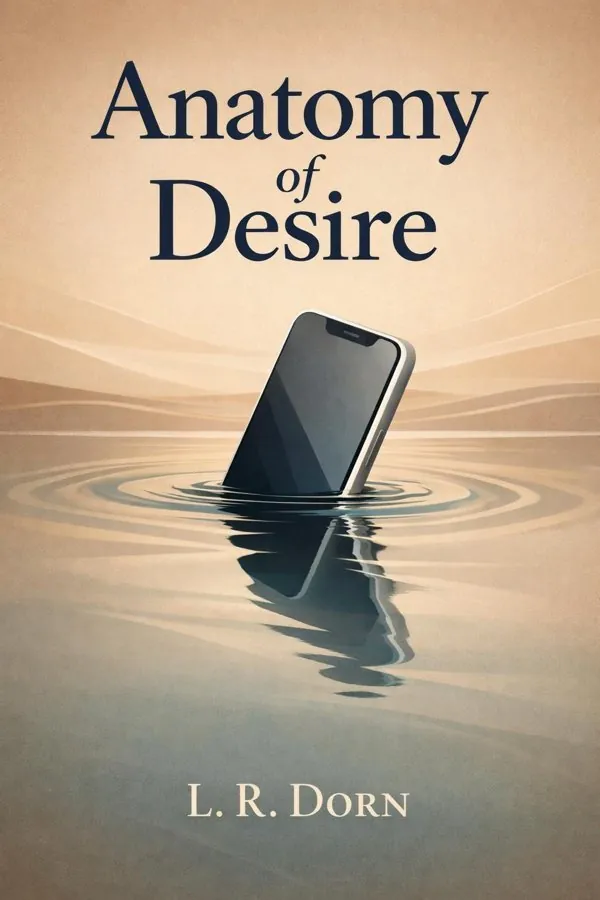
Anatomy of Desire: Summary & Key Insights
by L. R. Dorn
 10 min8 chaptersAudio available
Key Takeaways from Anatomy of Desire
One of the novel’s smartest insights is that the person telling the story often becomes as important as the person living it.
Ambition becomes dangerous when self-invention starts replacing self-knowledge.
The novel understands that desire is rarely only romantic; it is often economic, social, and symbolic at the same time.
A suspicious death is never just a factual event in this novel; it is a battlefield of interpretation.
In the digital age, accusation can become a permanent personality assigned by strangers.
What Is Anatomy of Desire About?
Anatomy of Desire by L. R. Dorn is a bestsellers book spanning 11 pages. Anatomy of Desire is a sharp, cinematic literary thriller that reimagines Theodore Dreiser’s An American Tragedy for the age of influencers, podcasts, and algorithm-driven fame. Written by L. R. Dorn, the pseudonym of screenwriters Matt Dorff and Suzanne Dunn, the novel follows Cleo Ray, a young woman who climbs from an ordinary background into the seductive world of beauty branding and social media visibility. When a woman in her orbit dies under suspicious circumstances, Cleo becomes the center of a murder investigation and a public spectacle. What makes the book so compelling is not only the mystery of what happened, but the way the story is told: through interviews, transcripts, media fragments, and the self-conscious machinery of true-crime storytelling. The result is both a suspenseful narrative and a critique of how modern culture consumes women, reinvents facts as content, and turns identity into performance. Dorn’s background in screenwriting gives the novel unusual momentum and visual immediacy, making it feel uncannily like a documentary you cannot stop watching while asking whether the camera ever tells the whole truth.
This FizzRead summary covers all 8 key chapters of Anatomy of Desire in approximately 10 minutes, distilling the most important ideas, arguments, and takeaways from L. R. Dorn's work. Also available as an audio summary and Key Quotes Podcast.
Anatomy of Desire
Anatomy of Desire is a sharp, cinematic literary thriller that reimagines Theodore Dreiser’s An American Tragedy for the age of influencers, podcasts, and algorithm-driven fame. Written by L. R. Dorn, the pseudonym of screenwriters Matt Dorff and Suzanne Dunn, the novel follows Cleo Ray, a young woman who climbs from an ordinary background into the seductive world of beauty branding and social media visibility. When a woman in her orbit dies under suspicious circumstances, Cleo becomes the center of a murder investigation and a public spectacle. What makes the book so compelling is not only the mystery of what happened, but the way the story is told: through interviews, transcripts, media fragments, and the self-conscious machinery of true-crime storytelling. The result is both a suspenseful narrative and a critique of how modern culture consumes women, reinvents facts as content, and turns identity into performance. Dorn’s background in screenwriting gives the novel unusual momentum and visual immediacy, making it feel uncannily like a documentary you cannot stop watching while asking whether the camera ever tells the whole truth.
Who Should Read Anatomy of Desire?
This book is perfect for anyone interested in bestsellers and looking to gain actionable insights in a short read. Whether you're a student, professional, or lifelong learner, the key ideas from Anatomy of Desire by L. R. Dorn will help you think differently.
- ✓Readers who enjoy bestsellers and want practical takeaways
- ✓Professionals looking to apply new ideas to their work and life
- ✓Anyone who wants the core insights of Anatomy of Desire in just 10 minutes
Want the full summary?
Get instant access to this book summary and 100K+ more with Fizz Moment.
Get Free SummaryAvailable on App Store • Free to download
Key Chapters
One of the novel’s smartest insights is that the person telling the story often becomes as important as the person living it. Anatomy of Desire opens through the voices of a podcast and documentary team, immediately placing Cleo Ray’s life inside a mediated frame. This structure does more than create suspense. It reminds us that every crime story is edited, curated, and packaged for an audience hungry for conclusions. The documentary-makers ask questions, choose clips, arrange interviews, and decide what emotional tone the viewer should feel. In other words, they are not neutral observers; they are architects of meaning.
This matters because the book is deeply interested in how modern audiences confuse access with truth. Seeing surveillance footage, hearing testimony, or scrolling a social feed can feel like direct contact with reality, but the novel keeps showing that these fragments are partial and easily manipulated. A witness remembers selectively. A producer highlights what is dramatic. A platform rewards what is shareable. Together, these forces create a version of events that may be convincing without being complete.
Outside the novel, this insight applies to how we consume headlines, documentaries, and viral scandals. We often inherit strong opinions from the structure of a story rather than from verified evidence. The order in which facts appear, the music under a scene, or the inclusion of one interview over another can quietly shape judgment.
Actionable takeaway: whenever a story feels definitive, ask who assembled it, what was omitted, and how format itself may be steering your emotions.
Ambition becomes dangerous when self-invention starts replacing self-knowledge. Cleo Ray begins as a young woman from modest circumstances, someone shaped by ordinary limitations but animated by extraordinary longing. She wants visibility, beauty, access, and escape. The novel does not portray these desires as inherently shameful. In fact, it shows how understandable they are in a culture that constantly teaches people that attention equals worth. Cleo’s rise into digital influence feels aspirational at first because she is resourceful, observant, and willing to transform herself.
But the same qualities that help her ascend also destabilize her. Online life rewards a curated self: a cleaner, prettier, more legible version of reality. As Cleo learns to perform desirability for an audience, she also learns to split herself into versions. There is the girl she once was, the woman the internet wants, the lover someone else imagines, and the suspect the media constructs. These identities do not align, and the gap between them becomes psychologically costly.
The novel uses Cleo to explore a broader modern truth: many people now build public identities before they have formed private ones. Career branding, social posting, and public performance can create momentum while quietly eroding inner stability. The more a person depends on outside validation, the harder it becomes to know what they genuinely want.
A practical application is easy to see in everyday life. Many people feel pressure to project confidence, success, or desirability online even when they are uncertain or struggling offline.
Actionable takeaway: build a life that can survive without constant performance, and make room to ask who you are when no audience is watching.
A suspicious death is never just a factual event in this novel; it is a battlefield of interpretation. The lake incident at the center of Anatomy of Desire is reconstructed through competing accounts, inferred motives, and incomplete physical evidence. This layered retelling keeps the reader in a state of productive uncertainty. Instead of offering a clean detective puzzle, the novel asks a harder question: how do we decide what happened when evidence arrives already entangled with fear, bias, media pressure, and personal self-protection?
The scene’s power lies in its ambiguity. A death near water naturally evokes accident, panic, concealment, and vulnerability all at once. But the novel resists letting the event harden into a simple moral label too quickly. Every retelling reveals as much about the speaker as about the victim. Memory is unstable. Motive is speculative. Context changes everything. In that sense, the lake becomes symbolic: its surface suggests clarity while its depth conceals what cannot easily be retrieved.
This idea has strong real-world relevance. In both legal and social settings, people often mistake confidence for accuracy. We assume that the loudest narrative, the most emotionally satisfying explanation, or the most repeated version must be true. Yet high-stakes events are often murkier than public discourse allows.
A practical lesson emerges for readers navigating controversy in daily life, whether in workplaces, friendships, or public debates. Initial interpretations are often incomplete, and fragmented facts can harden into reputational damage before fuller context appears.
Actionable takeaway: when faced with a charged event, delay certainty, separate evidence from narrative, and remember that ambiguity is not the same as innocence or guilt.
In the digital age, accusation can become a permanent personality assigned by strangers. One of the novel’s most unsettling themes is how quickly public reaction transforms Cleo from a complicated person into a consumable role: the beautiful suspect, the manipulator, the liar, the fallen influencer. Before any legal process reaches completion, the media ecosystem generates a parallel trial powered by headlines, comment sections, podcasts, and social feeds. This trial is faster, more emotional, and less accountable than the one in court.
The novel shows how media does not simply report suspicion; it manufactures narrative gravity around it. Once a person fits a culturally irresistible script, every detail starts confirming the story audiences already want to believe. Beauty becomes evidence of vanity. ambition becomes evidence of selfishness. inconsistency becomes evidence of deceit. Even silence becomes suspicious. Cleo’s public image, which once created opportunity, now becomes the very mechanism through which she is condemned.
This process is familiar well beyond crime stories. Online culture frequently flattens people into symbols, rewarding moral certainty over complexity. Public shaming often relies on fragments detached from context and then amplified through repetition. The emotional reward for participation is immediate, while the ethical cost remains abstract.
For readers, the practical application is significant. We all play some role in attention markets, whether by posting, sharing, reacting, or consuming. The novel asks us to notice how quickly we turn human lives into stories that satisfy our hunger for villains.
Actionable takeaway: be slow to participate in public judgment, especially when a person’s entire identity is being reduced to the most clickable interpretation of events.
Facts do not emerge in a vacuum; they are produced under pressure, and pressure changes people. The sections dealing with police investigation and Cleo’s interrogation reveal how official truth is shaped through procedure, strategy, fatigue, and psychological leverage. Detectives are not merely collecting information. They are testing stories, exposing contradictions, and pushing suspects into clarifying or altering their accounts. This makes the investigative process feel less like the discovery of a hidden object and more like a contest over narrative coherence.
Cleo’s unraveling is especially compelling because it may reflect both guilt and human fragility. People under scrutiny become inconsistent for many reasons: fear, shame, trauma, self-protection, or simple confusion. The novel understands that hesitation can look incriminating even when it is not, and polished certainty can look innocent even when it is false. That tension gives the story its moral complexity.
In practical life, this theme speaks to how institutions evaluate credibility. Employers, schools, legal systems, and even families often equate composure with honesty and emotional distress with deception. Yet real behavior under stress is unpredictable. We should be careful about reading too much moral meaning into presentation alone.
The investigation also shows how once authorities develop a theory, new information risks being sorted into that framework rather than testing it. This is a subtle warning about confirmation bias, one of the most powerful distortions in decision-making.
Actionable takeaway: whenever you assess a contested situation, focus not just on what someone said but on the conditions under which they said it, and watch for narratives becoming more rigid than the evidence warrants.
The novel treats the courtroom not as a sanctuary above storytelling, but as one of storytelling’s most sophisticated stages. Trial preparation and courtroom proceedings reveal lawyers building competing versions of reality from the same raw material. Evidence matters, of course, but so do pacing, framing, witness credibility, emotional tone, and the ability to give jurors a morally satisfying arc. In this sense, the law appears both serious and theatrical: a formal mechanism seeking justice through highly performative means.
This is where Anatomy of Desire becomes especially sharp about modern spectatorship. Because the case has already circulated through media channels, the courtroom inherits an audience primed for drama. Legal teams must engage not only with facts but with assumptions already seeded in the public imagination. The trial becomes a struggle to replace one dominant story with another. That dynamic exposes a difficult truth: institutions meant to resolve ambiguity often rely on simplified narratives because human beings decide better through stories than through abstractions.
The broader application is relevant in many professional and personal settings. Presentations, negotiations, and conflicts are rarely won by raw data alone. People respond to structure, trust, symbolism, and emotional coherence. That does not mean truth is irrelevant. It means truth often needs a persuasive form to be heard.
The danger, of course, is that persuasive form can overshadow complexity. The most elegant explanation is not always the most accurate.
Actionable takeaway: learn to distinguish between a compelling narrative and a well-supported one, especially when high-stakes decisions are being made in public or institutional settings.
A verdict may end a trial, but it rarely ends a story. One of the book’s lasting contributions is its insistence that innocence and guilt are not the only categories that shape a life after scandal. Once Cleo has been processed by media, law, and public fantasy, she cannot simply return to an untouched self. Reputation lingers. Search results linger. Cultural memory lingers. Even if a legal answer is reached, the social meaning of the case remains unstable and contested.
This aftermath is where the novel broadens into a meditation on identity in the digital era. Today, a person can become permanently searchable at the exact moment they are most frightened, confused, or publicly misread. The internet stores accusation more efficiently than nuance. It preserves fragments detached from growth, context, or correction. Anatomy of Desire captures the existential cost of this condition: the fear that one’s worst interpretation may become more durable than one’s actual life.
The post-trial analysis also deepens the novel’s central concern with desire. Cleo wanted to be seen, recognized, elevated. But visibility is not selective. Once a person enters the attention economy, they are exposed not only to admiration but to surveillance, simplification, and punishment. The same systems that reward image can weaponize it.
This has obvious practical relevance. Anyone building a public profile, personal brand, or online presence must reckon with the long memory of digital culture and the instability of public favor.
Actionable takeaway: pursue visibility carefully, document your values as intentionally as your image, and remember that what the internet amplifies today may shape how others read you long after the moment has passed.
All Chapters in Anatomy of Desire
About the Author
L. R. Dorn is the shared pseudonym of American screenwriters Matt Dorff and Suzanne Dunn. Drawing on their experience in film and television, the duo creates fiction that combines cinematic pacing with literary depth. Their collaborative style is especially effective in stories that rely on multiple perspectives, sharp structure, and a strong sense of visual atmosphere. In Anatomy of Desire, they use documentary-style narration, interviews, transcripts, and media fragments to build a novel that feels both contemporary and psychologically layered. Their work often explores how public narratives shape private lives, making them particularly well suited to stories about crime, identity, and cultural spectacle. Under the name L. R. Dorn, they have developed a distinctive voice that appeals to readers who enjoy suspenseful fiction with social insight.
Get This Summary in Your Preferred Format
Read or listen to the Anatomy of Desire summary by L. R. Dorn anytime, anywhere. FizzRead offers multiple formats so you can learn on your terms — all free.
Available formats: App · Audio · PDF · EPUB — All included free with FizzRead
Download Anatomy of Desire PDF and EPUB Summary
Key Quotes from Anatomy of Desire
“One of the novel’s smartest insights is that the person telling the story often becomes as important as the person living it.”
“Ambition becomes dangerous when self-invention starts replacing self-knowledge.”
“The novel understands that desire is rarely only romantic; it is often economic, social, and symbolic at the same time.”
“A suspicious death is never just a factual event in this novel; it is a battlefield of interpretation.”
“In the digital age, accusation can become a permanent personality assigned by strangers.”
Frequently Asked Questions about Anatomy of Desire
Anatomy of Desire by L. R. Dorn is a bestsellers book that explores key ideas across 8 chapters. Anatomy of Desire is a sharp, cinematic literary thriller that reimagines Theodore Dreiser’s An American Tragedy for the age of influencers, podcasts, and algorithm-driven fame. Written by L. R. Dorn, the pseudonym of screenwriters Matt Dorff and Suzanne Dunn, the novel follows Cleo Ray, a young woman who climbs from an ordinary background into the seductive world of beauty branding and social media visibility. When a woman in her orbit dies under suspicious circumstances, Cleo becomes the center of a murder investigation and a public spectacle. What makes the book so compelling is not only the mystery of what happened, but the way the story is told: through interviews, transcripts, media fragments, and the self-conscious machinery of true-crime storytelling. The result is both a suspenseful narrative and a critique of how modern culture consumes women, reinvents facts as content, and turns identity into performance. Dorn’s background in screenwriting gives the novel unusual momentum and visual immediacy, making it feel uncannily like a documentary you cannot stop watching while asking whether the camera ever tells the whole truth.
You Might Also Like

The Godfather
Mario Puzo
10 min
The Handmaid's Tale
Margaret Atwood
10 min
The Hunger Games
Suzanne Collins
10 min
The Nightingale
Kristin Hannah
10 min
The Seven Husbands of Evelyn Hugo
Taylor Jenkins Reid
10 min
Backwater Justice
Fern Michaels
10 minBrowse by Category
Ready to read Anatomy of Desire?
Get the full summary and 100K+ more books with Fizz Moment.