
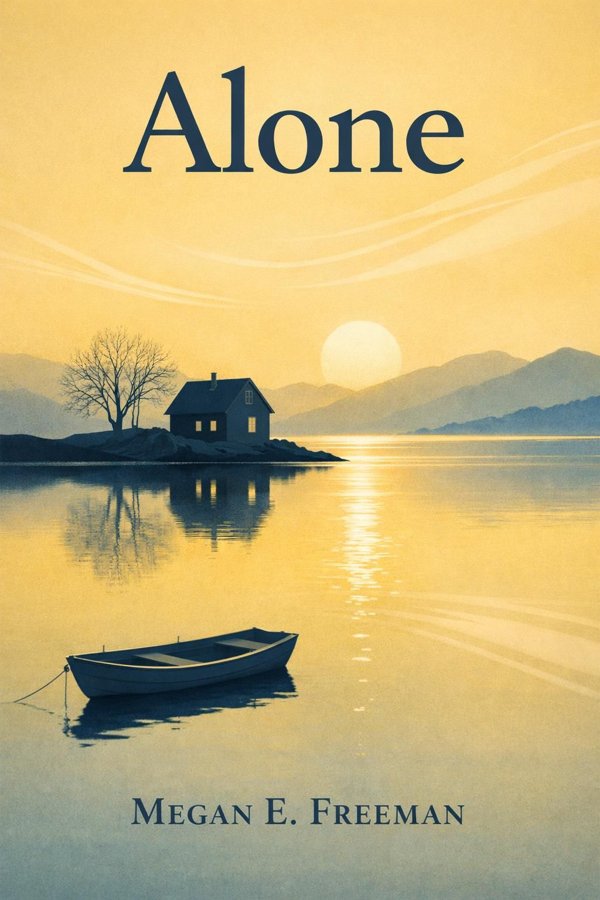
Alone: Summary & Key Insights
 10 min9 chaptersAudio available
Key Takeaways from Alone
Sometimes the smallest act of rebellion opens the door to the biggest transformation.
Absence can be more frightening than danger itself.
When no rescue appears, searching becomes a way of holding on to meaning.
Even in total isolation, no one survives on self-reliance alone.
Resilience is rarely dramatic at first; it usually begins as trial and error.
What Is Alone About?
Alone by Megan E. Freeman is a bestsellers book spanning 6 pages. What would happen if you woke up and everyone was gone? In Alone, Megan E. Freeman turns that chilling question into a deeply moving middle-grade novel in verse about survival, loneliness, and inner strength. The story follows twelve-year-old Maddie, who secretly spends the night at a friend’s house to avoid being shuffled between her divorced parents. By morning, her Colorado town has been evacuated, and she is left entirely on her own. With no adults to guide her, no explanation for the sudden disappearance, and no certainty that anyone will return, Maddie must learn how to stay alive physically and emotionally. What makes Alone especially powerful is its form. Freeman, a poet as well as a novelist, uses spare, vivid verse to capture fear, hunger, memory, grief, and hope with remarkable intensity. The novel speaks directly to young readers’ anxieties about independence, abandonment, and resilience, while also offering adults a profound reflection on what sustains us in crisis. More than a survival story, Alone is a portrait of a girl discovering resourcefulness, courage, and the stubborn human need for connection—even in the most silent of worlds.
This FizzRead summary covers all 9 key chapters of Alone in approximately 10 minutes, distilling the most important ideas, arguments, and takeaways from Megan E. Freeman's work. Also available as an audio summary and Key Quotes Podcast.
Alone
What would happen if you woke up and everyone was gone? In Alone, Megan E. Freeman turns that chilling question into a deeply moving middle-grade novel in verse about survival, loneliness, and inner strength. The story follows twelve-year-old Maddie, who secretly spends the night at a friend’s house to avoid being shuffled between her divorced parents. By morning, her Colorado town has been evacuated, and she is left entirely on her own. With no adults to guide her, no explanation for the sudden disappearance, and no certainty that anyone will return, Maddie must learn how to stay alive physically and emotionally.
What makes Alone especially powerful is its form. Freeman, a poet as well as a novelist, uses spare, vivid verse to capture fear, hunger, memory, grief, and hope with remarkable intensity. The novel speaks directly to young readers’ anxieties about independence, abandonment, and resilience, while also offering adults a profound reflection on what sustains us in crisis. More than a survival story, Alone is a portrait of a girl discovering resourcefulness, courage, and the stubborn human need for connection—even in the most silent of worlds.
Who Should Read Alone?
This book is perfect for anyone interested in bestsellers and looking to gain actionable insights in a short read. Whether you're a student, professional, or lifelong learner, the key ideas from Alone by Megan E. Freeman will help you think differently.
- ✓Readers who enjoy bestsellers and want practical takeaways
- ✓Professionals looking to apply new ideas to their work and life
- ✓Anyone who wants the core insights of Alone in just 10 minutes
Want the full summary?
Get instant access to this book summary and 100K+ more with Fizz Moment.
Get Free SummaryAvailable on App Store • Free to download
Key Chapters
Sometimes the smallest act of rebellion opens the door to the biggest transformation. At the beginning of Alone, Maddie is not trying to become a hero. She is a twelve-year-old girl frustrated by the rules and routines created by her parents’ divorce. Caught between homes and schedules, she longs for one simple thing: control over her own life. Her secret sleepover at her friends’ house feels like an ordinary childhood risk, the kind of decision many kids make when they want freedom without thinking too far ahead.
But that choice becomes the hinge on which the entire story turns. When Maddie wakes up, she discovers that her town has been evacuated overnight because of a dangerous emergency. Everyone is gone, and because she was hiding, no one knew to take her. This setup is powerful because it shows how quickly normal life can break apart. One evening she is navigating family tension; the next she is confronting absolute isolation.
Freeman uses this moment to highlight a truth young readers understand instinctively: children often feel powerless, but their choices still matter. Maddie’s decision is not morally outrageous, yet it has life-changing consequences. That does not make her deserving of what happens. Instead, it makes her believable. Her mistake is human, and that humanity is what makes her struggle gripping.
In everyday life, this idea translates into an important lesson about consequences and awareness. Small choices—ignoring instructions, hiding concerns, assuming adults will figure things out—can have larger effects than we expect. At the same time, the novel avoids shaming Maddie. It invites readers to think carefully about responsibility while also recognizing that growth often begins in imperfection.
Actionable takeaway: Before making a secretive or impulsive choice, pause and ask, “If something unexpected happened, would someone know where I am and how to help me?”
Absence can be more frightening than danger itself. Once Maddie realizes that her town is empty, the first challenge is not finding food or shelter—it is understanding what has happened. The silence around her is unnatural. Houses stand open, meals are unfinished, pets are missing or trapped, and no explanation arrives. Freeman captures this eerie emptiness through verse that makes every sound feel magnified and every unanswered question more terrifying.
At first, Maddie behaves the way many people would in a crisis: she waits. She hopes someone will come back, that there has been a mistake, that the strangeness will resolve itself by morning. But as the hours stretch on, waiting becomes its own kind of suffering. The novel shows how uncertainty drains energy and clouds judgment. Fear thrives in the space where information is missing.
This section of the story matters because it mirrors real emotional experiences. Children and adults alike often find uncertainty harder to endure than bad news. When people disappear, plans collapse, or routines are interrupted, the mind fills in the blanks with worst-case scenarios. Maddie’s empty neighborhood becomes an external version of internal panic.
Freeman also shows that naming reality is the first step toward surviving it. Maddie cannot solve the mystery of the evacuation immediately, but she can stop pretending everything is normal. Once she accepts that she is truly alone, her thinking changes from passive hope to active problem-solving.
In practical terms, this applies to any destabilizing moment—moving to a new place, losing a relationship, facing a family crisis, or entering unfamiliar territory. The more honestly we assess a situation, the better we can respond. Denial may feel protective, but it delays adaptation.
Actionable takeaway: When facing uncertainty, write down what you know, what you do not know, and what you can do next. Clarity reduces fear and creates momentum.
When no rescue appears, searching becomes a way of holding on to meaning. After the first shock passes, Maddie begins moving through the abandoned town looking for clues, supplies, and signs of life. She enters empty houses, reads the traces people left behind, and studies the half-finished patterns of ordinary routines abruptly interrupted. In these moments, the novel becomes more than a survival story; it becomes a meditation on what human presence leaves in a space.
Each home Maddie explores feels like a frozen snapshot of vanished lives. A load of laundry, a pet bowl, a toy on the floor, notes on a counter—these details remind her that she is not in a destroyed world but in a world paused without explanation. That distinction matters. It intensifies loneliness because everything around her still carries the shape of community, but none of the people remain.
Freeman uses Maddie’s searches to reveal a subtle emotional progression. At first, she is looking outward for answers. Over time, she is also confronting inward questions: Who is she without constant supervision? What habits matter? What memories keep her steady? Solitude strips away distractions and forces self-knowledge.
This part of the novel offers a practical lesson in attention. In unfamiliar or difficult situations, careful observation becomes a survival skill. Maddie notices where food might still be usable, which spaces are safest, and how the environment is changing. She learns that looking closely is not the same as wandering helplessly. Search, in her case, becomes strategy.
For readers, this speaks to moments when life feels empty or disorienting. Instead of assuming there is nothing left, we can train ourselves to notice what remains: structure, evidence, possibility, resources, and memory. Solitude can be painful, but it can also sharpen awareness.
Actionable takeaway: In times of disruption, practice deliberate observation. Spend five minutes identifying the resources, routines, and people—even if remote—that still exist in your life.
Even in total isolation, no one survives on self-reliance alone. One of the most emotionally resonant elements in Alone is George, the Rottweiler who becomes Maddie’s companion. George is far more than a pet in the story. He is comfort, responsibility, structure, protection, and proof that love can continue even after a world seems to empty out.
Maddie’s bond with George changes the tone of her survival. Without him, she would still be alive physically, but emotionally she might collapse under the weight of loneliness. Caring for him gives her a reason to move each day. She has to think beyond her own fear—finding food, offering companionship, staying alert to his needs. That responsibility keeps despair from swallowing her completely.
Freeman’s portrayal of George reminds readers that connection is not a luxury reserved for easier times. It is a core survival mechanism. Humans endure hardship better when they feel needed and accompanied. This can come through friendship, family, community, faith, or even an animal bond. George cannot explain the crisis to Maddie, but he offers something just as necessary: presence.
There is also a practical emotional lesson here. When people feel isolated, they often withdraw further, assuming that independence means needing no one. Alone pushes against that idea. Maddie becomes stronger not by rejecting attachment but by deepening it. George helps her maintain empathy, routine, and hope.
In everyday life, this applies to students adjusting to a new school, adults living alone, or anyone navigating grief and transition. Caring for another being—whether a pet, sibling, plant, or community role—can anchor the self. Responsibility can rescue us from emotional drift.
Actionable takeaway: If you are feeling isolated, create a daily connection ritual—check on a friend, care for a pet, help someone at home, or join a small responsibility that reminds you you matter to another life.
Resilience is rarely dramatic at first; it usually begins as trial and error. As days turn into weeks and then months, Maddie can no longer rely on leftovers, luck, or the fantasy that adults will return any moment. She has to learn how to survive systematically. She figures out food storage, shelter, hygiene, heating, and safety through observation, experimentation, and persistence. The novel treats these practical details seriously, showing that endurance is built from countless ordinary decisions.
This is one of the book’s most valuable contributions. Many stories romanticize survival by turning it into adventure. Freeman does the opposite. She shows the boredom, discomfort, and constant vigilance involved in staying alive. Maddie has to think ahead. What will she eat when supplies run low? Where can she stay warm? How can she avoid injury when no one is there to help? Every solved problem uncovers another.
The emotional implication is just as important. Competence grows through doing. Maddie does not suddenly become fearless; she becomes capable. That distinction matters in real life. Confidence often comes after repeated action, not before it. The more she learns, the less helpless she feels. Skills become a form of hope.
For readers, this idea is broadly applicable. Whether the challenge is academic pressure, family stress, or adapting to a new environment, progress often comes from breaking survival into manageable tasks. Make a plan. Test what works. Adjust. Keep going. The novel quietly teaches self-efficacy by showing Maddie build it step by step.
Freeman also suggests that young people are often more resourceful than adults assume. Given necessity, Maddie learns quickly—not because she should have to, but because human beings can adapt when they must.
Actionable takeaway: When a challenge feels overwhelming, identify three practical skills or tasks that would improve your situation, then learn and practice them one at a time.
Nature does not stop for human loneliness, and that is both cruel and comforting. As Alone progresses, the changing seasons become more than background scenery. They mirror Maddie’s emotional and practical journey. Summer offers mobility and foraging opportunities, but also exposure and uncertainty. Autumn brings preparation and warning. Winter sharpens every risk. Spring suggests renewal, but not without the cost of everything she has endured.
Freeman uses seasonal shifts to make time tangible. In many survival stories, readers know that hardship lasts a long time, but they do not always feel it. Here, the weather itself becomes a clock. Cold, darkness, storms, and scarcity all remind us that Maddie’s ordeal is not temporary inconvenience. She must evolve with the environment or be overcome by it.
On an emotional level, the seasons reflect how grief and resilience coexist. Maddie is not on a simple upward path toward strength. She cycles through fear, determination, despair, routine, memory, and hope. This rhythm feels deeply true. Healing is rarely linear; people revisit difficult emotions in new forms as conditions change.
There is a practical lesson in the way Maddie responds to nature: preparation matters more than panic. She cannot control winter, but she can gather supplies, improve shelter, and adjust expectations. The same principle applies outside literal survival. Exams, transitions, health challenges, and emotional lows all have seasons. We suffer more when we are shocked by predictable hardship and less when we prepare for it.
This idea also encourages humility. Maddie survives partly because she learns to respect the environment rather than assume she can outlast it by willpower alone. The world is larger than her fear.
Actionable takeaway: Think seasonally about your own life. Ask what challenge is coming next—busy period, stressful event, emotional dip—and prepare concrete supports before it arrives.
Hope is not always a grand feeling; often it is a discipline. One of the most moving aspects of Alone is how Maddie preserves her inner life when there is almost nothing outside her to reinforce it. She creates routines, revisits memories, talks through decisions, and continues imagining a future in which she is found. These habits may seem small, but they are what keep her from dissolving into despair.
Freeman shows that psychological survival is every bit as important as physical survival. Hunger and cold are dangerous, but so are hopelessness, disorientation, and the loss of meaning. Maddie needs structure to remain human in a world emptied of social cues. By marking time, maintaining rituals, and speaking to George, she creates continuity where none exists naturally.
Imagination also plays an important role. It can be painful, because it reminds her of what she has lost, but it is also sustaining. To imagine reunion is to refuse emotional surrender. To remember loved ones is to keep connection alive across absence. In this way, hope is not naive optimism. It is a stubborn commitment to possibility.
Readers can apply this lesson in many forms of isolation—illness, grief, remote living, social anxiety, or periods of transition. Waiting passively for motivation often fails. What works better is building a scaffold for the mind: morning habits, journaling, exercise, reading, creative projects, and regular points of connection.
The novel suggests that when life becomes overwhelming, meaning can be protected through repeatable acts. Routine tells us that time still has shape. Imagination tells us that life still has horizon.
Actionable takeaway: Build one daily ritual that protects your mental resilience—such as journaling for ten minutes, taking a walk, or checking in with someone at the same time each day.
By the time help appears, Maddie is no longer the girl who first broke the rules for a sleepover. One of the novel’s deepest insights is that transformation happens during the crisis, not just after it. Maddie does not simply endure an extreme event and then return unchanged to ordinary life. She becomes someone new—more observant, more capable, more scarred, and more aware of both her vulnerability and her strength.
This matters because many narratives imply that the goal of hardship is to “get back to normal.” Alone offers a more truthful vision. Some experiences permanently reshape how a person sees safety, family, and self. Maddie’s growth is real, but it is not neat. She has gained survival skills and emotional depth, yet she has also lost innocence. Freeman honors both truths.
The practical value of this idea lies in its honesty about change. Readers going through difficult periods often pressure themselves to act exactly as they did before loss, upheaval, or trauma. But adversity alters perspective. That does not mean life is ruined; it means identity expands to include what has been endured.
Maddie’s experience also suggests that capability can emerge before recognition catches up. Often, people do not realize how much they have changed until the emergency passes and they look back. In the middle of hardship, growth feels like exhaustion, repetition, and adaptation—not triumph.
This perspective can help readers approach change with more compassion. Instead of asking, “Why am I not the same as before?” we might ask, “What have I learned to carry?” Maddie’s identity is forged not through perfection but through persistence.
Actionable takeaway: After a difficult season, reflect on how you have changed by listing new strengths, sensitivities, and boundaries instead of measuring yourself only against your past self.
Rescue is not the end of the story; it is the beginning of recovery. When Maddie is finally reunited with other people, the emotional resolution is intentionally complicated. Readers may expect pure relief, and certainly relief is present. But Freeman resists turning reunion into a magical reset. After such prolonged isolation, returning to human society is overwhelming. Love comes back, but so do grief, shock, and the challenge of being understood.
This final movement of the novel is crucial because it broadens the book’s meaning. Alone is not just about surviving abandonment; it is about what happens when someone carries an extreme experience back into ordinary life. Maddie has changed, and the people who find her cannot fully grasp what her solitude felt like from the inside. Recovery requires patience, care, and room for the truth of what she endured.
The novel’s ending speaks to anyone who has gone through something difficult and then faced the awkwardness of “after.” Others may expect gratitude, cheerfulness, or instant normality. But healing rarely works that way. Reentry can be disorienting. Safety may return before peace does. Freeman treats this with sensitivity, making the ending emotionally credible rather than simplistic.
There is also a hopeful lesson here. While suffering leaves marks, reconnection still matters profoundly. Maddie’s return to other people does not erase her loneliness, but it gives her a future in which that loneliness no longer has total control. Healing begins not with forgetting, but with being met.
Actionable takeaway: When supporting someone after a hard experience, do not rush them toward normal. Offer steady presence, listen without fixing, and let recovery unfold at a human pace.
All Chapters in Alone
About the Author
Megan E. Freeman is an American author and poet who writes for children and young adults. She is especially known for her lyrical style and her ability to explore difficult emotional experiences with clarity, warmth, and honesty. Her writing often centers on themes such as resilience, self-discovery, identity, and the inner lives of young people facing extraordinary challenges. In Alone, Freeman combines the intensity of survival fiction with the precision and emotional power of poetry, creating a novel in verse that has connected with readers, educators, and librarians. Her background as a poet gives her work a strong sense of rhythm, imagery, and emotional focus. Freeman is widely appreciated for crafting stories that are accessible to younger readers while still offering depth, nuance, and lasting insight.
Get This Summary in Your Preferred Format
Read or listen to the Alone summary by Megan E. Freeman anytime, anywhere. FizzRead offers multiple formats so you can learn on your terms — all free.
Available formats: App · Audio · PDF · EPUB — All included free with FizzRead
Download Alone PDF and EPUB Summary
Key Quotes from Alone
“Sometimes the smallest act of rebellion opens the door to the biggest transformation.”
“Absence can be more frightening than danger itself.”
“When no rescue appears, searching becomes a way of holding on to meaning.”
“Even in total isolation, no one survives on self-reliance alone.”
“Resilience is rarely dramatic at first; it usually begins as trial and error.”
Frequently Asked Questions about Alone
Alone by Megan E. Freeman is a bestsellers book that explores key ideas across 9 chapters. What would happen if you woke up and everyone was gone? In Alone, Megan E. Freeman turns that chilling question into a deeply moving middle-grade novel in verse about survival, loneliness, and inner strength. The story follows twelve-year-old Maddie, who secretly spends the night at a friend’s house to avoid being shuffled between her divorced parents. By morning, her Colorado town has been evacuated, and she is left entirely on her own. With no adults to guide her, no explanation for the sudden disappearance, and no certainty that anyone will return, Maddie must learn how to stay alive physically and emotionally. What makes Alone especially powerful is its form. Freeman, a poet as well as a novelist, uses spare, vivid verse to capture fear, hunger, memory, grief, and hope with remarkable intensity. The novel speaks directly to young readers’ anxieties about independence, abandonment, and resilience, while also offering adults a profound reflection on what sustains us in crisis. More than a survival story, Alone is a portrait of a girl discovering resourcefulness, courage, and the stubborn human need for connection—even in the most silent of worlds.
You Might Also Like

The Godfather
Mario Puzo
10 min
The Handmaid's Tale
Margaret Atwood
10 min
The Hunger Games
Suzanne Collins
10 min
The Nightingale
Kristin Hannah
10 min
The Seven Husbands of Evelyn Hugo
Taylor Jenkins Reid
10 min
Backwater Justice
Fern Michaels
10 minBrowse by Category
Ready to read Alone?
Get the full summary and 100K+ more books with Fizz Moment.