
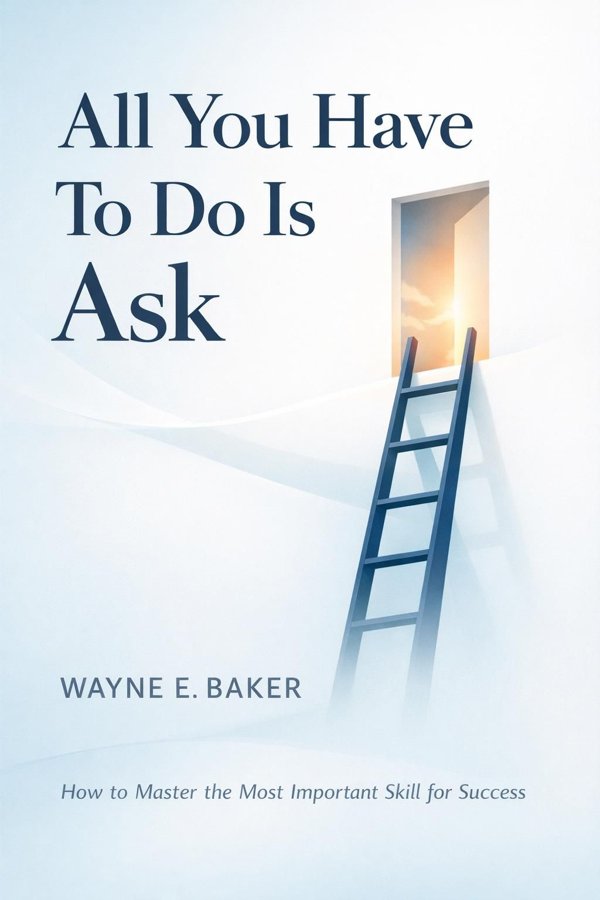
All You Have To Do Is Ask: How to Master the Most Important Skill for Success: Summary & Key Insights
 10 min8 chaptersAudio available
Key Takeaways from All You Have To Do Is Ask: How to Master the Most Important Skill for Success
One of the most surprising truths in modern work is that useful help is often available long before it is requested.
Many people think asking is a one-sided act: one person needs, another person gives.
A powerful culture of asking rarely emerges by accident; it often needs structure.
People often fail to get help not because others are unwilling, but because their requests are too vague.
The greatest barrier to asking is rarely logistical; it is psychological.
What Is All You Have To Do Is Ask: How to Master the Most Important Skill for Success About?
All You Have To Do Is Ask: How to Master the Most Important Skill for Success by Wayne E. Baker is a leadership book spanning 11 pages. Most people are surrounded by help they never receive. Not because others are unwilling, but because no one clearly asks. In All You Have To Do Is Ask, Wayne E. Baker argues that one of the most overlooked drivers of success is the ability to request what you need—advice, introductions, resources, feedback, time, or support—without shame or confusion. His central insight is simple but powerful: there is often a wide gap between what people are willing to give and what others actually request. Baker combines sociology, organizational research, and practical workplace tools to show why asking feels so difficult and why it matters so much. He explains that fear of rejection, concern about looking incompetent, and vague communication prevent individuals and teams from accessing the help already available around them. But asking can be learned, structured, and normalized. As a professor at the University of Michigan and a leading researcher on social capital, generosity, and organizational culture, Baker brings both academic authority and real-world relevance. This book is especially valuable for leaders, professionals, educators, and anyone who wants to collaborate better, solve problems faster, and create more generous, high-performing relationships at work and beyond.
This FizzRead summary covers all 8 key chapters of All You Have To Do Is Ask: How to Master the Most Important Skill for Success in approximately 10 minutes, distilling the most important ideas, arguments, and takeaways from Wayne E. Baker's work. Also available as an audio summary and Key Quotes Podcast.
All You Have To Do Is Ask: How to Master the Most Important Skill for Success
Most people are surrounded by help they never receive. Not because others are unwilling, but because no one clearly asks. In All You Have To Do Is Ask, Wayne E. Baker argues that one of the most overlooked drivers of success is the ability to request what you need—advice, introductions, resources, feedback, time, or support—without shame or confusion. His central insight is simple but powerful: there is often a wide gap between what people are willing to give and what others actually request.
Baker combines sociology, organizational research, and practical workplace tools to show why asking feels so difficult and why it matters so much. He explains that fear of rejection, concern about looking incompetent, and vague communication prevent individuals and teams from accessing the help already available around them. But asking can be learned, structured, and normalized.
As a professor at the University of Michigan and a leading researcher on social capital, generosity, and organizational culture, Baker brings both academic authority and real-world relevance. This book is especially valuable for leaders, professionals, educators, and anyone who wants to collaborate better, solve problems faster, and create more generous, high-performing relationships at work and beyond.
Who Should Read All You Have To Do Is Ask: How to Master the Most Important Skill for Success?
This book is perfect for anyone interested in leadership and looking to gain actionable insights in a short read. Whether you're a student, professional, or lifelong learner, the key ideas from All You Have To Do Is Ask: How to Master the Most Important Skill for Success by Wayne E. Baker will help you think differently.
- ✓Readers who enjoy leadership and want practical takeaways
- ✓Professionals looking to apply new ideas to their work and life
- ✓Anyone who wants the core insights of All You Have To Do Is Ask: How to Master the Most Important Skill for Success in just 10 minutes
Want the full summary?
Get instant access to this book summary and 100K+ more with Fizz Moment.
Get Free SummaryAvailable on App Store • Free to download
Key Chapters
One of the most surprising truths in modern work is that useful help is often available long before it is requested. Wayne Baker calls this missed opportunity the “asking gap”: the distance between the assistance people are willing to give and the assistance others actually ask for. In organizations, this gap quietly drains energy, slows problem-solving, and keeps people isolated even when they are surrounded by knowledge and goodwill.
Why does the gap exist? Many people assume others are too busy, fear rejection, or worry that asking will make them appear weak, dependent, or unqualified. As a result, they struggle alone, duplicate work, or delay action while the exact information or connection they need sits a few desks—or a few messages—away. The tragedy is not a lack of resources, but a lack of requests.
Baker shows that this gap appears in every setting: employees hesitate to ask senior colleagues for guidance, managers avoid asking peers for support, and even experienced leaders fail to request candid feedback. Yet when people do ask, they often discover that others are eager to contribute. Helping gives people meaning, strengthens relationships, and allows hidden skills to surface.
Imagine a product team stuck on a technical issue for weeks. No one asks outside the department because they assume they should solve it internally. Then one carefully worded request reaches another team, and a colleague shares a solution in ten minutes. This is the asking gap made visible.
The lesson is clear: unmet needs are often unasked needs. Start treating every challenge as a possible request, not just a private burden. Before struggling alone, pause and ask: who might already know, have, or offer what I need?
Many people think asking is a one-sided act: one person needs, another person gives. Baker overturns this assumption by showing that effective asking creates mutual value. Requests unlock productivity, speed learning, deepen trust, and generate innovation because they connect needs to underused resources. In other words, asking is not merely about getting help; it is about activating a network.
When people ask for advice, they reduce wasted effort. When they ask for introductions, they expand opportunity. When they ask for feedback, they improve performance faster than they could alone. The person who responds often benefits too. Helping can reinforce expertise, build reputation, increase connection, and create a sense of purpose. A workplace where people ask and respond generously becomes more adaptive and resilient.
Baker emphasizes that organizations suffer when employees feel they must prove self-sufficiency at all costs. That culture rewards invisible struggle over visible collaboration. By contrast, in teams where asking is normal, people solve problems earlier, spread knowledge faster, and avoid unnecessary reinvention. A junior employee who asks for a best-practice template may save hours. A leader who asks for dissenting views may avoid a costly strategic error. A cross-functional ask may uncover ideas no one inside one silo could produce.
This principle also applies outside work. Families, communities, and friendships become stronger when people express needs openly. Asking helps others know how to contribute instead of leaving them guessing.
The practical takeaway is to reframe asking from a burden into an exchange of value. When you need something, remember that your request gives others a chance to help, connect, and matter. This week, make one request you have been postponing and notice not only what you gain, but what your asking makes possible for others.
A powerful culture of asking rarely emerges by accident; it often needs structure. One of Baker’s most effective tools is the Reciprocity Ring, a simple but transformative group exercise in which participants make specific requests and others offer help, ideas, contacts, or resources. The genius of the method lies in its visibility. It brings hidden needs into the open and reveals that useful assistance is distributed widely across a community.
In a Reciprocity Ring, each person states a meaningful request—professional or personal—and the group responds with possible ways to help. These may include expertise, referrals, examples, tools, encouragement, or connections to someone else who can assist. What seems impossible in isolation often becomes solvable in minutes when a group’s collective knowledge is activated.
The exercise works because it normalizes both vulnerability and generosity. Participants quickly learn that nearly everyone needs something and nearly everyone has something to offer. This corrects the false belief that asking diminishes status. In fact, well-designed asking sessions often increase respect because they highlight clarity, trust, and resourcefulness.
A team might use a Reciprocity Ring during onboarding, quarterly planning, or project retrospectives. A manager could ask for examples of effective remote team rituals. A designer might request introductions to users in a niche market. A new hire could ask for guidance on navigating internal systems. Even personal requests—such as finding a language tutor or nonprofit contact—can strengthen connection.
The deeper lesson is that generosity scales when requests are shared publicly and specifically. You do not have to wait for a formal workshop to apply this idea. At your next meeting, invite each person to name one concrete ask and give the group five minutes to respond. Make asking a ritual, not an exception.
People often fail to get help not because others are unwilling, but because their requests are too vague. Baker’s SMART framework helps transform a weak ask into one others can actually answer. A good request should be Specific, Meaningful, Action-oriented, Realistic, and Time-bound. This structure increases the chances that people understand what you need, why it matters, and how they can respond.
Consider the difference between “I need help with my career” and “I’m exploring a transition into product marketing and would value a 20-minute conversation with someone who made a similar move in the last two years.” The first request is broad and difficult to act on. The second gives people a clear path to help. Specificity is respectful because it lowers the mental effort required to respond.
Meaningful requests explain why the ask matters. People are more motivated when they understand the purpose. Action-oriented requests tell others what form the help could take: an introduction, a recommendation, feedback on a draft, or a resource. Realistic requests stay within reasonable limits and avoid placing an unfair burden on others. Time-bound requests create momentum by clarifying urgency or deadlines.
This framework can be applied to nearly any context. A student can ask a professor for feedback on one section of a paper instead of general help. A founder can ask investors for introductions to three operators in a target industry. A team member can ask a colleague to review a slide deck by Thursday afternoon rather than “when you have time.”
When you need support, do not ask bigger—ask better. Before making your next request, rewrite it using the SMART criteria. If someone could read it and know exactly how to help, your ask is ready.
The greatest barrier to asking is rarely logistical; it is psychological. Baker shows that people hold back because of deeply rooted fears: fear of rejection, fear of seeming incompetent, fear of burdening others, and fear of losing status. These anxieties can be especially strong in competitive cultures where independence is praised and need is mistaken for weakness.
Yet much of this fear is based on distorted assumptions. People tend to overestimate how negatively others will judge a request and underestimate how good others feel when they are able to help. In reality, a thoughtful ask often signals self-awareness and commitment, not inadequacy. It shows that you care enough about the outcome to seek the best available support.
Baker encourages readers to examine the stories they tell themselves. Do you assume asking means you have failed? Do you believe competent people never need assistance? These beliefs are both unrealistic and costly. Every expert relies on networks, mentors, collaborators, and feedback loops. The most effective people are often the best askers.
One practical way to reduce fear is to start small. Ask for information before asking for major favors. Ask trusted people first. Practice using clear language instead of apologetic language. Another method is to separate your worth from the response. A “no” may reflect timing, priorities, or limitations—not your value. You can also make asking easier by giving people graceful ways to decline.
Leaders should pay special attention here. If managers never ask for help, teams may learn to hide needs. When leaders model thoughtful asking, they create permission for others to do the same.
Action step: identify one belief that makes you hesitate to ask. Challenge it with evidence from your own life, then make one low-risk request this week to build your asking muscle.
Individual skill matters, but Baker makes it clear that organizational culture determines whether asking becomes sustainable. In some workplaces, asking is encouraged as a sign of collaboration. In others, it is subtly punished through status games, overload, or the expectation that capable people should figure everything out alone. The result is a hidden tax on performance.
A culture of asking begins with norms. Teams need explicit permission to request help, share uncertainty, and surface obstacles early. Leaders shape these norms through what they reward, what they model, and what they make visible. If a manager praises heroic solo effort but ignores collaborative problem-solving, people will protect their image instead of seeking support. If the manager regularly asks for input, admits blind spots, and thanks those who contribute, asking becomes legitimate.
Baker also stresses the importance of systems. Organizations can create formal routines that invite requests: check-ins that include “What do you need?”, project reviews that identify resource gaps, digital spaces for requests and offers, and team exercises like Reciprocity Rings. These structures matter because they reduce the emotional burden of speaking up. When asking is built into the process, it feels normal rather than exceptional.
Consider a hospital unit, sales team, or school department where people begin each week by naming one challenge and one request. Over time, information flows faster, trust deepens, and preventable mistakes decline. Culture shifts not through slogans but through repeated practices.
If you lead others, treat asking as a capability worth designing for. Add one recurring ritual to your team this month that makes requests visible and welcome. The goal is not just to help people ask more, but to create an environment where they no longer have to wonder whether asking is allowed.
Good intentions alone do not create lasting habits. Baker strengthens his case by offering practical tools, real-world stories, and technological supports that make asking easier to practice and sustain. This is one reason the book feels immediately useful rather than merely persuasive. It does not stop at telling readers to ask; it shows them how to make asking operational.
Stories play a crucial role. When readers see professionals, teams, students, and leaders benefit from asking, the behavior becomes less abstract and less intimidating. Case studies illustrate that requests can unlock funding, solve stubborn technical problems, improve health outcomes, and deepen trust across hierarchies. These examples also reveal a consistent pattern: help was often available all along, but it remained hidden until someone articulated a need clearly.
Baker also highlights exercises and templates that help people prepare requests, identify barriers, and map who might be able to help. These tools are valuable because they turn asking into a repeatable practice. Instead of waiting until stress peaks, individuals can plan their requests strategically.
Technology can expand this process. Internal platforms, group chats, knowledge boards, and digital communities allow requests to travel beyond immediate circles. Someone in another office, time zone, or department may hold the exact answer or contact you need. Technology does not replace trust, but it can greatly increase visibility and reach.
To sustain the practice, Baker suggests making asking part of everyday workflows rather than an occasional intervention. For instance, teams can create dedicated channels for requests and offers, or organizations can prompt reflection on what people need after major milestones.
Your takeaway: choose one tool that reduces friction. It could be a request template, a shared help channel, or a recurring team story-sharing practice. Systems make courage easier.
All Chapters in All You Have To Do Is Ask: How to Master the Most Important Skill for Success
About the Author
Wayne E. Baker is a professor of management and organizations at the University of Michigan’s Ross School of Business and a faculty associate at the Institute for Social Research. His work focuses on social capital, networks, generosity, and the ways organizational culture shapes collaboration and performance. Over the course of his academic and applied career, Baker has studied how people create value through relationships and how teams can unlock hidden resources through better patterns of asking and giving. He is also known for helping develop practical tools that bring these ideas into workplaces, including methods that encourage mutual support and effective requests. Baker’s writing stands out for combining rigorous research with accessible advice, making complex social science useful for leaders, professionals, and organizations seeking stronger, more connected cultures.
Get This Summary in Your Preferred Format
Read or listen to the All You Have To Do Is Ask: How to Master the Most Important Skill for Success summary by Wayne E. Baker anytime, anywhere. FizzRead offers multiple formats so you can learn on your terms — all free.
Available formats: App · Audio · PDF · EPUB — All included free with FizzRead
Download All You Have To Do Is Ask: How to Master the Most Important Skill for Success PDF and EPUB Summary
Key Quotes from All You Have To Do Is Ask: How to Master the Most Important Skill for Success
“One of the most surprising truths in modern work is that useful help is often available long before it is requested.”
“Many people think asking is a one-sided act: one person needs, another person gives.”
“A powerful culture of asking rarely emerges by accident; it often needs structure.”
“People often fail to get help not because others are unwilling, but because their requests are too vague.”
“The greatest barrier to asking is rarely logistical; it is psychological.”
Frequently Asked Questions about All You Have To Do Is Ask: How to Master the Most Important Skill for Success
All You Have To Do Is Ask: How to Master the Most Important Skill for Success by Wayne E. Baker is a leadership book that explores key ideas across 8 chapters. Most people are surrounded by help they never receive. Not because others are unwilling, but because no one clearly asks. In All You Have To Do Is Ask, Wayne E. Baker argues that one of the most overlooked drivers of success is the ability to request what you need—advice, introductions, resources, feedback, time, or support—without shame or confusion. His central insight is simple but powerful: there is often a wide gap between what people are willing to give and what others actually request. Baker combines sociology, organizational research, and practical workplace tools to show why asking feels so difficult and why it matters so much. He explains that fear of rejection, concern about looking incompetent, and vague communication prevent individuals and teams from accessing the help already available around them. But asking can be learned, structured, and normalized. As a professor at the University of Michigan and a leading researcher on social capital, generosity, and organizational culture, Baker brings both academic authority and real-world relevance. This book is especially valuable for leaders, professionals, educators, and anyone who wants to collaborate better, solve problems faster, and create more generous, high-performing relationships at work and beyond.
You Might Also Like

Extreme Ownership
Jocko Willink
10 min
Dare to Lead
Brene Brown
10 min
Leaders Eat Last
Simon Sinek
10 min
The 21 Irrefutable Laws of Leadership
John Maxwell
10 min
Start With Why
Simon Sinek
10 min
How to Lead When You're Not in Charge
Clay Scroggins
10 minBrowse by Category
Ready to read All You Have To Do Is Ask: How to Master the Most Important Skill for Success?
Get the full summary and 100K+ more books with Fizz Moment.