
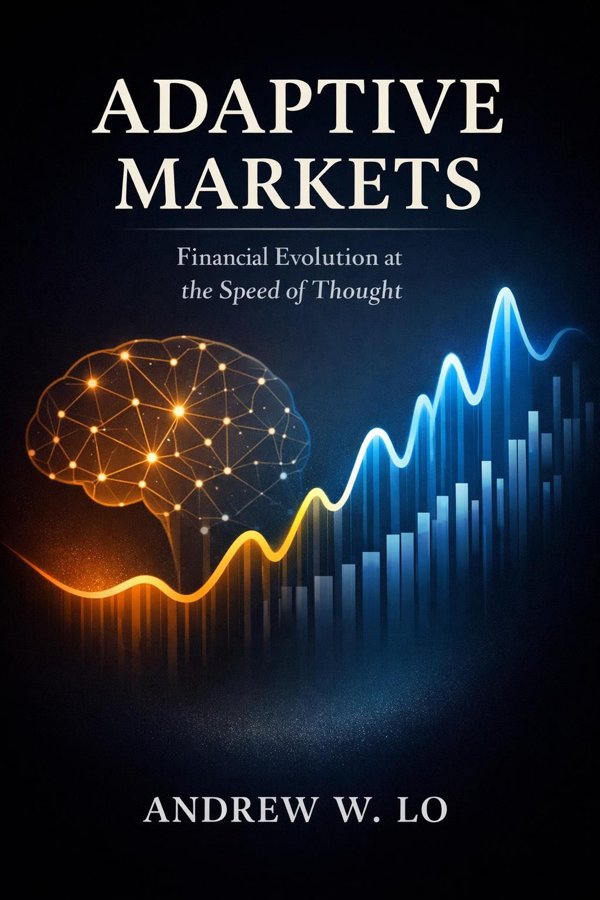
Adaptive Markets: Financial Evolution at the Speed of Thought: Summary & Key Insights
by Andrew W. Lo
 10 min9 chaptersAudio available
Key Takeaways from Adaptive Markets: Financial Evolution at the Speed of Thought
The most dangerous ideas in finance are often the ones that sound the cleanest.
If investors were always rational, bubbles and panics would be rare historical curiosities.
Markets behave less like physics experiments and more like ecosystems.
In nature, species survive by adapting faster than their rivals.
Most investors talk about risk as if it were a permanent property of an asset, like weight or color.
What Is Adaptive Markets: Financial Evolution at the Speed of Thought About?
Adaptive Markets: Financial Evolution at the Speed of Thought by Andrew W. Lo is a finance book spanning 11 pages. Adaptive Markets: Financial Evolution at the Speed of Thought offers a powerful new way to understand how finance really works when theory meets messy human reality. In this ambitious book, Andrew W. Lo argues that markets are neither perfectly efficient nor hopelessly irrational. Instead, they are living, evolving systems shaped by competition, learning, fear, innovation, and survival. By combining ideas from economics, evolutionary biology, psychology, and neuroscience, Lo develops the Adaptive Markets Hypothesis, a framework that explains why market behavior changes across time and why strategies that work in one era can suddenly fail in another. This book matters because traditional financial theories often break down during bubbles, crashes, and periods of rapid technological change. Lo shows that these failures are not exceptions to the system; they are part of how adaptive systems behave. His approach helps readers make better sense of risk, investor behavior, regulation, and portfolio management in an unstable world. As an MIT finance professor and leading researcher in financial engineering, Lo brings both academic rigor and practical insight, making this one of the most important books for readers who want a deeper, more realistic understanding of markets.
This FizzRead summary covers all 9 key chapters of Adaptive Markets: Financial Evolution at the Speed of Thought in approximately 10 minutes, distilling the most important ideas, arguments, and takeaways from Andrew W. Lo's work. Also available as an audio summary and Key Quotes Podcast.
Adaptive Markets: Financial Evolution at the Speed of Thought
Adaptive Markets: Financial Evolution at the Speed of Thought offers a powerful new way to understand how finance really works when theory meets messy human reality. In this ambitious book, Andrew W. Lo argues that markets are neither perfectly efficient nor hopelessly irrational. Instead, they are living, evolving systems shaped by competition, learning, fear, innovation, and survival. By combining ideas from economics, evolutionary biology, psychology, and neuroscience, Lo develops the Adaptive Markets Hypothesis, a framework that explains why market behavior changes across time and why strategies that work in one era can suddenly fail in another.
This book matters because traditional financial theories often break down during bubbles, crashes, and periods of rapid technological change. Lo shows that these failures are not exceptions to the system; they are part of how adaptive systems behave. His approach helps readers make better sense of risk, investor behavior, regulation, and portfolio management in an unstable world. As an MIT finance professor and leading researcher in financial engineering, Lo brings both academic rigor and practical insight, making this one of the most important books for readers who want a deeper, more realistic understanding of markets.
Who Should Read Adaptive Markets: Financial Evolution at the Speed of Thought?
This book is perfect for anyone interested in finance and looking to gain actionable insights in a short read. Whether you're a student, professional, or lifelong learner, the key ideas from Adaptive Markets: Financial Evolution at the Speed of Thought by Andrew W. Lo will help you think differently.
- ✓Readers who enjoy finance and want practical takeaways
- ✓Professionals looking to apply new ideas to their work and life
- ✓Anyone who wants the core insights of Adaptive Markets: Financial Evolution at the Speed of Thought in just 10 minutes
Want the full summary?
Get instant access to this book summary and 100K+ more with Fizz Moment.
Get Free SummaryAvailable on App Store • Free to download
Key Chapters
The most dangerous ideas in finance are often the ones that sound the cleanest. The Efficient Markets Hypothesis, or EMH, became dominant because it offered a beautifully simple claim: market prices already reflect all available information, so beating the market consistently should be nearly impossible. That framework helped build modern finance, index investing, and much of quantitative portfolio theory. But Andrew W. Lo shows that while EMH is useful, it is incomplete.
Real markets do not consist of perfectly rational machines. They are populated by human beings, institutions, and algorithms operating under pressure, with incomplete information, differing incentives, and changing competitive environments. In some settings, prices may indeed be highly efficient. In others, especially during stress, novelty, or illiquidity, markets can become distorted, slow to adjust, or wildly unstable.
Lo does not discard EMH entirely. Instead, he places it in context. Market efficiency is not a permanent condition; it is a variable outcome that depends on how many skilled competitors are searching for profits, how quickly information travels, how costly trading is, and how stable the environment remains. A quiet, liquid market with many smart participants may look efficient. A panicked market during a crisis may not.
Consider the difference between a heavily traded large-cap stock and a niche, thinly traded asset. The former may absorb news within seconds; the latter may misprice for weeks. The lesson is not that markets are always broken, but that efficiency comes in degrees and can change over time.
Actionable takeaway: Treat market efficiency as a spectrum, not a law. Before trusting any model or strategy, ask how competitive, liquid, informed, and stable the market environment really is.
If investors were always rational, bubbles and panics would be rare historical curiosities. Behavioral economics emerged because actual people do not think like textbook optimizers. Kahneman, Tversky, and other researchers showed that we rely on heuristics, mental shortcuts that help us make fast decisions but often create predictable errors. We anchor on irrelevant numbers, overreact to recent events, fear losses more than we value gains, and seek confirming evidence for what we already believe.
Lo accepts these findings, but he goes further by explaining why these biases exist in the first place. Many so-called irrational behaviors are not random defects. They are adaptations shaped by evolution for survival in uncertain environments. Being hyper-alert to threats, imitating the group, and reacting quickly to changing conditions may have been useful in natural settings, even if they sometimes produce bad financial decisions.
This perspective matters because it reframes bias. Investors are not simply flawed calculators. They are adaptive organisms using cognitive tools built for survival, not for pricing derivatives. In investing, those tools can misfire. Herding may protect an animal in the wild, but in markets it can inflate a bubble. Loss aversion may help preserve scarce resources, but it can also cause investors to cling to losing positions too long or sell winning assets too early.
A practical example is retirement investing. During a downturn, many individuals feel an overwhelming urge to move into cash. Emotionally, that response feels safe. But long-term investors who panic-sell often lock in losses and miss eventual recoveries.
Actionable takeaway: Build decision systems that protect you from your own instincts. Use checklists, predetermined asset-allocation rules, and cooling-off periods before making major investment changes.
Markets behave less like physics experiments and more like ecosystems. That is the central insight behind Lo’s Adaptive Markets Hypothesis, or AMH. Rather than choosing between efficient markets and behavioral finance, Lo integrates both. Investors are boundedly rational, competition is real, learning occurs, and environments change. As a result, market behavior evolves.
In this framework, profit opportunities appear when conditions shift faster than participants can adapt. As more investors notice and exploit those opportunities, the edge shrinks or disappears. Then new technologies, regulations, macro shocks, or shifts in behavior create fresh openings. There is no timeless equilibrium. There is ongoing adaptation.
This helps explain why an investing strategy can look brilliant for years and then suddenly stop working. A value strategy may outperform in one regime and struggle in another. Momentum may thrive when trends are strong and fail during sharp reversals. Hedge fund techniques that once produced excess returns can become crowded as competitors pile in. The AMH views these outcomes not as anomalies but as natural consequences of evolution in financial ecosystems.
It also explains why human behavior and rational pricing can coexist. In stable conditions with intense competition, markets may appear highly efficient. In novel or stressful conditions, behavioral biases and institutional frictions may dominate. The same market can therefore look rational one year and irrational the next.
For practitioners, this is a profound shift. Instead of searching for universal rules, they must focus on context, adaptation, and regime awareness. Investing becomes less about finding a permanent formula and more about understanding when a strategy fits its environment.
Actionable takeaway: Review every investment process with one question: what market conditions does this strategy depend on, and how will you know when those conditions have changed?
In nature, species survive by adapting faster than their rivals. In finance, strategies survive by delivering value before competition erodes them. Lo uses evolutionary logic to show that market participants, from retail investors to hedge funds to institutions, are engaged in a continuous struggle for survival. Successful behaviors spread; ineffective ones disappear. This process makes financial markets dynamic rather than static.
Competition is what links profit and adaptation. When few investors understand a market inefficiency, those who discover it can earn exceptional returns. But those profits attract imitators. As more capital chases the same edge, prices adjust, returns decline, and the once-profitable strategy becomes ordinary or even dangerous. This is why alpha is often temporary.
Think of statistical arbitrage, trend-following, or options-selling strategies. At one point, each may offer compelling returns. Over time, as models become widely known and assets under management grow, the strategy gets crowded. Then a period of stress exposes fragility, often painfully. Competition thus creates efficiency in some periods and instability in others.
Lo’s ecological view also highlights diversity. A healthy market ecosystem includes different participants with different goals, time horizons, and constraints. Pension funds, day traders, market makers, central banks, and long-term value investors all interact. Their diversity can stabilize markets, but if too many players converge on similar strategies, the system becomes vulnerable.
This has practical implications for investment selection. A strategy’s past success is not enough. You must ask how many others are doing it, whether the environment still supports it, and what happens if everyone tries to exit at once.
Actionable takeaway: Before adopting any investment approach, assess crowding. Look beyond returns and study flows, popularity, leverage, and how dependent the strategy is on other participants behaving predictably.
Most investors talk about risk as if it were a permanent property of an asset, like weight or color. Lo argues that risk is more like weather: real, measurable, but constantly changing. In adaptive systems, risk depends on the environment, the behavior of participants, and the interactions among them. What looks safe in one regime may be dangerous in another.
Traditional finance often equates risk with volatility. That can be useful, but it misses deeper threats. A strategy with stable returns may hide exposure to rare crashes, liquidity shortages, or crowded positioning. Conversely, an asset with visible short-term volatility may still offer strong long-term value if the underlying system is resilient.
The 2008 financial crisis is an obvious example. Many structured products were rated safe because historical data suggested low default correlation. But the model assumed a stable environment. When housing prices fell broadly and funding conditions tightened, the true system-wide risk appeared. What had looked diversified turned out to be tightly linked.
Lo’s framework encourages investors to think about risk as adaptation failure. If market participants become overconfident, highly leveraged, or too dependent on one funding source, small shocks can trigger large consequences. Risk is therefore not only about probabilities on a spreadsheet; it is about resilience, flexibility, and survival under stress.
For portfolio managers, this means combining quantitative measures with scenario analysis, liquidity assessment, and behavioral awareness. It also means recognizing that high Sharpe ratios can be seductive if they are produced by hidden exposures.
Actionable takeaway: Evaluate investments under changing conditions, not just average conditions. Ask how a position behaves during illiquidity, forced selling, regime shifts, and extreme correlation spikes.
Financial crises are often described as freak accidents. Lo sees them differently: they are signs that a market ecosystem has become badly adapted to its environment. In adaptive systems, success can breed vulnerability. When a strategy works for long enough, participants increase leverage, confidence, and scale. Safeguards weaken. Diversity declines. Then a shock arrives, and the system discovers that it is less robust than it appeared.
This idea explains why crises are often preceded by periods of calm. Stability encourages risk-taking. Investors extrapolate recent success, lenders loosen standards, and institutions build models from limited historical data. Everyone feels smarter than they are because the environment has been forgiving. But adaptation to one environment can become misadaptation when conditions shift.
The housing bubble provides a vivid example. Financial institutions, borrowers, rating agencies, and regulators all adapted to a world of rising home prices and abundant credit. Products and incentives evolved around that assumption. Once the environment changed, those adaptations became liabilities. The crisis was not simply caused by irrationality; it emerged from a system that had optimized itself for the wrong conditions.
Lo’s perspective matters because it shifts attention from blame to structure. Crises are not just stories about bad actors. They are often ecosystem failures involving feedback loops, common beliefs, and institutional fragility. Prevention therefore requires more than better forecasting. It requires promoting diversity, limiting excessive leverage, and building capacity for failure without systemic collapse.
For individuals, the lesson is equally important. A portfolio that looks strong in benign conditions may be one shock away from disaster if it depends on stable correlations, cheap funding, or constant liquidity.
Actionable takeaway: Regularly stress-test both portfolios and institutions for environment change. The key question is not whether recent conditions continue, but what breaks if they do not.
Every trade begins not in the market but in the mind. One of Lo’s most compelling contributions is his integration of neuroscience into finance. Traditional models often treat investors as disembodied rational agents, but actual decision-making is deeply tied to emotion, memory, stress responses, and neural reward systems. Fear and greed are not metaphors; they are biological realities.
Neuroscience helps explain why investors can know the right answer intellectually and still act against their own interests. Under stress, the brain prioritizes speed and survival. That can lead to panic selling, overtrading, or frozen inaction. Dopamine-driven reward systems can reinforce risk-taking after gains, while loss-related neural responses can amplify pain and avoidance after declines.
This matters because financial behavior changes with context. A calm investor reviewing a plan on a weekend may behave very differently from the same person watching prices collapse in real time. The body and brain are part of the market process. Professional traders, portfolio managers, and individual investors are all influenced by sleep, stress, time pressure, and social cues.
A practical application is in designing better investment habits. Automation can reduce the need for repeated emotional decisions. Rebalancing rules can force discipline. Diversification can lower not only financial risk but emotional volatility. Teams can also improve outcomes by encouraging dissent, slowing high-stakes decisions, and separating research from execution.
Lo’s broader point is that better finance requires better understanding of human biology. We do not eliminate emotion by pretending it does not exist. We manage it by designing systems that account for it.
Actionable takeaway: Reduce emotionally driven decisions by automating good behavior, limiting real-time portfolio checking, and using written rules for buying, selling, and rebalancing.
If markets evolve, then investment management and regulation must evolve with them. Lo argues that one-size-fits-all rules, whether in portfolio construction or public policy, are poorly suited to adaptive systems. What works in one era may fail in another because participants, technologies, incentives, and risks are constantly changing.
For portfolio management, this means abandoning the idea of a timeless optimal strategy. Diversification still matters, but so does flexibility. Investors should monitor changing correlations, market structure, liquidity conditions, and competitive crowding. A robust portfolio is not one that maximizes return under fixed assumptions. It is one that can survive and adapt across multiple regimes.
For regulators, Lo’s framework implies humility and vigilance. Financial rules should not assume permanent equilibrium. Instead, regulators should look for signs of ecosystem stress: excessive leverage, reduced diversity of strategy, hidden interconnections, and incentives that encourage short-term gains at long-term cost. The goal is not to eliminate failure entirely, which is impossible, but to prevent local failures from becoming systemic collapses.
Technology adds another layer. Machine learning, high-frequency trading, and algorithmic strategies can improve efficiency, but they can also create new feedback loops and new concentrations of risk. Adaptive regulation must therefore be data-informed, responsive, and willing to evolve as the system changes.
For individual readers, the lesson is practical. Do not confuse a static plan with a resilient one. Review assumptions regularly. Make room for uncertainty. Understand that preserving adaptability may matter as much as maximizing return.
Actionable takeaway: Build portfolios and policies around resilience. Revisit assumptions often, diversify across true risk drivers, and stay alert to structural change rather than relying only on historical averages.
The future of finance will not be defined by a final theory but by accelerating adaptation. Lo emphasizes that markets are increasingly shaped by technology, data, machine learning, and innovation in market structure. These developments can make markets faster and sometimes smarter, but they also compress the life cycle of competitive advantage. Edges emerge and disappear at greater speed.
Machine learning offers a clear example. A model may uncover subtle patterns in data and generate excess returns for a time. But as firms adopt similar tools, datasets, and infrastructure, those advantages become harder to sustain. Worse, models trained on past regimes may fail dramatically when the environment changes. In adaptive markets, technical sophistication is valuable, but it does not remove uncertainty or evolutionary pressure.
Lo’s ecosystem view is especially useful here. New species keep entering the market habitat: retail traders using apps, quantitative funds using alternative data, passive vehicles changing flows, crypto-native participants operating under different norms, and AI systems making or informing decisions. Their interactions reshape price formation, liquidity, and volatility.
This means the future of finance is not simply more efficient markets. It is more complex markets. Human judgment, institutional design, ethics, and risk oversight will matter even more as systems become faster and more interconnected. The winning participants may not be those with the most elegant models, but those best able to learn, adapt, and manage unintended consequences.
For readers, this final lesson is both cautionary and optimistic. Finance will continue to evolve, and rigid thinking will become increasingly costly. Adaptability is not a side skill; it is the central capability.
Actionable takeaway: Stay curious and update your mental models. In a changing financial ecosystem, the most durable edge is the ability to learn faster than conditions change.
All Chapters in Adaptive Markets: Financial Evolution at the Speed of Thought
About the Author
Andrew W. Lo is the Charles E. and Susan T. Harris Professor at the MIT Sloan School of Management and a leading scholar in financial economics. He is also the founder and director of the MIT Laboratory for Financial Engineering, where he has helped shape research at the intersection of markets, technology, risk, and human behavior. Lo’s work spans asset management, hedge funds, behavioral finance, statistics, and neuroscience, reflecting his unusual ability to connect disciplines that are often treated separately. He is widely known for developing the Adaptive Markets Hypothesis, a framework that rethinks how financial markets function in changing environments. Through his teaching, research, and writing, Lo has become one of the most influential voices in modern finance, especially for readers seeking a more realistic and interdisciplinary understanding of markets.
Get This Summary in Your Preferred Format
Read or listen to the Adaptive Markets: Financial Evolution at the Speed of Thought summary by Andrew W. Lo anytime, anywhere. FizzRead offers multiple formats so you can learn on your terms — all free.
Available formats: App · Audio · PDF · EPUB — All included free with FizzRead
Download Adaptive Markets: Financial Evolution at the Speed of Thought PDF and EPUB Summary
Key Quotes from Adaptive Markets: Financial Evolution at the Speed of Thought
“The most dangerous ideas in finance are often the ones that sound the cleanest.”
“If investors were always rational, bubbles and panics would be rare historical curiosities.”
“Markets behave less like physics experiments and more like ecosystems.”
“In nature, species survive by adapting faster than their rivals.”
“Most investors talk about risk as if it were a permanent property of an asset, like weight or color.”
Frequently Asked Questions about Adaptive Markets: Financial Evolution at the Speed of Thought
Adaptive Markets: Financial Evolution at the Speed of Thought by Andrew W. Lo is a finance book that explores key ideas across 9 chapters. Adaptive Markets: Financial Evolution at the Speed of Thought offers a powerful new way to understand how finance really works when theory meets messy human reality. In this ambitious book, Andrew W. Lo argues that markets are neither perfectly efficient nor hopelessly irrational. Instead, they are living, evolving systems shaped by competition, learning, fear, innovation, and survival. By combining ideas from economics, evolutionary biology, psychology, and neuroscience, Lo develops the Adaptive Markets Hypothesis, a framework that explains why market behavior changes across time and why strategies that work in one era can suddenly fail in another. This book matters because traditional financial theories often break down during bubbles, crashes, and periods of rapid technological change. Lo shows that these failures are not exceptions to the system; they are part of how adaptive systems behave. His approach helps readers make better sense of risk, investor behavior, regulation, and portfolio management in an unstable world. As an MIT finance professor and leading researcher in financial engineering, Lo brings both academic rigor and practical insight, making this one of the most important books for readers who want a deeper, more realistic understanding of markets.
You Might Also Like




Browse by Category
Ready to read Adaptive Markets: Financial Evolution at the Speed of Thought?
Get the full summary and 100K+ more books with Fizz Moment.