
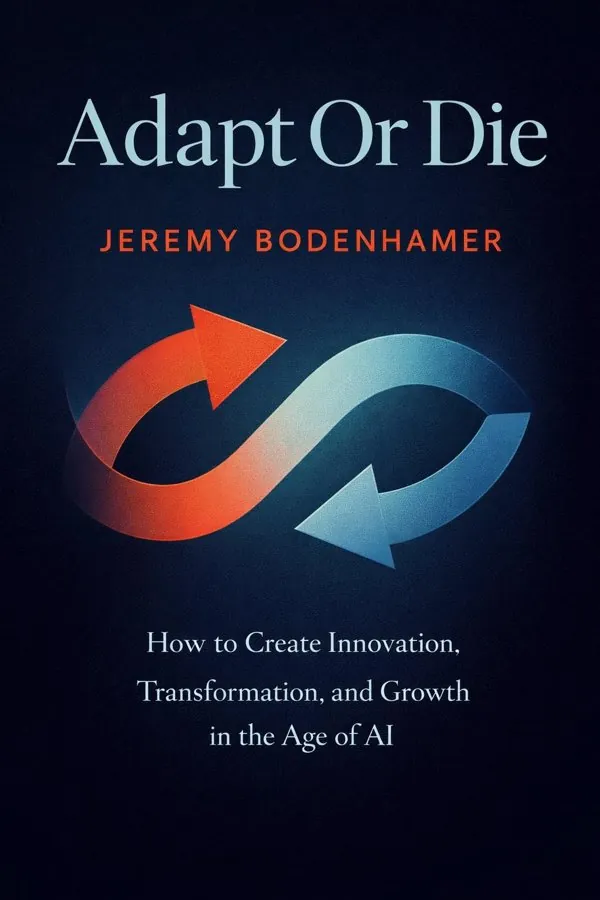
Adapt Or Die: How to Create Innovation, Transformation, and Growth in the Age of AI: Summary & Key Insights
 10 min13 chaptersAudio available
What Is Adapt Or Die: How to Create Innovation, Transformation, and Growth in the Age of AI About?
Adapt Or Die: How to Create Innovation, Transformation, and Growth in the Age of AI by Jeremy Bodenhamer is a leadership book spanning 13 pages. In Adapt Or Die, Jeremy Bodenhamer explores how businesses can thrive amid rapid technological change by embracing adaptability and innovation. Drawing on his experience as a logistics entrepreneur, he provides actionable strategies for leaders to transform their organizations through data-driven decision-making, customer-centric design, and AI integration. The book serves as a guide for navigating disruption and building resilient, future-ready companies.
This FizzRead summary covers all 13 key chapters of Adapt Or Die: How to Create Innovation, Transformation, and Growth in the Age of AI in approximately 10 minutes, distilling the most important ideas, arguments, and takeaways from Jeremy Bodenhamer's work. Also available as an audio summary and Key Quotes Podcast.
Adapt Or Die: How to Create Innovation, Transformation, and Growth in the Age of AI
In Adapt Or Die, Jeremy Bodenhamer explores how businesses can thrive amid rapid technological change by embracing adaptability and innovation. Drawing on his experience as a logistics entrepreneur, he provides actionable strategies for leaders to transform their organizations through data-driven decision-making, customer-centric design, and AI integration. The book serves as a guide for navigating disruption and building resilient, future-ready companies.
Who Should Read Adapt Or Die: How to Create Innovation, Transformation, and Growth in the Age of AI?
This book is perfect for anyone interested in leadership and looking to gain actionable insights in a short read. Whether you're a student, professional, or lifelong learner, the key ideas from Adapt Or Die: How to Create Innovation, Transformation, and Growth in the Age of AI by Jeremy Bodenhamer will help you think differently.
- ✓Readers who enjoy leadership and want practical takeaways
- ✓Professionals looking to apply new ideas to their work and life
- ✓Anyone who wants the core insights of Adapt Or Die: How to Create Innovation, Transformation, and Growth in the Age of AI in just 10 minutes
Want the full summary?
Get instant access to this book summary and 100K+ more with Fizz Moment.
Get Free SummaryAvailable on App Store • Free to download
Key Chapters
We live in a time when industries don’t simply evolve; they implode and reassemble at breakneck speed. Every company, no matter how traditional, is now a technology company. Logistics depends on algorithms, retail depends on data platforms, and even agriculture relies on sensors and autonomous systems. In the book, I call this the Age of Disruption. It is characterized not only by digital transformation but by a radical shift in customer expectations. People don’t just want faster, better, cheaper—they want experiences designed around them.
This new age did not begin with AI alone. It began when computing power became cheap enough and data plentiful enough to fuel constant iterative change. But AI has multiplied the intensity of disruption by automating what we once considered deeply human functions: perception, prediction, decision-making. In logistics, where my career began, I saw firsthand how AI-driven optimization could redefine entire cost structures. The shipping processes that once required teams of human analysts could now be done in seconds.
The point of understanding disruption is not to fear it but to map it—to decode its patterns. Disruption follows opportunity: wherever friction exists in a customer’s journey, technology rushes to eliminate it. The lesson for every leader is clear: the customer’s unmet need today is your company’s disruption tomorrow. To thrive, we must become translators of technological potential into customer value.
Adaptability is not an optional soft skill anymore—it’s the foundation of survival. In the Age of Disruption, planning rigidly is like steering a ship by the stars in a world where the sky itself is moving. The central argument of this section is that adaptability is a systemic capability, not a personality trait. It is designed into organizations through structures, incentives, and cultural norms that encourage learning and response.
I’ve often said that adaptability is built at the cultural level, but measured at the operational one. That means you must create an environment where new information triggers change automatically. Teams must be empowered to act without waiting for permission. Processes should be modular, flexible, and data-informed. When your organization can adjust its path quickly based on feedback, you don’t need to predict the future—you can simply respond to it faster than anyone else.
The companies that mastered adaptability during the early waves of automation were the ones that viewed uncertainty as a feature, not a flaw. In my own trajectory, I’ve seen that every disruption hides an advantage for those who can pivot quickly. Adaptability is the signal of life in an organization; rigidity is its early symptom of decline.
+ 11 more chapters — available in the FizzRead app
All Chapters in Adapt Or Die: How to Create Innovation, Transformation, and Growth in the Age of AI
About the Author
Jeremy Bodenhamer is an American entrepreneur and the founder and CEO of ShipHawk, a technology company specializing in logistics automation. He is recognized for his insights into supply chain innovation and digital transformation, frequently speaking on topics related to business adaptability and technology-driven growth.
Get This Summary in Your Preferred Format
Read or listen to the Adapt Or Die: How to Create Innovation, Transformation, and Growth in the Age of AI summary by Jeremy Bodenhamer anytime, anywhere. FizzRead offers multiple formats so you can learn on your terms — all free.
Available formats: App · Audio · PDF · EPUB — All included free with FizzRead
Download Adapt Or Die: How to Create Innovation, Transformation, and Growth in the Age of AI PDF and EPUB Summary
Key Quotes from Adapt Or Die: How to Create Innovation, Transformation, and Growth in the Age of AI
“We live in a time when industries don’t simply evolve; they implode and reassemble at breakneck speed.”
“Adaptability is not an optional soft skill anymore—it’s the foundation of survival.”
Frequently Asked Questions about Adapt Or Die: How to Create Innovation, Transformation, and Growth in the Age of AI
Adapt Or Die: How to Create Innovation, Transformation, and Growth in the Age of AI by Jeremy Bodenhamer is a leadership book that explores key ideas across 13 chapters. In Adapt Or Die, Jeremy Bodenhamer explores how businesses can thrive amid rapid technological change by embracing adaptability and innovation. Drawing on his experience as a logistics entrepreneur, he provides actionable strategies for leaders to transform their organizations through data-driven decision-making, customer-centric design, and AI integration. The book serves as a guide for navigating disruption and building resilient, future-ready companies.
You Might Also Like

Extreme Ownership
Jocko Willink
10 min
Dare to Lead
Brene Brown
10 min
Leaders Eat Last
Simon Sinek
10 min
The 21 Irrefutable Laws of Leadership
John Maxwell
10 min
Start With Why
Simon Sinek
10 min
How to Lead When You're Not in Charge
Clay Scroggins
10 minBrowse by Category
Ready to read Adapt Or Die: How to Create Innovation, Transformation, and Growth in the Age of AI?
Get the full summary and 100K+ more books with Fizz Moment.