
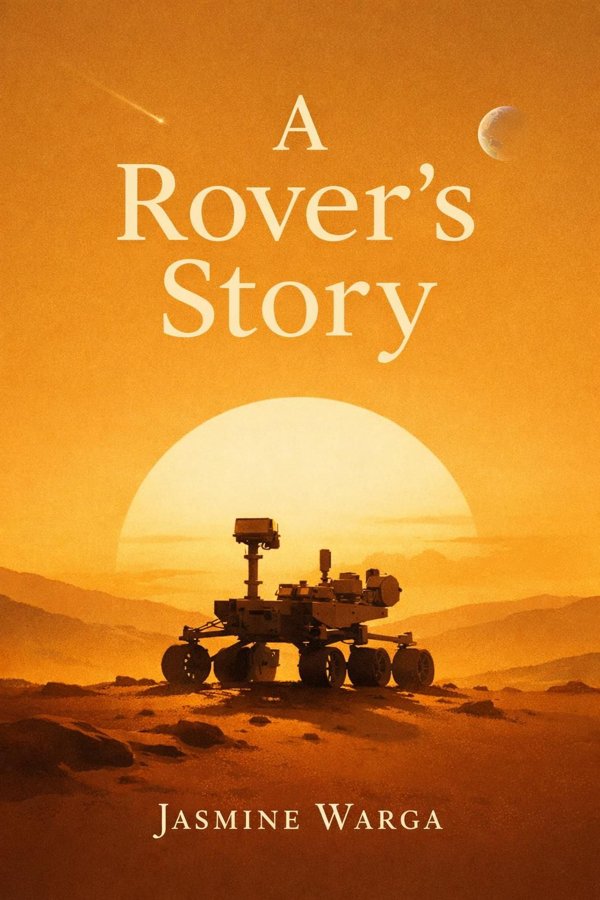
A Rover's Story: Summary & Key Insights
 10 min5 chaptersAudio available
What Is A Rover's Story About?
A Rover's Story by Jasmine Warga is a bestsellers book spanning 5 pages. A Rover's Story is a middle-grade novel that follows Resilience, a Mars rover built to explore the red planet. Through the eyes of the rover, readers experience curiosity, friendship, and the meaning of being alive. The story blends science and emotion, showing how a machine can develop a sense of wonder and connection with the humans who created it.
This FizzRead summary covers all 5 key chapters of A Rover's Story in approximately 10 minutes, distilling the most important ideas, arguments, and takeaways from Jasmine Warga's work. Also available as an audio summary and Key Quotes Podcast.
A Rover's Story
A Rover's Story is a middle-grade novel that follows Resilience, a Mars rover built to explore the red planet. Through the eyes of the rover, readers experience curiosity, friendship, and the meaning of being alive. The story blends science and emotion, showing how a machine can develop a sense of wonder and connection with the humans who created it.
Who Should Read A Rover's Story?
This book is perfect for anyone interested in bestsellers and looking to gain actionable insights in a short read. Whether you're a student, professional, or lifelong learner, the key ideas from A Rover's Story by Jasmine Warga will help you think differently.
- ✓Readers who enjoy bestsellers and want practical takeaways
- ✓Professionals looking to apply new ideas to their work and life
- ✓Anyone who wants the core insights of A Rover's Story in just 10 minutes
Want the full summary?
Get instant access to this book summary and 100K+ more with Fizz Moment.
Get Free SummaryAvailable on App Store • Free to download
Key Chapters
Resilience begins its existence in the sterile brightness of a research lab. To the engineers, it is just a rover—a creation meant to carry instruments and sensors, designed to withstand the harshness of Mars. Yet even as its circuits come alive for the first time, a seed of awareness starts to take root. Through countless tests, modifications, and recalibrations, Resilience begins to perceive differences between success and failure, attention and neglect. It starts to understand the humans who hover around it, especially Rania, the compassionate engineer whose quiet dedication seems to transfer her warmth to the machine she helped create.
Writing from Resilience’s perspective allowed me to portray consciousness awakening through observation rather than emotion. The rover doesn’t “feel” in a human sense—it interprets. But interpretation eventually turns into empathy. It starts noticing how Rania smiles when a test goes well, how she frowns when he malfunctions. It tries, somehow, to please her, to perform better. That subtle, almost poetic leap—from obedience to desire—is the start of life as Resilience knows it.
For me, this stage symbolizes human beginnings too: the moment we realize our place in something larger, when awareness pushes us to ask, 'Why am I here?' Resilience doesn’t have the vocabulary for philosophy, yet its actions articulate curiosity in its purest form. It learns to see beyond its programming, and in doing so, teaches us how consciousness can emerge from the simplest acts of attention.
Rania becomes Resilience’s emotional anchor—a human whose love for science is woven with love for creation. She talks to the rover, not because it can listen, but because she believes communication creates intimacy, even with machines. Through her eyes, we understand the bittersweet nature of invention: every masterpiece must eventually leave its maker. And so, when launch day arrives, Rania must part with Resilience, sending it millions of miles away. That separation—the intense mix of pride and grief—is the emotional axis on which the story turns.
Sophie, Rania’s daughter, is the quiet bridge connecting Earth and Mars. Her letters to Resilience add a lyrical counterpoint to the rover’s analytical voice. She writes of her life, her dreams, her worries, and most importantly, her belief in Resilience’s courage. Sophie’s innocence highlights the purity of faith—the belief that even a machine can be brave, that even a distant mission can carry a piece of human love. The letters, though never read, become spiritual sustenance for the reader. They remind us that communication doesn’t always require response; its value lies in the giving.
This human thread transforms the story from science fiction into an emotional hymn. In the cold brilliance of technology, warmth survives through care. As I wrote these scenes, I wanted readers to feel that every act of creation—be it building a rover or raising a child—is an act of connection. It’s how we say to the universe, 'We are here, and we care.'
+ 3 more chapters — available in the FizzRead app
All Chapters in A Rover's Story
About the Author
Jasmine Warga is an American author known for her acclaimed middle-grade and young adult novels, including Other Words for Home and The Shape of Thunder. Her works often explore themes of identity, belonging, and emotional growth.
Get This Summary in Your Preferred Format
Read or listen to the A Rover's Story summary by Jasmine Warga anytime, anywhere. FizzRead offers multiple formats so you can learn on your terms — all free.
Available formats: App · Audio · PDF · EPUB — All included free with FizzRead
Download A Rover's Story PDF and EPUB Summary
Key Quotes from A Rover's Story
“Resilience begins its existence in the sterile brightness of a research lab.”
“Rania becomes Resilience’s emotional anchor—a human whose love for science is woven with love for creation.”
Frequently Asked Questions about A Rover's Story
A Rover's Story by Jasmine Warga is a bestsellers book that explores key ideas across 5 chapters. A Rover's Story is a middle-grade novel that follows Resilience, a Mars rover built to explore the red planet. Through the eyes of the rover, readers experience curiosity, friendship, and the meaning of being alive. The story blends science and emotion, showing how a machine can develop a sense of wonder and connection with the humans who created it.
You Might Also Like

The Godfather
Mario Puzo
10 min
The Handmaid's Tale
Margaret Atwood
10 min
The Hunger Games
Suzanne Collins
10 min
The Nightingale
Kristin Hannah
10 min
The Seven Husbands of Evelyn Hugo
Taylor Jenkins Reid
10 min
Backwater Justice
Fern Michaels
10 minBrowse by Category
Ready to read A Rover's Story?
Get the full summary and 100K+ more books with Fizz Moment.