
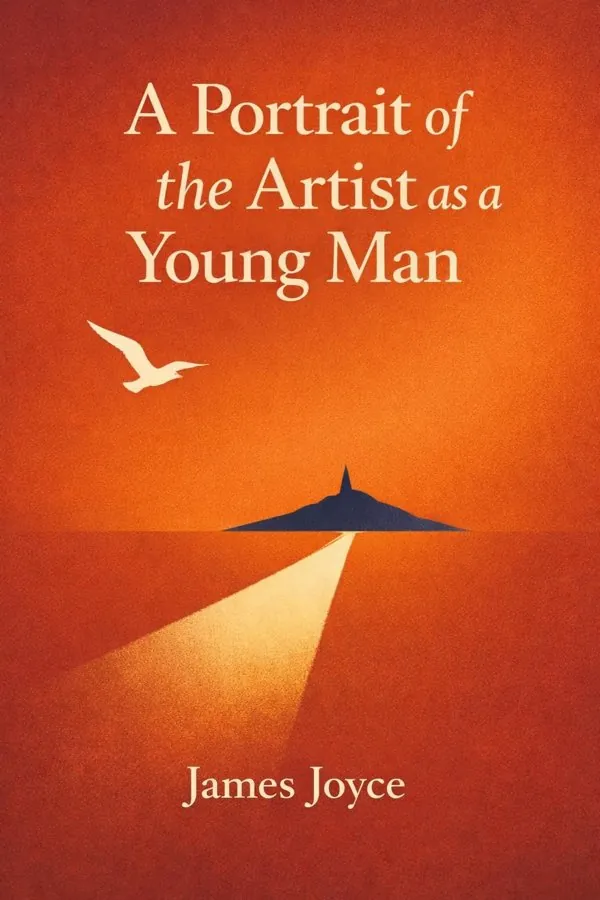
A Portrait of the Artist as a Young Man: Summary & Key Insights
by James Joyce
 10 min9 chaptersAudio available
Key Takeaways from A Portrait of the Artist as a Young Man
The first drama of life is not action but perception.
A family’s financial collapse does more than reduce comfort; it can rearrange a child’s understanding of dignity, class, and possibility.
Few experiences shape the self more deeply than being taught that your desires may endanger your soul.
Sometimes the strongest form of rebellion is not defiance but surrender.
A single moment of beauty can overturn an entire moral universe.
What Is A Portrait of the Artist as a Young Man About?
A Portrait of the Artist as a Young Man by James Joyce is a classics book spanning 6 pages. A Portrait of the Artist as a Young Man is James Joyce’s groundbreaking coming-of-age novel about the making of an artist—and the cost of becoming one. Following Stephen Dedalus from early childhood to young adulthood, the book traces how a sensitive, observant boy gradually struggles free from the forces that seek to define him: family expectations, Catholic doctrine, Irish nationalism, sexual guilt, poverty, and social conformity. Rather than telling this story in a conventional way, Joyce makes readers experience Stephen’s inner development through language that evolves with his age and awareness. The result is not just a novel about growing up, but a remarkable portrait of consciousness itself. The book matters because it captures a universal conflict with unusual intensity: how do you become yourself when every institution around you tells you who you should be? Stephen’s journey is deeply rooted in Ireland, yet his questions about identity, belief, art, and freedom still feel modern. Joyce, one of the most influential writers of the twentieth century, brings extraordinary authority to these themes through formal innovation, autobiographical insight, and unmatched attention to the life of the mind.
This FizzRead summary covers all 9 key chapters of A Portrait of the Artist as a Young Man in approximately 10 minutes, distilling the most important ideas, arguments, and takeaways from James Joyce's work. Also available as an audio summary and Key Quotes Podcast.
A Portrait of the Artist as a Young Man
A Portrait of the Artist as a Young Man is James Joyce’s groundbreaking coming-of-age novel about the making of an artist—and the cost of becoming one. Following Stephen Dedalus from early childhood to young adulthood, the book traces how a sensitive, observant boy gradually struggles free from the forces that seek to define him: family expectations, Catholic doctrine, Irish nationalism, sexual guilt, poverty, and social conformity. Rather than telling this story in a conventional way, Joyce makes readers experience Stephen’s inner development through language that evolves with his age and awareness. The result is not just a novel about growing up, but a remarkable portrait of consciousness itself.
The book matters because it captures a universal conflict with unusual intensity: how do you become yourself when every institution around you tells you who you should be? Stephen’s journey is deeply rooted in Ireland, yet his questions about identity, belief, art, and freedom still feel modern. Joyce, one of the most influential writers of the twentieth century, brings extraordinary authority to these themes through formal innovation, autobiographical insight, and unmatched attention to the life of the mind.
Who Should Read A Portrait of the Artist as a Young Man?
This book is perfect for anyone interested in classics and looking to gain actionable insights in a short read. Whether you're a student, professional, or lifelong learner, the key ideas from A Portrait of the Artist as a Young Man by James Joyce will help you think differently.
- ✓Readers who enjoy classics and want practical takeaways
- ✓Professionals looking to apply new ideas to their work and life
- ✓Anyone who wants the core insights of A Portrait of the Artist as a Young Man in just 10 minutes
Want the full summary?
Get instant access to this book summary and 100K+ more with Fizz Moment.
Get Free SummaryAvailable on App Store • Free to download
Key Chapters
The first drama of life is not action but perception. Joyce begins A Portrait of the Artist as a Young Man by showing Stephen Dedalus as a child immersed in fragments of sound, rhythm, fear, and sensation. The famous opening does not present a polished narrator looking back with clarity; instead, it places us inside the unstable texture of a child’s mind. This is one of the novel’s most radical achievements. We do not simply learn about Stephen’s childhood—we experience a consciousness still trying to organize the world.
At Clongowes Wood College, Stephen is small, physically vulnerable, and socially uncertain. He notices tiny humiliations, vague threats, and emotional shocks that adults might dismiss. A school punishment, a playground conflict, or a family argument becomes enormous because the child has not yet learned proportion. Joyce shows how identity forms through such impressions. Before Stephen has a philosophy, he has sensations; before he has convictions, he has wounds.
This idea matters beyond literature. Much of adult personality begins in these early encounters with power, belonging, shame, and approval. A child who feels different may become more observant. A child who feels exposed may develop inwardness as a refuge. Stephen’s artistic temperament emerges not from comfort but from acute sensitivity.
In practical terms, the novel invites readers to pay attention to the origins of their own responses. Why do certain spaces make you anxious? Why does authority affect you in a particular way? Why do some memories still feel physically alive? Reflection on early emotional patterns can reveal the roots of later values and ambitions.
Actionable takeaway: examine one vivid childhood memory and ask what it taught you about fear, belonging, or self-worth—because your present identity may still be shaped by that lesson.
Few experiences shape the self more deeply than being taught that your desires may endanger your soul. In one of the novel’s most powerful phases, Stephen enters adolescence and falls into sexual sin as defined by Catholic teaching. His visits to prostitutes are not presented simply as rebellion or pleasure; they trigger a devastating collision between bodily desire and religious fear. When he later hears sermons on hell, damnation, and judgment, the effect is overwhelming. Joyce renders guilt not as an abstract moral category but as a total psychic atmosphere.
Stephen’s crisis shows how moral systems gain power when they speak simultaneously to imagination, shame, and fear. The sermons terrify him because they give vivid form to his inward conflict. Suddenly, every act appears eternal in consequence. His body becomes a site of accusation. He is trapped between instinct and doctrine, appetite and punishment.
This section remains strikingly relevant because many people inherit versions of this conflict even outside religion. They may not fear hell, but they do fear unworthiness, contamination, failure, or exclusion. Cultural rules around sexuality, ambition, gender, or success can operate with the same internal force. The mind can become an echo chamber of condemnation.
Joyce does not mock spiritual seriousness; he shows how deeply it can structure inner life. But he also exposes the psychic cost of a morality rooted primarily in terror. Fear may produce obedience, but it rarely produces freedom or mature self-understanding.
A practical application is to distinguish between conscience and inherited panic. Conscience helps you act responsibly. Panic crushes judgment and makes self-reflection impossible. Stephen’s experience shows the danger of confusing the two.
Actionable takeaway: when guilt arises, ask whether it is guiding you toward repair and integrity—or merely reenacting old fear designed to keep you small.
Sometimes the strongest form of rebellion is not defiance but surrender. After his crisis of guilt, Stephen turns intensely toward religion. He confesses, repents, and embraces a life of spiritual discipline with great seriousness. For a time, he finds relief in obedience. Rules quiet inner chaos. Structure replaces temptation. The possibility of becoming a priest offers not only holiness but also order, prestige, and a defined role in the world.
Joyce treats this phase with psychological precision. Stephen is not hypocritical; he is genuinely drawn to devotion. Religious life promises clarity in a world that has become morally and socially unstable. It also offers a way to sublimate unruly desire into sacred purpose. In that sense, piety is appealing not just because of belief, but because it organizes identity.
Yet Stephen gradually perceives another danger: a life of complete submission may protect him from error while also preventing him from fully living. The priesthood would require him to accept a ready-made self. What first appears as salvation begins to feel like enclosure. He realizes that discipline can become another kind of prison when it suppresses vocation rather than serving it.
This insight applies well beyond religion. Many people are drawn to careers, ideologies, or communities that offer certainty during periods of confusion. The comfort is real. But a role that heals anxiety may still be wrong for one’s deepest nature. Safety and authenticity are not always the same.
The novel encourages discernment: are you choosing a path because it is truly yours, or because it spares you from ambiguity? Stephen’s near-embrace of religious life shows that not every meaningful opportunity is the right one.
Actionable takeaway: look closely at any path that feels reassuring and ask whether it expands your life—or merely protects you from the discomfort of becoming yourself.
A single moment of beauty can overturn an entire moral universe. Stephen’s famous vision of the girl wading at the seashore marks a turning point in the novel. He sees her not through the lens of sin or shame but through wonder, sensuality, and aesthetic rapture. This is not simply attraction. It is revelation. The world that religion had framed as temptation suddenly appears as radiance. Desire becomes linked with art rather than guilt.
What changes here is Stephen’s relationship to experience. He no longer wants merely to resist the world or submit to it; he wants to transform it through perception. Beauty gives him a new calling. The artist’s task, as he begins to imagine it, is to arrest moments of being, to hold what is fleeting and make it meaningful. In this sense, art becomes an alternative to both indulgence and renunciation. It is a disciplined way of honoring life’s intensity.
This awakening shows how vocation often emerges indirectly. It does not always arrive as a plan. Sometimes it comes as a feeling that a certain kind of encounter—music, language, image, landscape, a human face—reveals more reality than ordinary life allows. The person who notices such moments repeatedly may be discovering the shape of their calling.
For modern readers, this idea is highly practical. Creative life rarely begins with confidence or external permission. It begins with noticing what consistently awakens attention. What kinds of beauty make you feel more alive? What experiences return to your mind because they seem to ask for expression?
Stephen’s awakening suggests that art is not a luxury added after life is sorted out. For some people, it is the way life becomes legible.
Actionable takeaway: keep a record of moments that stir wonder, because repeated patterns of attention often point toward the work you are meant to do.
Artists are not made by emotion alone; they also need a language for what they value. As Stephen matures, he develops theories of art and beauty, especially in conversations with friends. These passages can seem abstract at first, but they are central to the novel’s design. Stephen is trying to build an intellectual framework that justifies his artistic life. He wants not only to feel intensely, but to understand why art matters and how it works.
His aesthetic thinking reflects a deeper need: to convert scattered experience into form. Throughout the novel, Stephen has been overwhelmed by sensation, guilt, desire, and social pressure. Theory becomes a tool of self-clarification. By defining beauty, analyzing art, and distinguishing proper artistic response from crude emotional reaction, he creates distance from chaos. Thinking becomes part of making.
This has practical relevance far beyond literary criticism. Anyone pursuing meaningful work eventually needs principles. Raw talent without reflection can remain inconsistent. A designer needs standards of clarity. A teacher needs a philosophy of learning. A leader needs a conception of justice. Art, in Joyce’s view, is not merely self-expression; it is the disciplined shaping of experience according to an inner order.
At the same time, Joyce subtly warns against turning theory into vanity. Stephen’s intelligence can become self-dramatizing. Ideas can illuminate vocation, but they can also become a shield against vulnerability and actual creation. Thinking about art is not the same as making it.
The lesson is to build a framework that sharpens practice rather than replacing it. Your principles should help you decide, refine, and persist. They should not become excuses for endless abstraction.
Actionable takeaway: write down three principles that define excellent work in your field, then use them this week to revise something real rather than merely admiring the principles themselves.
One of Joyce’s boldest insights is that a life cannot be understood apart from the language through which it is lived. In A Portrait of the Artist as a Young Man, style is not decorative; it is psychological. The prose changes as Stephen changes. Early sections echo a child’s sensory confusion and limited vocabulary. Later sections grow denser, more analytical, and more self-aware. This stylistic evolution allows the novel to dramatize development from within.
The effect is profound. Instead of reporting that Stephen becomes more intelligent or introspective, Joyce makes the reader feel the expansion of consciousness in real time. Language itself becomes evidence of growth. At the same time, the novel reveals a tension: as Stephen gains verbal sophistication, he also risks becoming more isolated, more mediated by thought, and more enclosed within his own perspective.
This idea matters because language shapes how we perceive ourselves. The words available to us influence what we can notice, name, and endure. A person with only blunt labels for emotion may live in confusion. A person who develops nuance gains freedom. The same applies in everyday life. Learning better language for grief, desire, resentment, beauty, or ambition can transform experience from something suffered passively into something understood and acted upon.
Joyce also reminds us to listen to how our own inner speech evolves. Do we still describe ourselves with inherited labels from childhood? Do we use vague clichés where precision is needed? Growth often requires linguistic change: a richer vocabulary, a more honest self-description, a more exact sense of what matters.
Actionable takeaway: notice one repeated phrase in your self-talk and revise it into something more precise, because changing language can be the first step toward changing identity.
Belonging can nourish a person, but it can also demand submission. Stephen grows up amid powerful collective claims: Catholic faith, Irish nationalism, family loyalty, and cultural expectation. Each offers meaning, history, and a sense of duty. Yet each also tries to tell him who he must be. Stephen’s response is not simple rejection of Ireland, but an increasingly urgent need for distance. He fears being trapped in the “nets” of nationality, religion, and language before he has discovered his own voice.
This tension gives the novel much of its political and emotional force. Stephen is shaped by Ireland at every level, yet feels he must leave it to create freely. Exile becomes both painful and necessary. Joyce portrays national identity as complex: it can inspire pride and solidarity, but it can also burden the individual with inherited conflicts. Stephen cannot become an artist merely by repeating collective slogans, even noble ones. He must pass through separation.
Many readers encounter a similar dilemma in less dramatic form. Family, nation, class, profession, and community all provide scripts for identity. These scripts may be valuable, but they become limiting when unquestioned. Maturity often requires some form of distance—geographic, emotional, intellectual, or spiritual—from what first formed us.
Distance does not always mean betrayal. Sometimes it is the only way to return honestly rather than mechanically. Stephen’s departure is an act of self-preservation, but also of artistic responsibility. He wants to encounter his culture as a creator, not merely as an obedient participant.
Actionable takeaway: identify one “net” in your life—an expectation you inherited without choosing—and test what happens when you step back from it long enough to hear your own convictions clearly.
The self is not discovered fully formed; it is forged through deliberate choices, often under conditions of uncertainty. By the end of the novel, Stephen embraces a life oriented toward artistic creation, accepting solitude, exile, and risk as part of that commitment. His closing declarations are not triumphant in a simplistic sense. They are charged with ambition, vulnerability, and a near-mythic determination to “forge” in the smithy of his soul the uncreated conscience of his race.
This image of forging is crucial. It suggests heat, labor, resistance, and craft. Identity is not a hidden essence waiting to be uncovered; it is something made. Stephen does not expect freedom to feel comfortable. He expects it to demand sacrifice. Leaving home, disappointing expectations, and entering uncertainty are presented as necessary costs of artistic seriousness.
This final movement speaks powerfully to anyone choosing a difficult but authentic path. Whether the goal is artistic, intellectual, entrepreneurial, or moral, the transition from inherited life to chosen life often feels like exile. Others may misunderstand. External validation may disappear. The future may remain unclear. Yet there is dignity in accepting these conditions when they serve genuine vocation.
Joyce does not offer easy reassurance that Stephen will succeed. The novel ends with becoming, not arrival. That is part of its honesty. To choose your path is not to guarantee greatness; it is to take responsibility for your own making.
Actionable takeaway: define one commitment that reflects your chosen self rather than your inherited self, and make a concrete move toward it now—even if that move feels lonely or uncertain.
All Chapters in A Portrait of the Artist as a Young Man
About the Author
James Joyce (1882–1941) was an Irish novelist, poet, and short story writer whose innovations reshaped modern literature. Born in Dublin, he drew heavily on Irish life, Catholic education, and his own experience of exile, transforming them into works of extraordinary psychological and stylistic depth. His major books include Dubliners, A Portrait of the Artist as a Young Man, Ulysses, and Finnegans Wake. Joyce is especially known for his experimental prose, interior monologue, and attention to the movement of consciousness. Though some of his work is famously challenging, his influence on twentieth-century fiction is immense. He remains a central figure in literary modernism and one of the most important writers in the English language.
Get This Summary in Your Preferred Format
Read or listen to the A Portrait of the Artist as a Young Man summary by James Joyce anytime, anywhere. FizzRead offers multiple formats so you can learn on your terms — all free.
Available formats: App · Audio · PDF · EPUB — All included free with FizzRead
Download A Portrait of the Artist as a Young Man PDF and EPUB Summary
Key Quotes from A Portrait of the Artist as a Young Man
“The first drama of life is not action but perception.”
“A family’s financial collapse does more than reduce comfort; it can rearrange a child’s understanding of dignity, class, and possibility.”
“Few experiences shape the self more deeply than being taught that your desires may endanger your soul.”
“Sometimes the strongest form of rebellion is not defiance but surrender.”
“A single moment of beauty can overturn an entire moral universe.”
Frequently Asked Questions about A Portrait of the Artist as a Young Man
A Portrait of the Artist as a Young Man by James Joyce is a classics book that explores key ideas across 9 chapters. A Portrait of the Artist as a Young Man is James Joyce’s groundbreaking coming-of-age novel about the making of an artist—and the cost of becoming one. Following Stephen Dedalus from early childhood to young adulthood, the book traces how a sensitive, observant boy gradually struggles free from the forces that seek to define him: family expectations, Catholic doctrine, Irish nationalism, sexual guilt, poverty, and social conformity. Rather than telling this story in a conventional way, Joyce makes readers experience Stephen’s inner development through language that evolves with his age and awareness. The result is not just a novel about growing up, but a remarkable portrait of consciousness itself. The book matters because it captures a universal conflict with unusual intensity: how do you become yourself when every institution around you tells you who you should be? Stephen’s journey is deeply rooted in Ireland, yet his questions about identity, belief, art, and freedom still feel modern. Joyce, one of the most influential writers of the twentieth century, brings extraordinary authority to these themes through formal innovation, autobiographical insight, and unmatched attention to the life of the mind.
More by James Joyce
You Might Also Like

Browse by Category
Ready to read A Portrait of the Artist as a Young Man?
Get the full summary and 100K+ more books with Fizz Moment.