
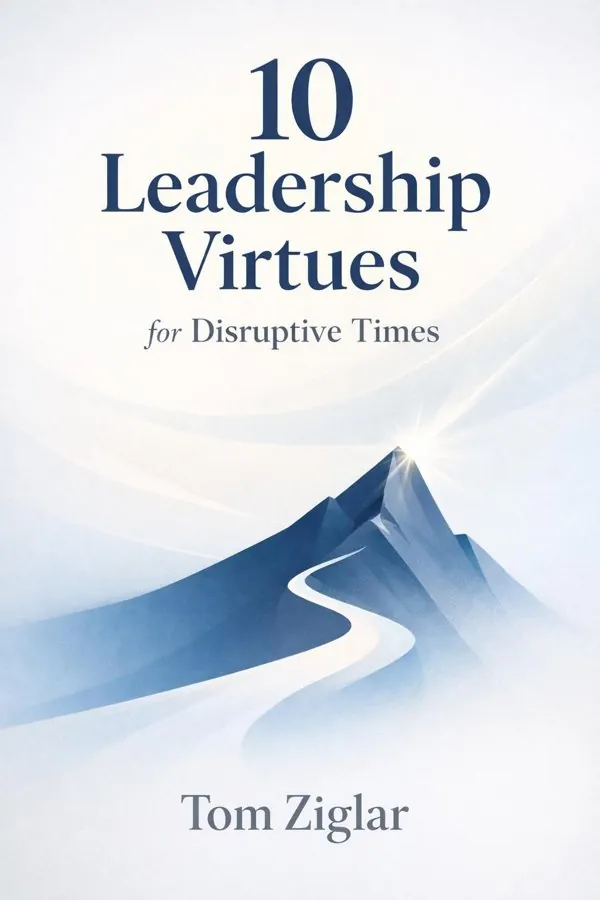
10 Leadership Virtues for Disruptive Times: Coaching Leaders to Thrive in the New Reality: Summary & Key Insights
by Tom Ziglar
 10 min9 chaptersAudio available
Key Takeaways from 10 Leadership Virtues for Disruptive Times: Coaching Leaders to Thrive in the New Reality
The greatest danger in disruptive times is not change itself, but allowing change to define you.
In stable times, people appreciate integrity; in chaotic times, they depend on it.
Leadership often breaks down when ego takes over.
Disruption tempts leaders to lower standards in the name of survival.
When the future feels foggy, people do not need false certainty; they need meaningful direction.
What Is 10 Leadership Virtues for Disruptive Times: Coaching Leaders to Thrive in the New Reality About?
10 Leadership Virtues for Disruptive Times: Coaching Leaders to Thrive in the New Reality by Tom Ziglar is a leadership book spanning 11 pages. Disruption exposes the true quality of leadership. When markets shift overnight, teams feel exhausted, and certainty disappears, technical skill alone is not enough. In 10 Leadership Virtues for Disruptive Times, Tom Ziglar argues that leaders endure chaos not by controlling every variable, but by developing inner qualities that guide wise action under pressure. The book outlines ten virtues—ranging from identity and integrity to resilience, self-discipline, and hope—that help leaders remain steady, trustworthy, and effective in a fast-changing world. What makes this book especially useful is its blend of principle and practice. Ziglar does not present leadership as a title or a personality style. He treats it as a daily discipline rooted in character. That perspective is timely for leaders facing cultural change, economic uncertainty, digital transformation, and rising expectations from employees and customers alike. Tom Ziglar brings unusual authority to the subject. As CEO of Ziglar, Inc., and the son of legendary teacher Zig Ziglar, he combines a values-based leadership tradition with practical coaching experience. The result is a concise but thoughtful guide for leaders who want to thrive without losing their integrity, purpose, or humanity.
This FizzRead summary covers all 9 key chapters of 10 Leadership Virtues for Disruptive Times: Coaching Leaders to Thrive in the New Reality in approximately 10 minutes, distilling the most important ideas, arguments, and takeaways from Tom Ziglar's work. Also available as an audio summary and Key Quotes Podcast.
10 Leadership Virtues for Disruptive Times: Coaching Leaders to Thrive in the New Reality
Disruption exposes the true quality of leadership. When markets shift overnight, teams feel exhausted, and certainty disappears, technical skill alone is not enough. In 10 Leadership Virtues for Disruptive Times, Tom Ziglar argues that leaders endure chaos not by controlling every variable, but by developing inner qualities that guide wise action under pressure. The book outlines ten virtues—ranging from identity and integrity to resilience, self-discipline, and hope—that help leaders remain steady, trustworthy, and effective in a fast-changing world.
What makes this book especially useful is its blend of principle and practice. Ziglar does not present leadership as a title or a personality style. He treats it as a daily discipline rooted in character. That perspective is timely for leaders facing cultural change, economic uncertainty, digital transformation, and rising expectations from employees and customers alike.
Tom Ziglar brings unusual authority to the subject. As CEO of Ziglar, Inc., and the son of legendary teacher Zig Ziglar, he combines a values-based leadership tradition with practical coaching experience. The result is a concise but thoughtful guide for leaders who want to thrive without losing their integrity, purpose, or humanity.
Who Should Read 10 Leadership Virtues for Disruptive Times: Coaching Leaders to Thrive in the New Reality?
This book is perfect for anyone interested in leadership and looking to gain actionable insights in a short read. Whether you're a student, professional, or lifelong learner, the key ideas from 10 Leadership Virtues for Disruptive Times: Coaching Leaders to Thrive in the New Reality by Tom Ziglar will help you think differently.
- ✓Readers who enjoy leadership and want practical takeaways
- ✓Professionals looking to apply new ideas to their work and life
- ✓Anyone who wants the core insights of 10 Leadership Virtues for Disruptive Times: Coaching Leaders to Thrive in the New Reality in just 10 minutes
Want the full summary?
Get instant access to this book summary and 100K+ more with Fizz Moment.
Get Free SummaryAvailable on App Store • Free to download
Key Chapters
The greatest danger in disruptive times is not change itself, but allowing change to define you. When leaders are surrounded by uncertainty, it becomes easy to measure themselves by quarterly numbers, public opinion, or the latest crisis. Ziglar begins with identity and purpose because leadership collapses when a person no longer knows who they are or why they lead. A strong identity anchors behavior, while purpose gives hardship meaning.
In the book’s framework, identity is not based on title, status, or external success. It is rooted in values, convictions, and a clear understanding of the kind of leader you intend to be. Purpose then directs that identity outward. It answers questions such as: Who do I serve? What problem am I called to solve? What kind of impact do I want my leadership to have on people? Leaders who can answer those questions are much less likely to panic when conditions change.
This matters in practical settings. A company facing layoffs, a nonprofit adjusting to funding cuts, or a school leader navigating rapid policy shifts all need more than strategy. They need a stable center. If a leader knows that their purpose is to serve people, create value, and act with courage, they can make difficult decisions without becoming reactive or cynical.
Ziglar’s deeper point is that purpose transforms disruption from a threat into a test of alignment. Instead of asking, “How do I protect my image?” leaders ask, “How do I stay faithful to my mission?” That shift produces clarity, steadiness, and trust.
Actionable takeaway: Write a one-sentence leadership purpose statement and review it before major decisions so your identity stays anchored in values, not volatility.
In stable times, people appreciate integrity; in chaotic times, they depend on it. Ziglar presents integrity as the soul of leadership because it creates confidence when everything else feels uncertain. Teams can survive bad news, difficult transitions, and imperfect plans, but they struggle to follow leaders who appear evasive, inconsistent, or self-protective.
Integrity means alignment between words, values, and actions. It is not simply honesty in speech, but reliability in character. Leaders with integrity do what they say they will do. They admit mistakes. They resist the temptation to manipulate information for short-term advantage. In disruptive environments, where misinformation spreads quickly and emotions run high, this consistency becomes a stabilizing force.
Consider a leader managing a major organizational restructure. An integrity-driven approach does not require pretending everything is fine. It requires transparent communication, respectful treatment of employees, and a willingness to explain decisions even when the answers are uncomfortable. Similarly, in customer-facing businesses, integrity appears in how organizations respond to service failures. Do they hide behind fine print, or do they take responsibility and make things right?
Ziglar also implies that integrity protects leaders from themselves. During stressful periods, it is easy to rationalize shortcuts: exaggerating progress, blaming others, or making promises that cannot be kept. Integrity draws a line leaders refuse to cross. That moral clarity reduces internal conflict and strengthens long-term credibility.
A leader may not control outcomes, but they can control trustworthiness. Over time, integrity compounds. Teams become more willing to follow, partners become more willing to collaborate, and organizations build reputations that endure beyond a single crisis.
Actionable takeaway: Identify one area where your actions and stated values are not fully aligned, and correct it this week through a concrete, visible change.
Leadership often breaks down when ego takes over. Ziglar’s virtues of humility, gratitude, and generosity work together to keep leaders grounded, relational, and effective. These qualities may sound soft compared with strategy and execution, but in disruptive times they become deeply practical. Teams do not merely need direction; they need leaders who create trust, dignity, and mutual commitment.
Humility allows a leader to keep learning. It means recognizing that no one has complete visibility during periods of disruption. Humble leaders ask questions, listen carefully, and adjust when new evidence appears. They do not confuse confidence with infallibility. This is crucial in a fast-changing environment, where yesterday’s expertise can quickly become outdated.
Gratitude shifts attention from scarcity to value. Instead of leading from frustration, grateful leaders notice progress, recognize effort, and reinforce what is working. A simple acknowledgment of a team’s resilience during a demanding quarter can restore morale. Gratitude also prevents entitlement, helping leaders remain aware that success is never a solo accomplishment.
Generosity turns leadership outward. It is the habit of giving time, encouragement, credit, and opportunity. In an organizational setting, generosity may mean mentoring emerging talent, sharing information freely, or investing in employee development even during uncertain times. It does not mean avoiding standards. It means using influence to help others grow rather than merely advancing personal status.
Together, these virtues humanize leadership. A humble leader learns faster. A grateful leader energizes people. A generous leader builds loyalty. In practical terms, this can look like inviting frontline staff into problem-solving sessions, publicly recognizing contributors, and giving meaningful ownership rather than hoarding authority.
Actionable takeaway: In your next team meeting, ask one sincere question, express one specific appreciation, and offer one concrete form of support to someone else’s growth.
Disruption tempts leaders to lower standards in the name of survival. Ziglar argues the opposite: difficult seasons make excellence more necessary, not less. Excellence is not perfectionism, image management, or constant overwork. It is the disciplined commitment to doing what matters well, especially when circumstances make mediocrity feel acceptable.
This virtue matters because chaos creates drift. Processes weaken, communication becomes rushed, and attention fragments. Without a standard of excellence, organizations begin making avoidable mistakes. Leaders then spend more time reacting to preventable problems than moving toward meaningful goals. Excellence restores intentionality. It asks: What are the few things we must do with high quality no matter how turbulent the environment becomes?
Ziglar’s approach is practical. Excellence starts with preparation, personal responsibility, and consistency in ordinary tasks. A leader demonstrates excellence by arriving prepared, communicating clearly, following up reliably, and refusing to treat people carelessly. It also means encouraging systems that support quality rather than relying only on heroic effort.
For example, a healthcare manager in a staffing shortage cannot eliminate pressure, but can maintain excellence through clear protocols, efficient handoffs, and regular check-ins that reduce errors. A startup leader can pursue excellence by defining priorities, improving customer response standards, and holding the team accountable for execution without creating panic.
Excellence also influences culture. When leaders excuse sloppiness, the organization absorbs that message. When they calmly insist on clear thinking, responsible action, and continual improvement, people rise to meet the expectation. In this sense, excellence becomes both a personal virtue and an organizational multiplier.
Actionable takeaway: Choose one recurring responsibility where standards have slipped, define what excellent performance looks like, and install one system or habit that makes that standard easier to maintain.
When the future feels foggy, people do not need false certainty; they need meaningful direction. Ziglar treats vision as a virtue because it is more than forecasting trends or setting goals. Vision is the ability to see beyond immediate disruption and help others understand what the organization is moving toward and why it matters.
Without vision, disruption becomes exhausting. Teams can handle hard work if they believe it leads somewhere worthwhile. They struggle when every day feels reactive and disconnected. A leader with vision creates coherence. They connect today’s sacrifices to tomorrow’s possibilities. They name what must change, what must stay constant, and what success will look like on the other side of transition.
Importantly, vision is not fantasy. Ziglar’s emphasis suggests that strong vision is both principled and practical. It is rooted in reality, but not imprisoned by it. For example, a business facing digital disruption may cast a vision not merely of surviving technology change, but of becoming more responsive, innovative, and customer-centered. A school leader in a shifting educational landscape might frame the future around better student support, stronger teaching practices, and a healthier culture rather than simply reacting to policy mandates.
Vision also helps leaders prioritize. In complex environments, everything can seem urgent. A clear picture of the future allows leaders to say no to distractions and yes to strategically important work. It aligns teams, resources, and decisions.
The deeper insight is that vision is a gift leaders give others. It transforms uncertainty from an empty space into a path. Even if every detail is unknown, people can move with confidence when they understand the destination and the values guiding the journey.
Actionable takeaway: Describe your desired future in three clear sentences and share it with your team in language that connects present action to long-term purpose.
Leadership is tested less by one dramatic moment than by repeated pressure over time. Ziglar’s pairing of resilience and self-discipline shows that thriving in disruption requires both emotional endurance and behavioral consistency. Resilience helps leaders recover; self-discipline helps them stay on course. One prevents collapse, the other prevents drift.
Resilience is not denial or endless toughness. It is the ability to absorb setbacks, adapt, and keep moving without losing heart. Resilient leaders do not pretend difficulty is easy. They acknowledge pain, disappointment, and uncertainty while refusing to be defined by them. This matters when projects fail, markets shift, or teams experience burnout. Recovery becomes a leadership responsibility.
Self-discipline gives resilience structure. It is the habit of doing what is necessary even when motivation is low. In practice, that may mean keeping commitments, protecting time for strategic thinking, maintaining healthy routines, and resisting impulsive reactions. During disruption, disciplined leaders are less likely to chase every new trend or make fear-based decisions.
Consider a leader whose organization loses a major client. Resilience allows them to process the setback without spiraling into despair. Self-discipline helps them reassess finances, communicate with the team, follow a recovery plan, and continue prospecting rather than freezing. Similarly, in personal leadership, resilience may involve mental recovery practices, while self-discipline ensures daily habits such as exercise, reading, reflection, and focused work continue.
Ziglar’s message is that endurance is trainable. Leaders become stronger not only through major breakthroughs, but through repeated acts of disciplined recovery. Over time, these virtues create credibility because others see a leader who remains steady without becoming rigid.
Actionable takeaway: Build a personal resilience routine with one recovery habit and one discipline habit you will practice every day for the next 30 days.
Hope is often misunderstood as wishful thinking, but Ziglar presents it as a strategic leadership force. In disruptive times, people borrow emotional cues from those who lead them. If a leader communicates only fear, fatigue, or cynicism, the team’s energy weakens. Hope, by contrast, creates forward motion. It tells people that although the path is hard, meaningful progress is still possible.
This kind of hope is not naive optimism. It does not deny risk or minimize pain. Instead, it combines realism with confidence in purpose, effort, and possibility. Hopeful leaders tell the truth about current conditions while refusing to let present difficulty become the final story. That balance matters because empty positivity quickly loses credibility, while relentless negativity destroys initiative.
In practical terms, hope shows up in language, expectations, and behavior. A hopeful leader celebrates small wins, points to evidence of growth, and reminds people of the mission. They help teams interpret setbacks as temporary and instructive rather than permanent and defeating. In a struggling business, that may mean showing how changes are beginning to improve customer retention. In a nonprofit under stress, it may mean reconnecting staff to the impact of their work despite funding pressures.
Hope also strengthens courage. People are more willing to experiment, innovate, and persevere when they believe effort can matter. This is especially important in disruptive environments, where adaptation requires emotional stamina as much as technical skill.
Ziglar suggests that hope is not a decorative virtue added at the end. It is what keeps all the others alive. Purpose, integrity, discipline, and resilience are far easier to sustain when leaders believe the future can still be shaped for the better.
Actionable takeaway: In your next communication, name one hard truth, one real reason for confidence, and one specific next step that moves people toward a better future.
One of the book’s most important themes is that leadership is not fundamentally about authority; it is about character expressed through influence. Titles may grant power, but virtues determine whether that power builds trust or erodes it. Ziglar’s ten virtues collectively argue that the deepest leadership advantage in disruptive times is not superior control, but superior character.
This idea matters because disruption often reveals the difference between positional leadership and real leadership. When systems are stable, weak character can remain hidden behind structure, process, or momentum. But during crisis, people quickly see whether a leader is grounded, honest, humble, disciplined, and hopeful. Character becomes visible under pressure.
The practical implication is significant. Organizations often invest heavily in strategy, tools, and process while underinvesting in the moral and relational formation of leaders. Yet a brilliant strategy implemented by a self-serving or erratic leader can cause enormous damage. By contrast, a character-centered leader can guide a team through ambiguity even without perfect information.
Examples appear everywhere. The manager who takes responsibility instead of assigning blame earns more loyalty than the one who hides behind hierarchy. The executive who listens before deciding often uncovers better solutions than the one who assumes authority equals wisdom. The entrepreneur who serves customers and employees with integrity builds a more durable company than the one chasing visibility alone.
Ziglar’s model reminds readers that leadership development is not merely skill acquisition. It is personal formation. Leaders must become the kinds of people others can trust in unstable times. That requires reflection, accountability, and the humility to keep growing.
Actionable takeaway: Ask three trusted people which virtue they most experience from you and which one they least experience, then use their feedback to guide your next stage of leadership growth.
A virtue is only powerful when it moves from admiration to application. Ziglar’s coaching-oriented approach makes the book more than a list of ideals. He frames leadership virtues as trainable habits that can be practiced, assessed, and reinforced over time. This is especially valuable because many leaders know what good leadership looks like in theory but struggle to embody it consistently under pressure.
The coaching framework implied throughout the book encourages leaders to examine themselves honestly. Where am I drifting? Which virtue is strongest in me right now? Which one breaks down when I am stressed? These questions turn abstract character traits into practical development goals. A leader may discover, for instance, that they have strong vision but weak patience, or high standards but low gratitude. That awareness creates a starting point for growth.
Coaching also emphasizes repetition. Leaders do not become resilient by reading about resilience once. They become resilient by practicing recovery, reflection, and disciplined action after setbacks. They do not become hopeful by liking the idea of hope. They become hopeful by learning how to communicate truth and possibility at the same time. Teams can support this process through regular reflection, feedback loops, and shared language around values.
In organizations, this framework can be integrated into one-on-ones, performance conversations, team debriefs, and succession planning. Instead of evaluating leaders only by output, companies can ask how they lead: Do they show integrity? Do they create clarity? Do they develop others generously? This broadens leadership development from metrics alone to character-informed effectiveness.
Ziglar’s larger contribution is to make virtue actionable. He gives leaders a language for personal examination and a pathway for consistent improvement.
Actionable takeaway: Pick one virtue to focus on for the next month, define one daily behavior that expresses it, and review your progress weekly with a coach, mentor, or trusted peer.
All Chapters in 10 Leadership Virtues for Disruptive Times: Coaching Leaders to Thrive in the New Reality
About the Author
Tom Ziglar is the CEO of Ziglar, Inc., where he carries forward the leadership and personal development legacy of his father, Zig Ziglar. An author, speaker, and executive coach, Tom focuses on helping individuals and organizations grow through values-based leadership, personal discipline, and purposeful action. His work emphasizes that lasting success is built not only on performance, but on character, trust, and service. Through keynote speaking, business training, and leadership coaching, he has worked with teams and leaders seeking practical ways to improve culture and results. In his writing, Tom combines motivational clarity with actionable guidance, making timeless principles relevant for modern challenges such as disruption, uncertainty, and organizational change.
Get This Summary in Your Preferred Format
Read or listen to the 10 Leadership Virtues for Disruptive Times: Coaching Leaders to Thrive in the New Reality summary by Tom Ziglar anytime, anywhere. FizzRead offers multiple formats so you can learn on your terms — all free.
Available formats: App · Audio · PDF · EPUB — All included free with FizzRead
Download 10 Leadership Virtues for Disruptive Times: Coaching Leaders to Thrive in the New Reality PDF and EPUB Summary
Key Quotes from 10 Leadership Virtues for Disruptive Times: Coaching Leaders to Thrive in the New Reality
“The greatest danger in disruptive times is not change itself, but allowing change to define you.”
“In stable times, people appreciate integrity; in chaotic times, they depend on it.”
“Leadership often breaks down when ego takes over.”
“Disruption tempts leaders to lower standards in the name of survival.”
“When the future feels foggy, people do not need false certainty; they need meaningful direction.”
Frequently Asked Questions about 10 Leadership Virtues for Disruptive Times: Coaching Leaders to Thrive in the New Reality
10 Leadership Virtues for Disruptive Times: Coaching Leaders to Thrive in the New Reality by Tom Ziglar is a leadership book that explores key ideas across 9 chapters. Disruption exposes the true quality of leadership. When markets shift overnight, teams feel exhausted, and certainty disappears, technical skill alone is not enough. In 10 Leadership Virtues for Disruptive Times, Tom Ziglar argues that leaders endure chaos not by controlling every variable, but by developing inner qualities that guide wise action under pressure. The book outlines ten virtues—ranging from identity and integrity to resilience, self-discipline, and hope—that help leaders remain steady, trustworthy, and effective in a fast-changing world. What makes this book especially useful is its blend of principle and practice. Ziglar does not present leadership as a title or a personality style. He treats it as a daily discipline rooted in character. That perspective is timely for leaders facing cultural change, economic uncertainty, digital transformation, and rising expectations from employees and customers alike. Tom Ziglar brings unusual authority to the subject. As CEO of Ziglar, Inc., and the son of legendary teacher Zig Ziglar, he combines a values-based leadership tradition with practical coaching experience. The result is a concise but thoughtful guide for leaders who want to thrive without losing their integrity, purpose, or humanity.
You Might Also Like

Extreme Ownership
Jocko Willink
10 min
Dare to Lead
Brene Brown
10 min
Leaders Eat Last
Simon Sinek
10 min
The 21 Irrefutable Laws of Leadership
John Maxwell
10 min
Start With Why
Simon Sinek
10 min
How to Lead When You're Not in Charge
Clay Scroggins
10 minFeatured In
Browse by Category
Ready to read 10 Leadership Virtues for Disruptive Times: Coaching Leaders to Thrive in the New Reality?
Get the full summary and 100K+ more books with Fizz Moment.