
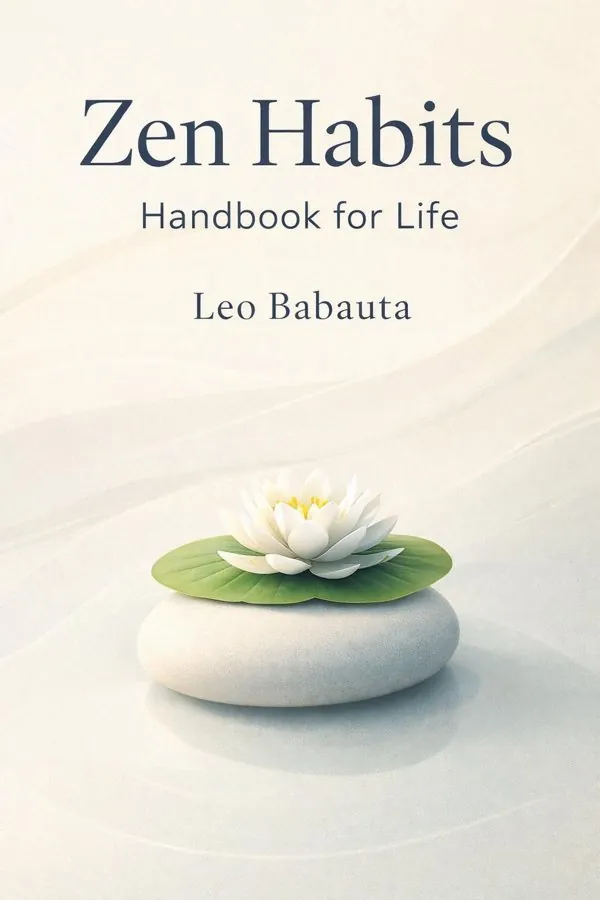
Zen Habits: Handbook for Life: Summary & Key Insights
by Leo Babauta
 10 min9 chaptersAudio available
Key Takeaways from Zen Habits: Handbook for Life
One of the most uncomfortable truths about modern life is that busyness can feel safer than stillness.
Simplicity is not merely about owning fewer things or having a cleaner calendar.
Many people feel exhausted not because life is inherently overwhelming, but because they have built a daily structure that demands too much.
A remarkable amount of life is lost not because time disappears, but because attention does.
People often fail at change because they aim for a new identity overnight.
What Is Zen Habits: Handbook for Life About?
Zen Habits: Handbook for Life by Leo Babauta is a habits book spanning 12 pages. Zen Habits: Handbook for Life is a practical guide to living with less stress, less clutter, and more intention. In this concise but influential work, Leo Babauta explores how modern life pulls us into constant busyness, distraction, and emotional overload, then shows how simplicity can become a powerful antidote. Rather than offering dramatic life overhauls, Babauta focuses on small, repeatable changes: clearing physical and mental clutter, building mindful routines, focusing on what matters most, and learning to be fully present in ordinary moments. The book matters because it addresses a problem that feels universal: many people are exhausted not because life is meaningful, but because it is crowded. Babauta’s approach is accessible, gentle, and realistic. He writes not as a distant expert, but as someone who transformed his own habits, health, finances, and daily life through simplicity and consistency. As the creator of the widely read Zen Habits blog, he brings lived experience and practical wisdom to the topic. This book is especially valuable for readers who want calm and clarity without adopting rigid systems or extreme self-discipline.
This FizzRead summary covers all 9 key chapters of Zen Habits: Handbook for Life in approximately 10 minutes, distilling the most important ideas, arguments, and takeaways from Leo Babauta's work. Also available as an audio summary and Key Quotes Podcast.
Zen Habits: Handbook for Life
Zen Habits: Handbook for Life is a practical guide to living with less stress, less clutter, and more intention. In this concise but influential work, Leo Babauta explores how modern life pulls us into constant busyness, distraction, and emotional overload, then shows how simplicity can become a powerful antidote. Rather than offering dramatic life overhauls, Babauta focuses on small, repeatable changes: clearing physical and mental clutter, building mindful routines, focusing on what matters most, and learning to be fully present in ordinary moments. The book matters because it addresses a problem that feels universal: many people are exhausted not because life is meaningful, but because it is crowded. Babauta’s approach is accessible, gentle, and realistic. He writes not as a distant expert, but as someone who transformed his own habits, health, finances, and daily life through simplicity and consistency. As the creator of the widely read Zen Habits blog, he brings lived experience and practical wisdom to the topic. This book is especially valuable for readers who want calm and clarity without adopting rigid systems or extreme self-discipline.
Who Should Read Zen Habits: Handbook for Life?
This book is perfect for anyone interested in habits and looking to gain actionable insights in a short read. Whether you're a student, professional, or lifelong learner, the key ideas from Zen Habits: Handbook for Life by Leo Babauta will help you think differently.
- ✓Readers who enjoy habits and want practical takeaways
- ✓Professionals looking to apply new ideas to their work and life
- ✓Anyone who wants the core insights of Zen Habits: Handbook for Life in just 10 minutes
Want the full summary?
Get instant access to this book summary and 100K+ more with Fizz Moment.
Get Free SummaryAvailable on App Store • Free to download
Key Chapters
One of the most uncomfortable truths about modern life is that busyness can feel safer than stillness. When every hour is packed with tasks, messages, errands, and obligations, we rarely have to face what is happening beneath the surface. Leo Babauta argues that stress is not caused only by a full calendar. It is often fueled by fear: fear of falling behind, disappointing others, missing opportunities, or feeling unimportant. In that sense, busyness becomes both a habit and a shield.
This insight matters because many people try to solve overwhelm by becoming more efficient, when the deeper issue is not efficiency but excess. If your life is overloaded with commitments that do not reflect your values, no productivity tool will bring peace. Babauta invites readers to pause and ask hard questions: Why do I keep saying yes? Why do I need to check my phone constantly? Why does doing nothing make me uncomfortable? These questions reveal that the problem is rarely just time management.
A practical application is to track your day and notice not only what you do, but why you do it. Do you open email to handle important communication, or to avoid a difficult project? Do you overcommit because you care, or because you fear judgment? Even ten minutes of quiet reflection can expose patterns that normally remain hidden.
Babauta’s message is not to reject responsibility, but to stop confusing frantic motion with a meaningful life. Awareness comes first. Action follows.
Actionable takeaway: For one week, identify three moments each day when you feel rushed or stressed, and write down the fear, expectation, or habit that may be driving that feeling.
Simplicity is not merely about owning fewer things or having a cleaner calendar. Without a clear sense of what matters, reducing your life can become empty rather than liberating. Babauta emphasizes that true simplicity is selective. It asks you to remove what is nonessential so you can devote more energy to what is deeply important. That requires knowing your values.
Core values are the principles and priorities that give shape to your days. They might include family, health, meaningful work, service, creativity, freedom, presence, or learning. The challenge is that many people live by inherited priorities rather than chosen ones. They spend their best attention on urgent requests, social expectations, and digital noise, while their real values remain abstract and neglected.
Babauta encourages readers to narrow their focus. Instead of claiming that everything matters, identify a small number of guiding values and use them to evaluate decisions. For example, if health is a core value, your routines should protect sleep, movement, and food choices. If relationships matter most, your schedule should allow for undistracted time with loved ones. If meaningful work is central, deep focus must replace constant multitasking.
This approach can transform ordinary choices. You decline meetings that do not matter. You reduce commitments that drain energy. You stop organizing your life around external approval. Simplicity becomes purposeful rather than aesthetic.
Actionable takeaway: Write down your top three values, then review your calendar and task list. Remove or reduce one regular activity that does not support any of those values.
Many people feel exhausted not because life is inherently overwhelming, but because they have built a daily structure that demands too much. Babauta argues that simplicity is created through subtraction. The more commitments, errands, decisions, and obligations you pile into your day, the less room you have for calm, attention, and joy. A simpler life is not accidental; it is designed.
This begins with commitments. Every promise you make, whether to work, friends, family, organizations, or yourself, carries hidden costs in time and mental energy. Babauta recommends becoming more selective about what you agree to. If you automatically say yes to every request, your schedule will always belong to other people. Learning to decline with kindness is a form of self-respect.
Routines matter just as much. Decision fatigue drains focus, especially in the morning and evening when your day is either beginning chaotically or ending without closure. Simple routines reduce friction. A morning ritual might include waking at the same time, drinking water, sitting quietly for five minutes, and identifying the day’s single most important task. An evening ritual might include tidying one space, reviewing tomorrow’s priorities, and shutting off screens at a consistent hour.
The goal is not a perfectly optimized life. It is a life with fewer moving parts, fewer unnecessary decisions, and fewer self-created pressures. When routines are simple and commitments are aligned, your mind becomes less scattered.
Actionable takeaway: Choose one area to simplify this week: your meetings, your errands, your morning routine, or your social obligations. Eliminate, combine, or automate at least two recurring demands.
A remarkable amount of life is lost not because time disappears, but because attention does. Babauta’s philosophy rests on a simple but powerful idea: peace is available now, but only if you are present enough to notice it. Mindfulness is not treated as an abstract spiritual concept in this book. It is a practical method for reducing reactivity, appreciating daily experience, and interrupting habits of distraction.
To be mindful is to return your attention to what is happening right now: the breath, the body, the task in front of you, the person speaking, the sound of rain, the feeling of walking. This sounds simple, yet most people live in a constant state of mental fragmentation. They eat while scrolling, work while checking messages, and spend conversations preparing their next response. The result is not just inefficiency, but a subtle sense of disconnection.
Babauta shows that mindfulness can be woven into ordinary activities. Washing dishes can become a pause rather than a chore. Drinking tea can become a moment of calm. Walking to your car can become a reset. Even frustration becomes easier to handle when you notice it as a passing mental event rather than immediately reacting.
This practice has practical consequences. You are more patient with others, less impulsive online, and more capable of noticing when stress is building. Mindfulness also supports simplicity, because it reveals how often craving, anxiety, and restlessness drive unnecessary action.
Actionable takeaway: Pick one routine activity you already do every day, such as brushing your teeth, making coffee, or walking outside, and practice doing it with full attention for one week.
People often fail at change because they aim for a new identity overnight. Babauta offers a gentler and more durable path: start small, make the habit easy, and repeat it until it becomes part of who you are. This principle is central to the Zen Habits approach. Transformation does not require heroic willpower. It requires consistency at a scale that feels almost too manageable to refuse.
The logic is straightforward. Large goals trigger resistance. If you decide to exercise for an hour every day, meditate for thirty minutes, declutter the whole house, and stop all distractions at once, your motivation may spike briefly but collapse under the weight of unrealistic expectations. Small habits bypass that cycle. One push-up can begin a fitness practice. Two minutes of meditation can begin mindfulness. Writing one paragraph can restart a creative life.
Babauta also emphasizes linking habits to existing routines and creating an environment that supports follow-through. If you want to read more, place a book by your bed. If you want to meditate, sit in the same chair each morning. If you want to eat better, prepare simple default meals. Progress comes from reducing friction, not constantly fighting yourself.
Importantly, small habits are not small in effect. Repeated over time, they reshape confidence. Each completed action becomes evidence that you are someone who follows through. The habit changes not only behavior, but identity.
Actionable takeaway: Choose one habit you want to build and reduce it to a version that takes two minutes or less. Commit to doing it daily for the next seven days without increasing the difficulty.
Procrastination is often misunderstood as laziness, when it is more commonly a response to discomfort. Babauta explains that people delay meaningful work because the task feels uncertain, difficult, boring, emotionally risky, or simply too large. The mind seeks relief, and distraction provides it instantly. That is why checking email, reorganizing files, or browsing online can feel oddly urgent just when real work should begin.
The solution is not harsh self-judgment. It is to reduce the friction around starting and protect your attention from easy escape routes. Babauta recommends choosing one important task at a time and beginning with the smallest visible action. Instead of “write the report,” the next step might be “open the document and draft the first sentence.” Instead of “clean the house,” it might be “clear the kitchen counter.” Starting breaks the spell of avoidance.
Environment matters too. If your phone is within reach, notifications are on, and fifteen browser tabs are open, your focus will be fragile. Babauta advocates creating distraction-free blocks of time, even if they are short. Twenty minutes of protected focus can be more valuable than two fragmented hours. He also encourages compassionate awareness: notice the urge to flee discomfort, breathe, and return to the task without drama.
This is where mindfulness and habit-building meet. Focus is less about intensity than about repeatedly returning. Each return strengthens attention.
Actionable takeaway: Tomorrow, identify your single most important task, remove one major distraction before you begin, and work on it for just twenty uninterrupted minutes.
Clutter is not just a physical problem. It is a form of visual, mental, and emotional noise that competes for attention. Babauta connects minimalist environments with inner calm because the spaces we inhabit influence the quality of our thoughts. A crowded room, an overloaded desktop, a chaotic inbox, and a phone full of alerts all send the same message: there is too much to manage.
Physical decluttering is often the most visible starting point. Clearing a table, simplifying a closet, or keeping a room with fewer objects can make daily life feel lighter. You spend less time cleaning, searching, deciding, and feeling subtly burdened by accumulation. But Babauta’s point goes further. Minimalism is not about owning a specific number of possessions. It is about removing what does not serve your life.
Digital clutter deserves equal attention. Endless apps, unread emails, social feeds, and constant notifications fragment concentration and erode peace. Babauta encourages readers to simplify their digital environment just as intentionally as their homes. Unsubscribe from unnecessary emails. Delete apps you use mindlessly. Turn off nonessential notifications. Keep fewer windows open. Create spaces where your attention is not always being claimed.
This practice supports gratitude and presence because you are no longer drowning in excess. A simpler environment reduces decision fatigue and invites clearer thought. It also makes room for what you genuinely value, whether that is work, creativity, rest, or relationships.
Actionable takeaway: Choose one physical space and one digital space today, such as your desk and your phone home screen, and remove everything nonessential until only the most useful items remain.
A life can be outwardly efficient and inwardly impoverished. Babauta reminds readers that simplicity is not just about reduction; it is about appreciation. If you remove clutter and busyness but remain trapped in dissatisfaction, comparison, and mental rushing, the deeper benefits of a simpler life never fully appear. Gratitude is what turns simplicity into abundance.
Gratitude, in this context, is not forced positivity. It is the discipline of noticing what is already here: a meal, a conversation, a healthy body part, a quiet morning, sunlight on a wall, the fact that you are breathing and alive. This practice interrupts the mind’s tendency to focus on what is missing or next. It anchors you in the present and makes ordinary life feel more vivid.
Babauta connects gratitude to relationships as well. When you are fully present with another person, you stop treating them as part of your schedule and start meeting them as a human being. This changes how you listen, how patient you are, and how much joy you find in simple connection. Presence is a form of generosity.
In practical terms, gratitude can shift how you experience inconvenience and change. The delayed flight becomes a chance to pause. The messy kitchen becomes evidence of a shared home. The difficult day at work becomes a reminder to return to essentials. Gratitude does not erase problems, but it broadens perspective.
Actionable takeaway: At the end of each day for the next week, write down three specific things you appreciated, including at least one small detail you would normally overlook.
One reason many self-improvement efforts fail is that people expect steady progress and become discouraged by ordinary setbacks. Babauta offers a more humane view: change is messy, inconsistency is normal, and imperfection is not evidence of failure. It is part of the practice. Simplicity and mindfulness are not destinations you achieve once and permanently. They are ways of returning, again and again, to what matters.
This mindset is especially important in a culture that prizes optimization and control. You will miss a meditation session. Your desk will become cluttered again. You will binge on distractions, overcommit, or lose your temper. Babauta does not suggest that these moments should be ignored, but that they should be met without harshness. Self-judgment often creates more resistance than the original mistake. Compassion, by contrast, makes renewal possible.
The same applies to life transitions. Jobs change, families grow, health fluctuates, and circumstances become unstable. A rigid lifestyle breaks under pressure, but a mindful, values-based approach can adapt. If your routines are interrupted, you return to a smaller version. If your priorities shift, you simplify again. If life feels chaotic, you look for the next calm, clear action rather than demanding immediate perfection.
This idea ties the entire book together. Simplicity is sustained not by flawless discipline, but by awareness, flexibility, and recommitment. The goal is not to become a perfect minimalist or a permanently calm person. It is to become someone who notices when life has drifted and knows how to come back.
Actionable takeaway: The next time you break a habit or feel overwhelmed, pause and ask, “What is the smallest way I can return right now?” Then do that one thing immediately.
All Chapters in Zen Habits: Handbook for Life
About the Author
Leo Babauta is an American writer and simplicity advocate best known for founding the influential blog Zen Habits. Originally from Guam, he built a large readership by writing about mindfulness, minimalism, habit change, focus, and intentional living in a clear and approachable style. Babauta’s work stands out because it is rooted in personal transformation. He has shared how small, consistent changes helped him improve his health, productivity, finances, and overall quality of life. Rather than promoting extreme discipline or complicated systems, he emphasizes simplicity, awareness, and sustainable routines. Through his books and essays, Babauta has become a respected voice for readers seeking a calmer, less cluttered, and more meaningful way to live.
Get This Summary in Your Preferred Format
Read or listen to the Zen Habits: Handbook for Life summary by Leo Babauta anytime, anywhere. FizzRead offers multiple formats so you can learn on your terms — all free.
Available formats: App · Audio · PDF · EPUB — All included free with FizzRead
Download Zen Habits: Handbook for Life PDF and EPUB Summary
Key Quotes from Zen Habits: Handbook for Life
“One of the most uncomfortable truths about modern life is that busyness can feel safer than stillness.”
“Simplicity is not merely about owning fewer things or having a cleaner calendar.”
“Many people feel exhausted not because life is inherently overwhelming, but because they have built a daily structure that demands too much.”
“A remarkable amount of life is lost not because time disappears, but because attention does.”
“People often fail at change because they aim for a new identity overnight.”
Frequently Asked Questions about Zen Habits: Handbook for Life
Zen Habits: Handbook for Life by Leo Babauta is a habits book that explores key ideas across 9 chapters. Zen Habits: Handbook for Life is a practical guide to living with less stress, less clutter, and more intention. In this concise but influential work, Leo Babauta explores how modern life pulls us into constant busyness, distraction, and emotional overload, then shows how simplicity can become a powerful antidote. Rather than offering dramatic life overhauls, Babauta focuses on small, repeatable changes: clearing physical and mental clutter, building mindful routines, focusing on what matters most, and learning to be fully present in ordinary moments. The book matters because it addresses a problem that feels universal: many people are exhausted not because life is meaningful, but because it is crowded. Babauta’s approach is accessible, gentle, and realistic. He writes not as a distant expert, but as someone who transformed his own habits, health, finances, and daily life through simplicity and consistency. As the creator of the widely read Zen Habits blog, he brings lived experience and practical wisdom to the topic. This book is especially valuable for readers who want calm and clarity without adopting rigid systems or extreme self-discipline.
More by Leo Babauta
You Might Also Like

Atomic Habits: An Easy & Proven Way to Build Good Habits and Break Bad Ones
James Clear
10 min
A Complaint Free World: How to Stop Complaining and Start Enjoying the Life You Always Wanted
Will Bowen
10 minBadass Habits: Cultivate the Awareness, Boundaries, and Daily Upgrades You Need to Make Them Stick
Jen Sincero
10 min
Better Than Before: Mastering The Habits Of Our Everyday Lives
Gretchen Rubin
10 min
Change Anything: The New Science of Personal Success
Kerry Patterson
10 min
Discipline Equals Freedom: Field Manual
Jocko Willink
10 minBrowse by Category
Ready to read Zen Habits: Handbook for Life?
Get the full summary and 100K+ more books with Fizz Moment.