
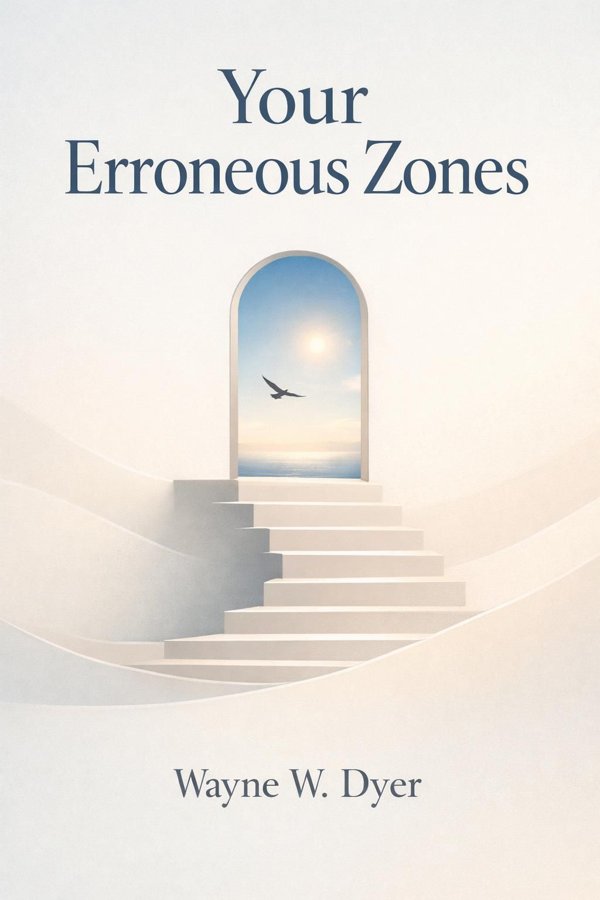
Your Erroneous Zones: Summary & Key Insights
 10 min9 chaptersAudio available
Key Takeaways from Your Erroneous Zones
Most people do not choose misery consciously; they inherit it through automatic thought patterns.
The moment you say, “They made me feel this way,” you hand over your emotional freedom.
Guilt and worry are among the most socially accepted forms of self-torture.
If your self-worth rises and falls with other people’s opinions, you will spend your life emotionally rented out.
Many people spend years trying to become worthy of themselves, as if self-acceptance must be earned through achievement, attractiveness, productivity, or flawless behavior.
What Is Your Erroneous Zones About?
Your Erroneous Zones by Wayne W. Dyer is a self_awareness book spanning 12 pages. What if many of the emotions that drain your energy—guilt, worry, anger, self-doubt, and the endless need for approval—are not unavoidable facts of life, but habits of thinking you can unlearn? In Your Erroneous Zones, psychologist Wayne W. Dyer argues that much of human suffering comes not from external events, but from mental patterns we continue to rehearse. First published in 1976, the book became a landmark in self-development because it offered a bold, empowering message: you are not condemned to live by inherited beliefs, social expectations, or emotional reflexes. You can choose thoughts and behaviors that support freedom instead of self-sabotage. Dyer writes with the authority of a trained psychologist and the urgency of a motivational teacher. His central concern is practical emotional independence—how to stop giving away your peace to criticism, uncertainty, the past, or the opinions of others. The book matters because its core challenge remains timeless: if your thoughts are creating unnecessary misery, why keep thinking them? Your Erroneous Zones invites readers to examine where they are trapped, reclaim responsibility, and build a life directed by conscious choice rather than old conditioning.
This FizzRead summary covers all 9 key chapters of Your Erroneous Zones in approximately 10 minutes, distilling the most important ideas, arguments, and takeaways from Wayne W. Dyer's work. Also available as an audio summary and Key Quotes Podcast.
Your Erroneous Zones
What if many of the emotions that drain your energy—guilt, worry, anger, self-doubt, and the endless need for approval—are not unavoidable facts of life, but habits of thinking you can unlearn? In Your Erroneous Zones, psychologist Wayne W. Dyer argues that much of human suffering comes not from external events, but from mental patterns we continue to rehearse. First published in 1976, the book became a landmark in self-development because it offered a bold, empowering message: you are not condemned to live by inherited beliefs, social expectations, or emotional reflexes. You can choose thoughts and behaviors that support freedom instead of self-sabotage.
Dyer writes with the authority of a trained psychologist and the urgency of a motivational teacher. His central concern is practical emotional independence—how to stop giving away your peace to criticism, uncertainty, the past, or the opinions of others. The book matters because its core challenge remains timeless: if your thoughts are creating unnecessary misery, why keep thinking them? Your Erroneous Zones invites readers to examine where they are trapped, reclaim responsibility, and build a life directed by conscious choice rather than old conditioning.
Who Should Read Your Erroneous Zones?
This book is perfect for anyone interested in self_awareness and looking to gain actionable insights in a short read. Whether you're a student, professional, or lifelong learner, the key ideas from Your Erroneous Zones by Wayne W. Dyer will help you think differently.
- ✓Readers who enjoy self_awareness and want practical takeaways
- ✓Professionals looking to apply new ideas to their work and life
- ✓Anyone who wants the core insights of Your Erroneous Zones in just 10 minutes
Want the full summary?
Get instant access to this book summary and 100K+ more with Fizz Moment.
Get Free SummaryAvailable on App Store • Free to download
Key Chapters
Most people do not choose misery consciously; they inherit it through automatic thought patterns. Dyer calls these patterns “erroneous zones,” the mental habits that quietly generate needless pain. They include guilt over the past, worry about the future, dependence on approval, fear of failure, anger as a reflex, and the belief that circumstances control your emotional state. The most dangerous part is that these patterns often feel normal. Because they are familiar, people confuse them with personality rather than learned behavior.
Dyer’s central point is liberating: erroneous zones are not permanent flaws. They are habits, and habits can be examined, interrupted, and replaced. This shift matters because it removes the excuse of helplessness. If your anxiety, resentment, or self-rejection is produced by the way you interpret life, then change becomes possible. You may not control events, but you do have influence over your mental response.
Consider someone who constantly says, “I’m just a worrier,” or “That’s the way I am.” Dyer would challenge this identity. Worry is not an essence; it is a repeated behavior of mind. The same is true for guilt, procrastination, or people-pleasing. Once you stop calling these traits and start calling them choices, however conditioned, you gain room to act differently.
A practical way to begin is to notice recurring moments of emotional discomfort and ask: What thought am I rehearsing right now? Is it useful, or is it one of my erroneous zones? Naming the pattern weakens its control. Actionable takeaway: for one week, track any episode of guilt, anger, worry, or approval-seeking and write down the thought behind it. Awareness is the first act of freedom.
The moment you say, “They made me feel this way,” you hand over your emotional freedom. One of Dyer’s most uncompromising ideas is that personal responsibility is the foundation of emotional maturity. This does not mean denying injustice, difficulty, or other people’s bad behavior. It means recognizing that your emotional response is still your own. Between what happens and how you react, there is a space—and in that space lies self-direction.
Dyer challenges the language of victimhood because language reveals beliefs. If you routinely say, “My boss ruined my day,” “My partner makes me angry,” or “My parents are why I can’t change,” you reinforce the idea that your inner life belongs to others. According to Dyer, this belief guarantees dependency. As long as your peace depends on other people behaving as you wish, you remain emotionally captive.
Personal responsibility begins with replacing blame-oriented thinking with ownership. Instead of “She upset me,” try “I responded with hurt and anger.” This small shift is not semantic; it changes the locus of control. It reminds you that while you may not have chosen the trigger, you still participate in the reaction.
In daily life, this might mean pausing before sending an angry message, refusing to let criticism determine your self-worth, or acknowledging that your procrastination is not caused by circumstances but by avoidance. Responsibility is not harsh self-judgment; it is self-leadership.
Dyer’s message is empowering because it restores authorship. If you create part of your emotional experience, then you can also rewrite it. Actionable takeaway: whenever you catch yourself blaming someone or something for how you feel, rewrite the sentence beginning with “I am choosing to…” or “I am responding by…”. This simple practice builds ownership and choice.
Guilt and worry are among the most socially accepted forms of self-torture. Dyer argues that they are not signs of morality or responsibility, but deeply unproductive habits that rob you of the present. Guilt is immobilization over what has already happened; worry is immobilization over what has not yet happened. One keeps you chained to the past, the other to an imaginary future. Neither improves your life unless it leads directly to constructive action.
Many people defend guilt as evidence that they care. A parent feels guilty for working too much, a student feels guilty for wasting time, a partner feels guilty for disappointing someone. But Dyer asks a sharp question: after guilt has appeared, what does it actually produce? If it leads to a thoughtful apology, changed behavior, or a repaired relationship, fine. But if it simply becomes repeated self-condemnation, it is useless suffering.
Worry works similarly. People often call it preparation, yet most worry is repetitive fantasy about things beyond immediate control. You worry about health, money, rejection, aging, or failure, but the worry itself does not solve the problem. It consumes attention that could be used for planning, action, or acceptance.
A practical distinction helps: ask whether your thought is leading to action or paralysis. If you forgot an important task, do it now, apologize, or make a system to prevent repetition. If you fear a future problem, prepare for what you can and release what you cannot control.
Dyer wants readers to stop mistaking suffering for virtue. Emotional pain is not proof of goodness. Action is. Actionable takeaway: whenever guilt or worry appears, ask two questions: “Can I do something now?” and “If yes, what is the next step?” If the answer is no, practice letting the thought go instead of rehearsing it.
If your self-worth rises and falls with other people’s opinions, you will spend your life emotionally rented out. Dyer treats the need for approval as one of the most common and damaging erroneous zones because it creates chronic dependence. The desire to be liked is natural; the need to be validated in order to feel okay is a trap. Once approval becomes a requirement, honesty, creativity, and freedom begin to shrink.
People-pleasing often looks harmless, even virtuous. You avoid conflict, say yes when you mean no, soften your opinions, or shape your identity around what is acceptable to family, coworkers, or society. But the cost is high: resentment, confusion, and disconnection from your actual values. Dyer insists that mature living requires tolerating disapproval. If you cannot bear someone being disappointed in you, you will betray yourself repeatedly.
This idea does not invite selfishness or cruelty. It simply means your internal worth cannot depend on applause. For example, a person may choose a career path their parents dislike, set a boundary with a demanding friend, or express an unpopular opinion respectfully. Disapproval may follow, but emotional independence means not collapsing under it.
Dyer reminds readers that no matter how agreeable or accomplished you become, universal approval is impossible. Trying to achieve it is therefore a guaranteed source of tension. The healthier goal is not to eliminate feedback, but to evaluate it without surrendering your center.
One useful practice is to notice how often you explain, defend, or over-justify your choices simply to avoid discomfort. Often, the real issue is not the situation but your fear of being judged. Actionable takeaway: choose one small area this week where you usually seek unnecessary approval—such as saying no, stating a preference, or making a decision without polling others—and practice acting from self-respect rather than permission.
Many people spend years trying to become worthy of themselves, as if self-acceptance must be earned through achievement, attractiveness, productivity, or flawless behavior. Dyer challenges this entire structure. He argues that self-image becomes poisonous when it turns into self-rating—when you decide that mistakes, limitations, or imperfections diminish your human worth. Genuine self-acceptance means valuing yourself without needing to be superior, successful, or approved of first.
This distinction is crucial. A healthy person can evaluate behavior without condemning identity. You can say, “That choice was unwise,” without concluding, “I am a failure.” You can want to improve your habits without living in self-disgust. Dyer believes emotional health depends on this separation. When self-worth is conditional, every setback becomes a threat to your identity.
In real life, self-rejection shows up everywhere: harsh self-talk after a mistake, embarrassment over appearance, comparing yourself endlessly to others, or treating rest as laziness unless it is “deserved.” These habits create a life of internal hostility. Dyer invites readers to replace them with a more rational stance: you are a worthwhile person because you exist, not because you are constantly winning.
This does not remove accountability. It makes accountability more effective by removing shame. When you stop attacking yourself, you can address problems more honestly. A student who fails an exam, for instance, can review study habits and improve—without spiraling into worthlessness.
Dyer’s broader point is that self-respect is a daily practice of thought. Actionable takeaway: listen for one recurring self-rejecting phrase you use—such as “I’m not good enough” or “I always mess up”—and replace it with a behavior-specific statement: “I made a mistake, and I can correct it.” This shifts you from condemnation to growth.
Security is often just a comfortable name for stagnation. Dyer argues that many people remain trapped not because they lack ability, but because they fear the uncertainty that comes with change. The unknown feels dangerous, so they cling to familiar routines, stale relationships, unsatisfying work, and inherited beliefs. Yet the price of safety can be a shrinking life. Avoiding risk may protect you from discomfort, but it also blocks learning, vitality, and self-respect.
Dyer does not suggest reckless behavior. His point is psychological: if fear consistently decides your choices, you stop developing. You postpone difficult conversations, avoid creative projects, stay silent in rooms where you have something to say, and remain attached to identities that no longer fit. Over time, this creates a subtler pain than failure—the pain of unlived potential.
Procrastination is one expression of this pattern. Often it is not laziness but avoidance disguised as delay. You tell yourself you will start later, when conditions are better, confidence is higher, or uncertainty is lower. But action rarely begins with certainty; it creates certainty through movement.
A practical example is someone wanting to change careers but waiting endlessly for the perfect moment. Dyer would encourage a small act of forward motion: research programs, contact someone in the field, update a resume, or test a side project. Courage grows through action, not before it.
The same principle applies to emotional risks—setting boundaries, ending destructive relationships, or admitting a truth you have hidden from yourself. Dyer sees these decisions as essential to self-directed living. Actionable takeaway: identify one area where fear has kept you static and take a measurable step within 24 hours. Not the entire leap—just the next move. Progress begins when avoidance loses its authority.
Anger often feels powerful, but Dyer views habitual anger and resentment as forms of self-harm. They create the illusion of strength while draining peace, clarity, and autonomy. At the heart of anger is usually an unmet demand: people must behave as I want, life must follow my script, the past must be different. When reality refuses, resentment grows. Dyer’s challenge is not to suppress emotion, but to question the beliefs that keep rage alive.
He distinguishes between noticing injustice and becoming psychologically imprisoned by it. You can dislike someone’s behavior, take decisive action, and set boundaries without carrying corrosive hostility. In fact, anger often becomes less about solving problems and more about preserving ego. It allows you to rehearse injury instead of choosing a useful response.
This idea is especially important in relationships. Emotional dependency says, “You must love me a certain way, agree with me, reassure me, or behave correctly for me to be okay.” That mindset turns every conflict into a threat to your equilibrium. Dyer encourages a stronger position: value connection deeply, but do not make your emotional survival contingent on another person’s compliance.
Imagine receiving criticism at work. An anger-driven response might involve replaying the comment all day, mentally attacking the other person, and carrying resentment home. A self-directed response would examine whether the criticism is useful, reject what is unfair, and move on without surrendering inner peace.
Dyer’s broader insight is that unresolved anger keeps the past in control of the present. Letting go is not approval; it is self-liberation. Actionable takeaway: the next time anger rises, ask, “What demand am I making of reality right now?” Then decide on one constructive response—communicate, leave, correct, or release—instead of feeding resentment.
A large share of human unhappiness comes from living by inherited scripts rather than conscious choice. Dyer argues that people are often shaped by “shoulds”: you should behave this way, want these things, honor these traditions, suppress these feelings, and pursue this approved life. When unquestioned, these scripts pull you away from the present and into performance. You stop asking what is true or meaningful now and start asking what role you are expected to play.
Breaking free from societal expectations does not mean rejecting every norm or acting rebelliously for its own sake. It means evaluating whether your beliefs and routines actually serve your life. Are you staying in a career because it fits your values, or because it wins approval? Are you maintaining obligations out of love, or out of fear of being judged? Are you postponing joy because you believe adulthood must be serious, dutiful, and joyless?
Dyer pairs this with a strong emphasis on the present moment. Since guilt ties you to the past and worry ties you to the future, freedom requires returning to the now—the only place where action, awareness, and experience actually occur. Presence is not passivity. It is direct engagement with life as it is, free from unnecessary mental clutter.
In practice, this may look like enjoying time with your children instead of mentally rehearsing unfinished tasks, taking pleasure in simple activities without needing them to be productive, or questioning a family expectation that no longer aligns with your principles. Present living restores aliveness because it replaces performance with participation.
Dyer wants readers to become authors rather than actors in their own lives. Actionable takeaway: choose one recurring “should” in your life and ask, “Do I truly believe this, or have I simply inherited it?” Then make one present-centered choice that reflects your actual values.
Lasting freedom does not come from insight alone; it comes from replacing old mental habits with deliberate new ones. Dyer’s ultimate aim is self-directed behavior—the ability to choose responses based on reason, values, and awareness rather than conditioning. This means becoming less reactive, less approval-driven, less fearful, and more intentional in how you think, speak, and act.
He urges readers to challenge thoughts not by asking whether they are familiar, but whether they are useful and true. Does this belief help me live better? Is it based on evidence, or on old conditioning? If I continue thinking this way, what kind of life will it produce? These questions move you out of autopilot. They also align with one of Dyer’s deepest convictions: happiness is not something granted from outside, but something built through disciplined inner choices.
For example, instead of thinking, “I can’t be happy until others understand me,” you might adopt, “I prefer understanding, but I do not require it to remain at peace.” Instead of “Failure would prove I’m inadequate,” you might think, “Failure is data, not identity.” These are not empty affirmations. They are rational alternatives to distorted beliefs.
Self-directed living also involves behavior. You become the kind of person who says what you mean, follows through, tolerates discomfort, and aligns actions with values. Over time, this builds confidence that is grounded in practice rather than fantasy.
Dyer’s book is not simply about eliminating negative thoughts; it is about constructing an internal system that supports freedom. Actionable takeaway: choose one recurring self-defeating belief and write a replacement statement that is realistic, empowering, and repeatable. Then pair it with one matching behavior. New thinking becomes believable when it is reinforced by action.
All Chapters in Your Erroneous Zones
About the Author
Wayne W. Dyer (1940–2015) was an American psychologist, author, and motivational speaker whose work helped shape the modern self-help movement. Raised in difficult circumstances, he went on to earn a doctorate in counseling psychology and later taught at St. John’s University. He gained international recognition with Your Erroneous Zones, a bestselling book that introduced millions of readers to the idea that many emotional struggles are maintained by self-defeating thought patterns. Over the course of his career, Dyer wrote numerous books on personal growth, intention, spirituality, and inner peace. Known for his warm but challenging style, he encouraged people to take responsibility for their lives, think independently, and pursue emotional freedom. His teachings continue to influence readers seeking practical wisdom and self-directed living.
Get This Summary in Your Preferred Format
Read or listen to the Your Erroneous Zones summary by Wayne W. Dyer anytime, anywhere. FizzRead offers multiple formats so you can learn on your terms — all free.
Available formats: App · Audio · PDF · EPUB — All included free with FizzRead
Download Your Erroneous Zones PDF and EPUB Summary
Key Quotes from Your Erroneous Zones
“Most people do not choose misery consciously; they inherit it through automatic thought patterns.”
“The moment you say, “They made me feel this way,” you hand over your emotional freedom.”
“Guilt and worry are among the most socially accepted forms of self-torture.”
“If your self-worth rises and falls with other people’s opinions, you will spend your life emotionally rented out.”
“Many people spend years trying to become worthy of themselves, as if self-acceptance must be earned through achievement, attractiveness, productivity, or flawless behavior.”
Frequently Asked Questions about Your Erroneous Zones
Your Erroneous Zones by Wayne W. Dyer is a self_awareness book that explores key ideas across 9 chapters. What if many of the emotions that drain your energy—guilt, worry, anger, self-doubt, and the endless need for approval—are not unavoidable facts of life, but habits of thinking you can unlearn? In Your Erroneous Zones, psychologist Wayne W. Dyer argues that much of human suffering comes not from external events, but from mental patterns we continue to rehearse. First published in 1976, the book became a landmark in self-development because it offered a bold, empowering message: you are not condemned to live by inherited beliefs, social expectations, or emotional reflexes. You can choose thoughts and behaviors that support freedom instead of self-sabotage. Dyer writes with the authority of a trained psychologist and the urgency of a motivational teacher. His central concern is practical emotional independence—how to stop giving away your peace to criticism, uncertainty, the past, or the opinions of others. The book matters because its core challenge remains timeless: if your thoughts are creating unnecessary misery, why keep thinking them? Your Erroneous Zones invites readers to examine where they are trapped, reclaim responsibility, and build a life directed by conscious choice rather than old conditioning.
More by Wayne W. Dyer
Change Your Thoughts, Change Your Life: Living the Wisdom of the Tao
Wayne W. Dyer
10 min
The Power of Intention: Learning to Co-Create Your World Your Way
Wayne W. Dyer
10 min
Excuses Begone!: How to Change Lifelong, Self-Defeating Thinking Habits
Wayne W. Dyer
10 min
The Power of Awakening: Mindfulness Practices and Spiritual Insights to Transform Your Life
Wayne W. Dyer
10 minYou Might Also Like
Rising Strong
Brené Brown
10 min
You Do You
Sarah Knight
10 min
Master Your Emotions: A Practical Guide to Overcome Negativity and Better Manage Your Feelings
Thibaut Meurisse
10 min
The Mountain Is You: Transforming Self-Sabotage Into Self-Mastery
Brianna Wiest
10 min
101 Essays That Will Change The Way You Think
Brianna Wiest
10 min
A Radical Awakening: Turn Pain into Power, Embrace Your Truth, Live Free
Shefali Tsabary
10 minBrowse by Category
Ready to read Your Erroneous Zones?
Get the full summary and 100K+ more books with Fizz Moment.