
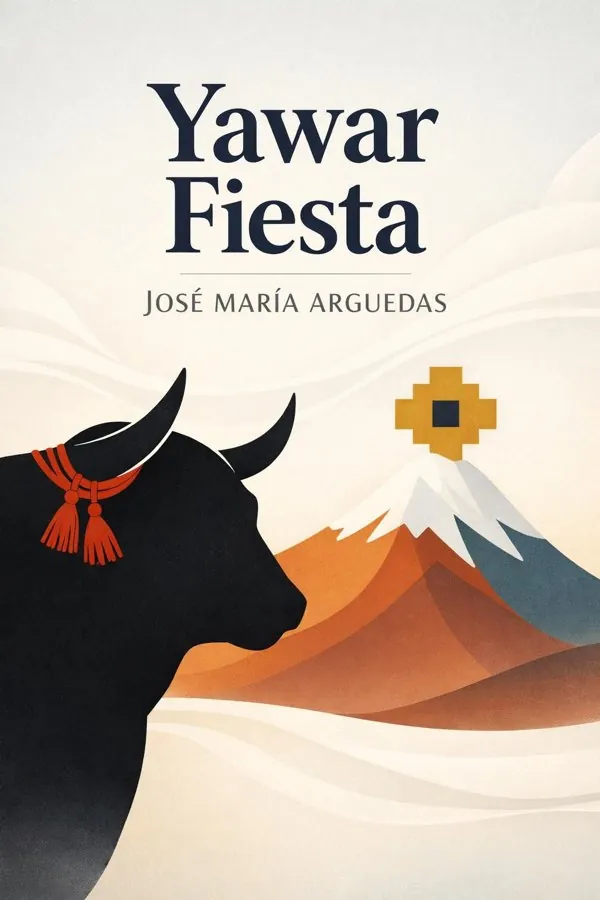
Yawar Fiesta: Summary & Key Insights
 10 min9 chaptersAudio available
Key Takeaways from Yawar Fiesta
A town can reveal an entire nation when its internal tensions are impossible to ignore.
A festival is never just a festival when a people’s dignity depends on it.
Modernization often presents itself as progress, but progress for whom is the harder question.
Power becomes vulnerable when people stop accepting the language used to diminish them.
Some truths become clearest only when they are enacted in public.
What Is Yawar Fiesta About?
Yawar Fiesta by José María Arguedas is a classics book spanning 5 pages. José María Arguedas’s Yawar Fiesta is far more than a regional novel about a festival in the Peruvian Andes. First published in 1941, it is a powerful portrait of a community fighting to protect its way of life against state authority, elite prejudice, and the pressures of cultural standardization. Set in the highland town of Puquio, the novel centers on the titular festival, a local form of bullfight in which Spanish spectacle is transformed by indigenous ritual, communal pride, and Andean symbolism. What unfolds is not simply a conflict over entertainment, but a struggle over who has the right to define civilization, order, and national identity. Arguedas writes with unusual authority because he was not merely observing Andean life from a distance. He grew up immersed in Quechua-speaking indigenous culture and later became an anthropologist and ethnologist, giving him both emotional intimacy and intellectual depth. The result is a novel that feels lived rather than invented. Yawar Fiesta matters because it reveals how culture survives: not as folklore frozen in time, but as a living force shaped by conflict, memory, and resistance.
This FizzRead summary covers all 9 key chapters of Yawar Fiesta in approximately 10 minutes, distilling the most important ideas, arguments, and takeaways from José María Arguedas's work. Also available as an audio summary and Key Quotes Podcast.
Yawar Fiesta
José María Arguedas’s Yawar Fiesta is far more than a regional novel about a festival in the Peruvian Andes. First published in 1941, it is a powerful portrait of a community fighting to protect its way of life against state authority, elite prejudice, and the pressures of cultural standardization. Set in the highland town of Puquio, the novel centers on the titular festival, a local form of bullfight in which Spanish spectacle is transformed by indigenous ritual, communal pride, and Andean symbolism. What unfolds is not simply a conflict over entertainment, but a struggle over who has the right to define civilization, order, and national identity. Arguedas writes with unusual authority because he was not merely observing Andean life from a distance. He grew up immersed in Quechua-speaking indigenous culture and later became an anthropologist and ethnologist, giving him both emotional intimacy and intellectual depth. The result is a novel that feels lived rather than invented. Yawar Fiesta matters because it reveals how culture survives: not as folklore frozen in time, but as a living force shaped by conflict, memory, and resistance.
Who Should Read Yawar Fiesta?
This book is perfect for anyone interested in classics and looking to gain actionable insights in a short read. Whether you're a student, professional, or lifelong learner, the key ideas from Yawar Fiesta by José María Arguedas will help you think differently.
- ✓Readers who enjoy classics and want practical takeaways
- ✓Professionals looking to apply new ideas to their work and life
- ✓Anyone who wants the core insights of Yawar Fiesta in just 10 minutes
Want the full summary?
Get instant access to this book summary and 100K+ more with Fizz Moment.
Get Free SummaryAvailable on App Store • Free to download
Key Chapters
A town can reveal an entire nation when its internal tensions are impossible to ignore. In Yawar Fiesta, Puquio is not just a backdrop for the plot; it is a compact social map of Peru itself. Arguedas presents a town structured by hierarchy, ethnic division, memory, land, and power. Indigenous communities, mestizos, landowners, local authorities, and outsiders all inhabit the same geography, yet they do not live the same reality. Their views of order, honor, religion, celebration, and law often collide. Puquio therefore becomes a living laboratory of cultural conflict.
What makes this setting so important is that Arguedas does not reduce it to a simple opposition between good and bad groups. Instead, he shows a layered social world in which every street, district, and communal relationship carries historical weight. The indigenous ayllus are not romantic remnants; they are organized communities with customs, loyalties, and political energy. The town’s elites are not merely villains; they represent the logic of official Peru, with its desire to regulate, classify, and dominate. This complexity gives the novel depth and realism.
The practical lesson is that place is never neutral. Communities are shaped by who controls public rituals, language, law, and memory. In modern terms, we see similar tensions whenever local traditions are dismissed as backward by centralized institutions, whether in education, urban planning, or cultural policy. To understand a conflict, we must ask not only what happened, but whose version of normal life is being defended.
Actionable takeaway: when studying any society, begin with its local geography and social divisions, because power often becomes visible first in the organization of place.
A festival is never just a festival when a people’s dignity depends on it. The yawar fiesta at the center of Arguedas’s novel is a striking example of how ritual can carry history, identity, and resistance all at once. The event combines the imported form of the bullfight with indigenous Andean elements, transforming a colonial spectacle into something distinctively local. In Puquio, this celebration is not merely entertainment. It is a communal act through which people express belonging, courage, masculinity, memory, and spiritual connection to the land.
Arguedas carefully shows that the festival matters because it is collectively owned. It belongs to the people who organize it, risk themselves in it, sing around it, and interpret its meaning. The blood, danger, music, and crowd energy turn the event into a kind of public language. Through the festival, the community says: we are still here, and we define ourselves on our own terms. Even the body becomes symbolic. Human endurance, the bull’s power, and the crowd’s emotional investment all merge into a ritual of identity.
This insight has broad relevance. Many communities today use festivals, ceremonies, food traditions, and local sports to maintain continuity amid migration, globalization, or state pressure. When outsiders judge these practices only by surface appearance, they miss their deeper social function. A tradition may seem rough, old-fashioned, or irrational from a distance, yet within the community it can serve as a crucial container of memory and solidarity.
Actionable takeaway: before dismissing a tradition, ask what emotional, historical, and communal work it performs for the people who sustain it.
Modernization often presents itself as progress, but progress for whom is the harder question. One of the novel’s central tensions comes from the attempt by outside authorities to regulate or ban the yawar festival in the name of order, safety, and civilization. On the surface, this seems like a straightforward administrative decision. But Arguedas reveals that such interventions are never purely technical. They are also cultural judgments. To call a local practice barbaric is to position another culture as superior.
In Yawar Fiesta, modernity arrives not as open dialogue but as pressure. Officials and urban-minded elites view Andean customs through a framework that privileges imported norms and centralized control. Their version of progress requires indigenous life to become legible to the state and acceptable to dominant tastes. What the people of Puquio resist, then, is not change itself but a specific kind of change: one imposed from above without respect for local meaning.
This conflict still feels current. Around the world, development projects, educational reforms, and bureaucratic policies often claim neutrality while quietly erasing local knowledge. A standardized solution may improve efficiency yet damage belonging. Arguedas invites readers to distinguish between modernization that expands human possibilities and modernization that humiliates living cultures.
The novel does not suggest that every custom must remain untouched forever. Rather, it insists that communities deserve agency in deciding how to adapt. Cultural evolution is healthiest when it grows from participation, not contempt.
Actionable takeaway: whenever a reform is presented as common sense, examine whether it includes the voices of those most affected or simply imposes an external definition of progress.
Power becomes vulnerable when people stop accepting the language used to diminish them. In the sections of the novel focused on confrontation and resistance, Arguedas shows that the defense of the festival is also the defense of collective speech. The people of Puquio do not resist only through physical action; they resist through insistence, memory, and communal will. Their shared attachment to the yawar fiesta gives them a political voice even when formal institutions exclude or underestimate them.
This matters because Arguedas portrays resistance as communal rather than heroic in the narrow individual sense. There is no single savior who resolves the conflict. Instead, the people’s strength emerges from networks of loyalty and a refusal to internalize shame. That is an important distinction. Too many narratives about marginalized communities focus on victims waiting for rescue. Yawar Fiesta shows a community already in possession of agency, even if that agency must struggle against unequal power.
The novel also reminds us that cultural resistance is not passive nostalgia. It is strategic. People negotiate, organize, argue, and mobilize symbols that authorities cannot easily erase. In contemporary life, we can see parallels in indigenous language revitalization, community-led heritage preservation, and grassroots efforts to defend local land or ritual practices. The lesson is that voice is strongest when it is anchored in shared values rather than isolated outrage.
Readers can apply this insight by paying attention to how communities narrate themselves. Official descriptions often flatten people into categories; local speech restores depth, humor, anger, and dignity.
Actionable takeaway: when defending something meaningful, build a shared narrative around it, because collective language often becomes the first tool of effective resistance.
Some truths become clearest only when they are enacted in public. The day of the yawar fiesta is the emotional and symbolic climax of the novel because it turns private attachment into visible collective reality. Everything that has been argued about in advance, whether by officials, elites, or community members, is suddenly tested in action. On festival day, identity is no longer an abstract concept. It appears in bodies, gestures, costumes, music, danger, and public emotion.
Arguedas uses this moment to show that culture is most powerful when it is lived rather than merely described. The townspeople do not defend the festival with philosophical essays. They defend it by making it happen. In that act, the community demonstrates endurance, technical knowledge, courage, and ceremonial seriousness. The event becomes a declaration that their world is not a relic but an active social force.
This is why the scene carries a sense of triumph beyond the immediate outcome. The true victory lies in manifestation. Once a culture shows itself with confidence and complexity, it becomes harder to dismiss it as primitive noise. Public performance can generate legitimacy. We see this in modern life whenever communities reclaim festivals, languages, or artistic practices in public spaces after long periods of exclusion. Visibility can become a form of power.
At a personal level, the lesson is equally useful. Values remain fragile when they exist only in private conviction. They gain force when expressed through regular practice, community participation, and concrete ritual.
Actionable takeaway: if something matters to your identity, do not only defend it in theory; create occasions to embody it visibly and collectively.
The most resilient traditions are rarely pure; they endure because they absorb, transform, and reinterpret. One of the richest insights in Yawar Fiesta is that Andean culture survives not by sealing itself off from history but by reshaping what history brings. The festival itself is evidence of this. Bullfighting comes from Spain, yet in Puquio it no longer belongs fully to the world that introduced it. Indigenous communities have altered its meaning, symbolism, and emotional structure until it becomes something distinctly local.
This challenges a common mistake in discussions of heritage. People often imagine authenticity as untouched origin. Arguedas suggests something more dynamic: authenticity can also mean faithful adaptation. A culture remains itself not by refusing all influence, but by filtering influence through its own values and communal imagination. That is why the novel feels so alive. It depicts a culture in motion, not a museum piece.
This idea is highly applicable today. Diaspora communities, bilingual families, and regions under global cultural pressure often struggle with the fear of losing authenticity. Yet the answer is not always rigid preservation. Sometimes cultural strength comes from creative continuity: keeping core meanings while allowing forms to change. Food, music, ritual, and language all evolve in this way.
Arguedas’s deeper point is that outsiders often misread hybridity as dilution. In fact, hybridity can be a sign of cultural confidence. Only a living tradition can transform what it inherits.
Actionable takeaway: when evaluating whether a culture is being preserved, look beyond surface change and ask whether the community still controls the meanings behind its evolving forms.
Land is not scenery in Arguedas’s fiction; it is part of thought itself. The Andean landscape of Yawar Fiesta shapes the novel at every level, from mood and movement to social identity and spiritual feeling. Hills, distances, altitudes, animals, dust, and weather are not decorative details added for realism. They help define how the people of Puquio experience time, community, labor, and danger. To understand the novel’s cultural conflicts, readers must also understand the environment in which those conflicts unfold.
Arguedas writes the Andes as a lived world, not an exotic postcard. The terrain influences how communities organize themselves, how they travel, what they fear, and what they revere. It also intensifies the significance of the festival. In a harsh landscape where survival requires collective endurance, ritual becomes one more way of asserting relationship with place. The community’s identity is rooted not only in ancestry but in repeated interaction with a demanding geography.
This perspective broadens the novel’s meaning. Cultural struggle is not only about laws or social class; it is also ecological. When people are uprooted from their land or when their landscape is treated as irrelevant to policy, their worldview is damaged. Modern readers can connect this to contemporary indigenous land movements, environmental justice, and debates over development in rural regions. Protecting a culture often requires protecting the environment that sustains its imagination.
For individual readers, this idea encourages a more attentive relationship with place. Our environments shape our habits and values more than we often realize.
Actionable takeaway: when trying to understand a community’s identity, study its landscape, because people’s beliefs and rituals are often inseparable from the land they inhabit.
Representation changes when the people once treated as background become the center of narrative attention. A crucial contribution of Yawar Fiesta is literary as much as thematic: Arguedas gives indigenous Andean life depth, seriousness, and expressive force within the novel form. He does not use indigenous characters as symbols of picturesque poverty or noble suffering. He presents them as thinking, feeling, arguing human beings embedded in complex communal worlds. That was a major intervention in Latin American literature.
Arguedas’s authority comes partly from his biographical experience. He knew Quechua-speaking environments intimately and later studied Andean culture academically. But what matters most in the novel is how that knowledge becomes style. He writes from within a cultural atmosphere that many writers of his time could only observe from the outside. The result is a narrative that expands the possibilities of who gets to occupy literary centrality.
This has practical importance beyond literature. The stories a society tells shape whose lives are considered meaningful. When only elite voices are represented with nuance, inequality becomes normalized at the level of imagination. By contrast, books like Yawar Fiesta train readers to perceive dignity where prejudice once saw only backwardness.
This insight applies today to reading habits, education, media, and workplace culture. We should ask whose experiences are being framed as universal and whose are treated as peripheral. Expanding the range of serious attention is not tokenism; it is an ethical correction.
Actionable takeaway: seek out works that center historically marginalized voices, because reading widely is one of the most concrete ways to challenge inherited hierarchies of value.
A nation becomes unstable when it demands unity by silencing the people who compose it. Beneath its local plot, Yawar Fiesta asks a larger political question: what kind of country is Peru if its indigenous majorities are treated as obstacles to civilization rather than as creators of the nation’s identity? The clash over the festival exposes a wider failure of national imagination. Official Peru claims authority over the Andes, yet often refuses to understand Andean life on its own terms.
Arguedas does not merely celebrate local color; he challenges the reader to rethink belonging. If the nation recognizes only urban, Hispanicized, centralized norms, then it is excluding the very cultures that give it historical depth. The novel therefore invites a different model of nationhood, one based not on erasure but on coexistence, mutual recognition, and cultural plurality.
This remains one of the book’s strongest contributions. Many countries still struggle with dominant narratives that treat minority cultures as supplemental rather than foundational. Debates over language rights, educational curricula, monuments, and public rituals all reflect the same basic issue: who gets to define the national story? Yawar Fiesta suggests that a mature nation must allow multiple cultural logics to coexist without forcing one to disappear.
For readers, the novel offers a useful test of political rhetoric. Any call for unity should be examined carefully. Unity can mean solidarity, but it can also conceal assimilationist pressure.
Actionable takeaway: whenever you hear appeals to national identity, ask whose traditions are being included, whose are being simplified, and whose are being excluded altogether.
All Chapters in Yawar Fiesta
About the Author
José María Arguedas (1911–1969) was a Peruvian novelist, anthropologist, translator, and ethnologist whose work transformed the representation of indigenous life in Latin American literature. Raised in close contact with Quechua-speaking communities, he developed an unusually intimate understanding of Andean culture, which later shaped both his fiction and his academic work. Arguedas wrote from a position that combined lived experience with scholarly insight, allowing him to portray indigenous worlds with emotional depth rather than exotic distance. His novels, essays, and ethnographic studies consistently explored the tensions between indigenous traditions, mestizo society, and the pressures of modernization. Today he is regarded as one of Peru’s most important writers and a central figure in literary indigenism, celebrated for giving artistic dignity and cultural complexity to voices long marginalized in national literature.
Get This Summary in Your Preferred Format
Read or listen to the Yawar Fiesta summary by José María Arguedas anytime, anywhere. FizzRead offers multiple formats so you can learn on your terms — all free.
Available formats: App · Audio · PDF · EPUB — All included free with FizzRead
Download Yawar Fiesta PDF and EPUB Summary
Key Quotes from Yawar Fiesta
“A town can reveal an entire nation when its internal tensions are impossible to ignore.”
“A festival is never just a festival when a people’s dignity depends on it.”
“Modernization often presents itself as progress, but progress for whom is the harder question.”
“Power becomes vulnerable when people stop accepting the language used to diminish them.”
“Some truths become clearest only when they are enacted in public.”
Frequently Asked Questions about Yawar Fiesta
Yawar Fiesta by José María Arguedas is a classics book that explores key ideas across 9 chapters. José María Arguedas’s Yawar Fiesta is far more than a regional novel about a festival in the Peruvian Andes. First published in 1941, it is a powerful portrait of a community fighting to protect its way of life against state authority, elite prejudice, and the pressures of cultural standardization. Set in the highland town of Puquio, the novel centers on the titular festival, a local form of bullfight in which Spanish spectacle is transformed by indigenous ritual, communal pride, and Andean symbolism. What unfolds is not simply a conflict over entertainment, but a struggle over who has the right to define civilization, order, and national identity. Arguedas writes with unusual authority because he was not merely observing Andean life from a distance. He grew up immersed in Quechua-speaking indigenous culture and later became an anthropologist and ethnologist, giving him both emotional intimacy and intellectual depth. The result is a novel that feels lived rather than invented. Yawar Fiesta matters because it reveals how culture survives: not as folklore frozen in time, but as a living force shaped by conflict, memory, and resistance.
More by José María Arguedas
You Might Also Like



Browse by Category
Ready to read Yawar Fiesta?
Get the full summary and 100K+ more books with Fizz Moment.