
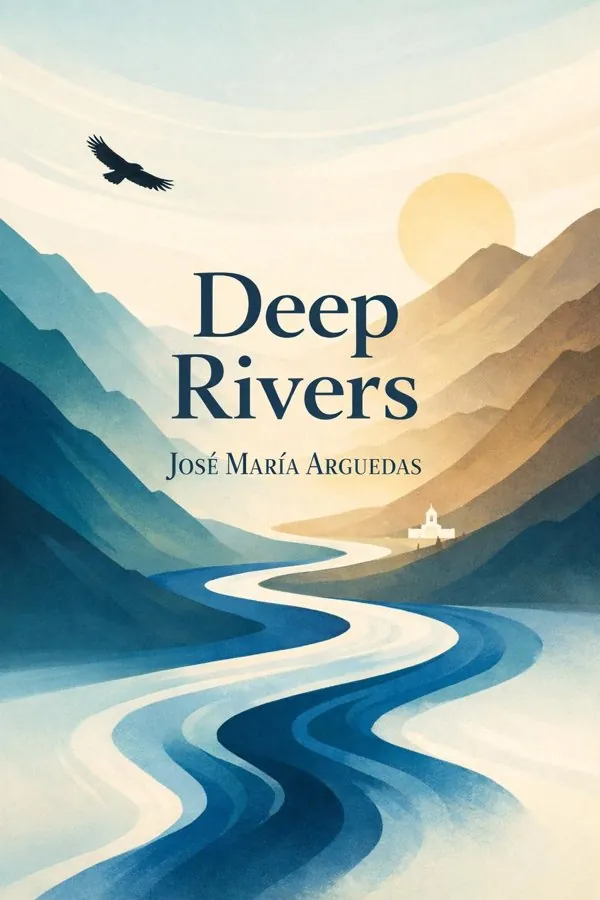
Deep Rivers: Summary & Key Insights
 10 min10 chaptersAudio available
Key Takeaways from Deep Rivers
A nation often reveals itself most clearly to those who are passing through it.
Freedom is easiest to appreciate when it is suddenly taken away.
Children do not invent social cruelty; they inherit and rehearse it.
Some landscapes are not backgrounds; they are moral presences.
Crisis exposes what a community truly believes.
What Is Deep Rivers About?
Deep Rivers by José María Arguedas is a classics book spanning 10 pages. Deep Rivers is José María Arguedas’s luminous novel of childhood, memory, and cultural fracture in the Peruvian Andes. First published in 1958 as Los Ríos Profundos, it follows Ernesto, a sensitive adolescent traveling with his father through mountain towns before being left at a religious boarding school in Abancay. What begins as a coming-of-age story gradually opens into something larger: a portrait of a nation divided by class, race, language, and power, yet still animated by deep indigenous traditions that refuse to disappear. Through Ernesto’s eyes, the world feels intensely alive. Rivers, stones, music, and landscapes carry spiritual meaning, while the cruelty of institutions reveals how violently colonial hierarchies continue to shape everyday life. Arguedas writes with unusual authority because he was not merely describing Andean culture from a distance; as a novelist, anthropologist, and ethnologist, he spent his life trying to express the emotional and moral reality of a bilingual, bicultural Peru. The result is one of Latin America’s most important novels: intimate, poetic, political, and enduringly relevant for anyone interested in identity, injustice, and the search for belonging.
This FizzRead summary covers all 10 key chapters of Deep Rivers in approximately 10 minutes, distilling the most important ideas, arguments, and takeaways from José María Arguedas's work. Also available as an audio summary and Key Quotes Podcast.
Deep Rivers
Deep Rivers is José María Arguedas’s luminous novel of childhood, memory, and cultural fracture in the Peruvian Andes. First published in 1958 as Los Ríos Profundos, it follows Ernesto, a sensitive adolescent traveling with his father through mountain towns before being left at a religious boarding school in Abancay. What begins as a coming-of-age story gradually opens into something larger: a portrait of a nation divided by class, race, language, and power, yet still animated by deep indigenous traditions that refuse to disappear. Through Ernesto’s eyes, the world feels intensely alive. Rivers, stones, music, and landscapes carry spiritual meaning, while the cruelty of institutions reveals how violently colonial hierarchies continue to shape everyday life. Arguedas writes with unusual authority because he was not merely describing Andean culture from a distance; as a novelist, anthropologist, and ethnologist, he spent his life trying to express the emotional and moral reality of a bilingual, bicultural Peru. The result is one of Latin America’s most important novels: intimate, poetic, political, and enduringly relevant for anyone interested in identity, injustice, and the search for belonging.
Who Should Read Deep Rivers?
This book is perfect for anyone interested in classics and looking to gain actionable insights in a short read. Whether you're a student, professional, or lifelong learner, the key ideas from Deep Rivers by José María Arguedas will help you think differently.
- ✓Readers who enjoy classics and want practical takeaways
- ✓Professionals looking to apply new ideas to their work and life
- ✓Anyone who wants the core insights of Deep Rivers in just 10 minutes
Want the full summary?
Get instant access to this book summary and 100K+ more with Fizz Moment.
Get Free SummaryAvailable on App Store • Free to download
Key Chapters
A nation often reveals itself most clearly to those who are passing through it. At the beginning of Deep Rivers, Ernesto travels with his father across the Peruvian Andes, and that movement matters. He is not yet rooted in one town, one school, or one social role. Because he is in transit, he sees more. He notices the grandeur of the mountains, the rhythm of indigenous life, the tension between poor villagers and local elites, and the fragile dignity of people trying to endure systems built against them.
Arguedas uses this journey to introduce the reader to a Peru that is geographically majestic and socially wounded. Ernesto’s father, a wandering lawyer who drifts from place to place, represents instability but also moral openness. He moves among the poor rather than above them. Through him, Ernesto learns to observe the world not as a set of abstractions but as a living field of human struggle. Travel becomes education.
This idea has a practical resonance beyond the novel. We often understand a society poorly when we only encounter it from the comfort of a single class, institution, or ideology. Movement exposes contradictions. Think of how traveling by bus rather than plane, walking through neighborhoods rather than reading headlines, or listening to people across generations changes one’s sense of reality.
In Ernesto’s case, the road prepares him for painful awakening. Before the school walls close around him, he experiences a larger world in which beauty and suffering coexist. That contrast becomes the emotional foundation of the book.
Actionable takeaway: when trying to understand a place, a community, or even your own life, step outside fixed routines and observe it in motion. Mobility can deepen perception.
Freedom is easiest to appreciate when it is suddenly taken away. After traveling through the open spaces of the Andes, Ernesto arrives in Abancay and is left at a religious boarding school. The transition is jarring. The living world of roads, rivers, and mountain air gives way to walls, schedules, discipline, and hierarchy. Abancay is not just a town; it is a social enclosure.
This change marks one of the novel’s central emotional turns. Ernesto’s separation from his father is painful, but the deeper shock is institutional. He enters a world designed to regulate bodies, speech, rank, and belonging. The school is meant to educate, yet it often humiliates. It is meant to form character, yet it reproduces social violence. In Arguedas’s hands, the boarding school becomes a miniature version of Peru itself: stratified, fearful, performative, and profoundly unequal.
Readers can recognize this structure in many modern environments. Schools, workplaces, bureaucracies, and even families often present themselves as orderly systems while quietly rewarding submission and punishing vulnerability. A newcomer senses this immediately. Ernesto’s sensitivity allows him to feel what others normalize.
Arguedas does not suggest that all structure is bad. Rather, he shows that institutions become dehumanizing when they sever people from compassion, memory, and the natural world. Ernesto survives not by fully adapting, but by preserving an inner life that resists the school’s moral deadness.
Actionable takeaway: whenever you enter a new institution, ask not only how it is organized, but what kind of human being it encourages you to become. Protect the parts of yourself that remain alive outside its walls.
Children do not invent social cruelty; they inherit and rehearse it. Inside the boarding school, Ernesto encounters a compressed version of the inequalities that structure the larger world. The students bully one another, compete for status, and absorb the prejudices of race and class that surround them. Priests and authority figures enforce order unevenly, and power often aligns with humiliation rather than justice.
Arguedas’s great insight is that the school is not separate from society. It trains boys to occupy the adult world they will later reproduce. The same contempt shown toward indigenous people outside the school appears inside it in coded ways: through language, insults, exclusion, and assumptions about worth. The novel therefore asks a difficult question: what happens when the institutions meant to civilize the young instead teach them domination?
This theme remains deeply relevant. Modern readers can see parallels in schools where wealth shapes opportunity, where accent or background affects treatment, or where institutions talk about equality while preserving old hierarchies. The novel reminds us that injustice is learned through daily interactions long before it appears in law or politics.
Ernesto’s moral struggle is not simply to avoid punishment; it is to avoid becoming numb. He watches, judges, suffers, and slowly forms an ethical consciousness. That matters because resistance often begins in perception. Before we can challenge an unjust system, we must recognize its normal routines.
Actionable takeaway: pay attention to the small rituals of exclusion in any community. Correcting everyday injustice is one of the most practical ways to resist larger systems of inequality.
Some landscapes are not backgrounds; they are moral presences. In Deep Rivers, the Andean world is alive with spiritual force. Rivers, stones, insects, songs, and mountains are never merely decorative. For Ernesto, nature offers companionship, meaning, and a language deeper than institutional speech. When human society becomes cruel or incomprehensible, the natural world remains a source of continuity.
This is one of Arguedas’s most original contributions. He does not portray indigenous connection to the land as folklore or sentimentality. Instead, he presents it as a valid and profound way of knowing. The landscape carries memory. It links the living to ancestors, to community, and to forms of truth that modern authority cannot fully erase. Ernesto senses this intuitively. His responses to sound, wind, and movement reveal a consciousness shaped by more than Western rationalism.
For contemporary readers, this idea has both literary and practical value. Many people live in environments so mediated by screens, schedules, and commerce that they forget how grounding the physical world can be. A walk by water, the repetition of a familiar path, or attention to seasonal change can restore perspective in ways abstract thinking cannot.
In the novel, nature does not solve social injustice. It does something subtler: it preserves Ernesto’s ability to feel deeply and to remain connected to a reality larger than oppression. That inner anchoring helps him endure.
Actionable takeaway: build a deliberate relationship with a place in the natural world. Returning to it regularly can strengthen memory, steadiness, and moral clarity when human systems feel disorienting.
Crisis exposes what a community truly believes. In Deep Rivers, the locust plague is more than a dramatic event. It becomes a test of how people interpret suffering, how fear spreads, and how social divisions shape collective response. Faced with natural threat, the town does not become automatically united. Instead, religious ritual, superstition, authority, and desperation intermingle.
Arguedas shows that in moments of uncertainty, people search urgently for meaning. Some turn to prayer, some to blame, some to obedience, and some to communal action. The plague reveals both the strengths and limits of faith. Ritual can console and bind people together, but it can also coexist with social inequality and moral blindness. A society may pray together while still allowing exploitation to continue.
This dynamic feels familiar in modern times. During epidemics, economic crises, or environmental disasters, communities often reveal existing fractures. Those with power define the narrative; those without power bear the greatest burden. Rumor and fear can overwhelm compassion. At the same time, shared vulnerability can create brief opportunities for solidarity.
For Ernesto, the plague intensifies his awareness that the visible world and the invisible world are intertwined. Human beings do not live by material facts alone; they live by interpretation. What they fear, worship, and imagine shapes their actions.
Actionable takeaway: in any collective crisis, examine not only the event itself but the stories people tell about it. Good judgment requires separating genuine solidarity from fear-driven scapegoating.
The most durable injustice is often the kind people treat as normal. One of the deepest currents in Deep Rivers is the exposure of social exploitation in the Andes. Indigenous people and the poor are not oppressed only through spectacular violence. They are controlled through labor systems, patronage, custom, debt, racial contempt, and the daily assumption that their suffering matters less.
Arguedas makes this visible without reducing his characters to symbols. He shows how exploitation penetrates ordinary life. It is present in who speaks and who remains silent, who eats well and who serves, who receives protection and who is disposable. Ernesto sees enough to understand that social order is not neutral. The apparent stability of the town rests on unequal burdens.
This insight applies far beyond the novel’s setting. Many modern systems remain dependent on invisible labor and unequal exposure to risk. Domestic workers, migrant laborers, service workers, and rural communities still sustain social comfort while receiving little recognition or power. The novel encourages readers to look beneath surface order and ask who is paying for it.
What makes Arguedas powerful is that he combines indignation with empathy. He does not merely denounce a system; he restores moral presence to those it degrades. That restoration matters because injustice thrives when victims are seen as faceless.
Actionable takeaway: whenever something appears efficient, orderly, or convenient, ask whose labor and whose vulnerability make it possible. Ethical awareness begins by tracing hidden costs.
When people denied dignity act together, even a rigid society begins to tremble. The women’s uprising in Deep Rivers is one of the novel’s most striking episodes because it reveals how collective action can break the spell of hierarchy. These women, usually expected to remain obedient and marginal, step into public force. Their rebellion does not erase injustice overnight, but it alters the moral atmosphere.
Arguedas presents this moment with urgency and admiration. The uprising is not romanticized as pure triumph; it emerges from accumulated pressure, deprivation, and rage. Yet it shows that social arrangements presented as eternal are often sustained by fear and habit. Once people move together, what seemed immovable can become unstable.
The episode also broadens Ernesto’s education. Until then, much of his growth comes through observation and suffering. Here he witnesses agency. He sees that the oppressed are not only victims; they are also actors capable of courage, coordination, and symbolic power. That realization complicates his view of Peru and of justice itself.
Modern readers can apply this lesson to labor movements, neighborhood organizing, student activism, or any setting where isolated individuals feel powerless. Institutions often depend on fragmentation. Solidarity changes the balance by transforming private grievance into visible public demand.
Arguedas also implies that rebellion is spiritual as well as political. To rise together is to reclaim self-respect.
Actionable takeaway: if a problem affects many people, do not face it only as a private burden. Find others who share the experience and turn complaint into coordinated action.
We often discover who we are through the people who recognize what the world ignores. In the harsh environment of the boarding school, friendship becomes one of Ernesto’s most important forms of survival. His bonds with other marginalized or wounded figures help him navigate loneliness, fear, and confusion. These relationships may be fragile, but they offer moments of trust in a world structured by rank.
Arguedas treats friendship not as sentimental relief but as a crucial moral space. Among outsiders, Ernesto finds reflections of himself. He learns that identity is formed not only through ancestry or culture, but also through chosen loyalties. In a society that categorizes people rigidly, friendship creates small zones of freedom where different forms of humanity can still be affirmed.
This matters because Ernesto’s struggle is also inward. He inhabits overlapping worlds: indigenous and Western, child and adolescent, observer and participant. Friendship helps him hold these tensions without collapsing into despair. Being seen by another person gives shape to a self still in formation.
The lesson extends easily to modern life. During periods of transition, migration, school change, grief, or social alienation, friendships often provide the emotional stability institutions fail to offer. A single honest ally can protect dignity more effectively than formal systems.
Arguedas suggests that solidarity begins in these intimate recognitions. Before one can imagine justice for a whole society, one must learn to value another person beyond utility or status.
Actionable takeaway: invest deliberately in relationships with people who bring out your deeper values. Identity becomes stronger when it is mirrored by trust rather than judged by hierarchy.
The deepest cultural conflicts are often lived inside a single person. Ernesto is not merely watching two civilizations collide; he embodies that collision. He moves between indigenous Andean sensibility and the world of Spanish-speaking institutions, Catholic authority, and colonial social structures. He is drawn to both and fully at home in neither.
This inner division is what gives Deep Rivers its lasting power. Arguedas refuses simplistic oppositions. The novel does not say that one world is pure and the other entirely corrupt. Instead, it shows the pain of inhabiting multiple inheritances when society insists they are incompatible. Ernesto’s sensitivity, imagination, and moral intensity emerge from this tension. His identity is not fixed but negotiated.
Many readers will recognize this experience. Children of migrants, bilingual communities, mixed families, or anyone moving between social classes often feel the same pressure to translate themselves constantly. They may be told to choose one side, one language, one loyalty. Ernesto’s journey shows that such demands are spiritually costly.
At the same time, his divided perspective becomes a form of insight. Because he belongs imperfectly in each world, he sees the limits of both. He can perceive beauty in indigenous culture and violence in elite institutions, but also complexity where ideology seeks simplification.
Actionable takeaway: if you live between identities, do not treat that condition only as a weakness. Your in-between perspective can become a source of empathy, critical vision, and original thought.
Coming of age rarely ends with certainty; more often it ends with a changed way of seeing. By the close of Deep Rivers, Ernesto has not solved Peru’s injustices or resolved every conflict within himself. What he gains instead is spiritual and moral awakening. He understands more clearly the cruelty of the world around him, but also the endurance of forces that exceed that cruelty: memory, song, nature, solidarity, and inner dignity.
Departure in the novel is therefore more than physical movement. It symbolizes transition from innocence to consciousness. Ernesto does not leave behind suffering; he leaves behind a simpler way of interpreting it. The deep rivers of the title suggest continuity beneath disturbance. Surface life may be full of fear, corruption, and fragmentation, but deeper currents continue to flow. Those currents hold cultural memory and the possibility of renewal.
This ending offers a realistic but hopeful vision. Maturity is not the loss of feeling; it is the ability to carry feeling without being destroyed by it. Readers facing morally confusing times may find this especially meaningful. We are not always able to repair the world immediately, but we can learn to perceive more truthfully and act with greater integrity.
Arguedas leaves us with motion rather than closure. That is fitting. Life, like the Andean rivers, keeps moving through obstacles.
Actionable takeaway: measure growth not by whether life becomes simple, but by whether you emerge with deeper perception, steadier values, and the courage to keep moving forward.
All Chapters in Deep Rivers
About the Author
José María Arguedas (1911–1969) was a Peruvian novelist, anthropologist, and ethnologist whose work transformed the representation of Andean life in modern literature. Raised in close contact with indigenous communities, he developed a deep familiarity with Quechua language and culture, which became central to both his fiction and his scholarly work. Arguedas is celebrated for portraying Peru as a nation divided by colonial hierarchy yet sustained by powerful indigenous traditions. His writing combines lyrical intensity with anthropological insight, allowing him to depict social conflict from within rather than from a distant, elite perspective. Among his best-known works are Yawar Fiesta, Deep Rivers, and The Fox From Up Above and the Fox From Down Below. He remains one of the most important voices in twentieth-century Latin American literature.
Get This Summary in Your Preferred Format
Read or listen to the Deep Rivers summary by José María Arguedas anytime, anywhere. FizzRead offers multiple formats so you can learn on your terms — all free.
Available formats: App · Audio · PDF · EPUB — All included free with FizzRead
Download Deep Rivers PDF and EPUB Summary
Key Quotes from Deep Rivers
“A nation often reveals itself most clearly to those who are passing through it.”
“Freedom is easiest to appreciate when it is suddenly taken away.”
“Children do not invent social cruelty; they inherit and rehearse it.”
“Some landscapes are not backgrounds; they are moral presences.”
“Crisis exposes what a community truly believes.”
Frequently Asked Questions about Deep Rivers
Deep Rivers by José María Arguedas is a classics book that explores key ideas across 10 chapters. Deep Rivers is José María Arguedas’s luminous novel of childhood, memory, and cultural fracture in the Peruvian Andes. First published in 1958 as Los Ríos Profundos, it follows Ernesto, a sensitive adolescent traveling with his father through mountain towns before being left at a religious boarding school in Abancay. What begins as a coming-of-age story gradually opens into something larger: a portrait of a nation divided by class, race, language, and power, yet still animated by deep indigenous traditions that refuse to disappear. Through Ernesto’s eyes, the world feels intensely alive. Rivers, stones, music, and landscapes carry spiritual meaning, while the cruelty of institutions reveals how violently colonial hierarchies continue to shape everyday life. Arguedas writes with unusual authority because he was not merely describing Andean culture from a distance; as a novelist, anthropologist, and ethnologist, he spent his life trying to express the emotional and moral reality of a bilingual, bicultural Peru. The result is one of Latin America’s most important novels: intimate, poetic, political, and enduringly relevant for anyone interested in identity, injustice, and the search for belonging.
More by José María Arguedas
You Might Also Like





Browse by Category
Ready to read Deep Rivers?
Get the full summary and 100K+ more books with Fizz Moment.