
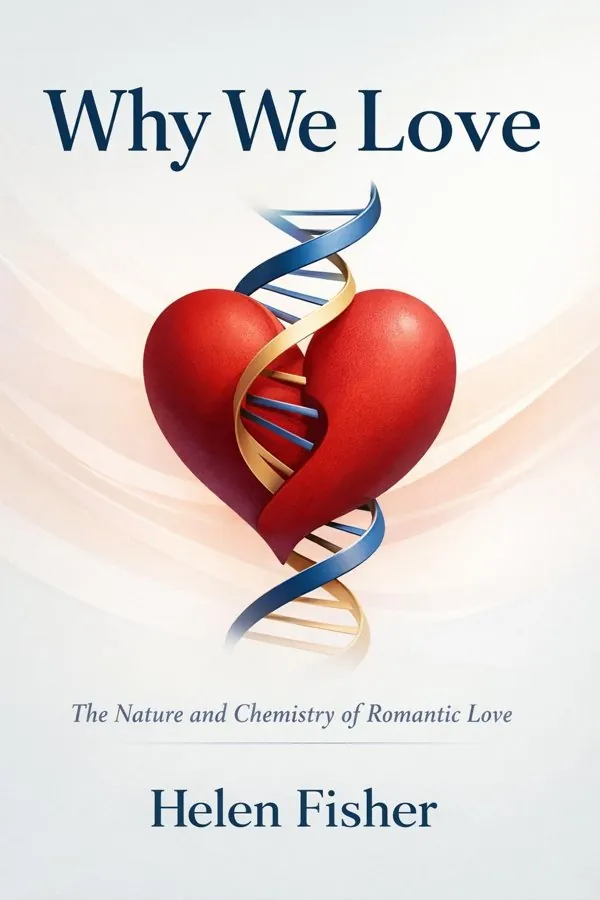
Why We Love: The Nature and Chemistry of Romantic Love: Summary & Key Insights
by Helen Fisher
 10 min10 chaptersAudio available
What Is Why We Love: The Nature and Chemistry of Romantic Love About?
Why We Love: The Nature and Chemistry of Romantic Love by Helen Fisher is a romantic_relationships book spanning 10 pages. In this groundbreaking work, biological anthropologist Helen Fisher explores the science behind romantic love. Drawing on neuroscience, psychology, and evolutionary biology, she reveals how human attraction and attachment are deeply rooted in brain chemistry and evolutionary imperatives. Fisher explains the biological mechanisms that drive passion, intimacy, and long-term bonding, offering insights into why we fall in love, how we choose partners, and what happens when love fades.
This FizzRead summary covers all 10 key chapters of Why We Love: The Nature and Chemistry of Romantic Love in approximately 10 minutes, distilling the most important ideas, arguments, and takeaways from Helen Fisher's work. Also available as an audio summary and Key Quotes Podcast.
Why We Love: The Nature and Chemistry of Romantic Love
In this groundbreaking work, biological anthropologist Helen Fisher explores the science behind romantic love. Drawing on neuroscience, psychology, and evolutionary biology, she reveals how human attraction and attachment are deeply rooted in brain chemistry and evolutionary imperatives. Fisher explains the biological mechanisms that drive passion, intimacy, and long-term bonding, offering insights into why we fall in love, how we choose partners, and what happens when love fades.
Who Should Read Why We Love: The Nature and Chemistry of Romantic Love?
This book is perfect for anyone interested in romantic_relationships and looking to gain actionable insights in a short read. Whether you're a student, professional, or lifelong learner, the key ideas from Why We Love: The Nature and Chemistry of Romantic Love by Helen Fisher will help you think differently.
- ✓Readers who enjoy romantic_relationships and want practical takeaways
- ✓Professionals looking to apply new ideas to their work and life
- ✓Anyone who wants the core insights of Why We Love: The Nature and Chemistry of Romantic Love in just 10 minutes
Want the full summary?
Get instant access to this book summary and 100K+ more with Fizz Moment.
Get Free SummaryAvailable on App Store • Free to download
Key Chapters
When we think of love, we often think of something ineffable—music, poetry, the flutter of the heart. But in reality, romantic love evolved because it solved specific survival problems. In ancestral environments, forming a romantic bond increased the likelihood of successful reproduction and child survival. I argue that love is an adaptation—an evolved strategy that helped mates focus their energy on one partner long enough to conceive and raise offspring.
Our ancestors faced demanding environments. Those who could form strong pair bonds were more likely to protect and provide for their young, ensuring their genes persisted. Romantic love, therefore, is not merely about pleasure or companionship; it is about focused mating effort. Evolution shaped our brains to crave this singular attachment.
Yet this drive operates alongside two others: the sex drive, which motivates us to seek partners; and attachment, which keeps us together after mating. Love forms a bridge between those systems. It narrows attention to one person, motivating perseverance even when challenges arise. In ancient times, those who could maintain such bonds survived. Love, in short, is nature’s matchmaking trick—bonding chemistry wrapped in idealism.
When I began using brain scanners to study people newly in love, what I found astonished even me. Romantic passion activates the same brain circuits that spark when we anticipate rewards—particularly deep regions such as the ventral tegmental area and the caudate nucleus, both rich in dopamine-producing neurons. In essence, love is not an emotion but a drive: a motivation system designed to focus our energy on one person.
Dopamine floods the brain in these early stages, creating feelings of euphoria, heightened energy, and intense focus. You can’t eat, can’t sleep, and can’t stop thinking about your beloved. Norepinephrine amplifies alertness and excitement, while serotonin levels often drop—perhaps explaining the obsessional thinking that characterizes infatuation. In the scanning room, those illuminated brain maps mirrored what lovers told me in interviews: love feels both exhilarating and uncontrollable.
This understanding reframes love not as madness, but as biology at work. When you fall in love, you are neurologically rewarded for your focus. Nature reinforces your choice, urging you to pursue and maintain this singular bond. Understanding this does not diminish the mystery; rather, it reveals how ancient and integral passion truly is.
+ 8 more chapters — available in the FizzRead app
All Chapters in Why We Love: The Nature and Chemistry of Romantic Love
About the Author
Helen Fisher is an American biological anthropologist and research fellow at the Kinsey Institute. She is known for her pioneering research on the biology of love and attraction, and has authored several influential books on human relationships and mating behavior.
Get This Summary in Your Preferred Format
Read or listen to the Why We Love: The Nature and Chemistry of Romantic Love summary by Helen Fisher anytime, anywhere. FizzRead offers multiple formats so you can learn on your terms — all free.
Available formats: App · Audio · PDF · EPUB — All included free with FizzRead
Download Why We Love: The Nature and Chemistry of Romantic Love PDF and EPUB Summary
Key Quotes from Why We Love: The Nature and Chemistry of Romantic Love
“When we think of love, we often think of something ineffable—music, poetry, the flutter of the heart.”
“When I began using brain scanners to study people newly in love, what I found astonished even me.”
Frequently Asked Questions about Why We Love: The Nature and Chemistry of Romantic Love
Why We Love: The Nature and Chemistry of Romantic Love by Helen Fisher is a romantic_relationships book that explores key ideas across 10 chapters. In this groundbreaking work, biological anthropologist Helen Fisher explores the science behind romantic love. Drawing on neuroscience, psychology, and evolutionary biology, she reveals how human attraction and attachment are deeply rooted in brain chemistry and evolutionary imperatives. Fisher explains the biological mechanisms that drive passion, intimacy, and long-term bonding, offering insights into why we fall in love, how we choose partners, and what happens when love fades.
You Might Also Like

Rebel
Beverly Jenkins
10 min
The Last Letter
Rebecca Yarros
10 min
A Thousand Boy Kisses
Tillie Cole
10 min
Aflame
Penelope Douglas
10 min
After The Bite
Lynsay Sands
10 min
Alchemised
SenLinYu
10 minBrowse by Category
Ready to read Why We Love: The Nature and Chemistry of Romantic Love?
Get the full summary and 100K+ more books with Fizz Moment.