
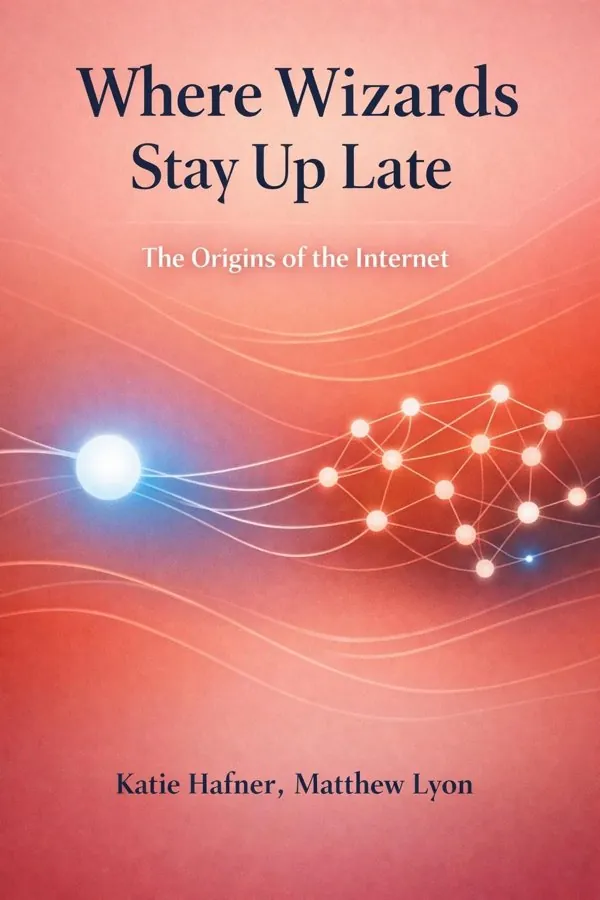
Where Wizards Stay Up Late: The Origins of the Internet: Summary & Key Insights
 10 min4 chaptersAudio available
What Is Where Wizards Stay Up Late: The Origins of the Internet About?
Where Wizards Stay Up Late: The Origins of the Internet by Katie Hafner, Matthew Lyon is a technology book spanning 4 pages. This book chronicles the creation of the ARPANET, the pioneering computer network that evolved into the modern Internet. Drawing on interviews with key engineers, scientists, and visionaries, it recounts how a small group of researchers in the 1960s and 1970s built a revolutionary communication system that transformed global connectivity.
This FizzRead summary covers all 4 key chapters of Where Wizards Stay Up Late: The Origins of the Internet in approximately 10 minutes, distilling the most important ideas, arguments, and takeaways from Katie Hafner, Matthew Lyon's work. Also available as an audio summary and Key Quotes Podcast.
Where Wizards Stay Up Late: The Origins of the Internet
This book chronicles the creation of the ARPANET, the pioneering computer network that evolved into the modern Internet. Drawing on interviews with key engineers, scientists, and visionaries, it recounts how a small group of researchers in the 1960s and 1970s built a revolutionary communication system that transformed global connectivity.
Who Should Read Where Wizards Stay Up Late: The Origins of the Internet?
This book is perfect for anyone interested in technology and looking to gain actionable insights in a short read. Whether you're a student, professional, or lifelong learner, the key ideas from Where Wizards Stay Up Late: The Origins of the Internet by Katie Hafner, Matthew Lyon will help you think differently.
- ✓Readers who enjoy technology and want practical takeaways
- ✓Professionals looking to apply new ideas to their work and life
- ✓Anyone who wants the core insights of Where Wizards Stay Up Late: The Origins of the Internet in just 10 minutes
Want the full summary?
Get instant access to this book summary and 100K+ more with Fizz Moment.
Get Free SummaryAvailable on App Store • Free to download
Key Chapters
In the 1950s and early 1960s, computing lived behind locked doors. Machines filled entire rooms, demanded constant maintenance, and answered only to specialists. Each computer was an island. Communication between them was nearly impossible. It was a world dominated by batch processing, where users submitted decks of punched cards and waited hours—or days—for results. There was no interactivity, no network, and no conversation between man and machine.
It was into this environment that J.C.R. Licklider—Lick, as everyone called him—entered with a disruptive idea. At MIT’s Lincoln Laboratory and later as head of ARPA’s Information Processing Techniques Office (IPTO), Lick envisioned something radical: computers as communicators. He imagined a world in which scientists at distant locations could share ideas instantly through interconnected machines—a world of online collaboration, what he playfully called an “Intergalactic Computer Network.” What made Licklider extraordinary wasn’t just his technical acumen but his psychological insight. Trained as a psychologist, he viewed computers as partners in thinking, extensions of the human mind.
When Licklider joined ARPA, his mission was to fund research that would bring interactive computing to life. Most of the computing establishment saw a computer as a calculator; Lick saw it as a medium for dialogue. His letters and memos—particularly his memo on ‘Man-Computer Symbiosis’—would become the philosophical blueprint for everything that followed. He gathered around him a community of believers, including young researchers at MIT, Stanford, and UCLA, who understood that connecting computers was not only technically feasible but socially transformative.
Under Licklider’s gentle but persistent guidance, the IPTO fostered a new research culture. Instead of top-down military projects, ARPA encouraged creative autonomy. Scientists were free to explore, fail, and improvise. The result was astonishing speed. Within a few years, ideas like time-sharing, packet-switching, and wide-area networking emerged—not from corporate R&D departments but from university labs alive with youthful enthusiasm. This freedom laid the foundation for everything that became the Internet.
As the 1960s unfolded, the challenge shifted from vision to implementation. Could these ideas about shared computing resources and communication actually work? The technical challenge was immense: how could disparate machines—with different architectures and operating systems—exchange data efficiently and reliably? The solution came from a radical concept known as packet switching.
Traditional communications, such as telephony, used circuit-switching: a fixed physical path carried data from one end to the other. That made perfect sense for voice calls, but it was disastrously inefficient for computers, which send information in bursts. In packet switching, data would be broken into discrete packets, each carrying address headers and capable of finding its own route across a network. The concept had been floated by researchers like Paul Baran and Donald Davies, but it was in the ARPA context that it moved from theory to reality.
In 1967, Larry Roberts—another Licklider disciple—was appointed to lead what would become the ARPANET project. Roberts had both the credibility and the sheer organizational stamina to make it happen. He set out to connect four major computing centers—UCLA, Stanford Research Institute (SRI), the University of California at Santa Barbara (UCSB), and the University of Utah—into a common network by the end of 1969. It was a breathtakingly ambitious goal.
At the heart of the design was the Interface Message Processor, or IMP, a rugged packet-switching node that would connect to local computers. The contract to build the IMPs was awarded to Bolt Beranek and Newman (BBN), a small Cambridge firm known for its engineering creativity. Frank Heart led a small, tireless team that quite literally worked nights and weekends to make the impossible real. When the first IMPs shipped, they resembled refrigerator-sized cabinets. But they embodied an idea that would scale endlessly.
The first node went live at UCLA in September 1969, and a month later the second node came online at SRI. On October 29, 1969, a young graduate student, Charley Kline, attempted to send the first message over the network from UCLA to SRI. They intended to type “LOGIN.” The system crashed after the first two letters—“LO”—but even in that failure, the Internet’s first message had been sent. It was a modest beginning that carried with it the seeds of a revolution.
+ 2 more chapters — available in the FizzRead app
All Chapters in Where Wizards Stay Up Late: The Origins of the Internet
About the Authors
Katie Hafner is an American journalist and author known for her work on technology and society, contributing to The New York Times and other publications. Matthew Lyon was a writer and researcher who collaborated with Hafner on this detailed history of the Internet’s early development.
Get This Summary in Your Preferred Format
Read or listen to the Where Wizards Stay Up Late: The Origins of the Internet summary by Katie Hafner, Matthew Lyon anytime, anywhere. FizzRead offers multiple formats so you can learn on your terms — all free.
Available formats: App · Audio · PDF · EPUB — All included free with FizzRead
Download Where Wizards Stay Up Late: The Origins of the Internet PDF and EPUB Summary
Key Quotes from Where Wizards Stay Up Late: The Origins of the Internet
“In the 1950s and early 1960s, computing lived behind locked doors.”
“As the 1960s unfolded, the challenge shifted from vision to implementation.”
Frequently Asked Questions about Where Wizards Stay Up Late: The Origins of the Internet
Where Wizards Stay Up Late: The Origins of the Internet by Katie Hafner, Matthew Lyon is a technology book that explores key ideas across 4 chapters. This book chronicles the creation of the ARPANET, the pioneering computer network that evolved into the modern Internet. Drawing on interviews with key engineers, scientists, and visionaries, it recounts how a small group of researchers in the 1960s and 1970s built a revolutionary communication system that transformed global connectivity.
You Might Also Like

Browse by Category
Ready to read Where Wizards Stay Up Late: The Origins of the Internet?
Get the full summary and 100K+ more books with Fizz Moment.