
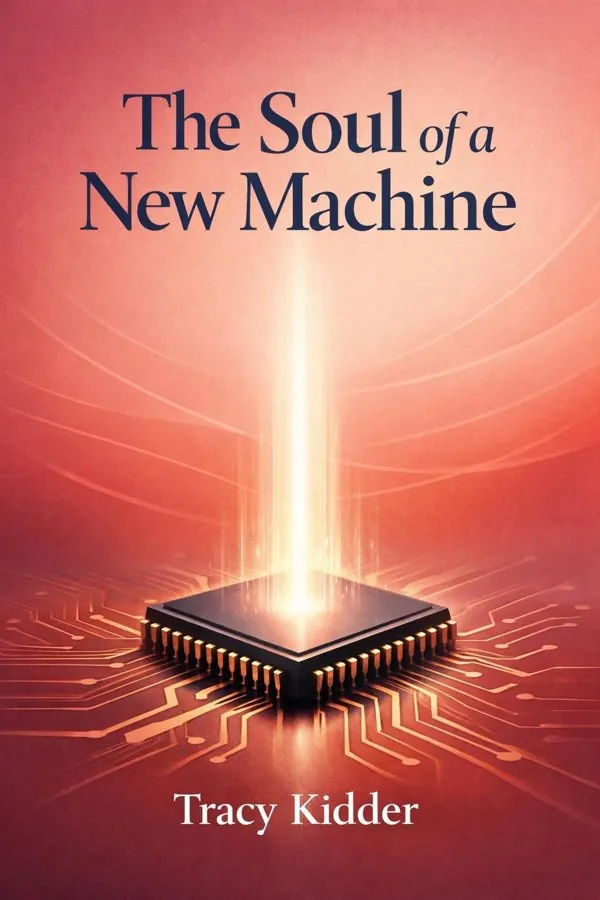
The Soul of a New Machine: Summary & Key Insights
by Tracy Kidder
 10 min4 chaptersAudio available
What Is The Soul of a New Machine About?
The Soul of a New Machine by Tracy Kidder is a technology book spanning 4 pages. A nonfiction account of the development of a new computer at Data General Corporation in the late 1970s, chronicling the engineers’ intense work, technical challenges, and the human dynamics behind innovation in the computing industry.
This FizzRead summary covers all 4 key chapters of The Soul of a New Machine in approximately 10 minutes, distilling the most important ideas, arguments, and takeaways from Tracy Kidder's work. Also available as an audio summary and Key Quotes Podcast.
The Soul of a New Machine
A nonfiction account of the development of a new computer at Data General Corporation in the late 1970s, chronicling the engineers’ intense work, technical challenges, and the human dynamics behind innovation in the computing industry.
Who Should Read The Soul of a New Machine?
This book is perfect for anyone interested in technology and looking to gain actionable insights in a short read. Whether you're a student, professional, or lifelong learner, the key ideas from The Soul of a New Machine by Tracy Kidder will help you think differently.
- ✓Readers who enjoy technology and want practical takeaways
- ✓Professionals looking to apply new ideas to their work and life
- ✓Anyone who wants the core insights of The Soul of a New Machine in just 10 minutes
Want the full summary?
Get instant access to this book summary and 100K+ more with Fizz Moment.
Get Free SummaryAvailable on App Store • Free to download
Key Chapters
In the late 1970s, the minicomputer was the beating heart of a new technological frontier. Data General, a Massachusetts-based company, had once been an industry pioneer. But by the time this story begins, its chief competitor, DEC, was eating its lunch. DEC’s new VAX computer had set a new standard—a faster, more powerful model that changed expectations across the industry. Data General’s leadership knew they needed something radical to stay alive, but the path forward was tangled in corporate politics and technological risk.
Inside Data General, the main project—the Eclipse MV/8000, internally known as the Eagle—wasn’t just about building another machine. It was about restoring a sense of purpose and winning back prestige. The pressure came from every direction—investors wanted results, management wanted secrecy, and engineers wanted autonomy. Against that backdrop, a quiet, intense man named Tom West stepped forward. West had a peculiar mix of authority and restraint; he delegated freely but trusted sparingly. To him, this project wasn’t just another job—it was an opportunity to prove what a small, scrappy team could do when driven by purpose rather than policy.
Eagle was born in secrecy. Officially, another project—the Fountain—was the company’s main bet. But Eagle, operating almost as a skunkworks project, had to outperform its better-funded sibling. This duality set the tone for the whole story: a blend of rebellion and loyalty, defiance and dedication. The engineers rallied under West’s cryptic leadership, pulled in not by salaries or titles, but by the challenge of doing something others said could not be done.
From this tension emerged the soul of the machine itself—the idea that technology is not just an artifact but a story of people wrestling with limits, ambition, and the relentless pace of change.
To build the Eagle, West needed more than technical competence—he needed belief. He assembled a group of young engineers, most fresh out of college, who would become known as the Hardy Boys. These were kids in the purest sense of engineering culture—brilliant, untested, intoxicated by the challenge of bending logic and physics to their will.
The Hardy Boys worked long into the night in a drab office filled with terminals, equipment racks, and the smell of solder and coffee. They designed logic circuits by hand, wrote microcode line by line, and battled with timing errors that could collapse entire systems. Yet what united them was not corporate loyalty but a sense of adventure. In West’s minimalist, mystical management style, they found both frustration and liberation. He rarely gave praise or clear orders, preferring instead to let them confront problems until they became personal trials of intellect and will.
This environment forged a deep camaraderie—what Kidder captures as the peculiar fraternity of technical creativity. From the outside, their work seemed mechanical and monotonous; from the inside, it was a passionate, almost artistic endeavor. The engineers took pride in clever debug fixes, in the elegance of a circuit’s solution, in the clean alignment of logic that only a fellow enthusiast could appreciate. Over time, fatigue blurred into identification: they were the machine, and the machine was them.
Still, this unity came with a cost. Personal lives frayed. Relationships strained. The office became their home, the project their purpose. For some, like West, it was a way to stave off existential emptiness—for others, it was the purest form of creation they’d ever taste. Through the Hardy Boys, the book reveals that innovation is never sterile—it’s fueled by obsession, camaraderie, and the fragile human spirits that tie them together.
+ 2 more chapters — available in the FizzRead app
All Chapters in The Soul of a New Machine
About the Author
Tracy Kidder is an American author and journalist known for his narrative nonfiction works that explore technology, education, and social issues. He won the Pulitzer Prize for 'The Soul of a New Machine' and has been recognized for his detailed, human-centered reporting.
Get This Summary in Your Preferred Format
Read or listen to the The Soul of a New Machine summary by Tracy Kidder anytime, anywhere. FizzRead offers multiple formats so you can learn on your terms — all free.
Available formats: App · Audio · PDF · EPUB — All included free with FizzRead
Download The Soul of a New Machine PDF and EPUB Summary
Key Quotes from The Soul of a New Machine
“In the late 1970s, the minicomputer was the beating heart of a new technological frontier.”
“To build the Eagle, West needed more than technical competence—he needed belief.”
Frequently Asked Questions about The Soul of a New Machine
The Soul of a New Machine by Tracy Kidder is a technology book that explores key ideas across 4 chapters. A nonfiction account of the development of a new computer at Data General Corporation in the late 1970s, chronicling the engineers’ intense work, technical challenges, and the human dynamics behind innovation in the computing industry.
More by Tracy Kidder

You Might Also Like



Browse by Category
Ready to read The Soul of a New Machine?
Get the full summary and 100K+ more books with Fizz Moment.