
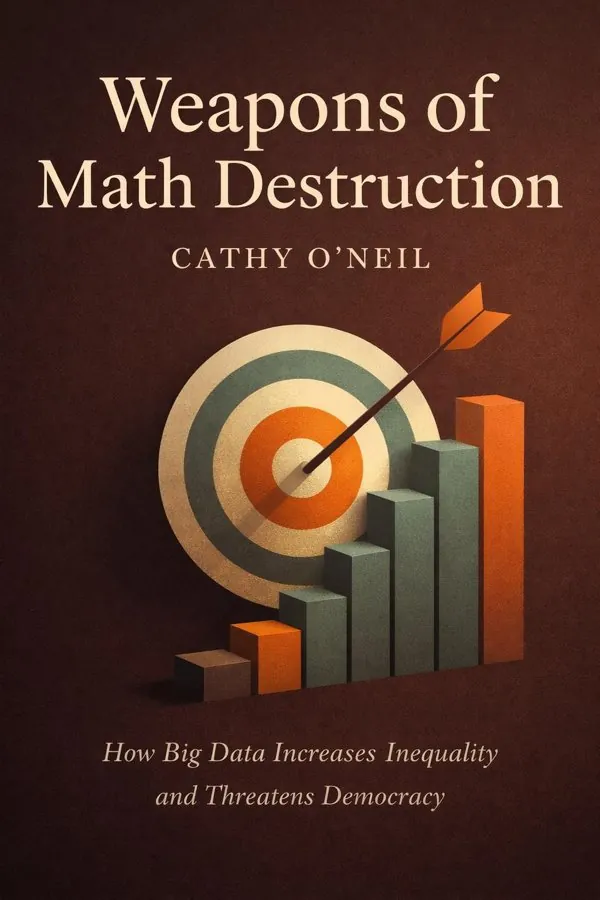
Weapons of Math Destruction: How Big Data Increases Inequality and Threatens Democracy: Summary & Key Insights
by Cathy O’Neil
 10 min9 chaptersAudio available
Key Takeaways from Weapons of Math Destruction: How Big Data Increases Inequality and Threatens Democracy
One of the most dangerous myths in modern society is that numbers do not lie.
Not all algorithms are harmful, and O’Neil is careful to draw that distinction.
When a ranking becomes a target, it stops being a neutral measure and starts changing behavior.
A job application rejected in seconds may feel efficient, but efficiency is not the same as fairness.
Financial models are often presented as simple tools for managing risk, but risk scoring can become a way of charging the vulnerable more for being vulnerable.
What Is Weapons of Math Destruction: How Big Data Increases Inequality and Threatens Democracy About?
Weapons of Math Destruction: How Big Data Increases Inequality and Threatens Democracy by Cathy O’Neil is a data_science book spanning 11 pages. Weapons of Math Destruction is a powerful critique of the modern belief that algorithms are naturally objective, efficient, and fair. In this book, mathematician and data scientist Cathy O’Neil argues that many of the models now used to rank schools, screen job applicants, set insurance prices, predict criminal behavior, target voters, and approve loans are not neutral tools at all. Instead, when they are opaque, unaccountable, and deployed at massive scale, they can deepen inequality, punish the poor, and undermine democratic life. O’Neil calls these systems “Weapons of Math Destruction,” or WMDs, because they combine technical authority with real-world harm. What makes the book especially compelling is O’Neil’s perspective: she is not an outsider criticizing technology from afar, but a trained mathematician with experience in academia, hedge funds, and data science. She understands both the elegance of mathematical models and the incentives that distort their use. The result is a clear, urgent, and highly relevant book that helps readers see how automated decision-making shapes everyday life—and why we must demand transparency, fairness, and accountability from the systems governing us.
This FizzRead summary covers all 9 key chapters of Weapons of Math Destruction: How Big Data Increases Inequality and Threatens Democracy in approximately 10 minutes, distilling the most important ideas, arguments, and takeaways from Cathy O’Neil's work. Also available as an audio summary and Key Quotes Podcast.
Weapons of Math Destruction: How Big Data Increases Inequality and Threatens Democracy
Weapons of Math Destruction is a powerful critique of the modern belief that algorithms are naturally objective, efficient, and fair. In this book, mathematician and data scientist Cathy O’Neil argues that many of the models now used to rank schools, screen job applicants, set insurance prices, predict criminal behavior, target voters, and approve loans are not neutral tools at all. Instead, when they are opaque, unaccountable, and deployed at massive scale, they can deepen inequality, punish the poor, and undermine democratic life. O’Neil calls these systems “Weapons of Math Destruction,” or WMDs, because they combine technical authority with real-world harm. What makes the book especially compelling is O’Neil’s perspective: she is not an outsider criticizing technology from afar, but a trained mathematician with experience in academia, hedge funds, and data science. She understands both the elegance of mathematical models and the incentives that distort their use. The result is a clear, urgent, and highly relevant book that helps readers see how automated decision-making shapes everyday life—and why we must demand transparency, fairness, and accountability from the systems governing us.
Who Should Read Weapons of Math Destruction: How Big Data Increases Inequality and Threatens Democracy?
This book is perfect for anyone interested in data_science and looking to gain actionable insights in a short read. Whether you're a student, professional, or lifelong learner, the key ideas from Weapons of Math Destruction: How Big Data Increases Inequality and Threatens Democracy by Cathy O’Neil will help you think differently.
- ✓Readers who enjoy data_science and want practical takeaways
- ✓Professionals looking to apply new ideas to their work and life
- ✓Anyone who wants the core insights of Weapons of Math Destruction: How Big Data Increases Inequality and Threatens Democracy in just 10 minutes
Want the full summary?
Get instant access to this book summary and 100K+ more with Fizz Moment.
Get Free SummaryAvailable on App Store • Free to download
Key Chapters
One of the most dangerous myths in modern society is that numbers do not lie. When big data rose to prominence, it arrived with a hopeful promise: decisions could become more rational, less biased, and more meritocratic. Instead of relying on flawed human judgment, institutions could use evidence, patterns, and statistical models to sort candidates, predict outcomes, and allocate resources more efficiently. To many technologists, including Cathy O’Neil earlier in her career, this sounded like progress.
But the book shows why this optimism was incomplete. Data does not speak for itself; people choose what to measure, which outcomes matter, what assumptions to include, and how to define success. A model built on biased historical data does not erase injustice—it often codifies it. If a bank has historically underserved poor neighborhoods, or if an employer has disproportionately hired from elite schools, a model trained on that history may simply automate those patterns and label them “objective.”
The appeal of big data comes from its scale and speed. It can process more information than any human could. Yet scale without reflection creates risk. A flawed hiring manager may harm dozens of applicants; a flawed algorithm can reject millions. The authority of mathematics also makes these decisions harder to challenge, because people assume that a model must be right if it is technical enough.
O’Neil’s core point is not that data is useless, but that data-driven systems inherit values from the institutions that build them. The practical takeaway is simple: whenever a model claims to improve fairness, ask what data it uses, what outcome it optimizes, and who bears the cost when it gets things wrong.
Not all algorithms are harmful, and O’Neil is careful to draw that distinction. A recommendation engine that suggests movies is inconvenient when it fails; a model that determines whether someone gets a job, loan, parole hearing, or affordable insurance can reshape a life. O’Neil reserves the term “Weapon of Math Destruction” for systems that combine three features: opacity, scale, and damage.
Opacity means the model is a black box. The people affected usually cannot see how the system works, what variables it uses, or how to appeal its decisions. They may be told only that they failed to meet a hidden standard. Scale means the model is widely deployed, so its judgments affect large populations. Damage means the model causes real harm, often to people with the fewest resources to resist it.
This framework helps readers distinguish between harmless automation and socially dangerous modeling. Consider a credit score. It may include variables that seem statistically useful but correlate with class disadvantage. A person denied a loan often has little way to inspect or contest the logic behind the score. Multiply that process across millions of people, and the model becomes a mechanism for distributing opportunity and hardship.
By contrast, a baseball analytics model that predicts player performance may be secretive, but players can ultimately prove the model wrong on the field. In high-stakes social systems, that kind of feedback is often missing or delayed.
The actionable lesson is to evaluate algorithms not by their sophistication but by their social context. Ask three questions: Is it transparent? Is it used at scale? Can it cause serious harm? If the answer is yes, it deserves public scrutiny.
When a ranking becomes a target, it stops being a neutral measure and starts changing behavior. O’Neil uses education to show how metrics that appear informative can distort institutions and deepen inequality. College rankings, teacher evaluations, and school performance scores promise clarity for parents, students, and policymakers. Yet once these metrics carry prestige, funding, or punishment, schools begin optimizing for the numbers rather than the mission.
A university might spend heavily on cosmetic improvements that lift ranking criteria while neglecting teaching quality or student support. Schools may recruit students strategically to improve test averages instead of broadening access. Teacher evaluation systems, especially those tied to student test scores, can punish educators based on noisy statistical models that fail to capture classroom realities such as poverty, language barriers, or unstable home environments.
The problem is not measurement itself. Institutions need feedback. The problem is reducing complex human development to narrow proxies that are treated as truth. A ranking can become a self-fulfilling prophecy: top-ranked schools attract better applicants, more donations, and more media attention, while lower-ranked schools lose resources and reputation, even if they are doing vital work for difficult populations.
This dynamic affects families too. Students from wealthier backgrounds often know how to game the system with tutoring, application coaching, and strategic choices. Those with fewer resources are judged by the same metrics but without the same support.
O’Neil’s insight is that education metrics often reward advantage instead of measuring learning. The practical takeaway is to treat rankings and scores as partial signals, not definitive truths. If you are evaluating a school, ask what the metric leaves out: student growth, mentorship, affordability, context, and who benefits from the ranking system itself.
A job application rejected in seconds may feel efficient, but efficiency is not the same as fairness. O’Neil shows how employers increasingly use personality tests, résumé filters, productivity metrics, and behavioral scoring systems to sort workers before a human ever sees them. These tools are marketed as data-driven solutions that remove bias and reduce hiring costs. In practice, they often screen out capable people for opaque and questionable reasons.
Many hiring systems rely on proxies rather than demonstrated ability. They may prefer candidates with certain employment histories, zip codes, educational backgrounds, or digital behaviors that correlate with prior hires. But prior hires may reflect an organization’s past prejudices rather than true merit. If a company has historically favored applicants from elite institutions or excluded people with employment gaps, the model can reinforce those preferences automatically.
The damage goes beyond hiring. Workers may be monitored continuously and judged by metrics that measure speed, click rates, or customer interactions without considering quality, context, or impossible workloads. In low-wage sectors, these systems can trap people in cycles of instability, scheduling unpredictability, and punishment based on narrow performance indicators.
A crucial asymmetry appears here: elites are often hired through personal networks, interviews, and holistic judgment, while poorer applicants are subjected to rigid automated screening. In other words, the people with the least power face the most algorithmic scrutiny.
O’Neil’s broader warning is that models designed to reduce uncertainty in hiring may actually magnify social sorting. The actionable takeaway is for employers and applicants alike to demand validation. Ask whether the model predicts actual job success, whether it disproportionately excludes certain groups, and whether rejected applicants have a meaningful path to explanation or review.
Financial models are often presented as simple tools for managing risk, but risk scoring can become a way of charging the vulnerable more for being vulnerable. O’Neil examines credit scoring, loan underwriting, insurance pricing, and other financial systems to show how models can lock people into disadvantage. If you have less money, fewer assets, or a thinner credit history, the system may label you risky. Once labeled risky, you are offered worse terms, higher rates, and fewer opportunities, which makes financial stability even harder to achieve.
This is a classic feedback loop. Wealthy consumers often receive lower interest rates, better rewards, and more favorable treatment because they already appear safe. Poorer consumers may pay more for basic financial access, from payday loans to subprime products to higher insurance premiums. The math seems rational from the perspective of profit, but socially it becomes a machine for extracting resources from those who can least afford it.
O’Neil also points out that many financial products are too complex for consumers to understand, while firms using sophisticated analytics know exactly how to segment and target vulnerable populations. A model may discover, for example, which customers are least likely to comparison-shop or most likely to miss payments, and then design offers accordingly. This is not neutral optimization. It is precision exploitation.
The issue is not merely unfair individual outcomes; it is the normalization of a two-tier system in which data-rich institutions continuously learn how to price discriminate more effectively.
The practical takeaway is to view financial scores as political as well as technical. Support policies and products that increase transparency, limit predatory targeting, and give consumers access to understandable explanations, appeals, and fair alternatives.
When algorithms enter criminal justice, the cost of error becomes profound. O’Neil argues that predictive policing tools, recidivism scores, and sentencing models often claim scientific neutrality while reproducing historical patterns of unequal enforcement. If police have historically concentrated patrols in poor neighborhoods, the data will show more arrests there. A predictive model trained on that data may then recommend sending even more police to those same neighborhoods, generating more surveillance and more arrests. The system mistakes biased observation for objective reality.
This is a crucial distinction: crime data is not the same as crime. It reflects where authorities look, whom they stop, and what behaviors they prioritize. White-collar crime, tax fraud, wage theft, and other harms may be undercounted not because they are rare, but because they are less aggressively policed. Meanwhile, low-level street offenses in heavily monitored communities become statistical evidence that justifies further monitoring.
Risk assessment tools used in bail, parole, or sentencing raise similar concerns. They often rely on variables like neighborhood, employment history, prior arrests, or family background. Even if race is not explicitly included, proxies can reproduce racial and class disparities. Defendants may never fully understand the model judging them, yet its score can influence whether they remain free, go to jail, or face harsher treatment.
O’Neil does not deny that data can help improve justice. But using flawed historical patterns to predict future danger turns bias into policy.
The actionable takeaway is to insist that criminal justice algorithms meet the highest standards of transparency, independent auditing, and due process. If a model influences liberty, people must be able to examine, challenge, and contest it.
Some of the most powerful algorithms do not punish you directly; they shape what you see, what you believe, and what opportunities reach you. O’Neil explores how data-driven advertising systems segment populations, infer personal weaknesses, and deliver highly customized messages with little public visibility. In commerce, this allows firms to target likely buyers. In politics, it enables campaigns and interest groups to tailor emotional appeals, suppress turnout, or spread misinformation to specific audiences.
What makes this dangerous is the collapse of a shared public sphere. Traditional political communication was at least somewhat visible and contestable. A television ad could be debated by journalists, opponents, and voters. Microtargeted digital messages can be shown only to carefully chosen groups, making manipulation harder to detect and easier to deny. Different citizens may receive entirely different political realities.
The same machinery is used commercially to identify people in vulnerable moments: students anxious about debt, parents worried about safety, workers searching for jobs, or gamblers prone to addictive behavior. Models optimize for clicks, conversions, and engagement, not for truth or human flourishing. If inflammatory or deceptive content performs best, the system amplifies it.
O’Neil’s concern is democratic as much as economic. When persuasion becomes individualized and invisible, accountability weakens. People are no longer participating in a common debate but being nudged through personalized influence operations.
The practical takeaway is to treat targeted content skeptically. Ask why you are seeing a message, who paid for it, and what data likely informed it. On a broader level, support stronger disclosure rules, platform transparency, and limits on manipulative political and commercial targeting.
A flawed model can become more powerful precisely because it keeps generating evidence that appears to confirm itself. This is one of O’Neil’s most important ideas. Weapons of Math Destruction do not merely make isolated bad decisions; they create feedback loops that reinforce the conditions they predict. Once this happens, the model looks accurate not because it discovered truth, but because it helped produce the outcome.
Take predictive policing. More patrols in a neighborhood lead to more observed offenses, which then justify more patrols. Or consider credit scoring: poor financial terms increase the likelihood of default, which confirms that the borrower was risky all along. In education, low rankings can reduce applications and funding, causing institutional decline that seems to validate the ranking. In hiring, excluding candidates with unconventional backgrounds narrows the workforce, making the model appear successful because it only selects from people who resemble previous hires.
These loops are especially hard to break because the people harmed by them often lack the power to challenge the system. The model becomes an invisible architecture of opportunity. Meanwhile, decision-makers see cleaner dashboards, stronger correlations, and more confidence in the process.
O’Neil’s analysis reminds us that prediction is never fully passive. In social systems, predictions shape behavior, incentives, and institutions. A model can become an actor in the world it claims merely to describe.
The actionable takeaway is to examine whether a model is creating self-fulfilling outcomes. Whenever predictions affect human behavior, organizations should monitor not only accuracy but downstream effects: who gets excluded, who gets over-policed, who pays more, and whether the system is amplifying the very problem it claims to solve.
The answer to harmful algorithms is not to abandon mathematics, but to govern it. O’Neil ends on a constructive note: data science can serve the public if it is designed with accountability, transparency, and ethical purpose. Models should be evaluated not just for efficiency or profit, but for fairness, explainability, and social impact. In other words, technical success must include moral responsibility.
An ethical model begins by clarifying its objective. What exactly is being optimized, and is that goal defensible? A hiring algorithm that optimizes retention may inadvertently discriminate against people with caregiving responsibilities. A school metric that rewards test score gains may encourage teaching to the test. A political advertising model that maximizes engagement may spread outrage and lies. Better systems require broader definitions of success.
O’Neil also calls for auditing and feedback. High-stakes models should be tested regularly for disparate impact, error rates, and unintended consequences. People affected by decisions should have access to explanations and a route for appeal. Regulators, journalists, researchers, and citizens all have roles to play in making algorithmic power visible.
Most importantly, data scientists themselves must see their work as part of society, not outside it. Code is never neutral once it governs human opportunity. The profession needs norms closer to medicine or engineering, where practitioners are expected to consider safety and harm.
The practical takeaway is clear: if you build, buy, or manage algorithmic systems, insist on ethical review, external auditing, and measurable fairness standards. If a model affects people’s life chances, accountability is not optional—it is part of the design.
All Chapters in Weapons of Math Destruction: How Big Data Increases Inequality and Threatens Democracy
About the Author
Cathy O’Neil is an American mathematician, data scientist, and author known for her work on algorithmic accountability and the social impact of big data. She earned her PhD in mathematics from Harvard University and began her career as an academic before moving into quantitative finance during the hedge fund boom. After the financial crisis, she became increasingly critical of the ways mathematical models can be misused by powerful institutions. O’Neil later worked in data science and became a leading public voice on technology ethics, fairness, and transparency. Her book Weapons of Math Destruction brought widespread attention to how algorithms influence education, employment, finance, policing, and politics. Through her writing, speaking, and advisory work, she advocates for data systems that are more just, explainable, and accountable.
Get This Summary in Your Preferred Format
Read or listen to the Weapons of Math Destruction: How Big Data Increases Inequality and Threatens Democracy summary by Cathy O’Neil anytime, anywhere. FizzRead offers multiple formats so you can learn on your terms — all free.
Available formats: App · Audio · PDF · EPUB — All included free with FizzRead
Download Weapons of Math Destruction: How Big Data Increases Inequality and Threatens Democracy PDF and EPUB Summary
Key Quotes from Weapons of Math Destruction: How Big Data Increases Inequality and Threatens Democracy
“One of the most dangerous myths in modern society is that numbers do not lie.”
“Not all algorithms are harmful, and O’Neil is careful to draw that distinction.”
“When a ranking becomes a target, it stops being a neutral measure and starts changing behavior.”
“A job application rejected in seconds may feel efficient, but efficiency is not the same as fairness.”
“Financial models are often presented as simple tools for managing risk, but risk scoring can become a way of charging the vulnerable more for being vulnerable.”
Frequently Asked Questions about Weapons of Math Destruction: How Big Data Increases Inequality and Threatens Democracy
Weapons of Math Destruction: How Big Data Increases Inequality and Threatens Democracy by Cathy O’Neil is a data_science book that explores key ideas across 9 chapters. Weapons of Math Destruction is a powerful critique of the modern belief that algorithms are naturally objective, efficient, and fair. In this book, mathematician and data scientist Cathy O’Neil argues that many of the models now used to rank schools, screen job applicants, set insurance prices, predict criminal behavior, target voters, and approve loans are not neutral tools at all. Instead, when they are opaque, unaccountable, and deployed at massive scale, they can deepen inequality, punish the poor, and undermine democratic life. O’Neil calls these systems “Weapons of Math Destruction,” or WMDs, because they combine technical authority with real-world harm. What makes the book especially compelling is O’Neil’s perspective: she is not an outsider criticizing technology from afar, but a trained mathematician with experience in academia, hedge funds, and data science. She understands both the elegance of mathematical models and the incentives that distort their use. The result is a clear, urgent, and highly relevant book that helps readers see how automated decision-making shapes everyday life—and why we must demand transparency, fairness, and accountability from the systems governing us.
You Might Also Like
Data Science from Scratch: First Principles with Python
Joel Grus
10 min
Applied Predictive Modeling
Max Kuhn, Kjell Johnson
10 min
Better Data Visualizations: A Guide for Scholars, Researchers, and Wonks
Jonathan Schwabish
10 min
Big Data: A Revolution That Will Transform How We Live, Work, and Think
Viktor Mayer-Schönberger, Kenneth Cukier
10 min
Big Data: Principles and Best Practices of Scalable Real-Time Data Systems
Nathan Marz
10 min
Data Points: Visualization That Means Something
Nathan Yau
10 minBrowse by Category
Ready to read Weapons of Math Destruction: How Big Data Increases Inequality and Threatens Democracy?
Get the full summary and 100K+ more books with Fizz Moment.