
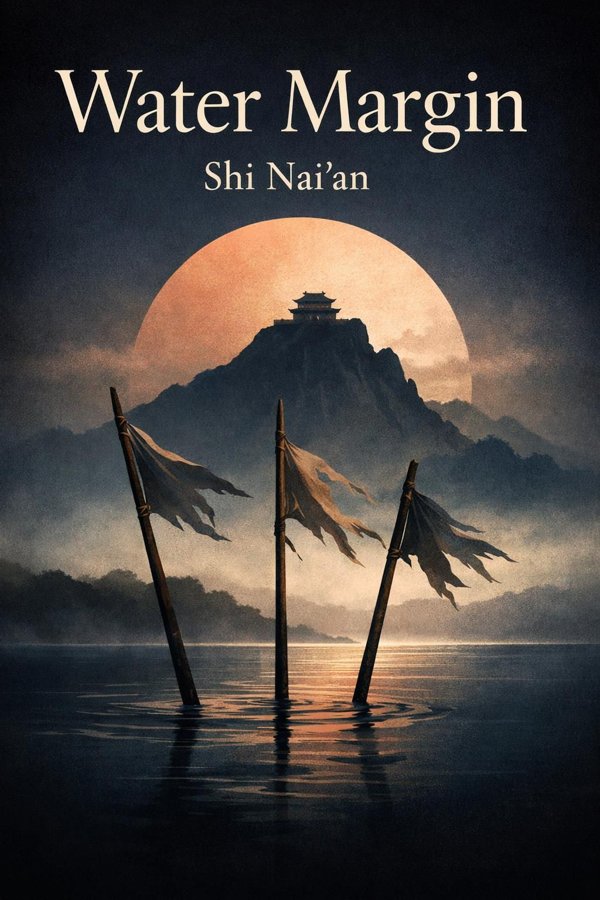
Water Margin: Summary & Key Insights
by Shi Nai'an
 10 min10 chaptersAudio available
Key Takeaways from Water Margin
A society rarely collapses because of one villain; it breaks when corruption becomes ordinary.
Heroes are often created not by ambition, but by injury.
Sometimes the edge of society becomes the place where human dignity is rebuilt.
Great leaders often unite people not because they are simple, but because they contain tension.
A movement becomes powerful when it learns how to absorb difference without losing identity.
What Is Water Margin About?
Water Margin by Shi Nai'an is a classics book spanning 10 pages. Water Margin, also known as Outlaws of the Marsh or All Men Are Brothers, is one of the Four Great Classical Novels of Chinese literature and one of the most influential stories ever written about rebellion, justice, and power. Set during the late Northern Song dynasty, it follows 108 men and women driven by corruption, betrayal, and social cruelty into outlaw life at Liangshan Marsh. What begins as a sequence of personal tragedies grows into a sweeping portrait of a society so broken that criminals may appear more honorable than officials. The novel endures because it offers more than adventure: it asks when resistance becomes moral, whether loyalty can survive politics, and what happens when idealism meets the state. Traditionally attributed to Shi Nai'an, a writer associated with the late Yuan and early Ming periods, the book stands out for its vivid vernacular style, unforgettable character portraits, and sharp social observation. Water Margin matters not only as a cornerstone of Chinese fiction, but as a timeless meditation on injustice, brotherhood, and the tragic cost of seeking righteousness in a corrupt world.
This FizzRead summary covers all 10 key chapters of Water Margin in approximately 10 minutes, distilling the most important ideas, arguments, and takeaways from Shi Nai'an's work. Also available as an audio summary and Key Quotes Podcast.
Water Margin
Water Margin, also known as Outlaws of the Marsh or All Men Are Brothers, is one of the Four Great Classical Novels of Chinese literature and one of the most influential stories ever written about rebellion, justice, and power. Set during the late Northern Song dynasty, it follows 108 men and women driven by corruption, betrayal, and social cruelty into outlaw life at Liangshan Marsh. What begins as a sequence of personal tragedies grows into a sweeping portrait of a society so broken that criminals may appear more honorable than officials. The novel endures because it offers more than adventure: it asks when resistance becomes moral, whether loyalty can survive politics, and what happens when idealism meets the state. Traditionally attributed to Shi Nai'an, a writer associated with the late Yuan and early Ming periods, the book stands out for its vivid vernacular style, unforgettable character portraits, and sharp social observation. Water Margin matters not only as a cornerstone of Chinese fiction, but as a timeless meditation on injustice, brotherhood, and the tragic cost of seeking righteousness in a corrupt world.
Who Should Read Water Margin?
This book is perfect for anyone interested in classics and looking to gain actionable insights in a short read. Whether you're a student, professional, or lifelong learner, the key ideas from Water Margin by Shi Nai'an will help you think differently.
- ✓Readers who enjoy classics and want practical takeaways
- ✓Professionals looking to apply new ideas to their work and life
- ✓Anyone who wants the core insights of Water Margin in just 10 minutes
Want the full summary?
Get instant access to this book summary and 100K+ more with Fizz Moment.
Get Free SummaryAvailable on App Store • Free to download
Key Chapters
A society rarely collapses because of one villain; it breaks when corruption becomes ordinary. That is one of the foundational insights of Water Margin. The late Northern Song world depicted in the novel is outwardly civilized, yet inwardly decayed. Officials enrich themselves, manipulate law for private gain, and treat common people as expendable. Under such conditions, crime is not simply a personal failure. It often becomes a distorted response to institutions that no longer protect the innocent.
The novel repeatedly shows how bad governance generates instability. Honest men are framed, households are ruined by extortion, and those without influence are left defenseless. This is why so many future Liangshan heroes do not begin as rebels in spirit. They begin as soldiers, clerks, teachers, hunters, jailers, or local strongmen trying to live within the system. When the system itself becomes predatory, lawful life turns impossible. Rebellion then appears less like a choice and more like the last remaining form of dignity.
This idea remains practical far beyond the novel. In organizations, families, and communities, trust erodes when rules are applied selectively. People become cynical not because they reject order, but because they see order used as a weapon. A workplace where favoritism outweighs merit, for example, may produce disengagement, sabotage, or quiet resistance. The outward problem seems behavioral, but the deeper cause is structural injustice.
Water Margin does not romanticize chaos, yet it forces readers to ask a hard question: when official systems become immoral, what options remain for ordinary people? The book suggests that restoring justice requires more than punishing a few bad actors. It requires examining the conditions that make corruption normal.
Actionable takeaway: When you see repeated conflict or rule-breaking, look beyond individuals and examine whether the system itself is rewarding unfairness.
Heroes are often created not by ambition, but by injury. Water Margin gives many of its central figures a moment of rupture in which the world they trusted turns against them. Lin Chong is one of the clearest examples: a skilled military instructor whose life is destroyed through false accusation and elite abuse of power. Wu Song, Lu Zhishen, and others likewise move toward outlawry through experiences of humiliation, betrayal, or legal manipulation. Their violence is not presented as pure virtue, but as a reaction to unbearable wrong.
This is one reason the novel feels psychologically powerful. Instead of introducing heroes as flawless champions, it shows how moral identity is forged under pressure. A person can be loyal, disciplined, and law-abiding for years, yet one corrupt official, one rigged verdict, or one act of predatory cruelty can drive him beyond the boundaries of accepted life. The novel invites us to sympathize with this process without fully endorsing every consequence.
In practical terms, this theme reminds us that behavior often has a backstory. In modern life, someone who appears angry, distrustful, or oppositional may be carrying a history of mistreatment. That does not excuse every action, but it changes how we understand human conduct. Leaders, teachers, and managers who ignore hidden grievances often misread symptoms as character flaws.
Water Margin also suggests that suffering can reveal latent strength. The characters discover courage, strategic intelligence, and fierce loyalty only after the system fails them. Hardship uncovers capacities that comfort never demanded.
Yet the book adds a warning: pain can ennoble, but it can also harden. The transition from victim to avenger is morally dangerous. Readers are asked to admire resilience while remaining alert to the cost of rage.
Actionable takeaway: Before judging someone’s extreme reaction, ask what injury or injustice may have shaped it, and respond to root causes rather than surface behavior alone.
Sometimes the edge of society becomes the place where human dignity is rebuilt. Liangshan Marsh is more than a hiding place for fugitives; it is an alternative community formed by people cast out by a corrupt order. In the novel, the marsh functions as both physical refuge and symbolic counterstate. Those who arrive there do not merely escape arrest. They enter a fellowship organized around codes of loyalty, courage, mutual aid, and rough justice.
This matters because Water Margin is not just a collection of outlaw biographies. It is a story about institution-building from below. The heroes pool talent, assign responsibilities, establish hierarchies, and create internal norms. Skilled fighters, planners, scouts, administrators, and negotiators all find roles. This turns a scattered group of wounded individuals into a functioning brotherhood. The message is clear: solidarity can transform vulnerability into strength.
The practical relevance is striking. Many people experience exclusion from formal systems, whether in workplaces, schools, or social environments. Healthy alternative communities can provide belonging, validation, and opportunity when official structures fail. Support groups, grassroots organizations, and mission-driven teams often thrive for this reason: they offer recognition where people once felt invisible.
At the same time, Water Margin avoids portraying such communities as perfect. The marsh is built on necessity and force, not innocence. It can protect, but it can also intensify the group’s separation from wider society. A refuge that begins as ethical resistance may become trapped by its own outsider identity.
Liangshan therefore represents a deep human truth: when institutions betray people, they create the conditions for parallel institutions. The stronger and fairer these informal communities become, the more they reveal the failures of official power.
Actionable takeaway: If an existing system excludes or harms people, do not just criticize it; build communities of trust that restore belonging, competence, and shared purpose.
Great leaders often unite people not because they are simple, but because they contain tension. Song Jiang, one of the novel’s central figures, exemplifies this complexity. He is admired for generosity, emotional intelligence, political awareness, and devotion to brotherhood. He earns trust because he recognizes talent, respects shared codes, and can speak to men of vastly different backgrounds. In many ways, he is the adhesive that transforms Liangshan from a collection of strong personalities into a coherent force.
Yet Song Jiang is also deeply conflicted. He is drawn to rebellion by circumstance and loyalty to his comrades, but he never fully abandons his attachment to the imperial order. He dreams of recognition, legitimacy, and service to the throne, even after the state has brutally mistreated men like him. This tension gives the novel much of its tragic force. The same leader who inspires solidarity also guides the brotherhood toward imperial pardon, setting in motion future disillusionment.
The novel’s treatment of Song Jiang offers a practical lesson about leadership. Charisma and moral reputation are not enough; the leader’s inner worldview shapes the fate of the whole group. A team may trust a leader’s kindness while underestimating his assumptions about authority, compromise, and acceptable sacrifice. In modern organizations, founders or executives often unite people around mission, but hidden loyalties to prestige, external validation, or institutional approval can redirect the entire enterprise.
Water Margin neither condemns nor glorifies Song Jiang outright. Instead, it presents leadership as morally weighty and historically consequential. A leader’s virtues may become dangerous when paired with unresolved attachment to the very system the group resists.
Actionable takeaway: When evaluating leadership, look beyond personal charisma and ask what deeper loyalties, ambitions, and beliefs will ultimately shape major decisions.
When lawful channels fail, force can begin to look righteous. Water Margin understands this temptation deeply. Many of the battles, ambushes, rescues, and raids carried out by the Liangshan heroes are framed as morally justified responses to oppression. The targets are often abusive officials, predatory landlords, or hostile military forces acting on behalf of corrupt power. Readers are invited to cheer acts of daring resistance because the legal order itself has lost credibility.
Yet the novel does not offer a simplistic celebration of violence. It repeatedly shows that force, even when initially justified, carries moral danger. Once a group becomes skilled at coercion, it may rely on it too easily. Personal vengeance can disguise itself as justice. Tactical necessity can override compassion. The same sword that protects the weak can also normalize bloodshed.
This tension is one reason the book remains mature and enduring. It recognizes that oppressed people may have real reasons to fight back, while also warning that violence changes those who wield it. In modern life, the principle extends beyond physical conflict. Aggressive tactics in politics, business, or activism may feel necessary against bad actors, but they can gradually distort the values of the movement itself. Winning by harmful methods can reshape what victory means.
The practical lesson is not passive submission. Rather, it is moral vigilance. Resistance requires strategy, boundaries, and continual reflection on whether means still serve ends. Water Margin shows heroes at their most admirable when they combine courage with restraint, not when they confuse anger with righteousness.
The novel therefore asks a difficult but essential question: how can one confront injustice without becoming captured by the logic of domination?
Actionable takeaway: If strong action is necessary, define clear moral limits in advance so that the methods you use do not quietly destroy the principles you claim to defend.
The greatest threats to a cause do not always come from outside; they often emerge from within. Water Margin is full of scenes in which the brotherhood must navigate pride, rivalry, differing temperaments, and competing moral instincts. Some heroes are disciplined and strategic, while others are impulsive, fierce, or easily provoked. These differences make Liangshan formidable, but they also make unity fragile.
This is crucial to the novel’s realism. A community founded on shared injury does not automatically achieve harmony. Common enemies can unite people temporarily, but lasting solidarity requires negotiation, hierarchy, forgiveness, and emotional maturity. The heroes frequently face dilemmas about obedience, punishment, status, and trust. Such moments reveal that loyalty is not just passionate feeling. It is a practice sustained through difficult decisions.
The practical value of this theme is obvious in any collaborative setting. Teams often assume that shared goals are enough to prevent conflict. They are not. High-performing groups need mechanisms for resolving disagreement, clarifying roles, and checking ego. Without those structures, talent turns into friction. A startup, creative team, or activist coalition can collapse not because its mission is weak, but because personal tensions overwhelm collective discipline.
Water Margin also shows that internal disagreement can be productive if handled well. Diverse dispositions mean the group can respond flexibly to changing circumstances. The challenge is to channel difference rather than suppress it. Brotherhood in the novel is not sameness; it is an unstable but meaningful commitment to remain bound despite friction.
The novel thus complicates romantic ideas of solidarity. Unity is precious precisely because it is difficult. It requires constant maintenance and cannot survive on emotion alone.
Actionable takeaway: In any group you value, treat conflict resolution as part of the mission, because loyalty survives not by avoiding tension, but by learning how to manage it honorably.
Recognition from power can be more dangerous than open persecution. One of the most consequential turns in Water Margin is the acceptance of imperial amnesty. For many of the Liangshan heroes, pardon appears to promise resolution: their crimes erased, their honor restored, their talents finally used in service of the realm rather than against it. On the surface, this seems like vindication. The outlaws are no longer hunted rebels but acknowledged subjects.
Yet the novel treats this moment with deep ambiguity. The state that failed them now seeks to absorb them. What looks like mercy is also strategy. By granting legitimacy, imperial power neutralizes a threatening alternative community and redirects its strength toward official campaigns. The brotherhood gains status, but loses autonomy. Their rebellion is not resolved; it is repurposed.
This dynamic has broad modern relevance. Institutions often handle dissent not only by suppressing it, but by co-opting it. A critic may be given a title, a reform movement may be absorbed into bureaucracy, or a disruptive innovator may be offered prestige in exchange for accommodation. These arrangements can produce real benefits, but they can also blunt the radical energy that made change possible in the first place.
Water Margin does not imply that legitimacy is always corrupt. Rather, it asks what is surrendered in the process of entering official structures. For Song Jiang in particular, imperial recognition fulfills a long-held dream, but for the brotherhood as a whole, it initiates a tragic transition from self-directed resistance to state-directed sacrifice.
The lesson is subtle: not every invitation from power is a victory. Some are tests of whether a movement can preserve its moral purpose while accepting institutional acceptance.
Actionable takeaway: When offered recognition by an established system, ask not only what you gain, but what independence, values, or leverage you may be giving up.
Winning official approval does not guarantee justice; sometimes it only changes the form of exploitation. After receiving amnesty, the Liangshan heroes are sent on military campaigns against external enemies and internal rebels. In theory, this allows them to prove loyalty and cleanse their reputations. In practice, it exposes the deep tragedy of their incorporation into the state. They fight bravely, but the rewards are uncertain, the sacrifices immense, and the political order remains morally compromised.
This phase of Water Margin transforms the novel from a story of outlaw resistance into a meditation on disillusionment. The heroes who once fought as brothers for one another now die in service of institutions that never truly understood them. The state gains from their courage while offering little lasting protection in return. What was framed as redemption becomes attrition.
The pattern is familiar in many areas of life. People often believe that once they are accepted by a prestigious institution, hard struggle will finally be meaningful and fairly rewarded. Yet organizations may consume loyalty without reciprocating it. Employees burn out for companies that replace them easily. Reformers enter systems hoping to humanize them, only to discover that the system uses their credibility more than it changes its own behavior.
Water Margin is especially powerful here because it does not simply say that the state is evil and the outlaws pure. Instead, it shows how idealistic integration can collide with entrenched power. The heroes are not only betrayed by others; they are betrayed by the hope that recognition would heal what injustice had broken.
This is the book’s darker wisdom: institutions may praise courage while still wasting the courageous.
Actionable takeaway: Do not assume that formal acceptance by a powerful institution means your values are now protected; keep evaluating whether your labor and loyalty are being honored or merely used.
A tragic ending can reveal truths that a triumphant ending would hide. The downfall of the Liangshan heroes is not an accidental dark twist; it is the emotional and moral completion of Water Margin. Deaths, betrayals, exhaustion, and political manipulation strip away the illusion that bravery alone can overcome systemic corruption. The novel closes not with stable reconciliation, but with a profound sense of waste, honor, and unresolved contradiction.
This ending matters because it changes how we read everything that came before. The feasts, vows, victories, and heroic exploits remain stirring, but they are now seen against a horizon of impermanence. Brotherhood is real, yet vulnerable. Justice is desired, yet compromised. Legitimacy is pursued, yet fatal. In this way, the novel achieves depth beyond adventure literature. It becomes a meditation on the cost of living ethically in a damaged world.
For modern readers, tragic closure offers a practical kind of wisdom. We often evaluate lives and projects by whether they end in obvious success. Water Margin suggests another standard: meaning may lie in fidelity to values even when outcomes are mixed or painful. A movement may not fully transform society, a career may not bring deserved reward, and a principled stand may carry loss. None of that makes the effort worthless.
At the same time, the ending warns against naive hero worship. Courage without structural change can be consumed. Noble people need more than personal virtue; they need institutions worthy of that virtue.
What lingers after the novel ends is not hopelessness, but sobered clarity. Human dignity can resist corruption, but it cannot remain untouched by it.
Actionable takeaway: Measure your commitments not only by visible success, but by whether they align with enduring values, while also working to build structures that can protect those values over time.
All Chapters in Water Margin
About the Author
Shi Nai'an is the traditional author associated with Water Margin, one of the Four Great Classical Novels of Chinese literature. He is believed to have lived during the late Yuan and early Ming dynasties and is often linked to Xinghua in Jiangsu province, though many details of his life remain uncertain. His reputation rests on the enduring power of Water Margin, a work celebrated for its vivid storytelling, memorable characters, social realism, and pioneering use of vernacular Chinese rather than elite literary language. The novel helped shape the development of long-form fiction in China and influenced countless later writers, dramatists, and storytellers. Whether understood as a single author or part of a more complex textual history, Shi Nai'an remains a towering figure in the history of Chinese narrative literature.
Get This Summary in Your Preferred Format
Read or listen to the Water Margin summary by Shi Nai'an anytime, anywhere. FizzRead offers multiple formats so you can learn on your terms — all free.
Available formats: App · Audio · PDF · EPUB — All included free with FizzRead
Download Water Margin PDF and EPUB Summary
Key Quotes from Water Margin
“A society rarely collapses because of one villain; it breaks when corruption becomes ordinary.”
“Heroes are often created not by ambition, but by injury.”
“Sometimes the edge of society becomes the place where human dignity is rebuilt.”
“Great leaders often unite people not because they are simple, but because they contain tension.”
“A movement becomes powerful when it learns how to absorb difference without losing identity.”
Frequently Asked Questions about Water Margin
Water Margin by Shi Nai'an is a classics book that explores key ideas across 10 chapters. Water Margin, also known as Outlaws of the Marsh or All Men Are Brothers, is one of the Four Great Classical Novels of Chinese literature and one of the most influential stories ever written about rebellion, justice, and power. Set during the late Northern Song dynasty, it follows 108 men and women driven by corruption, betrayal, and social cruelty into outlaw life at Liangshan Marsh. What begins as a sequence of personal tragedies grows into a sweeping portrait of a society so broken that criminals may appear more honorable than officials. The novel endures because it offers more than adventure: it asks when resistance becomes moral, whether loyalty can survive politics, and what happens when idealism meets the state. Traditionally attributed to Shi Nai'an, a writer associated with the late Yuan and early Ming periods, the book stands out for its vivid vernacular style, unforgettable character portraits, and sharp social observation. Water Margin matters not only as a cornerstone of Chinese fiction, but as a timeless meditation on injustice, brotherhood, and the tragic cost of seeking righteousness in a corrupt world.
More by Shi Nai'an
You Might Also Like





Browse by Category
Ready to read Water Margin?
Get the full summary and 100K+ more books with Fizz Moment.