
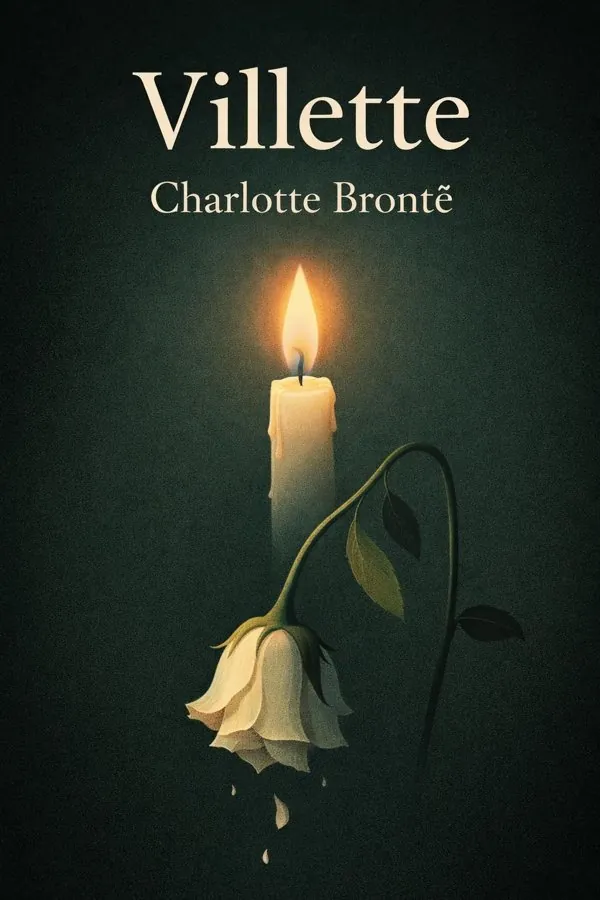
Villette: Summary & Key Insights
 10 min6 chaptersAudio available
What Is Villette About?
Villette by Charlotte Brontë is a classics book spanning 6 pages. Villette is the final novel by Charlotte Brontë, first published in 1853. It tells the story of Lucy Snowe, an Englishwoman who travels to the fictional city of Villette to teach at a girls’ boarding school. Through Lucy’s experiences, Brontë explores themes of isolation, identity, unrequited love, and the struggle for female independence within a restrictive society. The novel combines psychological depth with sharp social observation and a deeply personal narrative style.
This FizzRead summary covers all 6 key chapters of Villette in approximately 10 minutes, distilling the most important ideas, arguments, and takeaways from Charlotte Brontë's work. Also available as an audio summary and Key Quotes Podcast.
Villette
Villette is the final novel by Charlotte Brontë, first published in 1853. It tells the story of Lucy Snowe, an Englishwoman who travels to the fictional city of Villette to teach at a girls’ boarding school. Through Lucy’s experiences, Brontë explores themes of isolation, identity, unrequited love, and the struggle for female independence within a restrictive society. The novel combines psychological depth with sharp social observation and a deeply personal narrative style.
Who Should Read Villette?
This book is perfect for anyone interested in classics and looking to gain actionable insights in a short read. Whether you're a student, professional, or lifelong learner, the key ideas from Villette by Charlotte Brontë will help you think differently.
- ✓Readers who enjoy classics and want practical takeaways
- ✓Professionals looking to apply new ideas to their work and life
- ✓Anyone who wants the core insights of Villette in just 10 minutes
Want the full summary?
Get instant access to this book summary and 100K+ more with Fizz Moment.
Get Free SummaryAvailable on App Store • Free to download
Key Chapters
Lucy Snowe’s early life unfolds in quiet shadows. She is neither the orphan heroine of sentimental fiction nor the triumphant visionary of romance. Her story opens in a domestic setting—tranquil, respectable, restrained—but marked already by a certain isolation. She connects briefly with the Bretton family, finding in young Graham Bretton an early spark of warmth and companionship. Yet before affection can take root, circumstances tear her away. From that moment, Lucy’s life becomes one of self-containment. The early scenes in England establish her voice: composed, observant, and guarded. She endures losses unnamed to the reader, and though no grand tragedy is described, one senses beneath her composure the ache of displacement.
This reserve is not coldness. Rather, it is a survival instinct in a world that offers little to women without fortune or protection. Bereft of family, Lucy must rely upon intellect and propriety as her armor. She takes employment where she can, learning early how to govern emotion with duty. I wished to show through Lucy that emotional restraint can be both fortitude and prison—a necessary means of maintaining dignity, but one that risks suffocating vitality. Thus, when her few ties unravel and loneliness becomes unendurable, she does something radical for a woman of her time: she leaves England in search of a livelihood abroad.
Lucy’s journey to Villette is a pivotal act of courage. She travels alone, unaccompanied, to an unknown destination in a foreign land whose language she barely speaks. The voyage is described not in grand adventure tones but with quiet realism and private fear. The sea-crossing, with its tempest and sickness, mirrors her emotional turbulence. Upon arrival in the city of Villette, she finds herself destitute and friendless. Yet, by providence and her own composure, she meets Madame Beck, the administrator of a girls’ school, who engages her as an English teacher.
Madame Beck’s establishment is a world unto itself: ordered, cautious, rigidly moral on the surface, yet suffused with watchfulness. Madame Beck herself, the embodiment of surveillance and manipulation, governs her school with gentle tyranny. She spies upon teachers and pupils alike, and even upon Lucy, whose English reserve she cannot fathom. Within these walls, Lucy must learn the art of dissimulation—how to appear compliant while privately nurturing her own thoughts. This duplicity, though distasteful to her, becomes a form of self-preservation in a society that demands docility from women. Here the novel examines, with keen irony, the contradictions facing a woman who would live by her own mind.
+ 4 more chapters — available in the FizzRead app
All Chapters in Villette
About the Author
Charlotte Brontë (1816–1855) was an English novelist, the eldest of the Brontë sisters who achieved literary fame. She is best known for her works 'Jane Eyre', 'Shirley', and 'Villette'. Her writing is noted for its emotional intensity, exploration of female psychology, and critique of the social limitations imposed on women of her time.
Get This Summary in Your Preferred Format
Read or listen to the Villette summary by Charlotte Brontë anytime, anywhere. FizzRead offers multiple formats so you can learn on your terms — all free.
Available formats: App · Audio · PDF · EPUB — All included free with FizzRead
Download Villette PDF and EPUB Summary
Key Quotes from Villette
“Lucy Snowe’s early life unfolds in quiet shadows.”
“Lucy’s journey to Villette is a pivotal act of courage.”
Frequently Asked Questions about Villette
Villette by Charlotte Brontë is a classics book that explores key ideas across 6 chapters. Villette is the final novel by Charlotte Brontë, first published in 1853. It tells the story of Lucy Snowe, an Englishwoman who travels to the fictional city of Villette to teach at a girls’ boarding school. Through Lucy’s experiences, Brontë explores themes of isolation, identity, unrequited love, and the struggle for female independence within a restrictive society. The novel combines psychological depth with sharp social observation and a deeply personal narrative style.
More by Charlotte Brontë
You Might Also Like

Browse by Category
Ready to read Villette?
Get the full summary and 100K+ more books with Fizz Moment.