
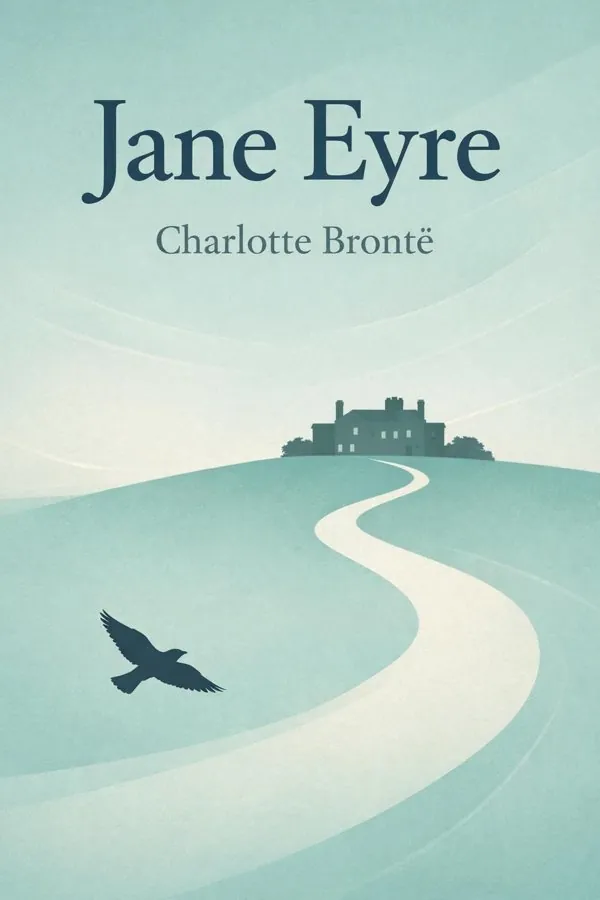
Jane Eyre: Summary & Key Insights
 10 min9 chaptersAudio available
Key Takeaways from Jane Eyre
A strong self is often born where love is absent.
Institutions often claim to improve people while quietly reproducing cruelty.
Not every form of strength looks like resistance.
Sometimes the greatest danger is not oppression but being loved on unequal terms.
The truths a household hides often reveal the truths a society refuses to face.
What Is Jane Eyre About?
Jane Eyre by Charlotte Brontë is a classics book spanning 5 pages. Jane Eyre is far more than a beloved Victorian love story. Charlotte Brontë’s novel follows an orphaned girl who begins life unwanted, humiliated, and powerless, yet gradually builds a self founded on conscience, intelligence, and emotional courage. From the oppressive rooms of Gateshead to the harsh discipline of Lowood School, from the haunted atmosphere of Thornfield Hall to the moral tests that shape her adulthood, Jane’s journey is one of becoming inwardly free in a world determined to rank people by class, gender, and wealth. What makes the novel endure is not only its memorable romance with the brooding Mr. Rochester, but its fierce insistence that love must never cost a person their dignity. Brontë writes with unusual psychological intensity, giving Jane a voice that is intimate, defiant, and morally alert. First published in 1847, the book remains a landmark in English literature because it blends gothic mystery, social criticism, spiritual inquiry, and emotional realism into a story that still feels startlingly modern. Jane Eyre matters because it asks a timeless question: how do you remain true to yourself while longing deeply to belong?
This FizzRead summary covers all 9 key chapters of Jane Eyre in approximately 10 minutes, distilling the most important ideas, arguments, and takeaways from Charlotte Brontë's work. Also available as an audio summary and Key Quotes Podcast.
Jane Eyre
Jane Eyre is far more than a beloved Victorian love story. Charlotte Brontë’s novel follows an orphaned girl who begins life unwanted, humiliated, and powerless, yet gradually builds a self founded on conscience, intelligence, and emotional courage. From the oppressive rooms of Gateshead to the harsh discipline of Lowood School, from the haunted atmosphere of Thornfield Hall to the moral tests that shape her adulthood, Jane’s journey is one of becoming inwardly free in a world determined to rank people by class, gender, and wealth. What makes the novel endure is not only its memorable romance with the brooding Mr. Rochester, but its fierce insistence that love must never cost a person their dignity. Brontë writes with unusual psychological intensity, giving Jane a voice that is intimate, defiant, and morally alert. First published in 1847, the book remains a landmark in English literature because it blends gothic mystery, social criticism, spiritual inquiry, and emotional realism into a story that still feels startlingly modern. Jane Eyre matters because it asks a timeless question: how do you remain true to yourself while longing deeply to belong?
Who Should Read Jane Eyre?
This book is perfect for anyone interested in classics and looking to gain actionable insights in a short read. Whether you're a student, professional, or lifelong learner, the key ideas from Jane Eyre by Charlotte Brontë will help you think differently.
- ✓Readers who enjoy classics and want practical takeaways
- ✓Professionals looking to apply new ideas to their work and life
- ✓Anyone who wants the core insights of Jane Eyre in just 10 minutes
Want the full summary?
Get instant access to this book summary and 100K+ more with Fizz Moment.
Get Free SummaryAvailable on App Store • Free to download
Key Chapters
A strong self is often born where love is absent. Jane’s childhood at Gateshead Hall begins not with comfort but rejection. As the orphaned dependent of her Aunt Reed, she lives in a house where she is constantly reminded that she is lesser: poorer than her cousins, less lovable than the family’s own children, and expected to accept injustice without protest. The adults call her difficult, but what they truly fear is her refusal to agree with her own humiliation. Her imprisonment in the red-room, where she is punished for defending herself, becomes an early emotional turning point. It teaches Jane that power often disguises cruelty as discipline. Yet it also awakens something essential in her: the conviction that her inner life has value even if no one around her acknowledges it.
This section of the novel matters because Brontë shows that moral independence does not begin in comfort. Jane’s first act of growth is not obedience but truthful resistance. She learns to name unfairness, to question authority, and to see that social rank does not equal virtue. Many readers recognize this pattern in real life. A child overlooked in a family, a student dismissed by teachers, or an employee underestimated in a workplace may discover that hardship sharpens self-knowledge. The lesson is not that suffering is good, but that a clear sense of wrong can become the foundation of personal integrity.
Jane’s time at Gateshead shows that self-respect often begins as a private flame. Actionable takeaway: when faced with belittlement, do not let others define your worth; identify the injustice clearly and protect your inner sense of value.
Institutions often claim to improve people while quietly reproducing cruelty. Lowood School appears to offer Jane rescue, education, and moral formation, but Brontë reveals a harsher truth. Under the hypocritical leadership of Mr. Brocklehurst, the school uses religious language to justify deprivation. The girls are underfed, cold, shamed, and treated as if comfort were a moral failure. Brocklehurst preaches humility while preserving privilege for himself and his family, exposing the gap between public virtue and private vanity. At Lowood, Jane learns that systems can wound as deeply as individuals.
Yet Lowood is not merely a place of oppression. It is also where Jane’s mind and soul begin to mature. Through education, she acquires intellectual discipline and practical skills. Through suffering, she learns patience. Most importantly, she meets Helen Burns and Miss Temple, two figures who widen her moral world. Helen models spiritual endurance and forgiveness, while Miss Temple represents intelligent kindness and principled leadership. Their influence helps Jane avoid becoming hard or purely reactive. She does not simply rebel; she learns to govern herself.
The practical insight here is subtle but powerful. Adverse environments can produce two equal dangers: submission or bitterness. Jane avoids both by developing competence and an internal standard of judgment. In modern life, people may encounter workplaces, schools, or communities that demand silence while rewarding appearance over substance. Jane’s example suggests that one should learn what is useful, recognize hypocrisy, and preserve moral clarity without losing humanity.
Lowood shapes Jane into someone who can survive the world without becoming like it. Actionable takeaway: when trapped in a flawed system, build your skills, observe character carefully, and let hardship refine rather than harden you.
Not every form of strength looks like resistance. Helen Burns, Jane’s friend at Lowood, offers a striking contrast to Jane’s fiery temperament. Where Jane burns at insult, Helen endures it with unusual calm, drawing on a Christian vision of forgiveness, humility, and life beyond earthly suffering. At first, Jane finds this posture difficult to understand. To her, injustice demands protest. Helen, however, teaches that not every wrong can be corrected by argument and that some forms of peace come from refusing to let cruelty colonize the soul.
Brontë does not present Helen as a simple answer to Jane’s struggles. Instead, she creates a living moral tension between two admirable instincts: self-respect and grace. Jane needs Helen because she must learn that anger alone cannot sustain a meaningful life. Helen needs Jane’s perspective too, because total resignation can leave injustice untouched. Their friendship enriches the novel by showing that maturity often comes from holding opposing truths together. We need boundaries, but we also need mercy. We need indignation, but we also need perspective.
In practical terms, Helen’s lesson applies whenever people face criticism, misunderstanding, or petty harm. Not every offense deserves a battle. Some conflicts are best met with distance, inward steadiness, or refusal to retaliate. At the same time, Helen’s story, ending in illness and death, reminds readers that gentleness should not be confused with social protection. The world does not always reward the good.
Helen leaves Jane with an interior inheritance: the possibility that dignity can coexist with compassion. Actionable takeaway: ask of every injury whether it requires confrontation, forgiveness, or release, and choose the response that protects both your peace and your principles.
Sometimes the greatest danger is not oppression but being loved on unequal terms. When Jane arrives at Thornfield Hall as governess to Adèle, her life expands. The house is mysterious but stimulating, and for the first time she occupies a role that gives her modest independence. Her relationship with Mr. Rochester quickly becomes the emotional center of the novel. Their conversations are unusually direct; he recognizes her intelligence, and she feels seen in a way she never has before. Yet Brontë carefully builds unease into this intimacy. Thornfield is full of strange sounds, hidden histories, and social ambiguities, suggesting that passionate connection can blur moral vision.
Jane’s attraction to Rochester is compelling because it is not merely romantic. She longs for emotional recognition, companionship, and a place where her inner life matters. Many readers know this temptation: when someone finally understands us, we may overlook imbalances in power, status, or transparency. Rochester is older, wealthier, male, and socially dominant. He often tests Jane, teases her, and stages emotional scenarios to gauge her feelings. Though he admires her spirit, the relationship is never entirely free of inequality.
Thornfield therefore becomes a study in how desire can mix with dependency. Jane must ask whether being cherished is enough if the conditions of that love compromise her independence. In modern terms, this applies to any relationship, friendship, or job that offers validation while quietly demanding self-erasure. Emotional intensity can make unhealthy arrangements feel meaningful.
At Thornfield, Jane learns that love should deepen identity, not consume it. Actionable takeaway: when entering an intense bond, look beyond chemistry and ask whether the relationship allows honesty, mutual respect, and equal moral standing.
The hardest moral choice is often the one that breaks your own heart. After discovering Rochester’s existing marriage, Jane faces the central ethical test of the novel. Rochester pleads with her to remain with him, arguing that their love is real and that legal forms should not matter when a marriage is empty in spirit. Emotionally, his appeal is powerful. Jane loves him deeply and knows that leaving means loneliness, poverty, and pain. Yet she refuses to become his mistress, even in a secluded life where society might never know. Her decision is not coldness; it is self-preservation at the level of conscience.
This moment explains why Jane Eyre remains so influential. Jane does not reject passion because she lacks feeling. She rejects an arrangement that would require her to betray her moral center. Brontë insists that integrity is not abstract. It is lived in moments when desire, fear, and principle collide. Jane’s famous insistence that she cares for herself when abandoned by others expresses a radical truth: self-respect is an ethical responsibility, not a luxury.
Modern readers can apply this lesson widely. People stay in relationships that violate their values, jobs that compromise their ethics, or friendships built on dependency because leaving seems unbearable. Jane demonstrates that immediate suffering may be the price of long-term wholeness. She does not know where she will go or how she will survive. She simply knows what she cannot become.
Her departure from Thornfield is an act of inner authorship. She chooses her future over emotional captivity. Actionable takeaway: when love or security asks you to betray your deepest principles, choose the path that lets you remain someone you can still respect.
Renewal often arrives only after a person is stripped of every false support. Jane’s flight from Thornfield leaves her physically exhausted, nearly destitute, and close to death. Rescued by the siblings Diana, Mary, and St. John Rivers at Moor House, she enters a different emotional world: one of restraint, mutual respect, and gradually revealed belonging. Here, for the first time, she experiences family not as domination or charity but as kinship. The later discovery that the Rivers siblings are her cousins, and that she has inherited a fortune, changes her external position dramatically. Yet the deeper transformation is internal. Jane no longer stands alone in the world.
This phase of the novel matters because it reframes independence. Earlier, Jane’s strength meant surviving without support. At Moor House, Brontë shows a fuller ideal: true independence includes the ability to receive affection, share resources, and belong without subordination. Jane responds to her inheritance not with greed but generosity, dividing it among her cousins. Money in Jane Eyre is never merely financial; it represents agency, mobility, and the power to enter relationships freely rather than under compulsion.
Readers can take from this an important practical point. Recovery after moral crisis often requires more than private resolve. It may involve finding healthier communities, rebuilding identity through work, or accepting help without shame. People leaving toxic relationships or oppressive environments frequently need new structures of support before they can choose wisely again.
Moor House teaches Jane that dignity is strengthened, not weakened, by rightful connection. Actionable takeaway: after loss or upheaval, seek communities where care is mutual, resources are shared fairly, and your worth does not depend on submission.
A life can be morally serious and still profoundly wrong for you. St. John Rivers represents one of the novel’s most challenging forms of temptation because he appears virtuous. He is disciplined, self-controlled, intelligent, and committed to religious service. He invites Jane into a life of purpose, asking her to marry him and join his missionary work in India. Unlike Rochester, he offers no scandal, no deception, and no sensual chaos. Yet Jane recognizes that his proposal is spiritually destructive in another way: he wants not her heart but her usefulness.
St. John values Jane’s strength, endurance, and competence, but he treats her as an instrument for his vocation. His model of marriage is based on duty, sacrifice, and suppression of feeling. Brontë’s critique here is sharp. Not all coercion comes through passion; some arrives wearing the face of righteousness. A person can be pressured into the wrong life not only by desire, but by ideals that deny essential parts of the self.
This insight has many modern applications. People are often drawn toward careers, relationships, or identities that look admirable from the outside yet slowly drain them because they are chosen from obligation rather than truth. A partnership may seem stable but emotionally barren. A profession may be prestigious but misaligned with one’s gifts. Social approval can mask inward deadness.
Jane’s refusal of St. John is therefore as important as her departure from Rochester. In both cases, she rejects a future that would cost her personhood. One future would degrade her conscience; the other would extinguish her spirit. Actionable takeaway: do not confuse discipline, duty, or external nobility with genuine calling; choose commitments that engage both your principles and your full humanity.
Love becomes trustworthy only when neither person must kneel. Jane’s return to Rochester near the novel’s end is often misunderstood as a simple romantic reunion, but Brontë carefully alters the conditions before bringing them together again. Thornfield has been destroyed by fire, Bertha is dead, and Rochester has been physically injured and partially blinded. The proud master of the house has been humbled, while Jane has gained inheritance, family ties, and economic independence. She returns not as a dependent governess but as a woman able to choose freely.
This shift matters enormously. Earlier, Jane and Rochester loved each other passionately but not from equal ground. Now the emotional and social balance has changed. Rochester has suffered, repented, and become more honest about his limitations. Jane’s love is no longer threatened by dependency because she can leave if she wishes. The novel’s conclusion suggests that intimacy flourishes best when neither person dominates and neither must bargain away dignity for affection.
In practical life, this speaks to the healthiest kind of partnership. Equality does not mean sameness, nor does it eliminate vulnerability. It means both people possess agency, truthfulness, and reciprocal respect. A relationship becomes sustainable when love is not used to excuse secrecy, control, or imbalance. Brontë does not imagine perfection; she imagines moral readiness.
Jane’s final union with Rochester is satisfying because she has not surrendered herself to obtain it. She reaches love after passing through self-knowledge, loss, and ethical testing. Actionable takeaway: pursue relationships where affection is matched by honesty, freedom, and mutual dependence chosen from strength rather than necessity.
All Chapters in Jane Eyre
About the Author
Charlotte Brontë (1816-1855) was an English novelist and poet whose work helped redefine the possibilities of the novel through psychological depth and powerful female narration. Born in Thornton, Yorkshire, and raised in Haworth, she was the eldest surviving sister of the literary Brontë family, which included Emily and Anne Brontë. Her experiences as a student, teacher, and governess informed much of her fiction, especially her understanding of isolation, class tension, and women’s limited options in Victorian society. She first published under the pseudonym Currer Bell, partly to avoid gender prejudice. Jane Eyre, released in 1847, became an immediate success and remains her most famous work. Brontë’s fiction is celebrated for its emotional intensity, moral seriousness, and vivid exploration of inner life.
Get This Summary in Your Preferred Format
Read or listen to the Jane Eyre summary by Charlotte Brontë anytime, anywhere. FizzRead offers multiple formats so you can learn on your terms — all free.
Available formats: App · Audio · PDF · EPUB — All included free with FizzRead
Download Jane Eyre PDF and EPUB Summary
Key Quotes from Jane Eyre
“A strong self is often born where love is absent.”
“Institutions often claim to improve people while quietly reproducing cruelty.”
“Not every form of strength looks like resistance.”
“Sometimes the greatest danger is not oppression but being loved on unequal terms.”
“The truths a household hides often reveal the truths a society refuses to face.”
Frequently Asked Questions about Jane Eyre
Jane Eyre by Charlotte Brontë is a classics book that explores key ideas across 9 chapters. Jane Eyre is far more than a beloved Victorian love story. Charlotte Brontë’s novel follows an orphaned girl who begins life unwanted, humiliated, and powerless, yet gradually builds a self founded on conscience, intelligence, and emotional courage. From the oppressive rooms of Gateshead to the harsh discipline of Lowood School, from the haunted atmosphere of Thornfield Hall to the moral tests that shape her adulthood, Jane’s journey is one of becoming inwardly free in a world determined to rank people by class, gender, and wealth. What makes the novel endure is not only its memorable romance with the brooding Mr. Rochester, but its fierce insistence that love must never cost a person their dignity. Brontë writes with unusual psychological intensity, giving Jane a voice that is intimate, defiant, and morally alert. First published in 1847, the book remains a landmark in English literature because it blends gothic mystery, social criticism, spiritual inquiry, and emotional realism into a story that still feels startlingly modern. Jane Eyre matters because it asks a timeless question: how do you remain true to yourself while longing deeply to belong?
More by Charlotte Brontë

You Might Also Like






Browse by Category
Ready to read Jane Eyre?
Get the full summary and 100K+ more books with Fizz Moment.