
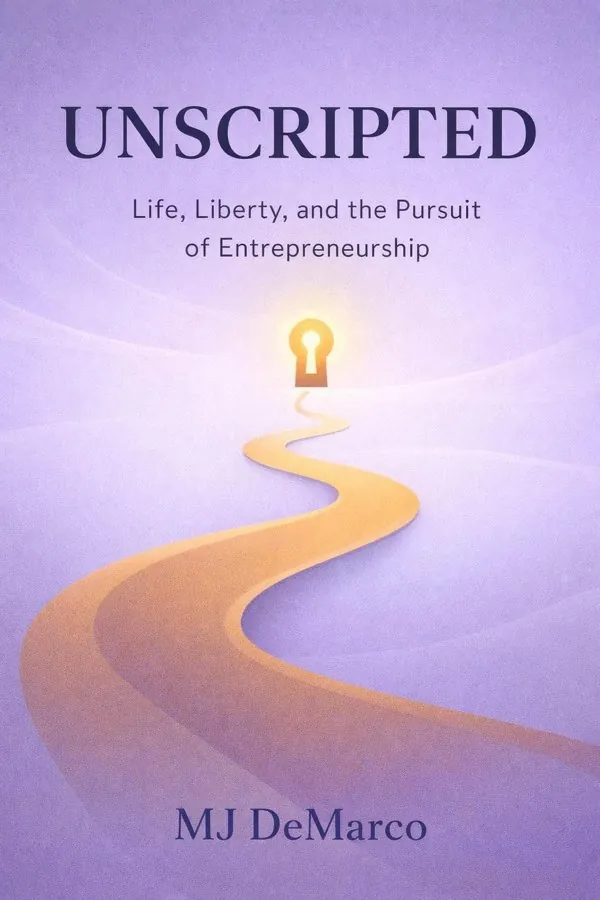
Unscripted: Life, Liberty, and the Pursuit of Entrepreneurship: Summary & Key Insights
by MJ DeMarco
 10 min9 chaptersAudio available
Key Takeaways from Unscripted: Life, Liberty, and the Pursuit of Entrepreneurship
Most people do not consciously design their lives; they inherit them.
The most powerful prison is the one that feels normal.
Money matters, but DeMarco insists that entrepreneurship is ultimately about control.
Before business changes your life, your thinking has to change your business.
Wealth is not created by wanting more money; it is created by delivering more value.
What Is Unscripted: Life, Liberty, and the Pursuit of Entrepreneurship About?
Unscripted: Life, Liberty, and the Pursuit of Entrepreneurship by MJ DeMarco is a entrepreneurship book spanning 9 pages. Unscripted is MJ DeMarco’s forceful challenge to the life plan most people accept without question: study hard, get a stable job, save diligently, retire late, and hope freedom arrives before life runs out. DeMarco argues that this conventional script is not a path to autonomy but a system of dependence—one that trades time for money, encourages consumerism, and keeps people financially vulnerable. In its place, he offers an entrepreneurial framework for building a life defined by control, purpose, and scalable value creation. What makes this book matter is its refusal to romanticize either corporate life or entrepreneurship. DeMarco does not promise easy riches or overnight success. Instead, he shows why freedom requires ownership, leverage, and the willingness to solve meaningful problems for others. Drawing on his own experience as a successful entrepreneur and author of The Millionaire Fastlane, he combines sharp cultural critique with practical guidance on mindset, business building, risk, and resilience. Unscripted is especially valuable for readers who feel trapped by routine, restless in traditional careers, or determined to create a life where income is no longer chained to hours worked.
This FizzRead summary covers all 9 key chapters of Unscripted: Life, Liberty, and the Pursuit of Entrepreneurship in approximately 10 minutes, distilling the most important ideas, arguments, and takeaways from MJ DeMarco's work. Also available as an audio summary and Key Quotes Podcast.
Unscripted: Life, Liberty, and the Pursuit of Entrepreneurship
Unscripted is MJ DeMarco’s forceful challenge to the life plan most people accept without question: study hard, get a stable job, save diligently, retire late, and hope freedom arrives before life runs out. DeMarco argues that this conventional script is not a path to autonomy but a system of dependence—one that trades time for money, encourages consumerism, and keeps people financially vulnerable. In its place, he offers an entrepreneurial framework for building a life defined by control, purpose, and scalable value creation.
What makes this book matter is its refusal to romanticize either corporate life or entrepreneurship. DeMarco does not promise easy riches or overnight success. Instead, he shows why freedom requires ownership, leverage, and the willingness to solve meaningful problems for others. Drawing on his own experience as a successful entrepreneur and author of The Millionaire Fastlane, he combines sharp cultural critique with practical guidance on mindset, business building, risk, and resilience. Unscripted is especially valuable for readers who feel trapped by routine, restless in traditional careers, or determined to create a life where income is no longer chained to hours worked.
Who Should Read Unscripted: Life, Liberty, and the Pursuit of Entrepreneurship?
This book is perfect for anyone interested in entrepreneurship and looking to gain actionable insights in a short read. Whether you're a student, professional, or lifelong learner, the key ideas from Unscripted: Life, Liberty, and the Pursuit of Entrepreneurship by MJ DeMarco will help you think differently.
- ✓Readers who enjoy entrepreneurship and want practical takeaways
- ✓Professionals looking to apply new ideas to their work and life
- ✓Anyone who wants the core insights of Unscripted: Life, Liberty, and the Pursuit of Entrepreneurship in just 10 minutes
Want the full summary?
Get instant access to this book summary and 100K+ more with Fizz Moment.
Get Free SummaryAvailable on App Store • Free to download
Key Chapters
Most people do not consciously design their lives; they inherit them. DeMarco’s first major idea is that the “Scripted” life is a cultural template handed down by schools, parents, employers, financial institutions, and media. It tells you to pursue safety above all else: get credentials, find a steady job, buy a house, finance your lifestyle, save in small increments, and trust that decades of obedience will one day lead to security. The problem is that this script appears normal precisely because it is everywhere, yet it often produces stress, dependence, and delayed living.
DeMarco argues that the Scripted life is dangerous because it ties survival to external forces you do not control—employers, market crashes, inflation, debt, and the erosion of time. A paycheck can disappear. Retirement assumptions can fail. Health can change. Meanwhile, the years spent waiting for “someday” never return. In this sense, the Script is not merely conventional; it is a fragile bargain.
A practical way to recognize the Script is to examine your defaults. Are your financial goals based on freedom or just consumption? Is your career path chosen from conviction or fear? Are you building assets, or are you simply maintaining obligations? Someone earning a good salary but drowning in payments may look successful while becoming less free each year.
DeMarco’s point is not that jobs are evil, but that unconscious conformity is costly. The first entrepreneurial act is mental: seeing that the standard path is not inevitable. Actionable takeaway: audit your life’s assumptions and write down which ones are truly yours versus inherited from culture.
The most powerful prison is the one that feels normal. DeMarco expands the critique by showing how culture and media reinforce the Scripted life at every turn. Advertising tells you to consume to signal status. News amplifies fear and uncertainty, making safe choices seem morally superior. Social media glamorizes lifestyles funded by debt or unstable income while hiding the trade-offs behind them. Even well-meaning advice from friends and family often reflects collective conditioning rather than independent thinking.
This conditioning machine shapes beliefs about risk, work, and success. Entrepreneurship is portrayed as reckless, while commuting to a job you dislike for forty years is treated as responsible. Borrowing for cars, homes, and lifestyle upgrades is normalized, while building a business is framed as unrealistic. People start to confuse familiarity with wisdom.
DeMarco’s insight is that these messages do not only influence spending; they shape identity. If you constantly hear that security comes from employment and that wealth comes slowly, you may never even consider building systems that generate scalable income. The Script survives because it is repeated so often that it becomes invisible.
In practical terms, breaking free requires controlling your informational environment. Limit media that intensifies fear or comparison. Study business owners instead of celebrity consumers. Replace passive entertainment with skill-building content. If your peer group discourages initiative, deliberately seek communities where ownership, creativity, and problem-solving are normal.
For example, someone trying to launch an online service may fail before starting if they internalize family skepticism. But exposure to builders, founders, and creators can normalize experimentation and persistence. Actionable takeaway: perform a “mental input cleanse” by identifying the people, platforms, and messages that reinforce passivity and replacing them with sources that strengthen independent thinking.
Money matters, but DeMarco insists that entrepreneurship is ultimately about control. The true promise of the Unscripted path is not luxury but freedom over time, decision-making, location, and purpose. Traditional employment trades hours for dollars within someone else’s system. Entrepreneurship, when built correctly, creates assets and processes that can produce income beyond your direct labor.
This distinction is crucial. Many people start side hustles that simply replicate jobs in self-employed form. If you stop working, the income stops. DeMarco pushes readers to think beyond self-employment toward businesses with leverage—products, systems, teams, software, content, platforms, distribution, or intellectual property that can reach many people without a one-to-one exchange of time.
For example, a freelance designer may earn more than an employee, but still remain trapped by hourly limits. By contrast, a designer who develops templates, courses, or a subscription-based design platform begins creating value that scales. The same principle applies to consultants who productize expertise, local service owners who systematize operations, or creators who build audiences they can serve repeatedly.
DeMarco does not deny that entrepreneurship is harder in the short term. It often requires uncertainty, delayed gratification, and learning through mistakes. But it offers something jobs rarely can: asymmetry. Your upside is no longer fixed. More importantly, your life becomes less dependent on the approval and policies of others.
The shift in mindset is simple but profound: stop asking, “How can I earn more per hour?” and start asking, “How can I create more value for more people in a way that is not tightly bound to my time?” Actionable takeaway: choose one idea, skill, or problem domain and brainstorm three ways to turn it from labor-based income into a scalable asset.
Before business changes your life, your thinking has to change your business. DeMarco emphasizes that escaping the Script is not just a financial move but a psychological one. Many people remain stuck because of internal barriers: fear of judgment, obsession with certainty, perfectionism, entitlement, and the desire for quick rewards. These habits make entrepreneurship feel impossible because they are designed for comfort, not creation.
The Unscripted mindset begins with responsibility. Instead of blaming markets, employers, luck, or background, you ask what you can learn, improve, build, or test. This does not mean circumstances are irrelevant; it means agency matters more. Entrepreneurs who succeed are often those who become resourceful before they become resourced.
Another key element is delayed gratification. Scripted culture trains people to seek immediate pleasure—new purchases, entertainment, social approval—while entrepreneurship demands sustained effort before visible payoff. You may spend months learning a market, refining an offer, or fixing a funnel before results appear. That is not failure; it is the price of building something real.
DeMarco also stresses emotional resilience. Rejection, mistakes, and uncertainty are normal, not signs that you should quit. A failed campaign, a weak launch, or an unresponsive market is data. The entrepreneurial mind interprets setbacks as feedback.
Practically, this mindset can be built through small acts of self-directed discipline: publishing before you feel ready, talking to customers, learning sales, tracking metrics, and making decisions despite incomplete information. A person waiting for confidence may wait forever; a person taking repeated action becomes confident through evidence.
Actionable takeaway: identify the one psychological pattern that most limits your progress—fear, perfectionism, procrastination, or distraction—and design a weekly habit that directly weakens it through action.
Wealth is not created by wanting more money; it is created by delivering more value. DeMarco repeatedly returns to this principle: the marketplace rewards solutions. If you can solve a painful problem, improve convenience, save time, reduce risk, entertain, educate, or help people achieve important outcomes, you create economic value. But value alone is not enough. To become Unscripted, you must pair value with leverage, control, and scale.
Leverage means your effort reaches beyond the limits of your personal time. Scale means your solution can serve many customers without linear increases in labor. Time leverage means the business can continue producing results when you are not actively working every minute. A software tool, online marketplace, physical product brand, educational platform, or systemized service business all illustrate these principles better than one-off labor.
Consider two entrepreneurs. One tutors students hourly and earns decent money, but must constantly trade time for income. Another creates a test-prep platform with recorded lessons, practice tools, and a recurring subscription. Both provide value, but only the second gains meaningful leverage and scale. DeMarco’s point is not that every business must be digital, only that businesses should be designed to break the one-hour-for-one-dollar trap.
He encourages readers to evaluate opportunities by asking: Does this solve a real need? Can I control the process and customer access? Can it scale? Can it detach income from my direct presence? These filters help distinguish businesses from glorified jobs.
Many aspiring entrepreneurs chase trendy ideas without checking whether those ideas have structural freedom built in. Actionable takeaway: assess your current or future business using four questions—what value it creates, what you control, how it scales, and how dependent it is on your personal hours.
Quitting your job is not the same as escaping the Script. DeMarco makes an important distinction between being an employee, being self-employed, and being a true business owner. Employees sell time to an employer. The self-employed sell time directly to clients. Owners build systems that create and deliver value with increasing independence from their daily presence. The transition to an Unscripted life depends on moving toward ownership, not merely independence in name.
This idea helps explain why many new entrepreneurs feel disappointed. They leave corporate life expecting freedom, only to discover they have created a business that demands more hours than their job did. They become the marketing department, operations manager, accountant, customer support team, and technician all at once. Without systems, delegation, or productization, they remain the bottleneck.
DeMarco advocates building with scalability from the beginning. That means documenting processes, simplifying offers, automating repetitive tasks, and eventually hiring or outsourcing strategically. A local cleaning business can become scalable through standardized service packages, scheduling software, trained teams, and repeatable customer acquisition. A coach can move from one-on-one sessions to workshops, digital products, group programs, and licensed frameworks.
The path is gradual. You may start by freelancing to generate cash flow, then use that cash flow to create a more leveraged offer. The key is not to confuse the starting point with the destination. Your first business model may be labor-intensive, but your long-term aim should be a company or asset that does not collapse when you take a week off.
Actionable takeaway: map every task in your current work and mark which ones can be automated, delegated, standardized, or turned into a repeatable product over the next 90 days.
Freedom without meaning can become another form of emptiness. DeMarco challenges the shallow version of entrepreneurship that focuses only on cars, travel photos, and status symbols. While financial freedom is valuable, the deeper promise of the Unscripted life is the ability to align your work with purpose, contribution, and personal values. Entrepreneurship is not just about escaping a boss; it is about building a life you actually want to live.
This matters because many people chase wealth as a substitute for clarity. They imagine that once they make enough money, fulfillment will automatically arrive. DeMarco argues otherwise. Money removes certain constraints, but it does not answer questions of identity, usefulness, or significance. In fact, one reason the Scripted life feels suffocating is that it often asks people to postpone meaning while prioritizing routine and security.
Purpose in this context does not have to mean changing the world on a grand scale. It can mean solving a problem you care about, serving a community you understand, creating something excellent, supporting your family with dignity, or gaining the autonomy to spend your time in ways that reflect your values. A business that helps elderly people remain independent, teaches immigrants practical language skills, or simplifies operations for small clinics can be deeply meaningful while also profitable.
DeMarco’s broader point is that the best entrepreneurial paths often combine utility with personal resonance. When your business aligns with what matters to you, endurance becomes easier. You are not just chasing numbers; you are building something with human significance.
Actionable takeaway: write a personal “freedom and meaning” statement describing not only how much money you want, but what kind of life, contribution, and daily reality that money is supposed to support.
Every entrepreneurial dream eventually collides with friction. DeMarco emphasizes that motivation is unreliable if it depends on excitement alone. The Unscripted path is full of uncertainty: ideas that fail, campaigns that flop, customers who complain, competitors who copy, and months when progress feels invisible. What separates builders from wishful thinkers is resilience—the ability to continue adapting when outcomes are messy.
Resilience is not blind stubbornness. It is disciplined responsiveness. Entrepreneurs must learn to distinguish between a strategy that needs refinement and a direction that should be abandoned. That requires metrics, customer feedback, and emotional control. A failed offer does not necessarily mean the market is bad; it may mean the messaging is weak, the price is wrong, or the need is misunderstood.
DeMarco also highlights the importance of motivation rooted in autonomy rather than hype. If your only reason for building is to get rich quickly, discouragement will hit hard. But if you are driven by reclaiming your time, supporting your family, solving a problem, or escaping dependency, you are more likely to persist intelligently.
Practical resilience can be cultivated through routines: weekly reviews, clear scoreboards, skill development, and deliberate recovery. For instance, instead of reacting emotionally to a bad month, a founder can examine conversion rates, traffic sources, retention, and customer comments, then test improvements. That turns disappointment into decision-making.
The long-term nature of entrepreneurship also means protecting your energy. Burnout can destroy good businesses. Sustainable effort beats erratic obsession. Actionable takeaway: create a resilience system with three parts—a weekly business review, one measurable growth metric, and one personal habit that preserves physical and mental stamina.
The greatest benefit of the Unscripted path is not wealth itself, but what wealth makes possible over time. DeMarco argues that building an entrepreneurial life changes your relationship with time, work, family, opportunity, and identity. Instead of spending decades waiting for freedom, you begin constructing freedom into the structure of your life. That structural shift compounds.
When you control your income sources, schedule, and decisions, you gain options that Scripted living rarely offers. You can choose projects instead of taking whatever keeps the lights on. You can weather economic shocks with greater flexibility. You can be more present for family, relocate if needed, take strategic breaks, or pursue creative work without immediate financial panic. Wealth, in this sense, is best understood as stored choice.
The impact is also generational. Children who see ownership, initiative, and self-direction modeled in the home inherit a different understanding of work. They learn that economic life is not limited to employment. Communities benefit too when entrepreneurs create useful products, jobs, and services rather than remaining passive consumers.
Importantly, DeMarco does not present the Unscripted life as a final destination where all problems disappear. Responsibility grows with freedom. But the problems become higher-quality problems—choosing between opportunities, improving systems, expanding impact—instead of enduring powerlessness.
Readers often come to this book looking for a business blueprint and leave with a broader realization: entrepreneurship is a life architecture. It is a way of organizing existence around agency instead of compliance. Actionable takeaway: define what “stored choice” would look like in your life five years from now, then identify the business asset or system you need to start building today to move toward it.
All Chapters in Unscripted: Life, Liberty, and the Pursuit of Entrepreneurship
About the Author
MJ DeMarco is an American entrepreneur, investor, and author known for challenging conventional beliefs about work, wealth, and retirement. He rose to prominence with his bestselling book The Millionaire Fastlane, which argued that financial freedom is built through entrepreneurship, value creation, and scalable business systems rather than slow accumulation through traditional employment. In Unscripted, he expands that philosophy into a broader critique of cultural conditioning and dependence. DeMarco is also the founder of The Fastlane Forum, a community where entrepreneurs share ideas, strategies, and hard-earned lessons about building businesses. His work is recognized for its blunt, practical style and its focus on time freedom, personal agency, and creating businesses that solve real problems in the marketplace.
Get This Summary in Your Preferred Format
Read or listen to the Unscripted: Life, Liberty, and the Pursuit of Entrepreneurship summary by MJ DeMarco anytime, anywhere. FizzRead offers multiple formats so you can learn on your terms — all free.
Available formats: App · Audio · PDF · EPUB — All included free with FizzRead
Download Unscripted: Life, Liberty, and the Pursuit of Entrepreneurship PDF and EPUB Summary
Key Quotes from Unscripted: Life, Liberty, and the Pursuit of Entrepreneurship
“Most people do not consciously design their lives; they inherit them.”
“The most powerful prison is the one that feels normal.”
“Money matters, but DeMarco insists that entrepreneurship is ultimately about control.”
“Before business changes your life, your thinking has to change your business.”
“Wealth is not created by wanting more money; it is created by delivering more value.”
Frequently Asked Questions about Unscripted: Life, Liberty, and the Pursuit of Entrepreneurship
Unscripted: Life, Liberty, and the Pursuit of Entrepreneurship by MJ DeMarco is a entrepreneurship book that explores key ideas across 9 chapters. Unscripted is MJ DeMarco’s forceful challenge to the life plan most people accept without question: study hard, get a stable job, save diligently, retire late, and hope freedom arrives before life runs out. DeMarco argues that this conventional script is not a path to autonomy but a system of dependence—one that trades time for money, encourages consumerism, and keeps people financially vulnerable. In its place, he offers an entrepreneurial framework for building a life defined by control, purpose, and scalable value creation. What makes this book matter is its refusal to romanticize either corporate life or entrepreneurship. DeMarco does not promise easy riches or overnight success. Instead, he shows why freedom requires ownership, leverage, and the willingness to solve meaningful problems for others. Drawing on his own experience as a successful entrepreneur and author of The Millionaire Fastlane, he combines sharp cultural critique with practical guidance on mindset, business building, risk, and resilience. Unscripted is especially valuable for readers who feel trapped by routine, restless in traditional careers, or determined to create a life where income is no longer chained to hours worked.
More by MJ DeMarco
You Might Also Like

Lean Analytics
Alistair Croll, Benjamin Yoskovitz
10 min
21 Days To A Big Idea: Creating Breakthrough Business Concepts
Bryan Mattimore
10 min
Sam Walton: Made in America: My Story
Sam Walton
10 min
10x Is Easier Than 2x: How World-Class Entrepreneurs Achieve More by Doing Less
Dan Sullivan, Benjamin Hardy
10 min
12 Months to $1 Million: How to Pick a Winning Product, Build a Real Business, and Become a Seven-Figure Entrepreneur
Ryan Daniel Moran
10 min
24 Assets: Create a Digital, Scalable, Valuable Business
Daniel Priestley
10 minBrowse by Category
Ready to read Unscripted: Life, Liberty, and the Pursuit of Entrepreneurship?
Get the full summary and 100K+ more books with Fizz Moment.