
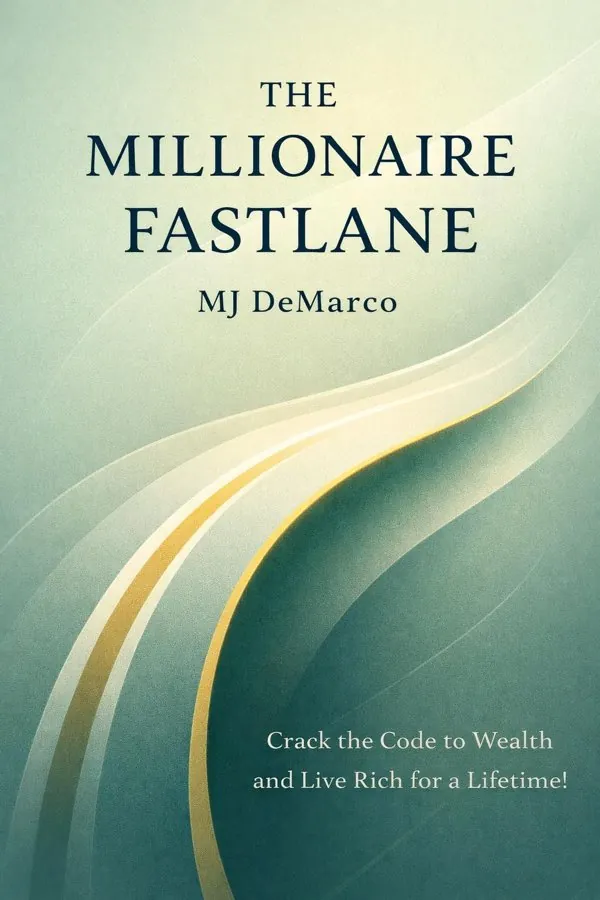
The Millionaire Fastlane: Crack the Code to Wealth and Live Rich for a Lifetime!: Summary & Key Insights
by MJ DeMarco
 10 min10 chaptersAudio available
Key Takeaways from The Millionaire Fastlane: Crack the Code to Wealth and Live Rich for a Lifetime!
Wealth is often lost long before it is ever earned, through habits that make financial instability feel normal.
A plan can be socially approved and still be painfully inefficient.
The biggest shift in the book is this: wealth is not a number you slowly crawl toward, but a system you intentionally design.
Income alone is a poor predictor of freedom if it cannot multiply.
Most people are trained to be excellent consumers long before they learn to be producers.
What Is The Millionaire Fastlane: Crack the Code to Wealth and Live Rich for a Lifetime! About?
The Millionaire Fastlane: Crack the Code to Wealth and Live Rich for a Lifetime! by MJ DeMarco is a entrepreneurship book spanning 10 pages. The Millionaire Fastlane is a provocative guide to wealth creation that rejects the standard script of working for decades, saving modestly, and hoping retirement arrives before energy runs out. In this entrepreneurship classic, MJ DeMarco argues that most financial advice is built for survival, not freedom. Rather than relying on a paycheck and slow compounding alone, he urges readers to build businesses and systems that create massive value, scale beyond their own time, and generate wealth far earlier in life. The book matters because it challenges deeply held assumptions about money, jobs, and security. DeMarco does not glorify reckless shortcuts or lottery-style thinking; instead, he lays out a framework for intentional entrepreneurship rooted in control, leverage, and customer value. His authority comes from lived experience: after building and selling a limousine booking business, he achieved financial independence and distilled his lessons into a direct, unfiltered philosophy. For readers tired of the “work now, live later” mindset, The Millionaire Fastlane offers a bold alternative: build assets, solve real problems, and buy back your life while you are still young enough to enjoy it.
This FizzRead summary covers all 10 key chapters of The Millionaire Fastlane: Crack the Code to Wealth and Live Rich for a Lifetime! in approximately 10 minutes, distilling the most important ideas, arguments, and takeaways from MJ DeMarco's work. Also available as an audio summary and Key Quotes Podcast.
The Millionaire Fastlane: Crack the Code to Wealth and Live Rich for a Lifetime!
The Millionaire Fastlane is a provocative guide to wealth creation that rejects the standard script of working for decades, saving modestly, and hoping retirement arrives before energy runs out. In this entrepreneurship classic, MJ DeMarco argues that most financial advice is built for survival, not freedom. Rather than relying on a paycheck and slow compounding alone, he urges readers to build businesses and systems that create massive value, scale beyond their own time, and generate wealth far earlier in life. The book matters because it challenges deeply held assumptions about money, jobs, and security. DeMarco does not glorify reckless shortcuts or lottery-style thinking; instead, he lays out a framework for intentional entrepreneurship rooted in control, leverage, and customer value. His authority comes from lived experience: after building and selling a limousine booking business, he achieved financial independence and distilled his lessons into a direct, unfiltered philosophy. For readers tired of the “work now, live later” mindset, The Millionaire Fastlane offers a bold alternative: build assets, solve real problems, and buy back your life while you are still young enough to enjoy it.
Who Should Read The Millionaire Fastlane: Crack the Code to Wealth and Live Rich for a Lifetime!?
This book is perfect for anyone interested in entrepreneurship and looking to gain actionable insights in a short read. Whether you're a student, professional, or lifelong learner, the key ideas from The Millionaire Fastlane: Crack the Code to Wealth and Live Rich for a Lifetime! by MJ DeMarco will help you think differently.
- ✓Readers who enjoy entrepreneurship and want practical takeaways
- ✓Professionals looking to apply new ideas to their work and life
- ✓Anyone who wants the core insights of The Millionaire Fastlane: Crack the Code to Wealth and Live Rich for a Lifetime! in just 10 minutes
Want the full summary?
Get instant access to this book summary and 100K+ more with Fizz Moment.
Get Free SummaryAvailable on App Store • Free to download
Key Chapters
Wealth is often lost long before it is ever earned, through habits that make financial instability feel normal. DeMarco calls this path the Sidewalk: a way of living driven by instant gratification, consumer identity, and dependence on external rescue. Sidewalk thinking is not just about being broke. It is about treating money as something to spend the moment it arrives, using debt to sustain appearances, and refusing responsibility for long-term outcomes. Someone on the Sidewalk may blame the economy, their boss, or bad luck, yet continue buying status items, ignoring skills, and avoiding ownership.
The danger of the Sidewalk is psychological as much as financial. It creates a life where every surprise becomes a crisis because there is no margin, no plan, and no discipline. A person may earn a decent income and still live on the edge if consumption rises with every paycheck. Credit cards, car loans, and lifestyle inflation then become a disguised form of bondage. In DeMarco’s view, this is poverty wearing fashionable clothes.
A practical example is the worker who receives a raise and immediately upgrades apartments, adds subscriptions, and finances a new car. Income rises, but freedom does not. Compare that with someone who uses increased income to eliminate debt, build a cash buffer, and invest in business skills or a side venture.
The first step toward wealth is refusing the Sidewalk mentality. Track every dollar for 30 days, cut one status expense, and redirect that money into savings or skill-building. Freedom begins when financial adulthood replaces financial impulse.
A plan can be socially approved and still be painfully inefficient. DeMarco describes the Slowlane as the conventional roadmap: get educated, find a stable job, save a portion of income, invest consistently, and retire rich decades later. This approach is not necessarily wrong, but in his argument it is deeply limited because it trades most of your life for a delayed reward that depends on time, market returns, and continued employment. The Slowlane promises safety, yet often produces dependency on a salary and the hope that nothing goes badly wrong.
The core flaw is arithmetic. If wealth depends mostly on a fixed paycheck and gradual compounding, then your path is constrained by income ceilings and by time itself. Even disciplined savers may need 40 years to reach meaningful freedom. That means youth, flexibility, and energy are spent serving the plan rather than benefiting from it.
Imagine two people. One earns a salary and saves 10 percent for retirement. The other keeps living expenses controlled but spends evenings building an online service that can reach thousands of customers. The first accumulates slowly. The second, if successful, creates an asset disconnected from hourly labor. The difference is not work ethic; it is the vehicle.
DeMarco is not saying retirement investing has no place. He is saying it should not be your only engine. Use the Slowlane for stability if needed, but do not mistake it for a reliable path to early freedom. Actionable takeaway: calculate how much wealth your current savings rate can realistically produce in 10, 20, and 40 years. If the timeline feels like a prison sentence, you need a different vehicle.
The biggest shift in the book is this: wealth is not a number you slowly crawl toward, but a system you intentionally design. The Fastlane is DeMarco’s alternative path, where money is created by building businesses or assets capable of serving many people without requiring your constant personal labor. In the Fastlane, the goal is not merely high income. It is ownership, leverage, and the ability to separate earnings from hours.
Fastlane thinking starts with a different relationship to time. Most people sell time for money and hope to eventually stop. Fastlaners use time to create systems that produce value repeatedly. That could be a software platform, a content business, a logistics company, a product brand, or a service firm built with processes and teams. What matters is not the industry but the structure: does it have the potential to scale, generate cash flow, and operate with increasing independence from the founder?
For example, a freelance designer may earn well but still be tied to every client request. A designer who builds a design software tool, a template marketplace, or an agency with standardized delivery is moving toward the Fastlane because the business can outgrow individual hours. Likewise, a local service business can become Fastlane-capable if it develops systems, recurring revenue, and expansion potential.
The Fastlane is not a shortcut in effort; it is a shortcut in timeline. It often demands more risk, more learning, and more responsibility upfront. But it offers something the Slowlane rarely can: the possibility of freedom while life is still unfolding. Actionable takeaway: identify one way your current skills could be turned into a scalable asset instead of a one-to-one service.
Income alone is a poor predictor of freedom if it cannot multiply. DeMarco reframes wealth through a practical equation shaped by time, leverage, and scale. In simple terms, wealth accelerates when you create something that reaches many people, solves a meaningful problem, and is not capped by your personal availability. This is why a business that serves ten thousand customers can outperform a high-paying job, even if the job feels prestigious and secure.
Time matters because it is your only nonrenewable resource. If your income stops whenever you stop working, you do not own wealth; you rent survival. Leverage matters because tools, systems, media, code, capital, and teams allow one unit of effort to produce many units of value. Scale matters because even excellent products create modest outcomes if they reach only a handful of buyers.
Consider a tutor charging by the hour versus a tutor who creates a digital course, licenses school materials, or builds an educational platform. The first business is limited by a calendar. The second leverages expertise across hundreds or thousands of users. The same principle applies to consultants, coaches, retailers, and creators.
This idea also explains why entrepreneurship is not just about hustle. Endless effort without leverage becomes another job. The smarter question is: how can this work once benefit me many times? That might mean building recurring subscriptions, templates, software, referral systems, or operational processes that make growth manageable.
Actionable takeaway: examine your income source and ask three questions. Is it tied directly to my time? Can it serve more people without equal increases in labor? What form of leverage could I add this year? Your answers reveal whether you are building wealth or just earning wages.
Most people are trained to be excellent consumers long before they learn to be producers. DeMarco argues that this conditioning quietly shapes financial destiny. Consumers spend attention, money, and emotional energy on what others make. Producers create solutions, assets, and systems that the market rewards. The shift sounds simple, but it is one of the deepest transformations in the book because it changes how you look at the world.
A consumer sees advertisements, trends, and products to buy. A producer sees unmet needs, weak customer experiences, and opportunities to improve what already exists. A consumer asks, “What can I afford?” A producer asks, “What can I build?” This difference affects decisions every day. Someone obsessed with image may use money to signal success. Someone obsessed with creation uses resources to acquire tools, knowledge, distribution, and customer insight.
Take social media as an example. A consumer scrolls, reacts, and purchases based on influence. A producer studies what audiences repeatedly complain about, what questions go unanswered, and what solutions are poorly delivered. That information can become a product, service, newsletter, app, or niche brand. The same platform that drains time for one person becomes market research for another.
This mindset does not require inventing something revolutionary. It can begin with improving a local service, packaging expertise, or streamlining a frustrating process. The point is to become a creator of value rather than a passive participant in the economy.
Actionable takeaway: for one week, write down five frustrations you notice in daily life, online communities, or at work. Then choose one and brainstorm a product or service that could solve it. Wealth begins when attention shifts from consumption to creation.
Not every business leads to freedom. DeMarco introduces five guiding principles, often remembered as the Fastlane Commandments: Need, Entry, Control, Scale, and Time. Together they form a filter for evaluating opportunities. Many ventures fail not because people lack passion, but because they choose businesses that violate one or more of these principles.
Need means the business must solve a real problem or satisfy a meaningful desire. Markets pay for usefulness, not for your excitement alone. Entry refers to barriers that protect the business from easy imitation. If anyone can start the same thing tomorrow with no advantage or differentiation, profits are fragile. Control means you own the core asset or customer relationship instead of depending on a platform, employer, or gatekeeper who can change the rules overnight. Scale asks whether the model can expand to reach more customers efficiently. Time asks whether the business can eventually operate without requiring your constant presence.
For example, selling generic products entirely through a single marketplace may violate control because the platform can suspend listings or compress margins. A highly customized local service may satisfy need but fail time and scale if every sale requires the founder’s personal labor. By contrast, a software product with recurring subscriptions, strong positioning, direct customer access, and broad market demand aligns far better with the commandments.
These principles are not rigid laws, but they are powerful warning signs. The more commandments you satisfy, the more likely your venture can create real leverage and freedom.
Actionable takeaway: score your current or planned business from 1 to 10 on each commandment. The lowest score reveals the biggest structural weakness and the next strategic improvement you should make.
Many entrepreneurs leave a job only to build another one with longer hours and more stress. DeMarco warns that self-employment alone is not freedom unless it evolves into a system. A business becomes Fastlane-worthy when it can function through processes, automation, delegation, and repeatable value delivery rather than constant heroic effort from the founder.
This distinction matters because owners often confuse being busy with building an asset. If every sale, customer issue, and operational decision flows through one person, the company may generate income but it remains fragile. It cannot scale cleanly, and it cannot free the founder’s time. Systems convert chaos into repeatability. Documentation, software tools, standard operating procedures, hiring, dashboards, and clear customer journeys all make the business less dependent on personality and more dependent on design.
Think of a local cleaning company. In its early stage, the owner may handle calls, scheduling, hiring, and quality control. To become a true asset, the company needs booking systems, training manuals, pricing frameworks, service standards, and perhaps management layers. The same logic applies to e-commerce, agencies, education businesses, and media brands. Systems are what allow growth without proportional exhaustion.
Automation also matters financially. Recurring billing, email sequences, inventory alerts, CRM pipelines, and analytics tools reduce error and save time. But automation should support customer value, not replace thoughtful service. The goal is operational independence with quality intact.
Actionable takeaway: list the five tasks in your business that only you currently handle. Choose one to document, automate, or delegate this month. Freedom is built one system at a time, not through endless hustle.
A great product that nobody notices is not a business victory; it is a hidden opportunity. DeMarco emphasizes that wealth comes from delivering value to people at scale, and that requires effective marketing, positioning, and trust. Many entrepreneurs romanticize product creation and underestimate distribution. Yet in the real world, businesses grow when they clearly communicate why they matter and for whom they exist.
Marketing in the Fastlane is not manipulation. It is the disciplined process of understanding customer pain, speaking to desired outcomes, reducing friction, and making action easy. Branding deepens this by shaping perception. A strong brand helps customers remember you, trust you, and choose you over cheaper or louder alternatives. It creates emotional shorthand in a crowded market.
Consider two similar businesses selling fitness programs. One promotes generic workouts and random discounts. The other speaks directly to busy professionals who want 20-minute plans, meal simplicity, and visible progress without gym anxiety. The second business is likely to win because it frames value around a specific need and identity. The same principle applies to software, consulting, home services, and physical products.
Customer value must remain central. Clever marketing cannot save an offer that does not solve a real problem. But when the offer is strong, clear messaging multiplies results. Listen to reviews, support tickets, and objections. They reveal what customers care about far more accurately than assumptions do.
Actionable takeaway: rewrite your offer in one sentence using this structure: “We help [specific audience] achieve [desired result] without [major frustration].” If that sentence is vague, your market positioning needs work before your marketing budget does.
Making money fast is impressive; keeping and compounding it is what turns success into freedom. DeMarco stresses that the Fastlane is not an excuse for reckless spending. In fact, entrepreneurial wealth requires unusual discipline because business income can be volatile, opportunities appear suddenly, and lifestyle inflation can quietly sabotage momentum. Without strong financial habits, even a rapidly growing founder can remain trapped by obligations.
The principle is simple: use money first as fuel, not as theater. Reinvest into systems, talent, product improvement, customer acquisition, and strategic reserves before upgrading your image. This does not mean living joylessly. It means recognizing that a flashy car bought too early may drain the very capital that could have expanded the business, increased resilience, or created recurring income.
A practical example is the founder who has a profitable year and faces a choice. One option is expensive status purchases that produce admiration but no return. The other is hiring a key operator, improving margins, building a sales funnel, and setting aside taxes and reserves. The second path may look less glamorous now, but it dramatically improves long-term freedom.
Discipline also protects against emotional decision-making. Entrepreneurs need emergency funds, cash flow awareness, tax planning, and a distinction between business wealth and personal lifestyle. The ability to delay unnecessary consumption is itself a competitive advantage because it extends runway and flexibility.
Actionable takeaway: create a simple allocation plan for every dollar your business earns this quarter, including taxes, reinvestment, reserves, owner pay, and discretionary spending. If your money has no assignment, impulse will assign it for you.
The ultimate point of wealth is not to collect expensive symbols. It is to gain control over your time, choices, and way of life. DeMarco closes the loop by reminding readers that money is valuable because of what it makes possible: autonomy, contribution, security, generosity, and the ability to live on your own terms. Luxury may be a byproduct, but it is not the core prize.
This idea prevents the Fastlane from becoming shallow materialism. A person can chase millions and still remain psychologically poor if every decision is driven by comparison or ego. Real wealth means waking up without dread, choosing work with intention, and being able to help family, pursue meaningful projects, or simply be present. In this sense, entrepreneurship is not just about financial engineering. It is about life design.
For some readers, freedom may mean traveling, creating art, raising children with more presence, or supporting causes they care about. For others, it may mean continuing to build companies from a position of desire rather than necessity. The key is that money becomes a servant, not the master.
This perspective also encourages purpose. Businesses built solely around extracting profit tend to become hollow or fragile. Businesses built around genuine value creation can produce both financial reward and personal meaning. The Fastlane works best when wealth supports a life you actually want, not one inherited from advertising or social pressure.
Actionable takeaway: define your personal version of “rich” in one paragraph without mentioning brands, status, or comparison. Include how you want to spend your days, who you want to help, and what freedom looks like. Wealth becomes easier to build when you know what it is for.
All Chapters in The Millionaire Fastlane: Crack the Code to Wealth and Live Rich for a Lifetime!
About the Author
MJ DeMarco is an American entrepreneur, investor, and author best known for challenging conventional ideas about wealth and retirement. He gained financial independence after founding and growing a limousine booking business, which he later sold for millions. Drawing on that experience, DeMarco developed a philosophy centered on entrepreneurship, leverage, and building scalable systems that generate wealth faster than traditional employment and long-term saving alone. He became widely known through The Millionaire Fastlane, a book that has influenced many aspiring founders and independent business owners. DeMarco also created The Fastlane Forum, an online community where entrepreneurs discuss business strategy, execution, and financial freedom. His writing is known for its direct tone, practical frameworks, and strong emphasis on personal responsibility and value creation.
Get This Summary in Your Preferred Format
Read or listen to the The Millionaire Fastlane: Crack the Code to Wealth and Live Rich for a Lifetime! summary by MJ DeMarco anytime, anywhere. FizzRead offers multiple formats so you can learn on your terms — all free.
Available formats: App · Audio · PDF · EPUB — All included free with FizzRead
Download The Millionaire Fastlane: Crack the Code to Wealth and Live Rich for a Lifetime! PDF and EPUB Summary
Key Quotes from The Millionaire Fastlane: Crack the Code to Wealth and Live Rich for a Lifetime!
“Wealth is often lost long before it is ever earned, through habits that make financial instability feel normal.”
“A plan can be socially approved and still be painfully inefficient.”
“The biggest shift in the book is this: wealth is not a number you slowly crawl toward, but a system you intentionally design.”
“Income alone is a poor predictor of freedom if it cannot multiply.”
“Most people are trained to be excellent consumers long before they learn to be producers.”
Frequently Asked Questions about The Millionaire Fastlane: Crack the Code to Wealth and Live Rich for a Lifetime!
The Millionaire Fastlane: Crack the Code to Wealth and Live Rich for a Lifetime! by MJ DeMarco is a entrepreneurship book that explores key ideas across 10 chapters. The Millionaire Fastlane is a provocative guide to wealth creation that rejects the standard script of working for decades, saving modestly, and hoping retirement arrives before energy runs out. In this entrepreneurship classic, MJ DeMarco argues that most financial advice is built for survival, not freedom. Rather than relying on a paycheck and slow compounding alone, he urges readers to build businesses and systems that create massive value, scale beyond their own time, and generate wealth far earlier in life. The book matters because it challenges deeply held assumptions about money, jobs, and security. DeMarco does not glorify reckless shortcuts or lottery-style thinking; instead, he lays out a framework for intentional entrepreneurship rooted in control, leverage, and customer value. His authority comes from lived experience: after building and selling a limousine booking business, he achieved financial independence and distilled his lessons into a direct, unfiltered philosophy. For readers tired of the “work now, live later” mindset, The Millionaire Fastlane offers a bold alternative: build assets, solve real problems, and buy back your life while you are still young enough to enjoy it.
More by MJ DeMarco
You Might Also Like
Lean Analytics
Alistair Croll, Benjamin Yoskovitz
10 min
21 Days To A Big Idea: Creating Breakthrough Business Concepts
Bryan Mattimore
10 min
Sam Walton: Made in America: My Story
Sam Walton
10 min
10x Is Easier Than 2x: How World-Class Entrepreneurs Achieve More by Doing Less
Dan Sullivan, Benjamin Hardy
10 min
12 Months to $1 Million: How to Pick a Winning Product, Build a Real Business, and Become a Seven-Figure Entrepreneur
Ryan Daniel Moran
10 min
24 Assets: Create a Digital, Scalable, Valuable Business
Daniel Priestley
10 minBrowse by Category
Ready to read The Millionaire Fastlane: Crack the Code to Wealth and Live Rich for a Lifetime!?
Get the full summary and 100K+ more books with Fizz Moment.