
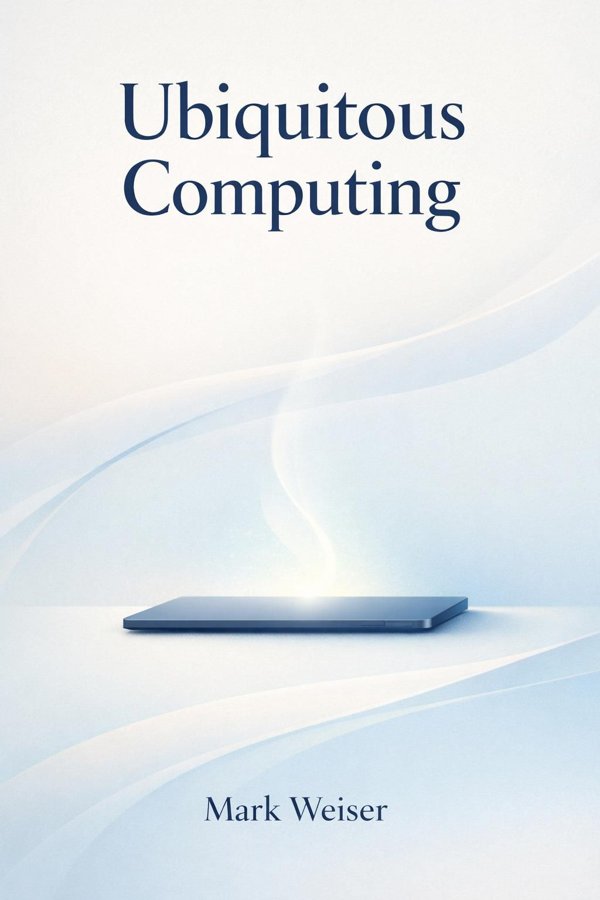
Ubiquitous Computing: Summary & Key Insights
by Mark Weiser
 10 min5 chaptersAudio available
What Is Ubiquitous Computing About?
Ubiquitous Computing by Mark Weiser is a emerging_tech book spanning 5 pages. This book presents the foundational vision and research of ubiquitous computing, a concept introduced by Mark Weiser at Xerox PARC in the late 1980s. It explores how computing can be seamlessly integrated into everyday life, making technology effectively invisible to users. The work compiles essays and research papers that shaped the field of pervasive computing, human-computer interaction, and context-aware systems.
This FizzRead summary covers all 5 key chapters of Ubiquitous Computing in approximately 10 minutes, distilling the most important ideas, arguments, and takeaways from Mark Weiser's work. Also available as an audio summary and Key Quotes Podcast.
Ubiquitous Computing
This book presents the foundational vision and research of ubiquitous computing, a concept introduced by Mark Weiser at Xerox PARC in the late 1980s. It explores how computing can be seamlessly integrated into everyday life, making technology effectively invisible to users. The work compiles essays and research papers that shaped the field of pervasive computing, human-computer interaction, and context-aware systems.
Who Should Read Ubiquitous Computing?
This book is perfect for anyone interested in emerging_tech and looking to gain actionable insights in a short read. Whether you're a student, professional, or lifelong learner, the key ideas from Ubiquitous Computing by Mark Weiser will help you think differently.
- ✓Readers who enjoy emerging_tech and want practical takeaways
- ✓Professionals looking to apply new ideas to their work and life
- ✓Anyone who wants the core insights of Ubiquitous Computing in just 10 minutes
Want the full summary?
Get instant access to this book summary and 100K+ more with Fizz Moment.
Get Free SummaryAvailable on App Store • Free to download
Key Chapters
To understand ubiquitous computing, we must begin with the evolution of how humans have interacted with machines. In the early days, mainframes represented authoritarian computing—they were massive, centralized, and shared by many users who approached them through terminals. The relationship was hierarchical and time-sliced; people adapted themselves to the machine’s schedule. Then came the personal computer revolution, democratizing access by giving each person a dedicated system. It was liberating in many ways, yet it also created confinement. We sat before glowing rectangles, tethered psychologically and physically to the screen. The world receded as attention tunneled inward.
I envisioned a third stage to overcome that isolation—the transition toward what I called calm technology. In this stage, computing becomes pervasive, embedded into everyday environments, and largely invisible. The goal is to let information ebb and flow naturally between the center and periphery of attention, permitting people to focus on the physical and social spaces they inhabit. Imagine walking through your home or office and having computation respond fluidly to your gestures, the ambient light, or the presence of other people, without requiring deliberate commands. That shift—from interaction by focus to interaction by environment—is profound. It challenges the traditional assumption that human-computer interaction must occur through explicit manipulation of icons or text.
The emerging philosophy of calm technology emphasizes awareness through design. Instead of asking how to make users aware of the computer, we ask how the computer can stay aware of the user. Machines, when placed at the background of existence, create a landscape of quiet support. The user becomes free to live in a more natural human rhythm, with technology providing subtle cues rather than constant interruption. At Xerox PARC, we began to prototype such ideas, experimenting with digital whiteboards that automatically captured notes, handheld tablets that shared context with nearby devices, and interconnected environments that adapted to human activity. These early experiments illuminated the path from the static, isolated machine to a living, dynamic ecology of devices. It was an evolution not in computational power but in relationship—the relationship between humans and the digital environment.
To illustrate how ubiquitous computing manifests materially, I introduced three scales of devices—tabs, pads, and boards—each corresponding to different dimensions of interaction. Tabs are small, often wearable or pocket-sized identifiers, akin to digital name tags. They are meant for mobility, for personal connection, for the fluid representation of identity across spaces. Pads are intermediate, roughly the size of notebooks or tablets. They serve as flexible instruments for manipulation and creation, easily handed from person to person, shared, stacked, or discarded. Boards exist at the large scale, surfaces that fill walls and conference rooms, designed for collaborative viewing and collective manipulation.
These categories were not conceived as product types but as conceptual anchors for a distributed ecology. Each device acts as part of an integrated network—the environment itself becomes computational. A single user might interact with dozens of tabs, several pads, and a few boards in the course of daily activity, without ever consciously thinking about connecting or configuring them. The point is seamlessness. Behind everyday actions lies a continuous exchange of information, rooted in proximity, context, and inferred intent. This architecture moves beyond the notion of a single, central computer to a vast landscape of interconnected microprocessors embedded throughout material space.
In our experiments, we learned that scale profoundly influences user experience. The smallest devices enable intimacy and personalization, while the largest invite collaboration and shared understanding. Between them lies an elegant gradient of interaction. For example, a meeting might unfold on a board displaying collective notes that automatically sync to each participant’s pad. A person stepping into the room could be recognized by her tab, bringing her documents into view. None of these actions require attention toward the machine; rather, the computational substrate quietly supports human intention. By thinking architecturally—by designing not isolated devices but an integrated ecology—we discovered that computing could, at last, step off the desktop and into life itself.
+ 3 more chapters — available in the FizzRead app
All Chapters in Ubiquitous Computing
About the Author
Mark Weiser (1952–1999) was an American computer scientist and Chief Technologist at Xerox PARC. He is widely regarded as the father of ubiquitous computing, a concept that profoundly influenced modern computing, mobile technology, and the Internet of Things.
Get This Summary in Your Preferred Format
Read or listen to the Ubiquitous Computing summary by Mark Weiser anytime, anywhere. FizzRead offers multiple formats so you can learn on your terms — all free.
Available formats: App · Audio · PDF · EPUB — All included free with FizzRead
Download Ubiquitous Computing PDF and EPUB Summary
Key Quotes from Ubiquitous Computing
“To understand ubiquitous computing, we must begin with the evolution of how humans have interacted with machines.”
“To illustrate how ubiquitous computing manifests materially, I introduced three scales of devices—tabs, pads, and boards—each corresponding to different dimensions of interaction.”
Frequently Asked Questions about Ubiquitous Computing
Ubiquitous Computing by Mark Weiser is a emerging_tech book that explores key ideas across 5 chapters. This book presents the foundational vision and research of ubiquitous computing, a concept introduced by Mark Weiser at Xerox PARC in the late 1980s. It explores how computing can be seamlessly integrated into everyday life, making technology effectively invisible to users. The work compiles essays and research papers that shaped the field of pervasive computing, human-computer interaction, and context-aware systems.
You Might Also Like
Blockchain Technology Guide (Chinese Edition)
Li Qilei
10 min
21st Century Technologies Revisited: What is Happening and What is Next
Organisation for Economic Co-operation and Development (OECD)
10 min
Autonomous Vehicles: Opportunities, Strategies, and Challenges
Various Authors
10 min
Autonomy
Lawrence Burns
10 min
Blockchain Basics: A Non-Technical Introduction in 25 Steps
Daniel Drescher
10 min
Blockchain Revolution: How the Technology Behind Bitcoin and Other Cryptocurrencies Is Changing the World
Don Tapscott & Alex Tapscott
10 minBrowse by Category
Ready to read Ubiquitous Computing?
Get the full summary and 100K+ more books with Fizz Moment.