
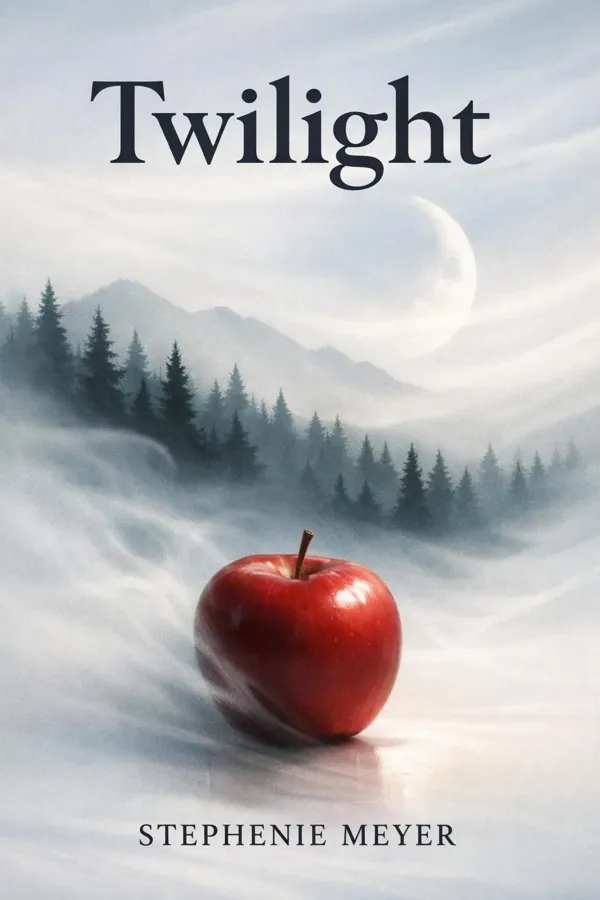
Twilight: Summary & Key Insights
 10 min8 chaptersAudio available
Key Takeaways from Twilight
Sometimes the most important turning points in life begin not with ambition, but with reluctant acceptance.
Attraction often begins where understanding fails.
Desire becomes more powerful when it is shadowed by danger.
The most important struggle in Twilight is not between humans and monsters, but between instinct and restraint.
Love stories become unforgettable when external danger exposes what the characters truly value.
What Is Twilight About?
Twilight by Stephenie Meyer is a romantic_relationships book spanning 5 pages. Twilight is a young adult novel that blends romance, fantasy, and suspense into a story about longing, identity, and the dangerous allure of the unknown. It follows Isabella “Bella” Swan, a quiet, introspective teenager who leaves sunny Phoenix to live with her father in the small, rain-soaked town of Forks, Washington. There, she meets Edward Cullen, an unnervingly beautiful and mysterious classmate whose presence unsettles and fascinates her. As Bella uncovers Edward’s secret—that he is a vampire—the novel deepens into a tale about forbidden love, self-control, fear, and choice. What makes Twilight culturally significant is not only its supernatural premise, but the intensity with which it captures adolescent emotional life: first love, alienation, obsession, vulnerability, and the desire to be truly seen. Stephenie Meyer became a global literary phenomenon through the Twilight saga, creating one of the most recognizable paranormal romances of the 21st century. Whether read as a love story, a fantasy thriller, or an exploration of emotional awakening, Twilight remains influential because it turns a deeply personal teenage experience into mythic drama.
This FizzRead summary covers all 8 key chapters of Twilight in approximately 10 minutes, distilling the most important ideas, arguments, and takeaways from Stephenie Meyer's work. Also available as an audio summary and Key Quotes Podcast.
Twilight
Twilight is a young adult novel that blends romance, fantasy, and suspense into a story about longing, identity, and the dangerous allure of the unknown. It follows Isabella “Bella” Swan, a quiet, introspective teenager who leaves sunny Phoenix to live with her father in the small, rain-soaked town of Forks, Washington. There, she meets Edward Cullen, an unnervingly beautiful and mysterious classmate whose presence unsettles and fascinates her. As Bella uncovers Edward’s secret—that he is a vampire—the novel deepens into a tale about forbidden love, self-control, fear, and choice.
What makes Twilight culturally significant is not only its supernatural premise, but the intensity with which it captures adolescent emotional life: first love, alienation, obsession, vulnerability, and the desire to be truly seen. Stephenie Meyer became a global literary phenomenon through the Twilight saga, creating one of the most recognizable paranormal romances of the 21st century. Whether read as a love story, a fantasy thriller, or an exploration of emotional awakening, Twilight remains influential because it turns a deeply personal teenage experience into mythic drama.
Who Should Read Twilight?
This book is perfect for anyone interested in romantic_relationships and looking to gain actionable insights in a short read. Whether you're a student, professional, or lifelong learner, the key ideas from Twilight by Stephenie Meyer will help you think differently.
- ✓Readers who enjoy romantic_relationships and want practical takeaways
- ✓Professionals looking to apply new ideas to their work and life
- ✓Anyone who wants the core insights of Twilight in just 10 minutes
Want the full summary?
Get instant access to this book summary and 100K+ more with Fizz Moment.
Get Free SummaryAvailable on App Store • Free to download
Key Chapters
Sometimes the most important turning points in life begin not with ambition, but with reluctant acceptance. Bella’s move from Phoenix to Forks is not framed as an exciting new beginning. Instead, it feels like a sacrifice—an act of quiet duty meant to help her mother pursue happiness. That emotional context matters, because it establishes Bella as someone who enters her new life already feeling displaced, watchful, and somewhat detached.
Forks itself becomes more than a setting. Its rain, isolation, and dense forests mirror Bella’s inner mood and create the atmosphere necessary for the story’s supernatural tension. In Phoenix, brightness and movement define daily life. In Forks, stillness dominates. That stillness forces Bella inward. She begins noticing details, studying people, and becoming more aware of her own emotional vulnerability.
This idea extends beyond fiction. Major life changes—moving cities, changing schools, starting a new job—often feel inconvenient before they become meaningful. Like Bella, many people initially experience transition as loss rather than opportunity. Yet unfamiliar environments can sharpen self-awareness and open the door to relationships and discoveries that would have been impossible otherwise.
Twilight uses Bella’s relocation to show that emotional transformation often begins in discomfort. Her loneliness makes her receptive. Her sense of not quite belonging prepares her to encounter something outside the ordinary. The move does not simply place her in Edward’s orbit; it resets the conditions of her life so that mystery, danger, and intimacy can enter.
Actionable takeaway: When facing an unwanted change, ask not only, “What am I losing?” but also, “What new awareness or connection might this transition make possible?”
Attraction often begins where understanding fails. Bella’s fascination with Edward is intensified by contradiction: he is beautiful yet cold, attentive yet evasive, protective yet frightening. He does not fit ordinary categories, and that is precisely what makes him compelling. Twilight builds suspense by making Edward a puzzle before it makes him a romantic partner.
Bella notices the small impossibilities first. His eyes change color. His reflexes are inhuman. His knowledge and speech feel oddly old-fashioned. Most importantly, his reactions to her shift dramatically—from visible hostility to intense concern. This pattern of mixed signals drives Bella not away, but deeper into curiosity. She wants coherence; he offers enigma.
This dynamic reflects something psychologically familiar. People are often drawn to what they cannot easily interpret. Mystery creates mental preoccupation. We replay interactions, look for patterns, and project meaning onto ambiguity. Twilight dramatizes this process through a supernatural framework, but the mechanism is deeply human.
At the same time, the novel warns that mystery should not be confused with trustworthiness. Bella’s desire to know Edward pushes her toward risk. Her curiosity is emotionally honest, but it also overrides self-protection. Readers can see both the thrill and the danger of pursuing someone who withholds essential truths.
Edward’s reveal as a vampire gives shape to all those contradictions. The mystery is not merely a flirtation device; it is the gateway into the novel’s larger themes of concealment, otherness, and restraint. He is not just difficult to read—he belongs to a hidden world with rules Bella does not yet understand.
Actionable takeaway: If someone fascinates you because they are hard to understand, pause and distinguish between healthy curiosity and risky idealization.
Desire becomes more powerful when it is shadowed by danger. One of Twilight’s central ideas is that Bella and Edward’s love feels irresistible precisely because it should not be possible. He is a vampire whose instincts could kill her; she is the human presence he finds uniquely difficult to resist. Their romance is not built on comfort or compatibility alone, but on tension, prohibition, and the constant pressure of self-control.
This is why their relationship feels emotionally heightened from the beginning. Every conversation carries double meaning. Every moment of closeness contains a threat. Even simple acts—sitting together, touching hands, walking side by side—are charged with unusual significance because the stakes are so high. Meyer uses this framework to turn emotional vulnerability into literal peril.
In real life, people are often drawn to relationships that feel intense because obstacles make them seem profound. Social disapproval, distance, timing, or incompatibility can all create the illusion that emotional difficulty equals destiny. Twilight captures that seductive logic. Bella interprets the relationship’s danger not as a reason to retreat, but as evidence of its importance.
Yet the novel also explores the cost of such intensity. Bella’s connection with Edward quickly becomes central to her identity. Her world narrows. Ordinary concerns lose relevance. This reflects the consuming nature of first love, especially in adolescence, when emotions often arrive without proportion.
The relationship’s power lies in its paradox: Edward is both the greatest source of danger in Bella’s life and the person most committed to protecting her. That contradiction defines the romance and gives the story its emotional voltage.
Actionable takeaway: Intensity can feel meaningful, but ask whether a relationship is deep because it is healthy—or simply because it is difficult.
The most important struggle in Twilight is not between humans and monsters, but between instinct and restraint. Edward’s defining trait is not his strength, speed, or immortality. It is his constant effort to master his own nature. As a vampire, he is biologically designed to hunt humans, yet he chooses a moral code that rejects killing people. Bella’s presence tests that code more severely than anything else.
This makes Edward’s self-control the novel’s moral center. Twilight could easily have romanticized power alone, but instead it emphasizes discipline. Edward is dangerous not because he lacks conscience, but because conscience must battle appetite every second he is near Bella. His love is expressed not simply through devotion, but through limitation—keeping distance, setting boundaries, and making choices against immediate desire.
That idea has broad relevance. Much of adulthood depends on managing impulses: anger, jealousy, appetite, obsession, ego, and fear. We often admire talent or charisma, but character is more accurately revealed by what people refuse to do. Twilight translates this into supernatural terms. Edward’s goodness is meaningful precisely because it is hard-won.
Bella, too, is confronted with the ethics of desire. Loving Edward means accepting that attraction alone cannot erase reality. She must understand what he is, what he can do, and what risks his world contains. The novel repeatedly asks whether love is still love when it includes caution, sacrifice, and delay. Its answer is yes—perhaps especially then.
By making restraint romantic rather than dull, Twilight offers an unusual message for a love story: not every feeling should be acted upon immediately, and sometimes the strongest proof of care is controlled behavior.
Actionable takeaway: In relationships, pay attention not just to what someone feels, but to how responsibly they manage those feelings.
Love stories become unforgettable when external danger exposes what the characters truly value. In Twilight, the arrival of James, a predatory nomadic vampire, shifts the novel from mysterious romance into active survival narrative. Until this point, Edward represents controlled danger—threat contained by love and discipline. James represents the opposite: danger without conscience, appetite without limits.
James’s interest in Bella is not personal at first; it is motivated by the thrill of the hunt. That detail matters because it strips away any romantic framing and reminds readers what vampirism can be when separated from morality. Through him, Meyer expands the world of the novel. The Cullens are not simply unusual outsiders; they are an exception within a darker supernatural order.
The hunt also reveals the strength of the Cullen family. Their coordinated efforts to protect Bella show that Twilight is not just a romance between two isolated individuals. It is also a story about belonging, loyalty, and chosen family. Alice’s foresight, Jasper’s strategic caution, Emmett’s physical power, and Carlisle’s calm leadership all come into focus.
In practical terms, crisis clarifies relationships. When life becomes difficult—illness, conflict, stress, danger—we quickly learn who stays calm, who takes responsibility, and who can be trusted. The chase in Twilight functions exactly this way. It turns affection into action.
Bella’s final confrontation with James also underscores the cost of vulnerability. Her love for Edward has placed her in a world where she can be targeted by forces she barely understands. Romance now has consequences beyond feeling.
Actionable takeaway: Notice who becomes reliable in moments of pressure; real character is easiest to see when the stakes rise.
The ending of Twilight does not resolve the story by eliminating conflict; it deepens it by making clear that love creates ongoing choices. After surviving James’s attack, Bella is not simply rewarded with safety and happiness. Instead, the experience reinforces the central dilemma of the novel: if she remains close to Edward, danger will remain part of her life.
Bella’s desire to become a vampire begins to take clearer shape here. For her, transformation represents more than immortality or fantasy. It means permanence, belonging, and the removal of the fragile barrier between herself and Edward’s world. Edward, however, views that possibility very differently. He sees vampirism as a loss, not an upgrade. This disagreement introduces a philosophical divide into their romance.
That tension reflects a universal truth: relationships often force people to confront incompatible visions of the future. One person may seek change; the other may fear its moral or emotional cost. Love does not erase those differences. If anything, it intensifies them because the stakes become deeply personal.
The prom scene captures this beautifully. It offers a traditional symbol of teenage romance—music, formal clothes, public celebration—yet beneath it lies an unresolved existential question about identity, mortality, and what Bella is willing to give up. The ordinary and the mythic coexist.
Twilight’s ending works because it refuses simplistic closure. Bella and Edward are together, but the future remains uncertain. Their love is real, but it demands sacrifice, patience, and continued negotiation.
Actionable takeaway: A strong relationship is not defined by the absence of hard choices, but by the willingness to face them honestly together.
Stories about the supernatural often rely on worldbuilding, but Twilight relies just as heavily on point of view. Everything is filtered through Bella’s first-person perspective, and that choice is crucial. Readers do not encounter vampires as objective facts; they encounter them as Bella does—through confusion, fascination, fear, and emotional projection.
This perspective makes the novel intensely subjective. Bella notices Edward obsessively, while many other aspects of school life, social dynamics, and even her own popularity remain secondary. That imbalance is not a flaw in the novel’s design; it reflects how overwhelming first love can feel. When emotion becomes central, the mind reorganizes reality around it.
Bella’s narration also gives Twilight its distinctive tone. She is self-conscious, wry, observant, and often uncertain of her own significance. She does not see herself as extraordinary, which makes Edward’s fixation on her more compelling. Through Bella’s eyes, readers experience both insecurity and idealization—two emotional states that often define adolescence.
In everyday life, perspective shapes emotional reality more than people realize. Two individuals can live through the same event and assign it entirely different meanings. Bella’s narration reminds us that interpretation is never neutral. Her version of Edward, of danger, and of love is inseparable from who she is at that moment in her life.
This also helps explain Twilight’s strong emotional effect on many readers. The novel does not merely describe intense feeling; it immerses readers in the consciousness of someone experiencing it in real time.
Actionable takeaway: When evaluating a situation, ask how much of what feels true comes from the facts themselves—and how much comes from your current emotional lens.
Twilight’s most interesting moral question may be this: what makes someone monstrous—nature, behavior, or choice? The Cullen family complicates traditional vampire mythology by refusing to fit the role of simple predators. They possess all the external markers of monstrosity—unnatural beauty, superhuman power, bloodlust, immortality—yet they actively choose compassion, restraint, and community.
Carlisle Cullen is especially important to this idea. As the family’s moral foundation, he proves that identity is not fixed by appetite alone. He has built an ethical life around healing rather than harming, using his medical career as a form of service. His example transforms vampirism from a curse into a moral test.
Each Cullen responds differently to that test. Edward experiences it as torment. Rosalie resents aspects of immortality. Jasper struggles most visibly with control. Alice embraces her gifts with joy and intuition. Together, they show that even within the same family, moral discipline is lived differently.
This idea has clear real-world applications. People inherit traits, histories, impulses, and wounds they did not choose. But they still bear responsibility for how they act. Twilight suggests that darkness within a person does not automatically define them; what matters is the structure of choices they build around it.
By presenting the Cullens as ethically aspirational despite their dangerous nature, the novel broadens its emotional and philosophical scope. Monsters are not always those with sharp teeth. Sometimes the true divide is between those who examine their power and those who indulge it.
Actionable takeaway: Judge character less by what someone is capable of feeling or desiring, and more by the principles they practice repeatedly.
All Chapters in Twilight
About the Author
Stephenie Meyer is an American novelist born in 1973 in Hartford, Connecticut, and raised in Arizona. She became an international literary sensation with Twilight, the first book in the Twilight saga, which helped redefine young adult paranormal romance in the 21st century. Her blend of romance, fantasy, suspense, and emotionally charged storytelling attracted a massive global readership and led to a bestselling series adapted into blockbuster films. Beyond Twilight, Meyer has written The Host, a science fiction novel, and The Chemist, a thriller, demonstrating her interest in combining genre elements with intimate character focus. She is widely recognized for creating one of the most commercially influential vampire stories in modern popular culture and for shaping the reading tastes of a generation of young adult fiction fans.
Get This Summary in Your Preferred Format
Read or listen to the Twilight summary by Stephenie Meyer anytime, anywhere. FizzRead offers multiple formats so you can learn on your terms — all free.
Available formats: App · Audio · PDF · EPUB — All included free with FizzRead
Download Twilight PDF and EPUB Summary
Key Quotes from Twilight
“Sometimes the most important turning points in life begin not with ambition, but with reluctant acceptance.”
“Attraction often begins where understanding fails.”
“Desire becomes more powerful when it is shadowed by danger.”
“The most important struggle in Twilight is not between humans and monsters, but between instinct and restraint.”
“Love stories become unforgettable when external danger exposes what the characters truly value.”
Frequently Asked Questions about Twilight
Twilight by Stephenie Meyer is a romantic_relationships book that explores key ideas across 8 chapters. Twilight is a young adult novel that blends romance, fantasy, and suspense into a story about longing, identity, and the dangerous allure of the unknown. It follows Isabella “Bella” Swan, a quiet, introspective teenager who leaves sunny Phoenix to live with her father in the small, rain-soaked town of Forks, Washington. There, she meets Edward Cullen, an unnervingly beautiful and mysterious classmate whose presence unsettles and fascinates her. As Bella uncovers Edward’s secret—that he is a vampire—the novel deepens into a tale about forbidden love, self-control, fear, and choice. What makes Twilight culturally significant is not only its supernatural premise, but the intensity with which it captures adolescent emotional life: first love, alienation, obsession, vulnerability, and the desire to be truly seen. Stephenie Meyer became a global literary phenomenon through the Twilight saga, creating one of the most recognizable paranormal romances of the 21st century. Whether read as a love story, a fantasy thriller, or an exploration of emotional awakening, Twilight remains influential because it turns a deeply personal teenage experience into mythic drama.
You Might Also Like

Rebel
Beverly Jenkins
10 min
The Last Letter
Rebecca Yarros
10 min
A Thousand Boy Kisses
Tillie Cole
10 min
Aflame
Penelope Douglas
10 min
After The Bite
Lynsay Sands
10 min
Alchemised
SenLinYu
10 minBrowse by Category
Ready to read Twilight?
Get the full summary and 100K+ more books with Fizz Moment.