
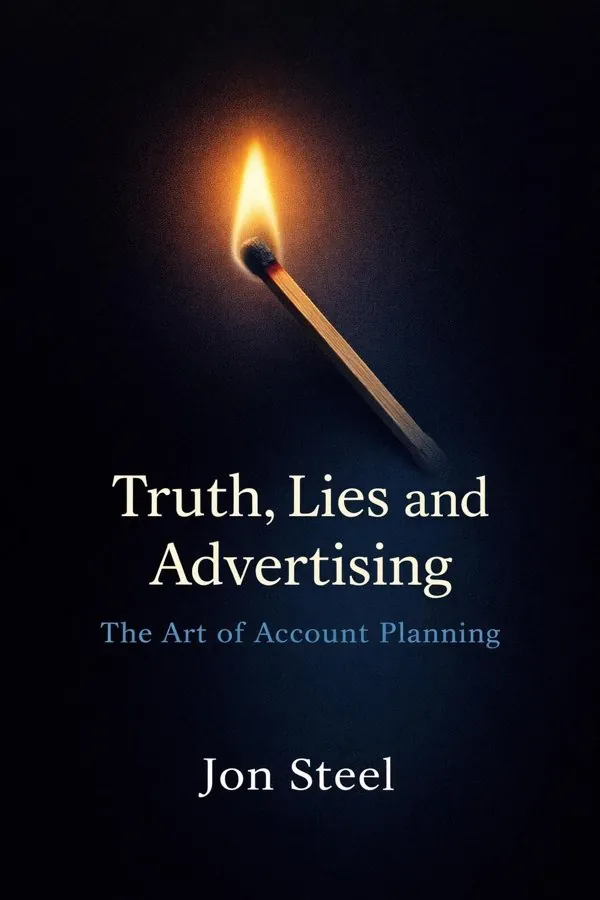
Truth, Lies and Advertising: The Art of Account Planning: Summary & Key Insights
by Jon Steel
 10 min5 chaptersAudio available
What Is Truth, Lies and Advertising: The Art of Account Planning About?
Truth, Lies and Advertising: The Art of Account Planning by Jon Steel is a marketing book spanning 5 pages. Truth, Lies and Advertising: The Art of Account Planning is a seminal work on the practice of account planning in advertising. Jon Steel, drawing from his experience at Goodby, Silverstein & Partners, explores how planners uncover consumer insights and translate them into creative strategies that drive effective campaigns. The book combines theory, case studies, and practical advice, making it a foundational text for advertising professionals and students alike.
This FizzRead summary covers all 5 key chapters of Truth, Lies and Advertising: The Art of Account Planning in approximately 10 minutes, distilling the most important ideas, arguments, and takeaways from Jon Steel's work. Also available as an audio summary and Key Quotes Podcast.
Truth, Lies and Advertising: The Art of Account Planning
Truth, Lies and Advertising: The Art of Account Planning is a seminal work on the practice of account planning in advertising. Jon Steel, drawing from his experience at Goodby, Silverstein & Partners, explores how planners uncover consumer insights and translate them into creative strategies that drive effective campaigns. The book combines theory, case studies, and practical advice, making it a foundational text for advertising professionals and students alike.
Who Should Read Truth, Lies and Advertising: The Art of Account Planning?
This book is perfect for anyone interested in marketing and looking to gain actionable insights in a short read. Whether you're a student, professional, or lifelong learner, the key ideas from Truth, Lies and Advertising: The Art of Account Planning by Jon Steel will help you think differently.
- ✓Readers who enjoy marketing and want practical takeaways
- ✓Professionals looking to apply new ideas to their work and life
- ✓Anyone who wants the core insights of Truth, Lies and Advertising: The Art of Account Planning in just 10 minutes
Want the full summary?
Get instant access to this book summary and 100K+ more with Fizz Moment.
Get Free SummaryAvailable on App Store • Free to download
Key Chapters
Account planning was born from frustration—the frustration that advertising decisions were being driven either by data without soul or creativity without grounding. In the late 1960s in the UK, agencies like JWT London and BMP began to experiment with a new role that would bridge these two worlds. It combined the analytical strength of market research with the emotional intelligence of creative intuition. This was the planner’s role: to be the voice of the consumer in the creative process.
In its early days, account planning was revolutionary. Stephen King at JWT and Stanley Pollitt at BMP recognized that traditional research often reduced consumers into statistics, ignoring their feelings, contradictions, and cultural contexts. They proposed a different approach—one that began with empathy. Rather than treating people as ‘targets,’ planners sought to understand them as human beings whose choices were rooted in emotions as much as in logic.
When account planning arrived in the United States, it had to adapt. American agencies, with their emphasis on bold creativity, sometimes viewed research as the enemy of art. My task at Goodby, Silverstein & Partners was to show that the planner was not there to tame creativity, but to inspire it. By bringing insights from real people—through conversations, ethnography, and cultural immersion—we could make creative work more relevant, more provocative, and ultimately more effective.
Account planning thus became the bridge: between research and inspiration, between clients’ business goals and consumers’ real lives, and between strategy and creative execution. The planner’s job is not to judge the work, but to ensure that the work is built on genuine human understanding. It is a balance of logic and empathy, of science and art.
If there is one unshakable belief that defines my view of advertising, it is that people do not buy products—they buy ideas that make them feel something about themselves. To uncover those ideas, a planner must go beyond surveys, focus groups, and data charts. We must observe people in their natural settings, listen to how they talk about brands when they don’t think anyone from the agency is listening, and capture the hidden motivations that conventional research misses.
I’ve often said that research should not be about asking people what they think, but discovering why they think it. The truth behind consumer behavior is rarely found in stated opinions. More often, it is hidden beneath them—in everyday habits, in contradictions, in the way people describe not the brand, but how it fits into their identities. For example, when we studied milk drinkers, we found that very few people were passionate about milk itself. The insight wasn’t about love—it was about absence. People only noticed milk when it was missing. That realization led to an entirely new way of talking about the product.
To reach those kinds of truths, planners must be both detectives and storytellers. We gather clues from conversation, observation, and experience, and then we interpret them into meaning. We translate raw behavior into emotional insight, and that insight becomes the foundation of a creative strategy. Our goal isn’t to dictate what creatives must make, but to inspire them with a truth so powerful it sets their imagination free.
True account planning treats research as an art form. It’s about having empathy strong enough to see the world through someone else’s eyes, patience to listen deeply, and the courage to tell the uncomfortable truth about what people actually feel. Because the truth is always more compelling than the lie.
+ 3 more chapters — available in the FizzRead app
All Chapters in Truth, Lies and Advertising: The Art of Account Planning
About the Author
Get This Summary in Your Preferred Format
Read or listen to the Truth, Lies and Advertising: The Art of Account Planning summary by Jon Steel anytime, anywhere. FizzRead offers multiple formats so you can learn on your terms — all free.
Available formats: App · Audio · PDF · EPUB — All included free with FizzRead
Download Truth, Lies and Advertising: The Art of Account Planning PDF and EPUB Summary
Key Quotes from Truth, Lies and Advertising: The Art of Account Planning
“Account planning was born from frustration—the frustration that advertising decisions were being driven either by data without soul or creativity without grounding.”
“If there is one unshakable belief that defines my view of advertising, it is that people do not buy products—they buy ideas that make them feel something about themselves.”
Frequently Asked Questions about Truth, Lies and Advertising: The Art of Account Planning
Truth, Lies and Advertising: The Art of Account Planning by Jon Steel is a marketing book that explores key ideas across 5 chapters. Truth, Lies and Advertising: The Art of Account Planning is a seminal work on the practice of account planning in advertising. Jon Steel, drawing from his experience at Goodby, Silverstein & Partners, explores how planners uncover consumer insights and translate them into creative strategies that drive effective campaigns. The book combines theory, case studies, and practical advice, making it a foundational text for advertising professionals and students alike.
You Might Also Like
Captivology: The Science of Capturing People's Attention
Ben Parr
10 min
Marketing 5.0: Technology for Humanity
Philip Kotler, Hermawan Kartajaya, Iwan Setiawan
10 min
Marketing Strategy
Paul Fifield
10 min
UnMarketing: Stop Marketing. Start Engaging.
Scott Stratten
10 min
$100M Leads: How to Get Strangers to Want to Buy Your Stuff
Alex Hormozi
10 min
80/20 Sales and Marketing: The Definitive Guide to Working Less and Making More
Perry Marshall
10 minBrowse by Category
Ready to read Truth, Lies and Advertising: The Art of Account Planning?
Get the full summary and 100K+ more books with Fizz Moment.