
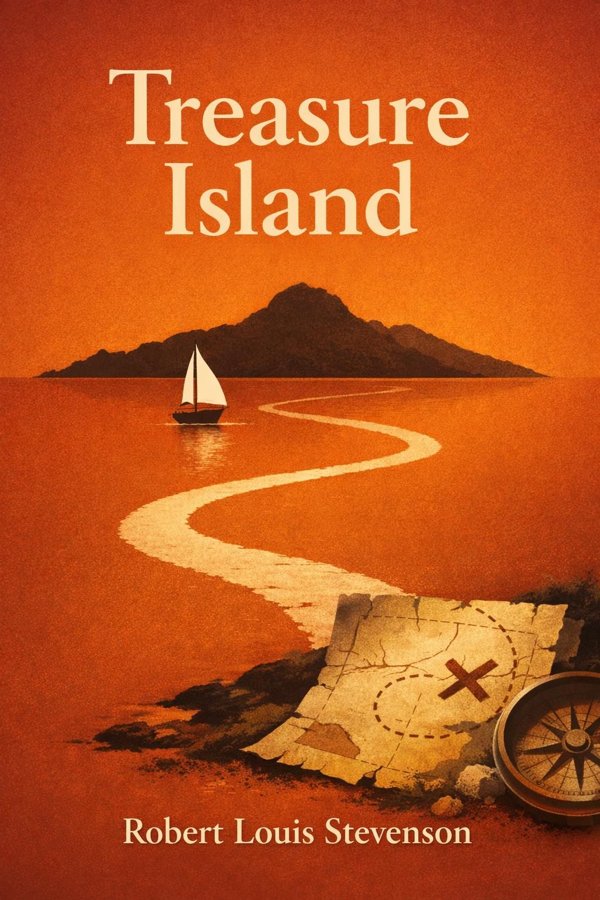
Treasure Island: Summary & Key Insights
 10 min9 chaptersAudio available
Key Takeaways from Treasure Island
Adventure often begins not with bravery, but with disruption.
The most dangerous threats are often the ones hidden beneath apparent order.
The real battle on Treasure Island is not only for gold, but for the ability to remain human in a world ruled by fear and appetite.
Not every treasure story ends with uncomplicated triumph.
Some of the most influential people in our lives are not the most virtuous, but the most persuasive.
What Is Treasure Island About?
Treasure Island by Robert Louis Stevenson is a classics book spanning 4 pages. Treasure Island is one of the defining adventure novels in English literature, a story that turns a simple seaside inn into the starting point for danger, discovery, and moral awakening. First published in 1883, Robert Louis Stevenson’s novel follows young Jim Hawkins after he comes into possession of a pirate’s treasure map. What begins as a dream of wealth quickly becomes a test of judgment, courage, and survival as Jim sails aboard the Hispaniola and finds himself trapped between honorable men and ruthless mutineers. At the center of the story stands Long John Silver, one of literature’s most unforgettable villains: charming, intelligent, fatherly, and deeply dangerous. Stevenson matters because he did more than write an exciting tale of buried gold. He helped shape the modern adventure story, giving readers vivid characters, tense plotting, and themes that still resonate: the seduction of greed, the loss of innocence, and the difficulty of knowing whom to trust. Treasure Island remains compelling not only for its action, but for its insight into human nature under pressure.
This FizzRead summary covers all 9 key chapters of Treasure Island in approximately 10 minutes, distilling the most important ideas, arguments, and takeaways from Robert Louis Stevenson's work. Also available as an audio summary and Key Quotes Podcast.
Treasure Island
Treasure Island is one of the defining adventure novels in English literature, a story that turns a simple seaside inn into the starting point for danger, discovery, and moral awakening. First published in 1883, Robert Louis Stevenson’s novel follows young Jim Hawkins after he comes into possession of a pirate’s treasure map. What begins as a dream of wealth quickly becomes a test of judgment, courage, and survival as Jim sails aboard the Hispaniola and finds himself trapped between honorable men and ruthless mutineers. At the center of the story stands Long John Silver, one of literature’s most unforgettable villains: charming, intelligent, fatherly, and deeply dangerous. Stevenson matters because he did more than write an exciting tale of buried gold. He helped shape the modern adventure story, giving readers vivid characters, tense plotting, and themes that still resonate: the seduction of greed, the loss of innocence, and the difficulty of knowing whom to trust. Treasure Island remains compelling not only for its action, but for its insight into human nature under pressure.
Who Should Read Treasure Island?
This book is perfect for anyone interested in classics and looking to gain actionable insights in a short read. Whether you're a student, professional, or lifelong learner, the key ideas from Treasure Island by Robert Louis Stevenson will help you think differently.
- ✓Readers who enjoy classics and want practical takeaways
- ✓Professionals looking to apply new ideas to their work and life
- ✓Anyone who wants the core insights of Treasure Island in just 10 minutes
Want the full summary?
Get instant access to this book summary and 100K+ more with Fizz Moment.
Get Free SummaryAvailable on App Store • Free to download
Key Chapters
Adventure often begins not with bravery, but with disruption. Jim Hawkins is not searching for danger when Treasure Island opens. He is a boy living a modest life at the Admiral Benbow Inn with his parents, occupied by ordinary responsibilities. Then Billy Bones arrives, carrying with him the atmosphere of the sea: secrecy, violence, fear, and stories of buried treasure. His presence unsettles the inn, but it also widens Jim’s world. After Bones dies, Jim discovers the treasure map hidden among the sailor’s belongings, and that single object changes the direction of his life.
The map matters because it represents more than promised gold. It is a symbol of possibility. For Jim, it offers escape from routine and entry into adulthood. Yet Stevenson is careful to show that opportunity is always mixed with risk. The same map that excites Jim also attracts dangerous men. In other words, every great opportunity tests character as much as it rewards ambition.
This idea applies beyond fiction. A new job, a business idea, or a major move can feel like Jim’s map: thrilling, transformative, and full of uncertainty. The question is not whether opportunity will bring danger, but whether we can meet that danger with clear judgment. Jim’s first important act is not blind heroism; it is paying attention, acting decisively, and bringing what he finds to trustworthy adults.
Actionable takeaway: When a life-changing opportunity appears, do not chase it blindly. Identify the risks, seek wise allies, and step forward with both courage and caution.
The most dangerous threats are often the ones hidden beneath apparent order. Once the treasure map is found, Squire Trelawney eagerly finances an expedition, Dr. Livesey brings steadiness and intelligence, and the ship Hispaniola is prepared for the journey. On the surface, everything looks promising. The vessel is sound, the mission is clear, and the crew appears capable. Yet Stevenson shows how fragile organized plans can be when leaders mistake enthusiasm for wisdom.
The central problem is that the expedition’s secrecy is poorly managed and its trust is misplaced. Trelawney talks too much, revealing more than he should, and several members of the crew are secretly tied to piracy. Long John Silver, hired as the ship’s cook, presents himself as cheerful, helpful, and dependable. Jim is naturally drawn to him. But Silver’s friendliness masks his true influence over the men. The result is a voyage defined by suspense long before any sword is drawn.
This part of the novel is not only about pirates. It is about leadership and the unseen weaknesses in any group. Teams fail when they confuse likability with loyalty, or momentum with security. In workplaces, families, and partnerships, the early warning signs of trouble are often present, but ignored because they are inconvenient.
Jim’s accidental overhearing of the mutiny plot becomes the turning point. His awareness gives the loyal party a chance to prepare. Knowledge does not eliminate danger, but it allows for smarter action.
Actionable takeaway: In any important venture, examine the character of the people involved as closely as the plan itself. Trust should be earned through evidence, not appearances.
The real battle on Treasure Island is not only for gold, but for the ability to remain human in a world ruled by fear and appetite. Once Jim and the others arrive, the conflict becomes immediate and physical. The crew splits between loyal men and mutineers, violence erupts, and safety depends on strategy, speed, and nerve. Yet Stevenson’s deeper concern is moral survival: what happens to people when greed and danger strip away social order.
The island becomes a testing ground. Jim must make decisions without the comfort of childhood dependence. Dr. Livesey remains calm and practical under pressure. Captain Smollett insists on discipline and responsibility. In contrast, the pirates are driven by impulse, suspicion, and selfish desire. They can unite briefly when there is treasure to be won, but their greed ultimately makes them unstable.
What makes this section powerful is that Stevenson avoids simplistic contrasts. The loyal men are not fearless, and the pirates are not all equally monstrous. Everyone is under strain. The question is who can still act according to principle when circumstances reward betrayal. Jim’s growth comes from learning that courage is not the absence of fear; it is acting usefully while afraid.
This insight is practical in modern life. Under stress, people reveal their habits of character. Crisis does not create values from nothing; it exposes them. Whether in conflict at work, pressure in relationships, or difficult public situations, people must decide what they are willing to compromise.
Actionable takeaway: Prepare your character before crisis arrives. In hard moments, habits of honesty, discipline, and self-control become your greatest protection.
Not every treasure story ends with uncomplicated triumph. By the conclusion of Treasure Island, some treasure has been recovered, many lives have been lost, and Jim returns home changed. The voyage gives him excitement and material reward, but it also leaves him with memories that are not easily romanticized. Stevenson refuses to present adventure as pure glory. Instead, he shows that every gain carries a cost, and maturity begins when we can acknowledge both.
Jim’s return is important because he no longer sees the world with a child’s innocence. He has witnessed death, deceit, courage, and moral ambiguity. He has learned that fortune can be won through bravery, but also that greed poisons those who worship it. The treasure itself, which once seemed like the central prize, becomes less significant than the knowledge Jim has gained about human nature and about himself.
This is one of the novel’s most enduring lessons. Many people pursue external rewards believing they will solve everything: money, status, recognition, or success. But after the achievement comes reflection. Was the cost worth it? What kind of person did the pursuit make me? Stevenson suggests that experience is valuable only if it deepens judgment.
Even Long John Silver’s escape reinforces this complexity. Evil is not always neatly punished, and justice is not always tidy. Life often ends with unfinished tensions rather than perfect closure.
Actionable takeaway: After every major success or struggle, pause to reflect not just on what you gained, but on what the experience taught you about values, priorities, and character.
Some of the most influential people in our lives are not the most virtuous, but the most persuasive. Long John Silver is one of literature’s greatest examples of charisma used without integrity. He is funny, warm, adaptable, and remarkably intelligent. He can speak to gentlemen and sailors alike, calm suspicion, and inspire loyalty even while plotting betrayal. Jim, like many readers, finds him hard not to admire. That is exactly Stevenson’s point.
Silver is memorable because he is never a flat villain. He is cruel when necessary, but also practical, affectionate in manner, and capable of restraint. He seems almost fatherly toward Jim at times. This complexity makes him more dangerous. Obvious villains are easy to resist; charming ones are harder to judge. Silver uses personal connection as a strategic tool, making others feel seen while quietly advancing his own interests.
This pattern appears everywhere in real life: in manipulative leaders, persuasive salespeople, controlling partners, or public figures who confuse confidence with trustworthiness. Stevenson teaches readers to separate magnetism from morality. A person may be impressive, witty, and emotionally intelligent while still being fundamentally unsafe.
At the same time, Silver’s character also reveals the power of adaptability. He survives because he reads situations quickly and adjusts. Stevenson therefore presents a paradox: traits like charisma and flexibility are powerful, but without ethics they become predatory.
Actionable takeaway: Learn to admire skill without surrendering judgment. When evaluating a powerful personality, ask not only whether they are compelling, but whether their actions consistently align with principle and trust.
Growing up is less about age than about responsibility accepted under pressure. Jim Hawkins begins Treasure Island as an ordinary boy, reactive rather than decisive. By the end, he has become capable of initiative, secrecy, endurance, and moral judgment. Stevenson traces this transformation carefully, showing that courage develops through action, not through self-image.
Jim’s growth is visible in a series of choices. He helps secure the map. He recognizes danger when others dismiss it. He slips away to act independently, sometimes recklessly, yet often decisively. His capture of the Hispaniola is especially important because it proves he can influence events rather than merely survive them. Still, Stevenson does not idealize him. Jim makes mistakes, takes risks without permission, and often acts from impulse. His bravery is mixed with immaturity, which makes his development convincing.
The novel suggests that courage has several layers. First comes physical bravery: facing immediate danger. Then comes moral bravery: choosing what is right despite temptation or fear. Finally, there is psychological bravery: continuing after one’s illusions have been broken. Jim must grow in all three ways.
This matters because readers often wait to feel ready before acting. Stevenson offers a truer model. People become capable by doing difficult things imperfectly, learning from consequences, and trying again. Confidence is often the result of action rather than the cause of it.
Actionable takeaway: Build courage in small but real ways. Take responsibility, act when something important is at stake, and allow imperfect effort to become the training ground for stronger character.
What people chase often reveals more about them than what they already possess. In Treasure Island, gold is the object everyone claims to want, but Stevenson uses it mainly to expose hidden motives and weaknesses. The treasure motivates the expedition, fuels mutiny, breaks alliances, and intensifies violence. Yet the closer the characters get to wealth, the less noble most of them become.
For the pirates, treasure is not merely money; it is fantasy. It promises freedom, indulgence, and power without labor or restraint. That fantasy makes them reckless and suspicious. Because greed is inherently competitive, it destroys trust from within. Men who unite to seek fortune quickly turn on one another once division of the reward becomes imaginable. Stevenson shows that greed is self-defeating because it cannot create stable loyalty.
The more honorable characters are not entirely free of desire, but they are governed by larger principles: order, duty, mutual protection, and justice. This contrast is central to the novel’s moral architecture. Wealth itself is not the villain. The problem is what happens when wealth becomes the supreme value.
The same dynamic appears today. People cut ethical corners for promotion, prestige, followers, or financial gain, only to damage relationships and credibility. When reward becomes the only measure of success, character deteriorates.
Stevenson’s insight is especially sharp because he never delivers it as a sermon. He lets greed reveal itself through conduct, fear, and betrayal.
Actionable takeaway: Decide in advance what values money or success will never be allowed to override. Clear boundaries protect your judgment when temptation becomes intense.
In dangerous situations, leadership is measured less by authority than by steadiness. Treasure Island offers several models of leadership through characters like Captain Smollett, Dr. Livesey, and Squire Trelawney. Trelawney provides resources and enthusiasm, but he is impulsive and indiscreet. Smollett provides structure, caution, and command. Livesey adds calm intelligence and moral balance. Together, they illustrate that effective leadership is rarely one quality; it is a combination of vision, restraint, and reliability.
Captain Smollett in particular represents disciplined leadership. He is not warm in the way Silver is, nor flamboyant in the way Trelawney is. He earns trust through competence. He notices weaknesses in the crew, insists on proper precautions, and values preparation over optimism. In crises, this kind of leadership becomes indispensable. It may seem less exciting, but it saves lives.
Dr. Livesey complements this with humane judgment. He stays rational when others panic and treats even difficult circumstances with practicality. Stevenson suggests that leadership is not domination; it is the ability to preserve order and purpose when confusion spreads.
This applies broadly to modern organizations and personal life. Good leaders do not merely inspire. They set boundaries, communicate clearly, and protect the group from preventable risks. They understand that trust is built through consistency, not charm.
Actionable takeaway: If you lead others, aim to be dependable before impressive. In uncertain situations, clear communication, preparation, and calm decision-making create the trust that keeps people aligned.
The lasting power of Treasure Island comes from the fact that its adventure is never only external. Sword fights, sea voyages, hidden coves, and buried treasure make the novel exciting, but the deeper journey is inward. Stevenson uses the structure of an adventure tale to ask enduring questions: How do people behave when laws are distant? What happens when fear competes with conscience? How do innocence and experience reshape identity?
This is why the book has remained alive for generations. It satisfies the appetite for suspense while also functioning as a study of decision-making under stress. Children can read it as an exciting pirate story. Adults can read it as a meditation on trust, corruption, authority, and moral ambiguity. The novel works at both levels because Stevenson understands that danger reveals truth quickly.
Adventure in this book is not escapism in the shallow sense. It is a laboratory for values. Removed from ordinary society, the characters become clearer versions of themselves. Some become loyal, some treacherous, some practical, some delusional. Jim, standing between childhood and adulthood, becomes the ideal observer of this world because he is still impressionable enough to be tempted and honest enough to learn.
For modern readers, this means the novel remains relevant. We may not sail after buried gold, but we still navigate risk, ambition, loyalty, and temptation. The island is simply a dramatic version of the moral terrain everyone crosses.
Actionable takeaway: Read adventure stories not only for excitement, but for self-examination. Ask which characters resemble your own instincts under pressure, and what that reveals about your values.
All Chapters in Treasure Island
About the Author
Robert Louis Stevenson (1850–1894) was a Scottish writer whose work transformed adventure fiction into a serious literary art. Born in Edinburgh, he originally studied engineering and then law, but devoted himself to writing instead. Despite chronic illness throughout his life, Stevenson produced novels, essays, poems, and travel writing distinguished by clarity, imagination, and psychological insight. He became internationally famous for works such as Treasure Island, Kidnapped, and Strange Case of Dr Jekyll and Mr Hyde. His fiction combines vivid storytelling with deeper questions about morality, identity, courage, and human weakness. Stevenson traveled widely in search of better climates and eventually settled in Samoa, where he spent his final years. His influence remains immense, especially in the genres of adventure, horror, and coming-of-age fiction.
Get This Summary in Your Preferred Format
Read or listen to the Treasure Island summary by Robert Louis Stevenson anytime, anywhere. FizzRead offers multiple formats so you can learn on your terms — all free.
Available formats: App · Audio · PDF · EPUB — All included free with FizzRead
Download Treasure Island PDF and EPUB Summary
Key Quotes from Treasure Island
“Adventure often begins not with bravery, but with disruption.”
“The most dangerous threats are often the ones hidden beneath apparent order.”
“The real battle on Treasure Island is not only for gold, but for the ability to remain human in a world ruled by fear and appetite.”
“Not every treasure story ends with uncomplicated triumph.”
“Some of the most influential people in our lives are not the most virtuous, but the most persuasive.”
Frequently Asked Questions about Treasure Island
Treasure Island by Robert Louis Stevenson is a classics book that explores key ideas across 9 chapters. Treasure Island is one of the defining adventure novels in English literature, a story that turns a simple seaside inn into the starting point for danger, discovery, and moral awakening. First published in 1883, Robert Louis Stevenson’s novel follows young Jim Hawkins after he comes into possession of a pirate’s treasure map. What begins as a dream of wealth quickly becomes a test of judgment, courage, and survival as Jim sails aboard the Hispaniola and finds himself trapped between honorable men and ruthless mutineers. At the center of the story stands Long John Silver, one of literature’s most unforgettable villains: charming, intelligent, fatherly, and deeply dangerous. Stevenson matters because he did more than write an exciting tale of buried gold. He helped shape the modern adventure story, giving readers vivid characters, tense plotting, and themes that still resonate: the seduction of greed, the loss of innocence, and the difficulty of knowing whom to trust. Treasure Island remains compelling not only for its action, but for its insight into human nature under pressure.
More by Robert Louis Stevenson

You Might Also Like






Browse by Category
Ready to read Treasure Island?
Get the full summary and 100K+ more books with Fizz Moment.