
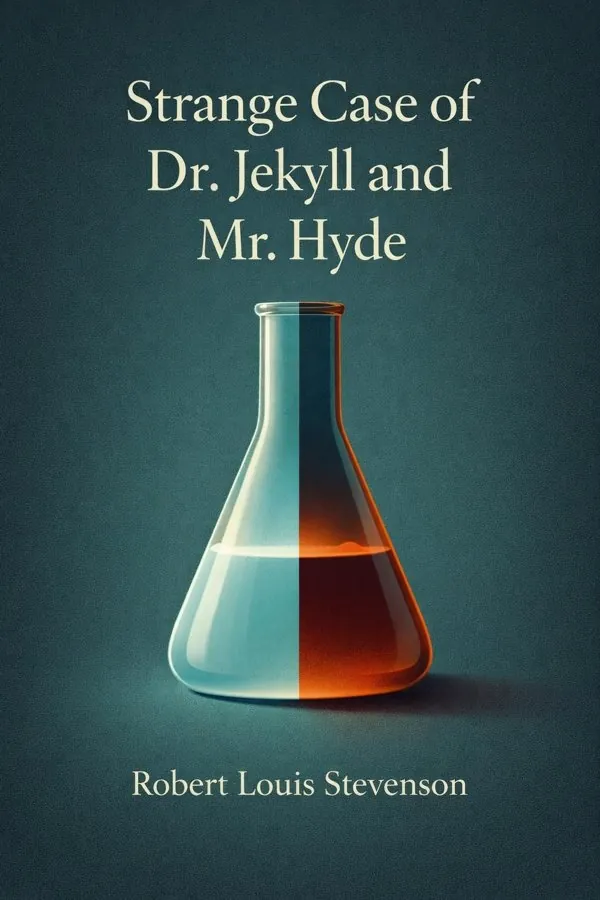
Strange Case of Dr. Jekyll and Mr. Hyde: Summary & Key Insights
 10 min4 chaptersAudio available
What Is Strange Case of Dr. Jekyll and Mr. Hyde About?
Strange Case of Dr. Jekyll and Mr. Hyde by Robert Louis Stevenson is a classics book spanning 4 pages. A novella exploring the duality of human nature through the story of Dr. Henry Jekyll, a respected scientist who creates a potion that transforms him into the violent and immoral Edward Hyde. Set in Victorian London, the work delves into themes of identity, morality, and the conflict between good and evil within the same person.
This FizzRead summary covers all 4 key chapters of Strange Case of Dr. Jekyll and Mr. Hyde in approximately 10 minutes, distilling the most important ideas, arguments, and takeaways from Robert Louis Stevenson's work. Also available as an audio summary and Key Quotes Podcast.
Strange Case of Dr. Jekyll and Mr. Hyde
A novella exploring the duality of human nature through the story of Dr. Henry Jekyll, a respected scientist who creates a potion that transforms him into the violent and immoral Edward Hyde. Set in Victorian London, the work delves into themes of identity, morality, and the conflict between good and evil within the same person.
Who Should Read Strange Case of Dr. Jekyll and Mr. Hyde?
This book is perfect for anyone interested in classics and looking to gain actionable insights in a short read. Whether you're a student, professional, or lifelong learner, the key ideas from Strange Case of Dr. Jekyll and Mr. Hyde by Robert Louis Stevenson will help you think differently.
- ✓Readers who enjoy classics and want practical takeaways
- ✓Professionals looking to apply new ideas to their work and life
- ✓Anyone who wants the core insights of Strange Case of Dr. Jekyll and Mr. Hyde in just 10 minutes
Want the full summary?
Get instant access to this book summary and 100K+ more with Fizz Moment.
Get Free SummaryAvailable on App Store • Free to download
Key Chapters
I began the story through the calm, rational eyes of Mr. Utterson, a man whose moral decency makes him the ideal observer of corruption. Utterson encounters disturbing gossip about a sinister figure named Edward Hyde, known for trampling a young girl and paying his way out of punishment with a suspicious cheque signed by Dr. Jekyll. This news unsettles Utterson profoundly, for Jekyll is not merely his client but his dear friend—a man of scientific virtue and social grace. The lawyer cannot comprehend how a being so vile could be associated with such honor. His confusion sets the groundwork for the investigation that anchors the early chapters.
Through Utterson’s perspective, I wanted to establish a sense of normalcy colliding with the irrational. Much like any sensible gentleman of London, he approaches moral outrage through legal curiosity. He analyses Hyde’s nature as though it were an anomaly that law and reason could explain. But soon, it becomes clear that Hyde is no ordinary criminal. Every description of him—his deformity without name, his unnerving aura, the instinctive hatred he provokes—suggests a metaphysical wrongness rather than mere social corruption. The reader, alongside Utterson, begins to sense that Hyde represents an elemental evil, the kind that cannot be legislated away.
Utterson’s journey into the fog-bound streets is, therefore, more than a detective pursuit; it is the voyage of reason confronting mystery. I wanted the reader to feel the pull of Victorian respectability—the certainty that good must be visible, success must be coherent—and juxtapose it with Hyde’s inscrutability. He becomes the embodiment of moral anxiety, the eruption of something forbidden and untamed that society’s moral order cannot define. Through these early chapters, I lay the psychological foundation for what is to follow: the battle between social decency and personal darkness.
As Utterson investigates further, he learns that Hyde has now committed an act far graver than trampling a child—he has murdered Sir Danvers Carew, a member of Parliament, and done so with shocking violence. The crime horrifies not only London’s citizens but also Jekyll’s circle. This moment shifts the narrative from mere curiosity to existential dread. Utterson’s inquiry becomes not just legal but profoundly moral: who could harbor such a monster within respectable circles?
In these middle chapters, I wanted to heighten the tension between public virtue and private vice. Hyde’s brutality lays bare the consequences of unchecked desire. While the world recoils, Jekyll retreats, claiming to have “put an end” to Hyde. For a time, he seems to return to his original gentleness—hosting dinners, speaking kindly, and engaging with his friends once more. But the reader senses the illusion. Jekyll’s serenity feels fragile, like sunlight over the fog, destined to vanish at the next moment of temptation.
This stage of the story is where psychological drama merges with social commentary. Victorian England prided itself on restraint and order. Yet through Jekyll’s turmoil, I expose the hypocrisy of that pride. His laboratory becomes the metaphorical closet where sin and instinct are bottled up but never destroyed. The more Hyde acts freely, the more Jekyll feels morally “redeemed.” The paradox is tragic and inescapable: his morality survives only because his evil has taken form elsewhere.
The murder of Carew signifies the tipping point. Hyde’s savagery—direct, gleeful, and void of remorse—reveals that separation of the soul does not divide good from evil; it endows evil with autonomy. In that revelation, Utterson’s fear evolves into understanding. He realizes that Hyde is not Jekyll’s associate but his creation, not friend but shadow. This is the moment when the mystery ceases to be external. The law can no longer apprehend Hyde, because what he embodies is intangible. The reader begins to grasp the overarching truth that moral corruption cannot be imprisoned or slain—it resides within.
+ 2 more chapters — available in the FizzRead app
All Chapters in Strange Case of Dr. Jekyll and Mr. Hyde
About the Author
Robert Louis Stevenson (1850–1894) was a Scottish novelist, poet, and travel writer best known for works such as 'Treasure Island', 'Kidnapped', and 'Strange Case of Dr. Jekyll and Mr. Hyde'. His writing combines adventure, psychological insight, and moral reflection, making him one of the most influential authors of the late 19th century.
Get This Summary in Your Preferred Format
Read or listen to the Strange Case of Dr. Jekyll and Mr. Hyde summary by Robert Louis Stevenson anytime, anywhere. FizzRead offers multiple formats so you can learn on your terms — all free.
Available formats: App · Audio · PDF · EPUB — All included free with FizzRead
Download Strange Case of Dr. Jekyll and Mr. Hyde PDF and EPUB Summary
Key Quotes from Strange Case of Dr. Jekyll and Mr. Hyde
“I began the story through the calm, rational eyes of Mr.”
“The crime horrifies not only London’s citizens but also Jekyll’s circle.”
Frequently Asked Questions about Strange Case of Dr. Jekyll and Mr. Hyde
Strange Case of Dr. Jekyll and Mr. Hyde by Robert Louis Stevenson is a classics book that explores key ideas across 4 chapters. A novella exploring the duality of human nature through the story of Dr. Henry Jekyll, a respected scientist who creates a potion that transforms him into the violent and immoral Edward Hyde. Set in Victorian London, the work delves into themes of identity, morality, and the conflict between good and evil within the same person.
More by Robert Louis Stevenson
You Might Also Like





Browse by Category
Ready to read Strange Case of Dr. Jekyll and Mr. Hyde?
Get the full summary and 100K+ more books with Fizz Moment.