
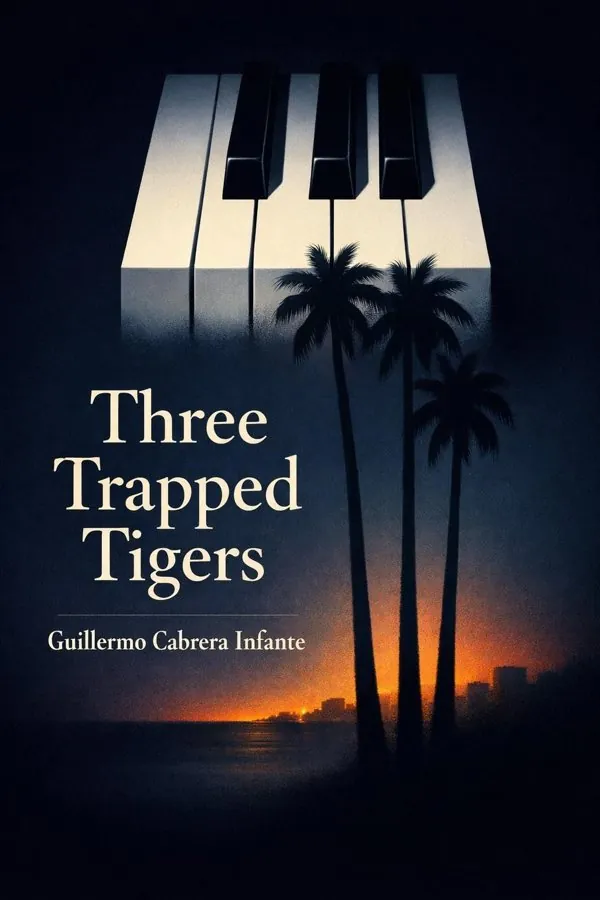
Three Trapped Tigers: Summary & Key Insights
 10 min9 chaptersAudio available
Key Takeaways from Three Trapped Tigers
Some novels use setting as background; Three Trapped Tigers makes the city itself the main event.
A powerful way to understand Three Trapped Tigers is to see its central figures not only as individuals but as different responses to art, performance, and modern life.
Nightlife in Three Trapped Tigers is not decorative excess; it is a system for understanding society.
The novel’s boldest claim is that language does not merely report reality; it creates it.
A fragmented novel can feel disorienting, but in Three Trapped Tigers fragmentation is not a flaw to be overcome.
What Is Three Trapped Tigers About?
Three Trapped Tigers by Guillermo Cabrera Infante is a classics book spanning 6 pages. Guillermo Cabrera Infante’s Three Trapped Tigers is less a conventional novel than an explosion of voices, rhythms, jokes, memories, songs, and verbal performances set in Havana on the eve of the Cuban Revolution. First published in 1967, the book follows writers, performers, talkers, drifters, and nightclub habitués as they move through bars, cabarets, studios, taxis, and conversations that seem to create the city even as they describe it. Plot matters less here than sound, style, and atmosphere. The novel turns speech into action and nightlife into literature. What makes Three Trapped Tigers so important is its radical belief that language is not simply a tool for telling a story but the story itself. Cabrera Infante captures Havana as a living orchestra of slang, wit, music, gossip, and improvisation, preserving a vanished cultural world while also reinventing the novel form. A major figure of the Latin American Boom, he brought to fiction the sensibility of a film critic, humorist, and linguistic virtuoso. The result is one of twentieth-century literature’s boldest experiments: dazzling, difficult, funny, and unforgettable.
This FizzRead summary covers all 9 key chapters of Three Trapped Tigers in approximately 10 minutes, distilling the most important ideas, arguments, and takeaways from Guillermo Cabrera Infante's work. Also available as an audio summary and Key Quotes Podcast.
Three Trapped Tigers
Guillermo Cabrera Infante’s Three Trapped Tigers is less a conventional novel than an explosion of voices, rhythms, jokes, memories, songs, and verbal performances set in Havana on the eve of the Cuban Revolution. First published in 1967, the book follows writers, performers, talkers, drifters, and nightclub habitués as they move through bars, cabarets, studios, taxis, and conversations that seem to create the city even as they describe it. Plot matters less here than sound, style, and atmosphere. The novel turns speech into action and nightlife into literature.
What makes Three Trapped Tigers so important is its radical belief that language is not simply a tool for telling a story but the story itself. Cabrera Infante captures Havana as a living orchestra of slang, wit, music, gossip, and improvisation, preserving a vanished cultural world while also reinventing the novel form. A major figure of the Latin American Boom, he brought to fiction the sensibility of a film critic, humorist, and linguistic virtuoso. The result is one of twentieth-century literature’s boldest experiments: dazzling, difficult, funny, and unforgettable.
Who Should Read Three Trapped Tigers?
This book is perfect for anyone interested in classics and looking to gain actionable insights in a short read. Whether you're a student, professional, or lifelong learner, the key ideas from Three Trapped Tigers by Guillermo Cabrera Infante will help you think differently.
- ✓Readers who enjoy classics and want practical takeaways
- ✓Professionals looking to apply new ideas to their work and life
- ✓Anyone who wants the core insights of Three Trapped Tigers in just 10 minutes
Want the full summary?
Get instant access to this book summary and 100K+ more with Fizz Moment.
Get Free SummaryAvailable on App Store • Free to download
Key Chapters
Some novels use setting as background; Three Trapped Tigers makes the city itself the main event. Havana in the 1950s is not merely where the characters happen to live. It shapes the pace of their thoughts, the form of their friendships, the texture of their speech, and the emotional weather of the book. Streets, nightclubs, radio stations, cafés, and taxis become stages on which identity is performed. The city is restless, seductive, theatrical, noisy, and unstable, and those qualities seep into every page.
Cabrera Infante does not present Havana through neat description. Instead, he lets the city emerge through overheard talk, jokes, lyrics, arguments, nightlife routines, and sensory fragments. This technique matters because it suggests that a place is not just architecture or geography; it is the total atmosphere created by voices, habits, and shared references. Havana becomes a temperament before it becomes a location.
That is one reason the novel feels so alive. Readers are not guided through a tourist portrait but thrown into a living social ecology. We experience how urban culture works: one person’s anecdote becomes another person’s memory, a nightclub performance becomes part of local mythology, and casual speech turns into cultural record.
This idea has broad application. Think of how we remember our own cities: not through maps, but through favorite late-night spots, local expressions, music scenes, and familiar kinds of conversation. Cabrera Infante reminds us that cities are collective improvisations, and literature can preserve that improvisation better than any official history.
Actionable takeaway: when reading the novel, treat Havana as you would a major protagonist—track its moods, sounds, and spaces, and ask how each scene reveals the city’s personality.
A powerful way to understand Three Trapped Tigers is to see its central figures not only as individuals but as different responses to art, performance, and modern life. Silvestre, Arsenio Cué, and Códac form a loose trio through whom Cabrera Infante explores writing, improvisation, observation, vanity, friendship, and the transformation of experience into style. They are memorable partly because each turns life into a different kind of act.
Silvestre is often read as the intellectual ironist, the writerly consciousness who cannot fully inhabit the present without reshaping it into language. He is reflective, playful, and self-aware, but also trapped by his need to mediate life through words. Arsenio Cué represents another kind of brilliance: spontaneous, charismatic, dazzling in conversation, a creature of verbal performance and social immediacy. Códac, meanwhile, functions as observer, recorder, witness, and sometime stand-in for the authorial eye. He is linked to cinema, looking, framing, and memory.
Together, the trio dramatizes a central tension in the book: is life meant to be lived, performed, documented, or rewritten? Cabrera Infante refuses to settle the question. Instead, he shows how modern urban experience constantly moves among these modes. A joke becomes literature. A memory becomes a scene. A friendship becomes a role.
Readers can apply this framework beyond the novel. In any creative circle or social group, we often find similar roles: the analyst, the improviser, the recorder. Understanding these types helps explain how culture is made collectively rather than individually.
Actionable takeaway: as you read, compare how Silvestre, Cué, and Códac speak, remember, and perform themselves; their differences reveal the novel’s deepest concerns about art and identity.
The novel’s boldest claim is that language does not merely report reality; it creates it. Three Trapped Tigers is famous for puns, verbal riffs, multilingual echoes, parody, alliteration, mishearings, and elaborate word games. These are not ornaments added to a stable story. They are the substance of the book. Speech is action. Voice is character. Sound is meaning.
Cabrera Infante writes as if ordinary conversation were already a kind of art form. Cuban slang, nightclub banter, literary jokes, and spoken rhythms become the machinery of the novel. Readers quickly discover that what matters is not only what is said but how it sounds, how it twists, and how it lands. In this sense, the book is deeply musical. Repetition, variation, improvisation, and syncopation govern its movement.
This emphasis on speech has an important cultural dimension. By preserving idiom and accent, Cabrera Infante turns local language into literary material of the highest order. He refuses the idea that only formal, polished, standardized language deserves artistic seriousness. Instead, the spoken life of Havana becomes a source of creativity and identity.
There is a practical lesson here for readers and writers alike. We often flatten speech when we summarize people or events. The novel teaches us that voice carries worldview. A person’s phrasing, tempo, and humor reveal class, mood, education, aspiration, and emotional defense. To listen closely is to understand more deeply.
Even if some wordplay is challenging, the larger point remains clear: language is never neutral. It shapes memory, relationships, and perception. In modern life, this insight applies to everything from advertising slogans to political rhetoric to everyday texting.
Actionable takeaway: instead of rushing for plot, slow down and listen to the book’s sounds; ask what each verbal performance tells you that plain description never could.
A fragmented novel can feel disorienting, but in Three Trapped Tigers fragmentation is not a flaw to be overcome. It is the form best suited to a world of unstable memory, overlapping stories, and urban overstimulation. The book shifts among voices, scenes, textual experiments, anecdotal digressions, and self-conscious narrative interruptions. Rather than offering a single authoritative viewpoint, it assembles a mosaic of partial perspectives.
This structure reflects how memory actually works. We do not remember life as a linear, well-edited plot. We remember flashes of dialogue, atmospheres, humiliations, songs, faces, and recurring jokes. We revise these memories each time we tell them. Cabrera Infante builds a novel out of this process. The result is a literary city made of echoes rather than certainties.
The fragmented form also captures modern urban consciousness. In a large city, identity is shaped by constant transitions: from one bar to another, one conversation to the next, one performance to one recollection. The self becomes plural. The novel dramatizes this by refusing seamless continuity.
For many readers, this can be freeing once accepted. You do not need to force the book into a traditional narrative mold. Instead, you can read it as an archive of experiences, voices, and styles. The pattern emerges cumulatively. Themes of longing, wit, performance, and disappearance become clearer with each section.
This idea has everyday relevance. We increasingly live through fragments: messages, clips, posts, memories, and notifications. Cabrera Infante’s method helps us see fragmentation not only as loss but as a genuine condition of contemporary experience.
Actionable takeaway: read the novel associatively rather than linearly—note recurring voices, motifs, and moods, and let the larger design emerge from repetition and contrast.
One of the most striking things about Three Trapped Tigers is how funny it is, especially given the melancholy that shadows it. Humor in this novel is not superficial entertainment. It is a survival strategy, a creative instinct, and a way of confronting impermanence. Jokes, puns, exaggerations, and comic impersonations become tools for resisting silence, boredom, banality, and historical erasure.
Cabrera Infante understands that laughter often appears where people sense fragility. The nightlife world he depicts is vibrant precisely because it may not last. Friendships are unstable, careers fleeting, and the city itself poised near transformation. Humor allows the characters to keep moving, to convert anxiety into brilliance, and to turn social vulnerability into verbal power.
This has an important artistic consequence. The novel never settles into solemn nostalgia. Instead of mourning a lost Havana in static tones, it animates loss through wit. Comedy keeps the world in motion. That is why the book feels so alive even when it is elegiac. It laughs not because nothing matters, but because everything matters too intensely.
Readers can apply this insight beyond literature. In many social settings, humor functions as a way of testing intimacy, relieving pressure, or reclaiming agency. A joke can reveal insecurity, intelligence, affection, or resistance all at once. Paying attention to who jokes, how, and when can deepen our understanding of any group dynamic.
In the novel, humor also invites rereading. Lines that seem merely playful often contain subtle commentary on class, art, vanity, and politics. The joke is rarely just a joke.
Actionable takeaway: whenever the novel becomes comic, ask what emotional or historical pressure the humor is absorbing; the laughter often points directly to the book’s deepest sadness.
Three Trapped Tigers refuses the old hierarchy that places high art above mass entertainment. Songs, radio voices, movie references, nightclub acts, gossip, catchphrases, and celebrity impressions all belong to the same cultural field as literature. Cabrera Infante treats popular culture not as trivial distraction but as a reservoir of memory, style, and collective identity.
This is one of the novel’s most forward-looking achievements. Long before academic discussions of media culture became common, the book recognized that people build themselves from widely circulated sounds and images. A singer’s voice, a comic routine, or a line from a film can shape emotional life just as powerfully as a canonical poem. By bringing these materials into the novel, Cabrera Infante expands what literature can contain.
The method also reflects Havana’s specific cultural richness. The city is shown as a crossroads of music, cinema, nightlife, advertising, and oral performance. Its inhabitants are not only readers of books but consumers and creators of mixed media. The novel captures this hybridity with unusual precision.
For modern readers, this remains highly relevant. Our own identities are assembled from playlists, memes, film references, interviews, online clips, and shared jokes. Cabrera Infante helps us see that these materials are not cultural leftovers. They are central to how communities imagine themselves.
This perspective changes how we read the book. A throwaway reference may carry emotional weight, social aspiration, or historical texture. Popular culture becomes evidence—of taste, class, longing, and belonging.
Actionable takeaway: do not skim past the novel’s references to music, film, or entertainment; treat them as clues to character and culture, and consider what your own popular references say about your identity.
Although Three Trapped Tigers is often discussed through its male talkers and literary games, its women performers are essential to understanding the novel’s emotional and cultural architecture. Actresses, singers, dancers, and glamorous public figures move through the text as embodiments of desire, artistry, vulnerability, and myth. They are often remembered through male voices, but that very filtering becomes part of the book’s meaning.
Cabrera Infante shows how nightlife culture turns women into icons while also exposing the cost of that transformation. A performer may be admired, imitated, eroticized, or memorialized, yet still remain partially inaccessible as a person. The gap between lived individual and cultural image is one of the novel’s recurring tensions. This dynamic is especially important in a book so concerned with memory, since memory itself often stylizes the people it claims to preserve.
The novel’s treatment of performance therefore raises useful questions. Who gets to narrate whom? How do admiration and objectification overlap? What happens when a voice is celebrated as spectacle but not fully heard as experience? These questions do not diminish the brilliance of the nightlife world; they deepen it by revealing the inequalities within its glamour.
Readers today can connect this to celebrity culture, influencer culture, and the pressure to maintain a public persona. The novel anticipates a world in which visibility can both empower and confine.
Approaching these portrayals critically enriches the book. Rather than simply accepting the mythology around its female figures, readers can examine how that mythology is built and what it conceals. The novel becomes not just a celebration of cultural glamour but a study of how glamour is made.
Actionable takeaway: pay attention to who is speaking about women performers, what language they use, and what remains unsaid; those omissions are often as revealing as the praise.
At its deepest level, Three Trapped Tigers is an act of preservation. It gathers the sounds, habits, jokes, rhythms, and nightlife textures of pre-revolutionary Havana and converts them into literary memory. Yet it does not preserve the city as a museum object. Instead, it recreates its movement, instability, and disorder. The past survives here not as static nostalgia but as living language.
This is what gives the book its elegiac force. Readers know, even when the text does not state it directly, that this world stands near historical rupture. That knowledge changes the atmosphere of every party, conversation, and performance. The exuberance becomes shadowed by disappearance. The city feels both immediate and already lost.
Cabrera Infante’s achievement lies in avoiding simplistic political allegory. He does not reduce Havana to a lesson or slogan. He preserves a complex cultural ecosystem filled with vanity, brilliance, superficiality, intelligence, tenderness, and excess. In doing so, he reminds us that history often destroys not only institutions but tones of voice, social rituals, informal art forms, and entire ways of being together.
This insight has universal relevance. Every generation sees some part of its everyday world vanish: local venues close, slang fades, technologies alter attention, neighborhoods transform. Literature can rescue these textures in ways official history rarely does.
Readers may find that the novel prompts reflection on their own endangered cultural landscapes. What conversations, sounds, or spaces define your era, and who is preserving them? Cabrera Infante suggests that memory must be active, inventive, and stylistically alive.
Actionable takeaway: read the novel as a cultural archive in motion, and ask what ordinary details of your own world might one day need the same kind of imaginative preservation.
All Chapters in Three Trapped Tigers
About the Author
Guillermo Cabrera Infante (1929–2005) was a Cuban novelist, essayist, translator, screenwriter, and film critic renowned for his dazzling verbal wit and his evocative portrayals of Havana. Born in Gibara and raised in Cuba, he became deeply involved in journalism, cinema, and literary culture before emerging as one of the most original writers associated with the Latin American Boom. His work often fused high literary experimentation with popular culture, slang, music, and urban memory. After initially supporting the Cuban Revolution, he later broke with the Castro regime and spent much of his life in exile in London. That exile intensified his literary reconstruction of Cuba, especially Havana’s lost soundscape. In 1997, he received the Cervantes Prize, the highest honor in Spanish-language literature.
Get This Summary in Your Preferred Format
Read or listen to the Three Trapped Tigers summary by Guillermo Cabrera Infante anytime, anywhere. FizzRead offers multiple formats so you can learn on your terms — all free.
Available formats: App · Audio · PDF · EPUB — All included free with FizzRead
Download Three Trapped Tigers PDF and EPUB Summary
Key Quotes from Three Trapped Tigers
“Some novels use setting as background; Three Trapped Tigers makes the city itself the main event.”
“A powerful way to understand Three Trapped Tigers is to see its central figures not only as individuals but as different responses to art, performance, and modern life.”
“Nightlife in Three Trapped Tigers is not decorative excess; it is a system for understanding society.”
“The novel’s boldest claim is that language does not merely report reality; it creates it.”
“A fragmented novel can feel disorienting, but in Three Trapped Tigers fragmentation is not a flaw to be overcome.”
Frequently Asked Questions about Three Trapped Tigers
Three Trapped Tigers by Guillermo Cabrera Infante is a classics book that explores key ideas across 9 chapters. Guillermo Cabrera Infante’s Three Trapped Tigers is less a conventional novel than an explosion of voices, rhythms, jokes, memories, songs, and verbal performances set in Havana on the eve of the Cuban Revolution. First published in 1967, the book follows writers, performers, talkers, drifters, and nightclub habitués as they move through bars, cabarets, studios, taxis, and conversations that seem to create the city even as they describe it. Plot matters less here than sound, style, and atmosphere. The novel turns speech into action and nightlife into literature. What makes Three Trapped Tigers so important is its radical belief that language is not simply a tool for telling a story but the story itself. Cabrera Infante captures Havana as a living orchestra of slang, wit, music, gossip, and improvisation, preserving a vanished cultural world while also reinventing the novel form. A major figure of the Latin American Boom, he brought to fiction the sensibility of a film critic, humorist, and linguistic virtuoso. The result is one of twentieth-century literature’s boldest experiments: dazzling, difficult, funny, and unforgettable.
You Might Also Like




Browse by Category
Ready to read Three Trapped Tigers?
Get the full summary and 100K+ more books with Fizz Moment.