
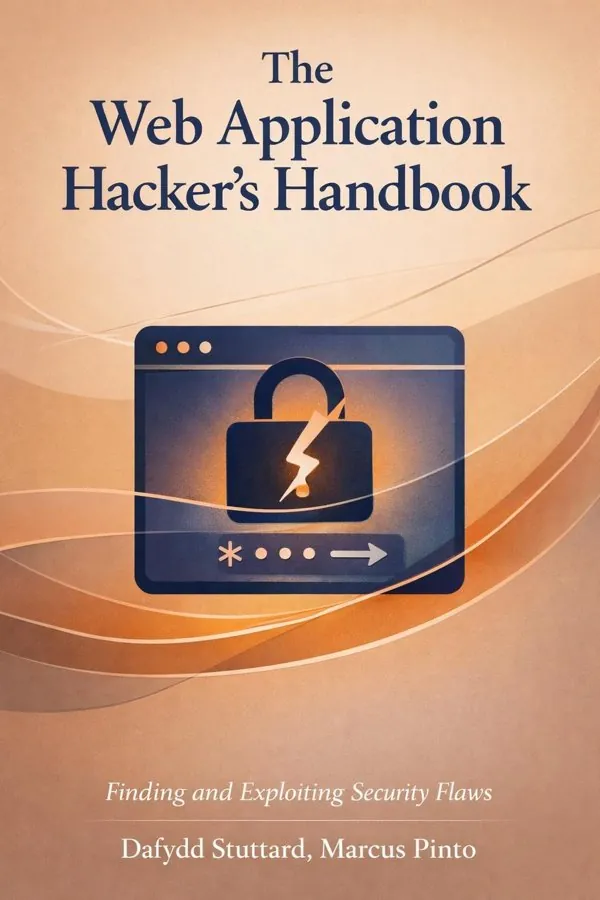
The Web Application Hacker’s Handbook: Finding and Exploiting Security Flaws: Summary & Key Insights
by Dafydd Stuttard, Marcus Pinto
 10 min7 chaptersAudio available
What Is The Web Application Hacker’s Handbook: Finding and Exploiting Security Flaws About?
The Web Application Hacker’s Handbook: Finding and Exploiting Security Flaws by Dafydd Stuttard, Marcus Pinto is a security book spanning 7 pages. This comprehensive guide explores the techniques and tools used by professional penetration testers to identify and exploit vulnerabilities in web applications. It covers authentication, session management, input validation, and advanced attack methods, providing practical examples and countermeasures for securing modern web systems.
This FizzRead summary covers all 7 key chapters of The Web Application Hacker’s Handbook: Finding and Exploiting Security Flaws in approximately 10 minutes, distilling the most important ideas, arguments, and takeaways from Dafydd Stuttard, Marcus Pinto's work. Also available as an audio summary and Key Quotes Podcast.
The Web Application Hacker’s Handbook: Finding and Exploiting Security Flaws
This comprehensive guide explores the techniques and tools used by professional penetration testers to identify and exploit vulnerabilities in web applications. It covers authentication, session management, input validation, and advanced attack methods, providing practical examples and countermeasures for securing modern web systems.
Who Should Read The Web Application Hacker’s Handbook: Finding and Exploiting Security Flaws?
This book is perfect for anyone interested in security and looking to gain actionable insights in a short read. Whether you're a student, professional, or lifelong learner, the key ideas from The Web Application Hacker’s Handbook: Finding and Exploiting Security Flaws by Dafydd Stuttard, Marcus Pinto will help you think differently.
- ✓Readers who enjoy security and want practical takeaways
- ✓Professionals looking to apply new ideas to their work and life
- ✓Anyone who wants the core insights of The Web Application Hacker’s Handbook: Finding and Exploiting Security Flaws in just 10 minutes
Want the full summary?
Get instant access to this book summary and 100K+ more with Fizz Moment.
Get Free SummaryAvailable on App Store • Free to download
Key Chapters
Every meaningful attack begins with understanding. A web application is fundamentally a conversation between client and server mediated by HTTP. Yet under this apparent simplicity lies immense complexity — cookies, forms, headers, redirects, asynchronous requests, and custom logic dancing in fragile harmony. The first job of a hacker is to listen attentively to that conversation.
We take you step by step through the anatomy of HTTP, demystifying each component: the request line, headers, message body, and response. Learning to read raw HTTP is not academic; it’s essential. When you can see precisely how a browser’s assumptions differ from the server’s expectations, you’ll understand where trust can be subverted. This deep fluency becomes your map.
Once you can observe and interpret that traffic, the next phase is mapping — discovering every reachable function and parameter an application exposes. Automated crawlers and intercepting proxies (like Burp Suite, which I wrote to make this process efficient) help you build an accurate inventory of inputs, cookies, and dynamic states. The map is never static; applications change behavior under different accounts, roles, and workflows. We teach you to combine automation with intuitive exploration until you can visualize the entire attack surface: every form, every header, every business rule. That visibility forms the foundation for everything that follows.
If the portal through which users authenticate can be tricked, the rest of the fortress falls without resistance. A huge proportion of compromised systems trace back to flawed authentication design. Too often passwords are stored weakly, login functions expose behavior through error messages, or auxiliary features like password resets allow enumeration. In this book, we dissect these mechanisms so you can see their silent assumptions.
Many developers treat authentication as a solved problem, relying on frameworks or plug‑ins. But the devil hides in custom logic — how login attempts are throttled, how forgotten password tokens are generated and validated, and how different accounts are handled. We demonstrate attacks such as credential stuffing, brute-force variants exploiting timing differences, and logic bypasses using inconsistent session states. Through real examples, you learn how a single misplaced comparison or mishandled account flag can translate into full compromise.
What matters most, however, is comprehension of the control’s intention. Authentication’s goal is to prove identity. Any time a system relies on hidden fields, predictable tokens, or user-supplied data to sustain that claim, you know the door is open. By understanding those mechanics deeply, you develop the eyes to design it right — salted one‑way password storage, challenge‑response flows free from side channels, tokens bound securely to both user and session.
+ 5 more chapters — available in the FizzRead app
All Chapters in The Web Application Hacker’s Handbook: Finding and Exploiting Security Flaws
About the Authors
Dafydd Stuttard is a security researcher and developer of Burp Suite, a leading web security testing tool. Marcus Pinto is a consultant specializing in web application security and penetration testing. Together, they have extensive experience in identifying and mitigating web vulnerabilities for major organizations.
Get This Summary in Your Preferred Format
Read or listen to the The Web Application Hacker’s Handbook: Finding and Exploiting Security Flaws summary by Dafydd Stuttard, Marcus Pinto anytime, anywhere. FizzRead offers multiple formats so you can learn on your terms — all free.
Available formats: App · Audio · PDF · EPUB — All included free with FizzRead
Download The Web Application Hacker’s Handbook: Finding and Exploiting Security Flaws PDF and EPUB Summary
Key Quotes from The Web Application Hacker’s Handbook: Finding and Exploiting Security Flaws
“Every meaningful attack begins with understanding.”
“If the portal through which users authenticate can be tricked, the rest of the fortress falls without resistance.”
Frequently Asked Questions about The Web Application Hacker’s Handbook: Finding and Exploiting Security Flaws
The Web Application Hacker’s Handbook: Finding and Exploiting Security Flaws by Dafydd Stuttard, Marcus Pinto is a security book that explores key ideas across 7 chapters. This comprehensive guide explores the techniques and tools used by professional penetration testers to identify and exploit vulnerabilities in web applications. It covers authentication, session management, input validation, and advanced attack methods, providing practical examples and countermeasures for securing modern web systems.
You Might Also Like



Browse by Category
Ready to read The Web Application Hacker’s Handbook: Finding and Exploiting Security Flaws?
Get the full summary and 100K+ more books with Fizz Moment.