
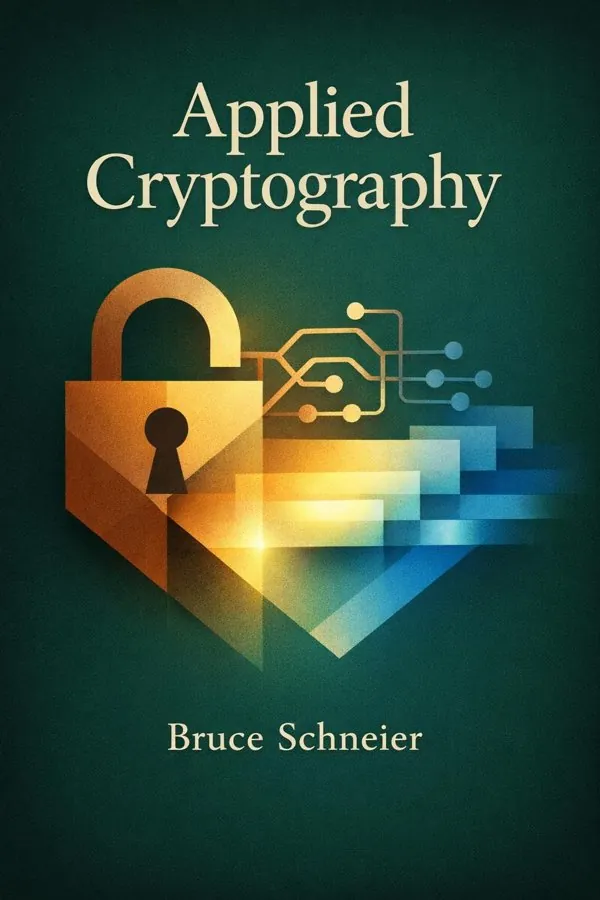
Applied Cryptography: Protocols, Algorithms, and Source Code in C: Summary & Key Insights
 10 min9 chaptersAudio available
Key Takeaways from Applied Cryptography: Protocols, Algorithms, and Source Code in C
Every modern security system begins with an old truth: if people value information, they will try to hide it.
A secure system is rarely built with one tool alone.
Strong encryption often looks simple from the outside because its complexity is carefully hidden inside well-designed primitives.
One of the most revolutionary ideas in computer security is that two people can communicate securely without ever having shared a secret beforehand.
A brilliant algorithm can still live inside a disastrous system.
What Is Applied Cryptography: Protocols, Algorithms, and Source Code in C About?
Applied Cryptography: Protocols, Algorithms, and Source Code in C by Bruce Schneier is a security book spanning 5 pages. Applied Cryptography is one of the most influential books ever written about securing information in the digital age. In this landmark work, Bruce Schneier takes a subject often treated as abstract mathematics and turns it into something practical, concrete, and essential. The book surveys the full landscape of cryptography: classical ciphers, modern symmetric and public-key algorithms, digital signatures, hash functions, random number generation, key management, and the protocols that let real systems establish trust over untrusted networks. What makes it especially valuable is its insistence that security does not come from algorithms alone. It comes from how those algorithms are selected, combined, implemented, and deployed. Schneier writes with the authority of a practicing cryptographer and security thinker who understands both theory and engineering. He explains not only how major techniques such as DES, RSA, and authentication systems work, but also where they fail when used carelessly. For programmers, security professionals, and technically curious readers, the book matters because it bridges the dangerous gap between “I know the algorithm” and “I know how to build a secure system.” It remains a foundational guide to thinking clearly about secrecy, integrity, authentication, and trust.
This FizzRead summary covers all 9 key chapters of Applied Cryptography: Protocols, Algorithms, and Source Code in C in approximately 10 minutes, distilling the most important ideas, arguments, and takeaways from Bruce Schneier's work. Also available as an audio summary and Key Quotes Podcast.
Applied Cryptography: Protocols, Algorithms, and Source Code in C
Applied Cryptography is one of the most influential books ever written about securing information in the digital age. In this landmark work, Bruce Schneier takes a subject often treated as abstract mathematics and turns it into something practical, concrete, and essential. The book surveys the full landscape of cryptography: classical ciphers, modern symmetric and public-key algorithms, digital signatures, hash functions, random number generation, key management, and the protocols that let real systems establish trust over untrusted networks. What makes it especially valuable is its insistence that security does not come from algorithms alone. It comes from how those algorithms are selected, combined, implemented, and deployed.
Schneier writes with the authority of a practicing cryptographer and security thinker who understands both theory and engineering. He explains not only how major techniques such as DES, RSA, and authentication systems work, but also where they fail when used carelessly. For programmers, security professionals, and technically curious readers, the book matters because it bridges the dangerous gap between “I know the algorithm” and “I know how to build a secure system.” It remains a foundational guide to thinking clearly about secrecy, integrity, authentication, and trust.
Who Should Read Applied Cryptography: Protocols, Algorithms, and Source Code in C?
This book is perfect for anyone interested in security and looking to gain actionable insights in a short read. Whether you're a student, professional, or lifelong learner, the key ideas from Applied Cryptography: Protocols, Algorithms, and Source Code in C by Bruce Schneier will help you think differently.
- ✓Readers who enjoy security and want practical takeaways
- ✓Professionals looking to apply new ideas to their work and life
- ✓Anyone who wants the core insights of Applied Cryptography: Protocols, Algorithms, and Source Code in C in just 10 minutes
Want the full summary?
Get instant access to this book summary and 100K+ more with Fizz Moment.
Get Free SummaryAvailable on App Store • Free to download
Key Chapters
Every modern security system begins with an old truth: if people value information, they will try to hide it. Schneier starts with classical cryptographic systems not out of nostalgia, but because these early methods expose the basic logic of secrecy. Substitution ciphers replace one symbol with another; transposition ciphers rearrange the order of symbols. On the surface, they seem primitive compared with modern encryption, yet they teach the enduring tension between concealment and analysis. A cipher is only useful until someone discovers the pattern behind it.
The real lesson is that secrecy based on obscurity rarely lasts. Classical ciphers often failed because human language contains structure. Frequent letters, common word patterns, and repeated phrases give attackers leverage. Frequency analysis turned many once-secret systems into open books. That history matters because the same principle still applies today: attackers exploit patterns, predictability, and implementation weakness.
Schneier uses this foundation to show why modern cryptography depends on formalized keys rather than hidden methods. In a well-designed system, the algorithm can be public; security should rest on the secrecy of the key. This is a profound shift from “hide the method” to “protect the secret input.” It also prepares readers to understand why key length, randomness, and protocol design matter far more than clever-looking tricks.
A practical example appears whenever a company invents its own “custom encryption” instead of using established standards. The mistake is ancient in spirit. Like a classical cipher dressed up in software, it often collapses under scrutiny because the design itself is weak.
Actionable takeaway: study old ciphers not to use them, but to remember the timeless rule that security must rely on strong keys and sound design, not secret mechanisms.
A secure system is rarely built with one tool alone. Schneier’s treatment of modern cryptographic principles revolves around the two great families of encryption: symmetric-key and public-key systems. Symmetric cryptography uses the same secret key to encrypt and decrypt data. It is fast, efficient, and ideal for protecting large volumes of information, which is why it powers file encryption, disk protection, and secure data transport. Public-key cryptography, by contrast, uses mathematically related key pairs: one public, one private. This enables secure key exchange and digital signatures without requiring a pre-shared secret.
The insight that makes this chapter so powerful is that each approach solves a different problem. Symmetric systems answer, “How do we encrypt data efficiently?” Public-key systems answer, “How do strangers establish trust and exchange secrets?” Confusing those roles leads to bad architecture. Schneier clarifies why real-world systems combine them: public-key methods negotiate or protect symmetric keys, and symmetric algorithms do the heavy lifting for actual data encryption.
Consider a secure web session. A browser and server may use public-key operations to authenticate identity and agree on a shared session key. Once established, a symmetric cipher handles the ongoing traffic because it is much faster. This hybrid structure is now standard because it aligns capability with function.
Schneier also emphasizes that modern cryptography protects more than confidentiality. It supports integrity, authentication, non-repudiation, and controlled access. Encryption alone cannot prove who sent a message or whether it was modified in transit.
Actionable takeaway: when evaluating any security system, ask which problem each cryptographic primitive is solving, and make sure symmetric and public-key techniques are used for their proper strengths rather than as interchangeable tools.
Strong encryption often looks simple from the outside because its complexity is carefully hidden inside well-designed primitives. Schneier gives special attention to block ciphers because they have long served as the workhorses of applied cryptography. A block cipher takes a fixed-size chunk of plaintext and transforms it into ciphertext under a secret key. By itself, that sounds straightforward, but the real sophistication lies in how confusion and diffusion are achieved through repeated rounds of substitution, permutation, and key mixing.
The book explains why algorithms such as DES became so important: they offered standardized, analyzable methods for protecting digital information. Schneier does not treat block ciphers as magical black boxes. He shows that their security depends on key size, resistance to known attacks, and the mode of operation used to process many blocks. This is a crucial practical point. Encrypting one block securely is not the same as encrypting a long message securely.
Modes like ECB, CBC, CFB, and OFB determine how patterns propagate through ciphertext and how errors affect decryption. For example, ECB can reveal repeated structures because identical plaintext blocks encrypt to identical ciphertext blocks under the same key. CBC reduces that risk by chaining each block with the previous ciphertext block. In storage systems, backups, database protection, and secure communications, these choices have direct consequences.
Schneier’s broader lesson is that algorithm strength alone never tells the whole story. A strong block cipher used in a poor mode, with weak key management, can still fail. Likewise, a secure cipher implemented incorrectly may leak data or create operational weaknesses.
Actionable takeaway: whenever you rely on a block cipher, examine not just the algorithm name, but also the mode of operation, key handling, and implementation details, because practical security emerges from the whole system, not the primitive in isolation.
One of the most revolutionary ideas in computer security is that two people can communicate securely without ever having shared a secret beforehand. Schneier presents public-key cryptography as the breakthrough that made open digital networks far more usable. Algorithms such as RSA and Diffie-Hellman made it possible to exchange keys, verify identity, and create digital signatures in environments where pre-arranged trust is impossible or impractical.
The key insight is that public-key systems transform the logistics of secrecy. In a symmetric-only world, every communicating pair needs a secure way to share and store a secret key. As the number of users grows, key management becomes overwhelming. Public-key infrastructure reduces that burden by separating the public from the private: anyone may know the public key, but only the owner should control the private key. This makes secure email, software signing, digital certificates, and authenticated network sessions possible.
Schneier is equally careful to show that public-key cryptography is not a complete solution on its own. It is slower than symmetric encryption and introduces its own problems: certificate validation, trust chains, revocation, and private-key protection. A digital signature is only meaningful if the signer’s private key is truly controlled and the public key is genuinely associated with the claimed identity.
A practical example is software distribution. When an operating system vendor signs updates, users can verify that the package came from the vendor and was not altered. But if the signing key is stolen, the entire trust model is endangered.
Actionable takeaway: use public-key cryptography to solve identity and key-exchange problems, but never assume the math alone creates trust; the surrounding system for certificates, key storage, and validation is just as important.
A brilliant algorithm can still live inside a disastrous system. That is one of Schneier’s most important and enduring messages. Cryptographic protocols define how participants use cryptographic primitives to achieve goals such as authentication, confidentiality, key exchange, and non-repudiation. The danger is that protocol design is full of subtle assumptions. Even when every individual algorithm is strong, the sequence of messages, the handling of nonces, the response to replay attempts, or the treatment of errors can create vulnerabilities.
Schneier teaches readers to think adversarially about interactions, not just components. Who knows what at each step? What happens if an attacker records old messages and replays them later? Can one party be tricked into authenticating the wrong thing? Are both sides verifying the same session data? These questions distinguish secure design from security theater.
This insight explains why real-world failures often occur in authentication flows, key exchange mechanisms, or custom secure messaging systems. A company may choose reputable encryption and hash algorithms yet still expose users because it forgot mutual authentication, reused nonces, or allowed downgrade paths. Many security disasters stem from the glue between primitives rather than the primitives themselves.
Schneier’s approach is practical: design protocols conservatively, analyze them from multiple attacker perspectives, and prefer established, reviewed constructions whenever possible. A protocol is not secure because it “sounds reasonable.” It must survive scrutiny against impersonation, man-in-the-middle attacks, replay, and implementation abuse.
Actionable takeaway: when assessing a secure system, spend at least as much attention on message flow, assumptions, and failure handling as on the encryption algorithm, because protocol mistakes routinely defeat otherwise strong cryptography.
Not every security problem is about hiding data; many are about proving that data has not changed. Schneier explains hash functions as compact mathematical fingerprints that transform inputs of arbitrary size into fixed-size outputs. A good cryptographic hash should make it computationally infeasible to reverse the input, find two messages with the same hash, or alter a message without changing the resulting digest. This makes hashes indispensable for integrity checks, password storage schemes, digital signatures, and many authentication protocols.
The thought-provoking point here is that integrity is often more operationally important than secrecy. A confidential message that can be silently altered is dangerous. A software package that arrives unencrypted but verifiably untampered may be safer than an encrypted one with no integrity guarantee. Schneier uses hash functions to show how cryptography supports trust in data, not just privacy.
In practice, hashes are used to verify downloads, create message authentication mechanisms, and compress large content into a value that can be signed efficiently. Instead of digitally signing an entire large document, a system usually signs its hash. Password systems, meanwhile, ideally store salted password hashes rather than raw passwords, reducing the damage of database compromise.
Schneier also implicitly teaches a discipline that remains relevant: cryptographic tools age. Hash functions once considered secure may later become vulnerable to collision attacks, meaning system designers must stay alert to cryptanalytic advances and migrate when necessary.
Actionable takeaway: whenever data integrity or authentication matters, pair encryption with strong, current hash-based mechanisms, and periodically review whether the chosen hash function still meets modern security expectations.
The strongest encryption in the world is useless if the keys are mishandled. Schneier repeatedly returns to key management because it is where theoretical security meets operational reality. Keys must be generated securely, distributed safely, stored properly, rotated on schedule, revoked when compromised, and destroyed when no longer needed. If any of these steps fail, the elegance of the underlying mathematics becomes irrelevant.
This idea is especially important because people often equate cryptography with algorithms alone. Schneier broadens the picture. A business may deploy excellent encryption but store private keys on the same server as encrypted data. An employee may email secret keys in plaintext for convenience. A certificate may remain trusted long after the associated private key has been stolen. These are not exotic edge cases; they are common modes of failure.
Practical applications include enterprise VPNs, encrypted backups, secure messaging apps, and payment systems. In each case, the security outcome depends on who can access keys, how recovery works, whether escrow exists, how revocation is handled, and what logs or hardware protections surround key use. Hardware security modules, smart cards, and dedicated key vaults exist precisely because key handling is such a high-value target.
Schneier’s framing also helps readers understand trade-offs. Easy recovery features may weaken secrecy. Broad administrative access may simplify operations while expanding insider risk. Long-lived keys reduce management overhead but increase damage if exposed.
Actionable takeaway: when judging any cryptographic deployment, ask first where the keys come from, where they live, who can use them, and how compromise is detected and contained, because key management is usually the decisive factor in real security.
Cryptography on paper is precise; cryptography in software is messy. One of the book’s defining strengths is its attention to implementation. By including source code in C and discussing engineering concerns, Schneier makes clear that secure design does not end when an algorithm is selected. Bugs, side effects, poor memory handling, unsafe defaults, and incorrect assumptions can undermine systems that are mathematically sound.
The central insight is uncomfortable but necessary: attackers do not care whether they break the cipher or the code around it. If an implementation leaks timing information, fails to clear sensitive memory, mishandles padding, or accepts malformed inputs, the practical result may be full compromise. Software security lives at the intersection of mathematics, systems programming, and operational discipline.
This is why real-world cryptographic engineering demands care with libraries, APIs, error messages, randomness sources, interoperability, and testing. For example, a developer may correctly choose RSA but use insecure padding or fail to validate certificates. Another may encrypt data properly yet log plaintext keys during debugging. In embedded systems, secrets may remain recoverable from memory or flash because they were never erased. These are implementation failures, not algorithm failures, but they are exactly how many systems break.
Schneier’s code examples historically helped practitioners understand how algorithms are constructed and used, though modern readers should treat legacy code educationally rather than blindly deploy it. The larger lesson remains powerful: security requires disciplined engineering, review, and continual skepticism.
Actionable takeaway: never assume a strong algorithm guarantees safety in software; use vetted libraries, follow modern implementation guidance, review edge cases rigorously, and test as though the attacker is targeting your code rather than your math.
All Chapters in Applied Cryptography: Protocols, Algorithms, and Source Code in C
About the Author
Bruce Schneier is an American cryptographer, security technologist, and influential author whose work has shaped modern thinking about digital trust and security. He became internationally known with Applied Cryptography, a landmark book that helped bring complex cryptographic concepts to programmers, engineers, and security professionals. Beyond cryptography, Schneier has written extensively on cybersecurity, privacy, surveillance, risk management, and security policy, often exploring how technical systems interact with institutions and society. He is also widely recognized as a public intellectual in the security field, valued for his ability to explain difficult ideas clearly and critically. Across books, essays, newsletters, and public speaking, Schneier has consistently argued that effective security requires not just strong technology, but sound design, realistic threat models, and an understanding of human and organizational behavior.
Get This Summary in Your Preferred Format
Read or listen to the Applied Cryptography: Protocols, Algorithms, and Source Code in C summary by Bruce Schneier anytime, anywhere. FizzRead offers multiple formats so you can learn on your terms — all free.
Available formats: App · Audio · PDF · EPUB — All included free with FizzRead
Download Applied Cryptography: Protocols, Algorithms, and Source Code in C PDF and EPUB Summary
Key Quotes from Applied Cryptography: Protocols, Algorithms, and Source Code in C
“Every modern security system begins with an old truth: if people value information, they will try to hide it.”
“A secure system is rarely built with one tool alone.”
“Strong encryption often looks simple from the outside because its complexity is carefully hidden inside well-designed primitives.”
“One of the most revolutionary ideas in computer security is that two people can communicate securely without ever having shared a secret beforehand.”
“A brilliant algorithm can still live inside a disastrous system.”
Frequently Asked Questions about Applied Cryptography: Protocols, Algorithms, and Source Code in C
Applied Cryptography: Protocols, Algorithms, and Source Code in C by Bruce Schneier is a security book that explores key ideas across 9 chapters. Applied Cryptography is one of the most influential books ever written about securing information in the digital age. In this landmark work, Bruce Schneier takes a subject often treated as abstract mathematics and turns it into something practical, concrete, and essential. The book surveys the full landscape of cryptography: classical ciphers, modern symmetric and public-key algorithms, digital signatures, hash functions, random number generation, key management, and the protocols that let real systems establish trust over untrusted networks. What makes it especially valuable is its insistence that security does not come from algorithms alone. It comes from how those algorithms are selected, combined, implemented, and deployed. Schneier writes with the authority of a practicing cryptographer and security thinker who understands both theory and engineering. He explains not only how major techniques such as DES, RSA, and authentication systems work, but also where they fail when used carelessly. For programmers, security professionals, and technically curious readers, the book matters because it bridges the dangerous gap between “I know the algorithm” and “I know how to build a secure system.” It remains a foundational guide to thinking clearly about secrecy, integrity, authentication, and trust.
More by Bruce Schneier
Data and Goliath: The Hidden Battles to Collect Your Data and Control Your World
Bruce Schneier
10 min
Click Here to Kill Everybody: Security and Survival in a Hyper-connected World
Bruce Schneier
10 min
Cryptography Engineering: Design Principles and Practical Applications
Niels Ferguson, Bruce Schneier, Tadayoshi Kohno
10 minYou Might Also Like

Browse by Category
Ready to read Applied Cryptography: Protocols, Algorithms, and Source Code in C?
Get the full summary and 100K+ more books with Fizz Moment.