
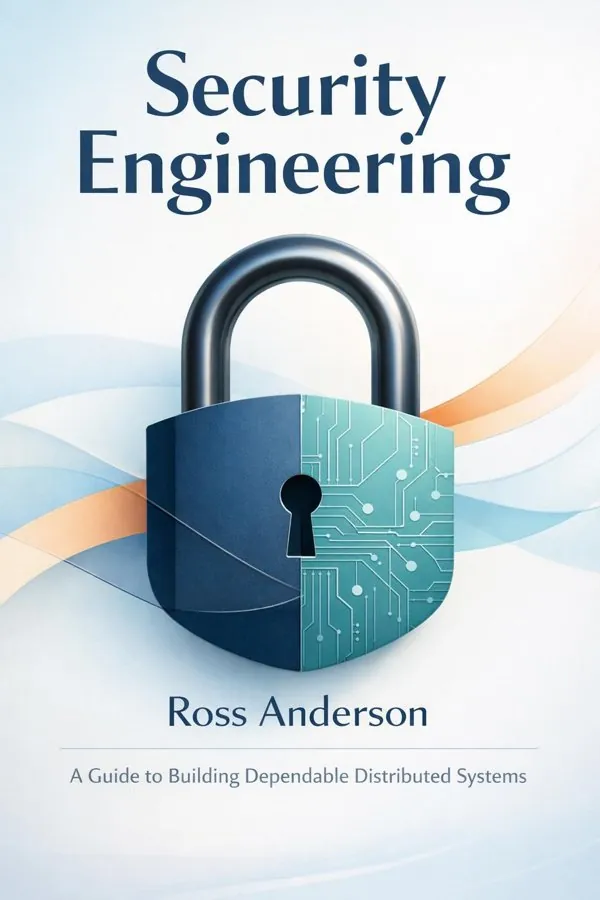
Security Engineering: A Guide to Building Dependable Distributed Systems: Summary & Key Insights
 10 min5 chaptersAudio available
What Is Security Engineering: A Guide to Building Dependable Distributed Systems About?
Security Engineering: A Guide to Building Dependable Distributed Systems by Ross Anderson is a security book spanning 5 pages. Security Engineering is a comprehensive reference on how to design, implement, and manage secure systems. It covers the principles of building dependable distributed systems, exploring topics such as cryptography, access control, protocols, and real-world case studies of system failures and attacks. The book emphasizes practical engineering approaches to security, blending technical depth with insights from economics, psychology, and policy.
This FizzRead summary covers all 5 key chapters of Security Engineering: A Guide to Building Dependable Distributed Systems in approximately 10 minutes, distilling the most important ideas, arguments, and takeaways from Ross Anderson's work. Also available as an audio summary and Key Quotes Podcast.
Security Engineering: A Guide to Building Dependable Distributed Systems
Security Engineering is a comprehensive reference on how to design, implement, and manage secure systems. It covers the principles of building dependable distributed systems, exploring topics such as cryptography, access control, protocols, and real-world case studies of system failures and attacks. The book emphasizes practical engineering approaches to security, blending technical depth with insights from economics, psychology, and policy.
Who Should Read Security Engineering: A Guide to Building Dependable Distributed Systems?
This book is perfect for anyone interested in security and looking to gain actionable insights in a short read. Whether you're a student, professional, or lifelong learner, the key ideas from Security Engineering: A Guide to Building Dependable Distributed Systems by Ross Anderson will help you think differently.
- ✓Readers who enjoy security and want practical takeaways
- ✓Professionals looking to apply new ideas to their work and life
- ✓Anyone who wants the core insights of Security Engineering: A Guide to Building Dependable Distributed Systems in just 10 minutes
Want the full summary?
Get instant access to this book summary and 100K+ more with Fizz Moment.
Get Free SummaryAvailable on App Store • Free to download
Key Chapters
Early in the book, I explore the historical landscape that shaped our field. You cannot understand security today without looking back at the failures of yesterday: the flawed cipher machines of World War II, the broken assumptions in banking software of the 1980s, or the mishandled network authentication schemes of the 1990s. Each failure was not simply a technical blunder—it was an organizational and conceptual one. We underestimated the ingenuity of adversaries, or the ability of ordinary users to misunderstand complex interfaces.
I recall the days when the banking industry believed cryptography could fix everything, only to discover that insider attacks and procedural lapses were more damaging than external hacking attempts. The military and intelligence communities taught similar lessons: even the strongest cipher is useless if the radio operator writes passwords on sticky notes. These stories are not nostalgic but diagnostic—they reveal patterns of human error, mismatched incentives, and overconfidence that continue to haunt our digital infrastructure.
Dependability, as I explain here, is about recognizing that safety, reliability, and security are facets of the same truth. Systems fail in predictable ways when people treat these properties as separate. A health monitoring system, for example, might be 'safe' in the mechanical sense but completely vulnerable to simple network interference. By connecting safety engineering with security design, we begin to see how the same principles of redundancy, containment, and graceful degradation apply to both. The purpose of this historical lens is to show that maturity in our profession requires learning these lessons collectively—and not having to relearn them each generation.
Cryptography is often considered the glamorous heart of security, yet its true strength lies not in mystery but in disciplined transparency. I dedicate a substantial portion of the book to explaining symmetric and asymmetric encryption, key management, and protocol design—not as isolated tools, but as parts of human systems. A well-chosen cipher is worthless if deployed without understanding how keys are generated, stored, or revoked. The practical art of cryptography lies in the messy interfaces where pure mathematics meets the realities of devices, networks, and users.
When I discuss symmetric vs. public-key systems, I emphasize why real deployments almost always use hybrids: symmetric keys for efficiency, public keys for distribution. The difficulty lies in how you keep these relationships stable and traceable over time. Public key infrastructures promise a universal web of trust, but in practice they depend on bureaucracies, certificate authorities, and revocation systems, each with its own vulnerabilities. Here enters the human dimension again—trust is not solely mathematical; it is social.
Throughout these chapters I trace examples ranging from early ATM authentication systems to modern encrypted messaging protocols. Time and again, designers have rediscovered the importance of simplicity and the dangers of subtle flaws. A protocol that works in isolation can fall apart under concurrency, replay, or timing attacks. The most successful systems manage to balance clarity with layered defenses: every part knows what it must protect and what assumptions it relies on. That awareness is the core of dependable engineering.
+ 3 more chapters — available in the FizzRead app
All Chapters in Security Engineering: A Guide to Building Dependable Distributed Systems
About the Author
Ross Anderson is a professor of security engineering at the University of Cambridge and a leading authority in computer security and cryptography. His research has influenced global security standards and public policy, and he is known for his contributions to the understanding of system dependability and privacy.
Get This Summary in Your Preferred Format
Read or listen to the Security Engineering: A Guide to Building Dependable Distributed Systems summary by Ross Anderson anytime, anywhere. FizzRead offers multiple formats so you can learn on your terms — all free.
Available formats: App · Audio · PDF · EPUB — All included free with FizzRead
Download Security Engineering: A Guide to Building Dependable Distributed Systems PDF and EPUB Summary
Key Quotes from Security Engineering: A Guide to Building Dependable Distributed Systems
“Early in the book, I explore the historical landscape that shaped our field.”
“Cryptography is often considered the glamorous heart of security, yet its true strength lies not in mystery but in disciplined transparency.”
Frequently Asked Questions about Security Engineering: A Guide to Building Dependable Distributed Systems
Security Engineering: A Guide to Building Dependable Distributed Systems by Ross Anderson is a security book that explores key ideas across 5 chapters. Security Engineering is a comprehensive reference on how to design, implement, and manage secure systems. It covers the principles of building dependable distributed systems, exploring topics such as cryptography, access control, protocols, and real-world case studies of system failures and attacks. The book emphasizes practical engineering approaches to security, blending technical depth with insights from economics, psychology, and policy.
You Might Also Like

Browse by Category
Ready to read Security Engineering: A Guide to Building Dependable Distributed Systems?
Get the full summary and 100K+ more books with Fizz Moment.