
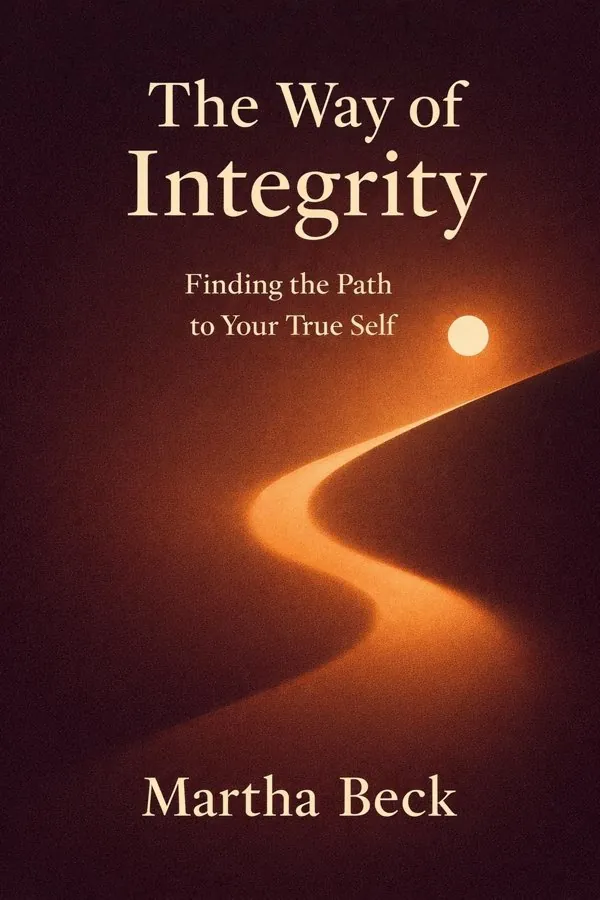
The Way of Integrity: Finding the Path to Your True Self: Summary & Key Insights
by Martha Beck
 10 min9 chaptersAudio available
Key Takeaways from The Way of Integrity: Finding the Path to Your True Self
Many people think their pain comes from difficult circumstances, but Beck’s deeper claim is that suffering intensifies when we become divided against ourselves.
Transformation rarely begins with clarity; it usually begins with disorientation.
Most people do not suffer only because they feel pain; they suffer because they fight feeling it.
Healing is not a sudden leap into perfection; it is a process of releasing what is false.
For Beck, paradise is not a distant heaven or a permanently blissful mood.
What Is The Way of Integrity: Finding the Path to Your True Self About?
The Way of Integrity: Finding the Path to Your True Self by Martha Beck is a self_awareness book spanning 12 pages. What if anxiety, burnout, numbness, and chronic dissatisfaction are not signs that you are broken, but signals that you are living out of alignment with your deepest truth? In The Way of Integrity, Martha Beck argues that much of human suffering comes from inner division: we learn to abandon our authentic selves in order to earn approval, stay safe, or meet social expectations. Over time, that self-betrayal creates confusion, emotional pain, and a persistent sense that something is off. Drawing inspiration from Dante’s Divine Comedy, modern psychology, neuroscience, and decades of coaching experience, Beck offers a practical map back to wholeness. For her, integrity is not merely about honesty or morality; it is about living undivided, so that your thoughts, words, feelings, and actions are aligned. The book matters because it reframes personal transformation in an unusually clear way: instead of trying to fix yourself, you learn to stop abandoning yourself. Beck’s authority comes from both scholarship and practice—she combines Harvard-trained sociological insight with accessible tools that help readers identify false beliefs, tell the truth, and build a life guided by inner knowing rather than external pressure.
This FizzRead summary covers all 9 key chapters of The Way of Integrity: Finding the Path to Your True Self in approximately 10 minutes, distilling the most important ideas, arguments, and takeaways from Martha Beck's work. Also available as an audio summary and Key Quotes Podcast.
The Way of Integrity: Finding the Path to Your True Self
What if anxiety, burnout, numbness, and chronic dissatisfaction are not signs that you are broken, but signals that you are living out of alignment with your deepest truth? In The Way of Integrity, Martha Beck argues that much of human suffering comes from inner division: we learn to abandon our authentic selves in order to earn approval, stay safe, or meet social expectations. Over time, that self-betrayal creates confusion, emotional pain, and a persistent sense that something is off.
Drawing inspiration from Dante’s Divine Comedy, modern psychology, neuroscience, and decades of coaching experience, Beck offers a practical map back to wholeness. For her, integrity is not merely about honesty or morality; it is about living undivided, so that your thoughts, words, feelings, and actions are aligned. The book matters because it reframes personal transformation in an unusually clear way: instead of trying to fix yourself, you learn to stop abandoning yourself. Beck’s authority comes from both scholarship and practice—she combines Harvard-trained sociological insight with accessible tools that help readers identify false beliefs, tell the truth, and build a life guided by inner knowing rather than external pressure.
Who Should Read The Way of Integrity: Finding the Path to Your True Self?
This book is perfect for anyone interested in self_awareness and looking to gain actionable insights in a short read. Whether you're a student, professional, or lifelong learner, the key ideas from The Way of Integrity: Finding the Path to Your True Self by Martha Beck will help you think differently.
- ✓Readers who enjoy self_awareness and want practical takeaways
- ✓Professionals looking to apply new ideas to their work and life
- ✓Anyone who wants the core insights of The Way of Integrity: Finding the Path to Your True Self in just 10 minutes
Want the full summary?
Get instant access to this book summary and 100K+ more with Fizz Moment.
Get Free SummaryAvailable on App Store • Free to download
Key Chapters
Many people think their pain comes from difficult circumstances, but Beck’s deeper claim is that suffering intensifies when we become divided against ourselves. From childhood onward, we learn which emotions, desires, and traits are acceptable and which must be hidden. We adapt to family systems, schools, workplaces, and cultures by presenting versions of ourselves that gain approval. That strategy may help us survive socially, but it often creates an internal split between the authentic self and the performed self.
Beck calls this fragmentation a loss of integrity in its original sense: wholeness. When your inner truth and outer life do not match, the mind and body register the mismatch. You may feel chronic anxiety, resentment, emptiness, fatigue, or a sense of unreality. Someone may have a respectable career, stable relationships, and visible success, yet still feel trapped because they are living according to scripts they never consciously chose. Another person may constantly say yes when they mean no, then wonder why they feel depleted and unseen.
This idea shifts the focus from symptom management to root-cause healing. Instead of asking, “How do I become more productive, likable, or accomplished?” Beck invites readers to ask, “Where have I abandoned what I know is true?” That question can apply to work, relationships, spirituality, identity, creativity, or daily habits.
A practical way to notice fragmentation is to track moments when your body tightens as you speak or agree to something. Tension, numbness, or exhaustion often signal self-betrayal. Actionable takeaway: identify one recurring situation in which your outer behavior conflicts with your inner truth, and write down what you actually feel before deciding your next step.
Transformation rarely begins with clarity; it usually begins with disorientation. Beck uses Dante’s image of the Dark Wood of Error to describe the stage where a person realizes that their old way of living no longer works. This can feel like a midlife crisis, burnout, heartbreak, depression, or a vague but persistent feeling of being lost. The key insight is that confusion is not necessarily failure. It may be the first honest response to a dishonest life.
In this stage, the maps that once guided you—achievement, people-pleasing, perfectionism, obedience, image management—stop producing meaning. You may suddenly question a career path you once pursued eagerly, feel disconnected in a long-term relationship, or discover that your goals were borrowed from family or culture rather than chosen from conviction. Beck suggests that this painful uncertainty is the beginning of awakening because it exposes false certainty.
The temptation here is to rush back into familiar roles just to end the discomfort. But the Dark Wood must be entered, not bypassed. You do not escape it by pretending everything is fine. You move through it by becoming willing to see what is true. This often requires slowing down, suspending self-judgment, and listening to emotional signals instead of silencing them.
A practical application is to stop demanding immediate answers and instead ask better questions. Rather than “What should I do with my life?” try “What feels false right now?” or “What am I forcing?” These questions create space for authentic direction to emerge.
Actionable takeaway: when you feel lost, resist the urge to fix your life instantly. Spend ten minutes journaling about what no longer feels true, even if you do not yet know what comes next.
Most people do not suffer only because they feel pain; they suffer because they fight feeling it. Beck’s Inferno stage represents the emotional consequences of living out of integrity. When we suppress truth, the buried material does not disappear. It surfaces as anxiety, rage, grief, compulsive behavior, numbness, or despair. The inferno is not punishment from life; it is the natural heat produced by inner contradiction.
Beck encourages readers to stop treating painful emotions as enemies. If you feel trapped in a job that violates your values, your dread may be intelligent. If you feel resentment in a relationship where you constantly self-silence, that resentment may be a messenger. In this framework, emotions are not inconveniences to manage away but signals pointing toward misalignment. Trying to be endlessly positive can become another form of denial.
This stage is difficult because truth often arrives with grief. You may need to admit that a dream is no longer yours, that a relationship is based on performance, or that your identity has been built around pleasing others. Yet once pain is felt directly, it begins to move. What prolongs suffering is resistance, not honesty.
A practical example is learning to name emotions precisely instead of using vague labels like “stressed.” Are you sad, ashamed, lonely, angry, afraid, or disgusted? Specificity brings self-understanding. Somatic awareness also helps: notice where the emotion sits in the body and what changes when you stop arguing with it.
Actionable takeaway: the next time strong emotion arises, pause before distracting yourself. Name the emotion, locate it in your body, and ask, “What truth might this feeling be trying to reveal?”
Healing is not a sudden leap into perfection; it is a process of releasing what is false. Beck frames Purgatory as the stage where we begin clearing away old conditioning, inherited beliefs, and survival habits that keep us out of integrity. This is the labor of unlearning. We start noticing the rules that once governed us—be agreeable, never disappoint anyone, always achieve, hide your sensitivity, do not want too much—and we test whether they are actually true.
What makes this stage powerful is that it turns transformation into practice. You do not need a dramatic revelation every day. You need repeated acts of honesty. For example, a person who learned to equate worth with overwork may experiment with rest and discover that their identity does not collapse. Someone who fears conflict may speak one uncomfortable truth and realize that authenticity creates cleaner relationships than silent resentment does.
Purgatory can feel awkward because new behavior often seems risky at first. The nervous system is accustomed to old patterns, even painful ones. Beck emphasizes patience: when you choose integrity, you may initially experience fear, guilt, or uncertainty. That does not mean you are wrong. It may simply mean you are no longer obeying familiar conditioning.
Useful tools in this stage include questioning stressful thoughts, practicing small truth-telling moments, setting clearer boundaries, and observing which activities expand your sense of aliveness. The aim is not to create a better mask but to peel masks away.
Actionable takeaway: choose one inherited rule that governs your behavior, write it down, and ask, “Is this universally true, and who would I be without it?” Then test a small action that challenges that rule.
For Beck, paradise is not a distant heaven or a permanently blissful mood. It is the lived experience of internal alignment. When your thoughts, speech, and actions become consistent with what you know to be true, life often feels lighter, simpler, and more vivid. Problems do not vanish, but unnecessary suffering decreases because you are no longer fighting yourself.
This stage is marked by coherence. Decisions become clearer because they are no longer filtered entirely through fear or approval-seeking. Relationships become more honest because you stop curating yourself so aggressively. Work becomes more meaningful because you are guided less by prestige and more by resonance. Even your body may respond: many people experience more energy, fewer stress symptoms, and a stronger sense of presence when they stop living a double life.
Paradise is also practical. It might look like leaving a career that impresses others but deadens you, telling a loved one the truth with compassion, creating more silence in your day, or embracing an unconventional path that fits your nature. Beck does not promise comfort at every moment; living honestly can disrupt existing arrangements. But the peace that comes from self-alignment is more stable than the comfort that comes from pretending.
Importantly, paradise is not earned by becoming morally superior. It emerges as a consequence of wholeness. You feel at home in yourself, and that changes your experience of the world.
Actionable takeaway: picture one area of life in complete alignment—work, love, health, or creativity. Ask what one honest adjustment would move that area 5 percent closer to how your true self wants to live.
A life built on distortion requires constant maintenance. Beck argues that truth-telling is one of the fastest ways to return to integrity because lies, omissions, and self-editing deepen fragmentation. This does not mean blurting out every thought without wisdom. It means reducing the gap between what you know inwardly and what you express outwardly.
Many people think dishonesty is mainly about deceiving others, but Beck highlights subtler forms of self-betrayal: saying “I’m fine” when you are hurting, pretending to want what you do not want, flattering people to avoid disapproval, or maintaining an identity that no longer fits. Each falsehood may seem small, yet together they create a life that feels alien.
Truth-telling starts internally. Before you can speak honestly, you must admit things to yourself. You may need to acknowledge, “I am deeply unhappy,” “I no longer believe this,” or “I want a different life.” Then comes the relational practice of expressing truth skillfully. This can include naming a boundary, declining an obligation, admitting uncertainty, or having a difficult conversation without aggression.
One practical method is to notice phrases that instantly create tension in your body. If you say yes and feel yourself contract, that is a clue. Another method is to replace polished but false responses with simple truthful ones: “I need time to think,” “That doesn’t work for me,” or “I’m not comfortable with that.”
Actionable takeaway: identify one low-risk situation today where you would normally edit yourself for approval, and practice a version of honest speech that is both clear and kind.
One of Beck’s most practical insights is that the body often detects truth and falsehood before the rational mind catches up. Because conditioning lives not just in thought but in the nervous system, integrity must be felt as well as understood. When something is true for you, there is often a sense of expansion, relief, calm, or increased aliveness. When something is false, there may be contraction, heaviness, agitation, fog, or fatigue.
This emotional guidance system is especially useful when logic alone produces confusion. The mind can argue for almost anything, especially if status, fear, or duty are involved. A person might create a perfect case for staying in a prestigious role, yet their body dreads every Monday. Another may have no socially acceptable reason to pursue an artistic path, yet feel unmistakably more alive while doing it. Beck invites readers to trust these somatic signals as forms of intelligence.
That does not mean every pleasant sensation equals truth or every discomfort means danger. Growth can feel scary. The distinction is subtle but learnable: fear associated with authentic growth often coexists with energy and openness, whereas falsehood tends to produce deadness or constriction. Paying attention over time helps sharpen discernment.
Practical exercises include saying possible choices out loud and noticing the body’s response, scanning for tightness when making commitments, and observing whether you feel more settled or more fragmented after interactions. Stillness is essential here because body wisdom is easy to miss in a noisy life.
Actionable takeaway: when facing a decision, state each option aloud and notice your breath, chest, stomach, and jaw. Choose the option that feels more deeply aligned, not merely more socially rewarded.
In a world saturated with noise, speed, and distraction, the true self is often not absent but drowned out. Beck emphasizes stillness as a way of hearing what constant activity prevents us from hearing. When the mind is busy performing, planning, scrolling, pleasing, and reacting, it becomes difficult to distinguish authentic desire from internalized expectation. Silence, solitude, and mindful attention create the conditions in which truth can surface.
Stillness is not passive withdrawal. It is active listening. Through meditation, quiet walks, breath awareness, journaling, or simply sitting without stimulation, you begin to notice what persists beneath social roles and mental chatter. Many people discover that when they become quiet enough, the body starts signaling clearly, emotions become more intelligible, and false obligations lose some of their hypnotic power.
This matters because integrity requires contact with inner reality. If you never pause, you may keep making decisions from momentum instead of wisdom. For example, someone may continue saying yes to invitations, projects, or relationships not because they truly want them, but because they have never stopped long enough to feel their own reluctance. Stillness interrupts automaticity.
Beck also suggests that awareness itself is healing. The more kindly and consistently you observe your inner world, the less compelled you are to run from it. That self-witnessing reduces shame and strengthens trust in your own perception.
Actionable takeaway: create a daily ten-minute stillness ritual with no phone, no agenda, and no performance. Use the time to notice what thoughts, emotions, or desires keep returning when you stop distracting yourself.
When you become more whole, every major domain of life is affected. Beck shows that integrity is not merely an inner feeling; it reorganizes relationships, work, purpose, and daily choices. The immediate result is often both liberating and disruptive. People who benefited from your old compliance may resist your honesty. Roles built on performance may begin to crumble. Yet what replaces them is usually far more real.
In relationships, integrity means bringing your authentic self into connection. Instead of managing others’ impressions at all costs, you communicate more clearly, set healthier boundaries, and allow love to be based on reality rather than performance. This may deepen intimacy with those who can meet the real you. It may also create distance where authenticity is unwelcome. Beck treats that not as failure but as clarification.
In work and purpose, integrity asks a different question from conventional ambition. Rather than “What should I do to look successful?” it asks, “What kind of life expresses my nature?” For some, this means dramatic change. For others, it means doing the same work differently—with more honesty, creativity, or self-respect. Purpose emerges less from chasing prestige and more from aligning with what brings a sense of truth and vitality.
Integration is ongoing. You do not arrive once and for all. New situations will test old patterns, and the practice is to keep returning to coherence. Exercises like journaling, truthful speech, body awareness, and boundary-setting become maintenance for a life lived awake.
Actionable takeaway: review your closest relationships and your work life, and ask in each area, “Where am I performing instead of participating honestly?” Then make one boundary, conversation, or decision that increases alignment.
All Chapters in The Way of Integrity: Finding the Path to Your True Self
About the Author
Martha Beck is an American sociologist, author, speaker, and life coach known for her work on personal transformation and authentic living. She earned a Ph.D. in sociology from Harvard University, where her academic background helped shape her interest in how social systems and expectations influence identity. Beck later became widely known through her bestselling self-help books, including Finding Your Own North Star, Expecting Adam, and The Way of Integrity. Her work combines psychology, spirituality, coaching, and practical exercises designed to help people reconnect with their deepest values and inner truth. Known for her warm, insightful, and often unconventional approach, Beck has built a large following among readers seeking clarity, courage, and meaningful change in their personal and professional lives.
Get This Summary in Your Preferred Format
Read or listen to the The Way of Integrity: Finding the Path to Your True Self summary by Martha Beck anytime, anywhere. FizzRead offers multiple formats so you can learn on your terms — all free.
Available formats: App · Audio · PDF · EPUB — All included free with FizzRead
Download The Way of Integrity: Finding the Path to Your True Self PDF and EPUB Summary
Key Quotes from The Way of Integrity: Finding the Path to Your True Self
“Many people think their pain comes from difficult circumstances, but Beck’s deeper claim is that suffering intensifies when we become divided against ourselves.”
“Transformation rarely begins with clarity; it usually begins with disorientation.”
“Most people do not suffer only because they feel pain; they suffer because they fight feeling it.”
“Healing is not a sudden leap into perfection; it is a process of releasing what is false.”
“For Beck, paradise is not a distant heaven or a permanently blissful mood.”
Frequently Asked Questions about The Way of Integrity: Finding the Path to Your True Self
The Way of Integrity: Finding the Path to Your True Self by Martha Beck is a self_awareness book that explores key ideas across 9 chapters. What if anxiety, burnout, numbness, and chronic dissatisfaction are not signs that you are broken, but signals that you are living out of alignment with your deepest truth? In The Way of Integrity, Martha Beck argues that much of human suffering comes from inner division: we learn to abandon our authentic selves in order to earn approval, stay safe, or meet social expectations. Over time, that self-betrayal creates confusion, emotional pain, and a persistent sense that something is off. Drawing inspiration from Dante’s Divine Comedy, modern psychology, neuroscience, and decades of coaching experience, Beck offers a practical map back to wholeness. For her, integrity is not merely about honesty or morality; it is about living undivided, so that your thoughts, words, feelings, and actions are aligned. The book matters because it reframes personal transformation in an unusually clear way: instead of trying to fix yourself, you learn to stop abandoning yourself. Beck’s authority comes from both scholarship and practice—she combines Harvard-trained sociological insight with accessible tools that help readers identify false beliefs, tell the truth, and build a life guided by inner knowing rather than external pressure.
More by Martha Beck

You Might Also Like
Rising Strong
Brené Brown
10 min
You Do You
Sarah Knight
10 min
Master Your Emotions: A Practical Guide to Overcome Negativity and Better Manage Your Feelings
Thibaut Meurisse
10 min
The Mountain Is You: Transforming Self-Sabotage Into Self-Mastery
Brianna Wiest
10 min
101 Essays That Will Change The Way You Think
Brianna Wiest
10 min
A Radical Awakening: Turn Pain into Power, Embrace Your Truth, Live Free
Shefali Tsabary
10 minBrowse by Category
Ready to read The Way of Integrity: Finding the Path to Your True Self?
Get the full summary and 100K+ more books with Fizz Moment.