
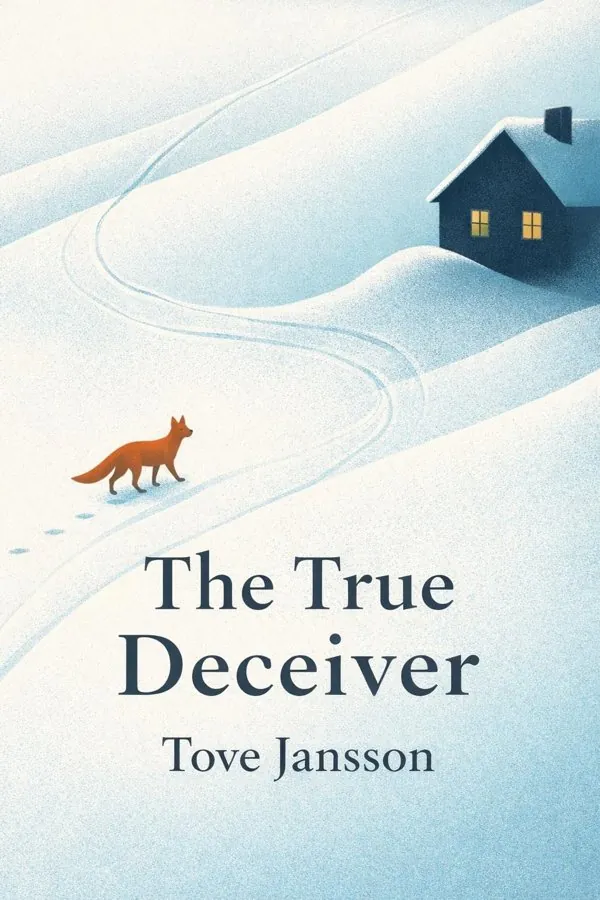
The True Deceiver: Summary & Key Insights
by Tove Jansson
 10 min9 chaptersAudio available
Key Takeaways from The True Deceiver
A frozen landscape can reveal what warmth usually hides.
Truth is not always kind, and in the wrong hands it can become a blade.
Not every illusion is a lie; some are structures people build to keep living.
Change rarely arrives as revelation; more often it comes as discomfort that can no longer be ignored.
Help is never neutral when one person understands the world better than the other.
What Is The True Deceiver About?
The True Deceiver by Tove Jansson is a classics book spanning 4 pages. What happens when honesty becomes a form of violence and deception begins to look like care? That unsettling question sits at the heart of The True Deceiver, one of Tove Jansson’s most quietly devastating novels. Set in a small Finnish village locked in winter, the story centers on two women whose lives collide: Katri Kling, intelligent, severe, and almost ruthlessly clear-sighted; and Anna Aemelin, a gentle illustrator who lives in a large house shaped by habit, imagination, and soft illusions. When Katri enters Anna’s world under the pretense of helping her manage practical affairs, the relationship deepens into a psychological contest neither woman fully understands at first. Jansson transforms this simple premise into a profound study of truth, power, loneliness, envy, dependence, and moral ambiguity. Best known for creating the Moomins, Jansson was also a master of adult fiction, and this novel shows her at her sharpest: spare, exact, and emotionally penetrating. The True Deceiver matters because it refuses easy moral categories. It asks whether truth really sets people free—or whether, in the wrong hands, it can become another tool of domination.
This FizzRead summary covers all 9 key chapters of The True Deceiver in approximately 10 minutes, distilling the most important ideas, arguments, and takeaways from Tove Jansson's work. Also available as an audio summary and Key Quotes Podcast.
The True Deceiver
What happens when honesty becomes a form of violence and deception begins to look like care? That unsettling question sits at the heart of The True Deceiver, one of Tove Jansson’s most quietly devastating novels. Set in a small Finnish village locked in winter, the story centers on two women whose lives collide: Katri Kling, intelligent, severe, and almost ruthlessly clear-sighted; and Anna Aemelin, a gentle illustrator who lives in a large house shaped by habit, imagination, and soft illusions. When Katri enters Anna’s world under the pretense of helping her manage practical affairs, the relationship deepens into a psychological contest neither woman fully understands at first. Jansson transforms this simple premise into a profound study of truth, power, loneliness, envy, dependence, and moral ambiguity. Best known for creating the Moomins, Jansson was also a master of adult fiction, and this novel shows her at her sharpest: spare, exact, and emotionally penetrating. The True Deceiver matters because it refuses easy moral categories. It asks whether truth really sets people free—or whether, in the wrong hands, it can become another tool of domination.
Who Should Read The True Deceiver?
This book is perfect for anyone interested in classics and looking to gain actionable insights in a short read. Whether you're a student, professional, or lifelong learner, the key ideas from The True Deceiver by Tove Jansson will help you think differently.
- ✓Readers who enjoy classics and want practical takeaways
- ✓Professionals looking to apply new ideas to their work and life
- ✓Anyone who wants the core insights of The True Deceiver in just 10 minutes
Want the full summary?
Get instant access to this book summary and 100K+ more with Fizz Moment.
Get Free SummaryAvailable on App Store • Free to download
Key Chapters
A frozen landscape can reveal what warmth usually hides. In The True Deceiver, the snowbound village is not just scenery; it is a moral atmosphere. Winter strips away distraction, compresses social life, and makes every movement visible. People watch one another through windows, repeat rumors, and measure neighbors by small gestures. The village runs on suspicion disguised as familiarity. Everyone seems to know everyone else, yet real understanding is rare. In this setting, loneliness becomes both ordinary and dangerous.
Jansson uses the village to show how isolation distorts judgment. Anna Aemelin, a successful but sheltered illustrator, is treated with a mix of affection, condescension, and opportunism. Katri Kling, by contrast, is respected for her intelligence but feared for her severity. Neither woman truly belongs. Anna is insulated by innocence and privilege; Katri is isolated by clarity and social distrust. Winter intensifies their difference. The whiteness outside reflects the emotional blankness between people, where motives are guessed at rather than known.
This idea extends beyond the novel. In any closed environment—a family, office, school, or online community—scarcity of trust can make interpretation harsher. Neutral actions begin to look strategic. Kindness is doubted. Silence becomes suspicious. We often assume isolation is simply being alone, but Jansson suggests a sharper truth: isolation is living among others without mutual recognition.
A practical way to apply this insight is to examine the climates you inhabit. Where in your life do people fill gaps in knowledge with stories, assumptions, or gossip? Where do you do the same? Before judging someone’s behavior, ask what conditions might be shaping it: fear, scarcity, shame, or exclusion. The actionable takeaway is simple: when an environment breeds suspicion, resist quick interpretation and choose deliberate curiosity over instinctive judgment.
Truth is not always kind, and in the wrong hands it can become a blade. One of the novel’s most disturbing achievements is its portrayal of Katri Kling as a person committed to honesty for reasons that are not purely ethical. She sees clearly how the villagers exploit Anna: they overcharge her, flatter her, and let confusion cover their self-interest. Katri steps in to correct these imbalances. On the surface, she seems to be protecting Anna from deception. But Jansson asks a harder question: what if exposing lies is also a way of establishing dominance?
Katri’s clarity gives her power. She understands money, motives, and social transactions better than Anna does. By organizing Anna’s affairs, she removes the fog around her life. Yet this practical help slowly becomes a form of infiltration. Katri does not merely reveal truth; she imposes her own framework of reality. She decides what matters, what is false, what is wasteful, and what Anna should see. In doing so, she turns truth into an instrument of control.
This is one of Jansson’s most modern insights. We often praise bluntness as courage and transparency as virtue. But honesty can be used aggressively. In personal relationships, someone may claim to be “just telling the truth” when they are actually humiliating, managing, or cornering another person. In workplaces, data and facts can be deployed to erase emotion or context. Precision does not guarantee goodness.
A useful test is to ask not only whether something is true, but what purpose the truth is serving. Is it clarifying, or is it punishing? Is it freeing the other person, or reducing their room to exist? The actionable takeaway: before delivering a hard truth, check your motive. If your aim is to dominate rather than illuminate, silence or gentler language may be the more honest choice.
Not every illusion is a lie; some are structures people build to keep living. Anna Aemelin inhabits a world of habits, stories, artistic routines, and softened perceptions. She is not foolish in any simple sense. Rather, she has arranged her life around selective attention. She sees what she can bear to see. The villagers take advantage of this, but her illusions are not only weaknesses. They also sustain her creativity, tenderness, and sense of continuity.
Katri cannot tolerate such softness. To her, Anna’s vagueness is wasteful and dangerous. She wants accounts balanced, motives exposed, and language made exact. Yet Jansson refuses to make Katri purely right. As Katri dismantles Anna’s protective illusions, she also destabilizes the emotional world that made Anna who she is. The novel’s brilliance lies in this tension: deception can be harmful, but total disillusionment can also be destructive.
This idea matters because modern life often treats self-awareness as an absolute good. We are urged to “face reality” in every domain: relationships, work, money, identity. But people need symbols, rituals, hopes, and even partial fictions to function. A family story may simplify the past while still providing belonging. An artist may need fantasy to create. A grieving person may need gradual realization rather than immediate confrontation.
The practical lesson is not to defend denial, but to distinguish between illusions that imprison and illusions that support growth. Ask: does this belief help me act with more courage, generosity, or resilience? Or does it keep me passive, exploited, or afraid? The actionable takeaway is to revise your illusions carefully, not brutally. Growth often requires truth, but truth delivered without timing or tenderness can destroy what it should have transformed.
Change rarely arrives as revelation; more often it comes as discomfort that can no longer be ignored. By the later movements of The True Deceiver, the collision between Katri and Anna has altered both women. Their relationship is not a simple victory of realism over fantasy or innocence over cynicism. Instead, Jansson shows transformation as reciprocal, unsettling, and morally incomplete. Each woman forces the other to confront what her life has been built upon.
Anna begins to see the mechanisms of dependence and convenience around her. She becomes less passive, less buffered by charm and routine. Katri, meanwhile, finds that entry into Anna’s world complicates her own self-image. She has imagined herself as someone beyond sentiment, beyond deception, beyond need. Yet the intimacy she creates exposes longings she cannot master through discipline alone. Truth has consequences not just for the person receiving it, but for the one delivering it.
This is a powerful corrective to the fantasy of clean personal growth. In real life, transformation often leaves residue. A person leaves a manipulative job and gains freedom, but also grief and uncertainty. Someone starts setting boundaries and discovers loneliness alongside self-respect. Honest confrontation may improve a relationship, but it may also reveal incompatibility. Better insight does not guarantee comfort.
Jansson’s stillness is crucial here. She does not dramatize change through speeches or dramatic moral conclusions. She lets it emerge through small shifts in behavior, atmosphere, and self-perception. That feels psychologically true. We become different not in one moment, but through repeated acts of seeing.
The actionable takeaway: when truth changes your life, do not expect immediate clarity or peace. Leave room for ambiguity, grief, and reorientation. Lasting transformation begins when you can tolerate the discomfort that follows insight instead of rushing to close it down.
Help is never neutral when one person understands the world better than the other. Katri enters Anna’s life through practical usefulness: accounting, organization, protection from petty exploitation. She appears indispensable because she can navigate systems Anna neglects. Jansson uses this arrangement to examine a subtle but important truth: dependence often begins in gratitude.
Anna needs help, and Katri genuinely provides it. That is what makes the dynamic so complex. There is no obvious villainy at first. But once one person becomes the translator of reality, a hierarchy forms. Katri interprets the village for Anna, manages information, and defines what counts as sensible behavior. Her competence gives her authority, and authority quickly becomes influence over the shape of another person’s life.
Many relationships follow this pattern. A financially literate partner takes over all household decisions. A capable employee becomes the gatekeeper for a vulnerable boss. An adult child helps an aging parent and gradually begins deciding not just logistics but values. Even friendships can tilt when one person is always the solver and the other the solved. The helper may feel burdened but also needed; the recipient may feel relieved but diminished.
Jansson’s insight is that power is most difficult to see when it is wrapped in care. To recognize this does not mean rejecting help. It means examining whether assistance preserves the other person’s agency or replaces it. Good help increases someone’s capacity to act. Controlling help narrows it.
A practical application is to ask two questions in any unequal relationship: What am I making easier for the other person? And what am I making impossible? If you are the one being helped, ask what knowledge or decision-making you have quietly surrendered. The actionable takeaway is to offer support in ways that build independence, not dependency.
Creative talent does not protect a person from practical blindness. Anna Aemelin is an artist whose work gives pleasure and value to others, yet she is strangely detached from the material systems surrounding that work. She earns money but does not manage it effectively. She creates images that charm the public, yet she remains exposed to manipulation in ordinary dealings. Jansson uses Anna to explore the fragile boundary between artistic innocence and social vulnerability.
The novel refuses a romantic view of art. Anna’s imagination is beautiful, but it does not automatically make her wise. In fact, her artistic disposition may contribute to her avoidance of unpleasant realities. She prefers emotional tone to hard detail, atmosphere to arithmetic. That preference feeds her creative life, but it also leaves gaps others can exploit. The villagers benefit from her passivity while praising her sweetness.
This tension remains highly relevant. Many creative people struggle with contracts, pricing, administration, negotiation, and boundaries. They may feel these tasks are somehow impure or unrelated to the work itself. But refusing the practical side of creation often means handing power to less scrupulous people. Inspiration without structure can become a form of self-endangerment.
The lesson is not that artists should become cynical or transactional. It is that protecting creative freedom requires practical literacy. A writer needs to understand rights. A freelancer needs to know rates. A musician needs to read agreements. Even outside the arts, people who are generous, imaginative, or idealistic need systems that guard them from exploitation.
The actionable takeaway: if your work depends on imagination, build a basic structure around it. Learn the numbers, ask direct questions, and seek trustworthy advice. Protecting your art is not a betrayal of innocence; it is what allows innocence to survive.
People rarely become morally ambiguous in the abstract; they do so under pressure from unmet needs. Katri’s severity, control, and manipulative intelligence do not emerge from pure malice. They grow in the soil of poverty, exclusion, and emotional deprivation. She lives with responsibility, restraint, and the constant awareness of scarcity. Her loneliness sharpens her observational powers but narrows her capacity for tenderness. She sees the world clearly because she expects little mercy from it.
Jansson does something remarkable here: she neither excuses Katri nor condemns her simplistically. Instead, she shows how loneliness can deform moral judgment. A person who has long gone unseen may start valuing efficiency over kindness. Someone denied softness may begin to distrust it wherever it appears. Envy, resentment, and possessiveness can disguise themselves as realism. Katri believes she is correcting Anna’s world, but she is also responding to what Anna represents: ease, beauty, privilege, and emotional shelter.
This matters because we often evaluate behavior without tracing the emotional economies beneath it. A controlling colleague may be driven by chronic insecurity. A cold family member may be defending against humiliation. A relentlessly critical person may be unable to tolerate another’s comfort because it intensifies awareness of their own deprivation. Understanding this does not remove accountability, but it deepens it.
A practical response is to notice when your judgments are becoming harsher in proportion to your loneliness. Are you calling something “stupid” because it is wrong, or because someone else has access to a life you resent? Are you framing envy as moral superiority? The actionable takeaway is to treat loneliness as ethically significant. If you want to act better, do not only refine your principles; also address the unmet needs that are bending them.
The most dangerous deceptions are often verbal habits so ordinary we stop hearing them. In The True Deceiver, language is never just communication; it is atmosphere, social currency, and a shield. The villagers soften requests, obscure prices, flatter Anna, and avoid direct statements when indirectness is more profitable. Anna herself lives among phrases and moods that blur hard edges. Katri stands apart because she distrusts such verbal cushioning. She wants words to correspond exactly to things.
Jansson’s prose mirrors this struggle. Her style is spare, exact, and quietly charged, showing how much can happen in a few carefully chosen sentences. Through this restraint, she highlights a central issue: unclear language often protects unequal arrangements. If no one names exploitation, it continues politely. If everyone speaks in hints, the most socially confident person controls interpretation.
This has obvious modern applications. Corporate jargon can hide overwork. Family euphemisms can conceal abuse or addiction. Romantic ambiguity can sustain unequal emotional investment. Even self-talk matters: saying “I’m just bad with money” may conceal avoidance, while “they’re complicated” may hide disrespectful behavior. Precision is not coldness; sometimes it is the beginning of freedom.
At the same time, Jansson warns that exact language can also wound if used without care. Naming everything harshly does not automatically produce truth. Words should fit reality, but they also enter human relationships, where timing and tone matter.
The actionable takeaway is to audit the language around your most stressful situations. What recurring phrases are smoothing over conflict, responsibility, or desire? Replace one vague statement this week with a specific one. Clear words cannot solve every problem, but they often reveal what the problem actually is.
The deepest maturity in literature often lies in refusing to divide people into the innocent and the guilty. The True Deceiver earns its title through this refusal. Katri deceives, but Anna deceives too—if not others, then herself. The villagers exploit, but they also operate within accepted habits and social hierarchies. No one is wholly monstrous, and no one is wholly pure. Jansson’s moral vision is clear-eyed without becoming cynical.
This is one reason the novel endures. It recognizes that harm often travels through ordinary channels: helpfulness, politeness, admiration, routine, dependency. People do not need to be evil to damage one another. They only need unexamined needs, power imbalances, and stories that justify their conduct. Katri tells herself she values truth; Anna tells herself gentleness is enough; the village tells itself its small dishonesties are harmless. Each partial truth supports a larger distortion.
In everyday life, we often seek relief through oversimplification. We want one person to be toxic, another to be pure, one choice to be obviously right. But difficult situations usually involve mixed motives and shared entanglement. A relationship may involve both care and manipulation. A workplace mentor may be both generous and controlling. A family tradition may preserve love while perpetuating silence.
Jansson does not ask us to abandon judgment. On the contrary, she asks for stronger judgment—judgment capable of complexity. Moral seriousness means looking at actions, structures, and motives together rather than settling for easy labels.
The actionable takeaway: when evaluating a conflict, resist the urge to identify a single villain too quickly. Ask instead what each person is protecting, denying, or using. Better judgment begins when you can hold complexity without losing your ethical center.
All Chapters in The True Deceiver
About the Author
Tove Jansson (1914–2001) was a Finnish-Swedish author, illustrator, and artist whose work ranges from beloved children’s literature to sophisticated adult fiction. She achieved worldwide fame as the creator of the Moomins, but her literary reputation also rests on her remarkable novels and stories for adults, many of which explore solitude, creativity, freedom, and emotional ambiguity. Born into an artistic family in Helsinki, Jansson studied art and worked across painting, illustration, and writing throughout her career. Her prose is known for its clarity, subtle psychological insight, and ability to suggest great depth with apparent simplicity. In books such as The True Deceiver, she reveals a darker, sharper sensibility than many readers expect, confirming her place as one of the most original Nordic writers of the twentieth century.
Get This Summary in Your Preferred Format
Read or listen to the The True Deceiver summary by Tove Jansson anytime, anywhere. FizzRead offers multiple formats so you can learn on your terms — all free.
Available formats: App · Audio · PDF · EPUB — All included free with FizzRead
Download The True Deceiver PDF and EPUB Summary
Key Quotes from The True Deceiver
“A frozen landscape can reveal what warmth usually hides.”
“Truth is not always kind, and in the wrong hands it can become a blade.”
“Not every illusion is a lie; some are structures people build to keep living.”
“Change rarely arrives as revelation; more often it comes as discomfort that can no longer be ignored.”
“Help is never neutral when one person understands the world better than the other.”
Frequently Asked Questions about The True Deceiver
The True Deceiver by Tove Jansson is a classics book that explores key ideas across 9 chapters. What happens when honesty becomes a form of violence and deception begins to look like care? That unsettling question sits at the heart of The True Deceiver, one of Tove Jansson’s most quietly devastating novels. Set in a small Finnish village locked in winter, the story centers on two women whose lives collide: Katri Kling, intelligent, severe, and almost ruthlessly clear-sighted; and Anna Aemelin, a gentle illustrator who lives in a large house shaped by habit, imagination, and soft illusions. When Katri enters Anna’s world under the pretense of helping her manage practical affairs, the relationship deepens into a psychological contest neither woman fully understands at first. Jansson transforms this simple premise into a profound study of truth, power, loneliness, envy, dependence, and moral ambiguity. Best known for creating the Moomins, Jansson was also a master of adult fiction, and this novel shows her at her sharpest: spare, exact, and emotionally penetrating. The True Deceiver matters because it refuses easy moral categories. It asks whether truth really sets people free—or whether, in the wrong hands, it can become another tool of domination.
More by Tove Jansson


You Might Also Like




Browse by Category
Ready to read The True Deceiver?
Get the full summary and 100K+ more books with Fizz Moment.