
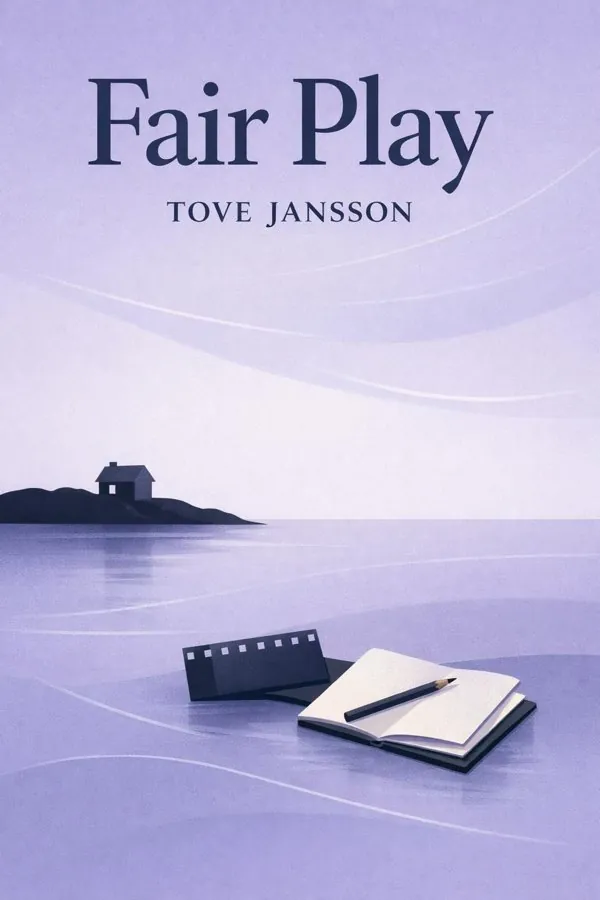
Fair Play: Summary & Key Insights
by Tove Jansson
 10 min8 chaptersAudio available
Key Takeaways from Fair Play
Real intimacy often depends less on constant togetherness than on well-designed distance.
Love becomes durable when it respects the seriousness of another person’s work.
Fairness in close relationships is rarely about equality in a mathematical sense; it is about proportion, timing, and emotional accuracy.
Solitude is not always loneliness; sometimes it is the environment in which perception becomes possible.
We never merely observe the world; we edit it through our temperament.
What Is Fair Play About?
Fair Play by Tove Jansson is a classics book spanning 8 pages. Fair Play by Tove Jansson is a quiet, luminous book about two women who have learned how to share a life without surrendering themselves. First published in 1989, this linked collection of short stories follows Jonna, a painter, and Mari, a writer, as they move between work, travel, irritation, affection, and long-practiced understanding. Very little “happens” in the conventional sense. Yet through small scenes—editing a manuscript, preparing for a trip, watching a film, retreating to an island—Jansson reveals the emotional intelligence required to sustain both art and intimacy. What makes the book matter is its rare honesty about companionship. Fair Play does not idealize love, friendship, or collaboration. Instead, it shows how closeness depends on tact, humor, boundaries, and the willingness to let another person remain fully themselves. Jansson writes with the authority of a master stylist and a lifelong artist; beyond creating the Moomins, she was also a painter and a major voice in adult Scandinavian fiction. In this late work, her prose becomes spare, exact, and deeply humane. The result is a subtle classic about freedom, loyalty, creativity, and the difficult art of living side by side.
This FizzRead summary covers all 8 key chapters of Fair Play in approximately 10 minutes, distilling the most important ideas, arguments, and takeaways from Tove Jansson's work. Also available as an audio summary and Key Quotes Podcast.
Fair Play
Fair Play by Tove Jansson is a quiet, luminous book about two women who have learned how to share a life without surrendering themselves. First published in 1989, this linked collection of short stories follows Jonna, a painter, and Mari, a writer, as they move between work, travel, irritation, affection, and long-practiced understanding. Very little “happens” in the conventional sense. Yet through small scenes—editing a manuscript, preparing for a trip, watching a film, retreating to an island—Jansson reveals the emotional intelligence required to sustain both art and intimacy.
What makes the book matter is its rare honesty about companionship. Fair Play does not idealize love, friendship, or collaboration. Instead, it shows how closeness depends on tact, humor, boundaries, and the willingness to let another person remain fully themselves. Jansson writes with the authority of a master stylist and a lifelong artist; beyond creating the Moomins, she was also a painter and a major voice in adult Scandinavian fiction. In this late work, her prose becomes spare, exact, and deeply humane. The result is a subtle classic about freedom, loyalty, creativity, and the difficult art of living side by side.
Who Should Read Fair Play?
This book is perfect for anyone interested in classics and looking to gain actionable insights in a short read. Whether you're a student, professional, or lifelong learner, the key ideas from Fair Play by Tove Jansson will help you think differently.
- ✓Readers who enjoy classics and want practical takeaways
- ✓Professionals looking to apply new ideas to their work and life
- ✓Anyone who wants the core insights of Fair Play in just 10 minutes
Want the full summary?
Get instant access to this book summary and 100K+ more with Fizz Moment.
Get Free SummaryAvailable on App Store • Free to download
Key Chapters
Real intimacy often depends less on constant togetherness than on well-designed distance. In Fair Play, the arrangement of Mari and Jonna’s homes expresses this truth perfectly. They live in separate apartments connected by a small attic passage, a physical detail that becomes the emotional architecture of the book. Each woman has her own territory, habits, mess, and rhythm. Yet each can reach the other with ease. Their bond is not built on fusion but on access: they are available to one another without being absorbed by one another.
Jansson uses this domestic layout to show how mature companionship works. The apartments face each other almost like two artistic temperaments in conversation. Mari’s writerly world and Jonna’s painterly world remain distinct, but the passage allows movement, surprise, and mutual care. Privacy is not a threat to love here; it is one of its conditions. The women can withdraw, focus, become irritable, and return. That freedom makes their connection resilient rather than fragile.
This idea has broad application beyond the story. In close relationships, conflict often grows when people confuse love with uninterrupted access. Shared lives need thresholds: a room of one’s own, protected work time, different routines, even different styles of silence. Healthy closeness is not measured by how little space exists between two people, but by how safely space can exist.
A practical way to apply Jansson’s insight is to build a symbolic attic passage into your own relationships. Create structures that make connection easy but not compulsory: scheduled check-ins, separate work corners, clear signals for solitude, and rituals of return. The takeaway is simple: protect independence if you want companionship to remain generous.
Love becomes durable when it respects the seriousness of another person’s work. One of the most beautiful qualities of Fair Play is that Mari and Jonna do not merely live together emotionally; they take each other’s creative labor seriously. Mari writes, Jonna paints, and both understand that art is not a decorative pastime but a demanding way of being in the world. Their companionship grows inside the rhythm of work: long stretches of concentration, practical interruptions, criticism, waiting, revision, and occasional delight.
Jansson presents creativity as ordinary and sacred at the same time. There is no romantic haze around it. Manuscripts must be edited. Paintings fail. Opinions are exchanged bluntly. One woman may ask for feedback and receive more honesty than comfort. Yet this bluntness is not cruelty. It is trust. To be taken seriously as an artist is, in this book, one form of love.
The stories also suggest that companionship can support work without engulfing it. Mari and Jonna are present to one another, but they do not constantly perform supportiveness. Often the highest respect lies in not intruding. They understand when to comment, when to help, and when to leave the other alone with a difficult piece of work.
In everyday life, this insight applies to any demanding vocation, not only art. Partners, friends, and collaborators often say they support one another, but real support means understanding the discipline, frustration, and solitude involved in meaningful work. It means not taking concentration personally and not asking every quiet moment to become a social moment.
Try treating someone’s work—or your own—with more structural respect. Ask what conditions help it flourish. Offer honest feedback only when invited. Defend time for concentration. The actionable takeaway: build relationships that honor focused labor, because shared respect for work deepens affection.
Fairness in close relationships is rarely about equality in a mathematical sense; it is about proportion, timing, and emotional accuracy. Throughout Fair Play, Mari and Jonna collide in small but meaningful ways. They irritate one another, judge one another’s habits, and react differently to people, plans, and disruptions. Jansson does not present harmony as the absence of friction. Instead, she shows that fairness emerges through the way two people negotiate differences without trying to win every exchange.
The title itself matters. “Fair play” suggests ethical conduct inside ongoing interaction: rules not imposed from outside but discovered through repeated living together. One person may need silence; the other may need speech. One may be practical; the other impulsive. Fairness means recognizing that a relationship is not a courtroom and not a competition. It is a living arrangement in which both people must remain legible to each other.
Jansson is especially perceptive about the minor grievances that reveal deeper values. A travel plan, a visitor, a working method, a criticism—these can all become tests of whether the other person is being seen accurately. The women do not resolve every tension with dramatic declarations. More often, fairness appears in restraint: choosing not to press a point, allowing embarrassment to pass, or correcting oneself after a sharp reaction.
This is highly practical wisdom. In modern relationships, many conflicts escalate because every irritation is treated as a referendum on the whole bond. Fair Play suggests another approach: respond to the specific moment and preserve the larger goodwill. Ask not only, “Am I right?” but “Am I being fair to the reality of this person?”
A useful practice is to pause during conflict and name the actual need beneath the irritation: rest, recognition, clarity, autonomy, reassurance. Then speak to that need without accusation. The takeaway: fairness is less about perfect balance than about responding truthfully and generously to difference.
Solitude is not always loneliness; sometimes it is the environment in which perception becomes possible. In Fair Play, the island serves as more than a setting. It is a distilled space where ordinary noise falls away and the deeper terms of life—weather, work, endurance, presence—become visible. For Mari and Jonna, the island is both refuge and test. It offers freedom, but it also exposes the inner weather each woman brings with her.
Jansson has long been associated with island life, and here she uses it to explore the solitude that creation requires. Away from the routines of the city, the women confront not only nature but themselves. The island strips life to essentials: light, wind, shelter, tools, meals, observation. In such a place, artistic attention sharpens. At the same time, emotional patterns become harder to avoid. Solitude can clarify, but it can also unsettle.
The book refuses easy pastoral romance. Nature is beautiful, but it is not sentimental. The island does not heal automatically. Rather, it makes honesty harder to escape. This is why it matters for artists and readers alike: many of us imagine that if we could just get away, we would become more creative, peaceful, or whole. Jansson suggests that place helps, but only if we are willing to meet ourselves inside it.
In practical life, the “island” may be any chosen retreat: a weekend without devices, a quiet morning walk, an artist residency, a garden, a corner desk before dawn. The goal is not dramatic isolation but conditions under which attention can deepen.
Create a recurring space of deliberate solitude and treat it as necessary rather than optional. Notice what surfaces when distraction recedes. The actionable takeaway: protect periods of quiet not to escape life, but to return to it with clearer sight.
We never merely observe the world; we edit it through our temperament. One of the subtle pleasures of Fair Play is the way Jansson uses film, viewing, and interpretation to explore how people understand differently. Mari and Jonna may witness the same event, image, or person and come away with different emphases. These differences are not mistakes to be corrected. They are evidence that perception itself is personal, shaped by craft, memory, fear, and desire.
Film is especially useful in the book because it resembles life while also framing it. A camera selects. A cut excludes. A scene acquires meaning through arrangement. Jansson quietly suggests that human understanding works the same way. We notice what confirms our habits of seeing. We are moved by different details. We construct narratives from fragments. In close relationships, this can become a source of misunderstanding: each person assumes they have seen the obvious truth, while the other has seen something equally real but differently weighted.
For artists, this idea has technical significance. Writers, painters, and filmmakers all decide where attention should fall. For ordinary readers, it offers relational wisdom. If two people interpret a shared experience differently, the answer is not always that one is perceptive and the other blind. Often they are standing inside different frames.
This insight can be applied whenever disagreement arises over motives, memories, or first impressions. Instead of arguing immediately over whose version is correct, ask what each person noticed first, feared most, or valued most. That often reveals the frame underneath the judgment.
A practical exercise: after a shared event, compare not conclusions but details. What did each of you remember? What did each overlook? The takeaway is to treat differences in perception as information, not insult; understanding deepens when we learn how another person sees.
Nothing reveals a relationship faster than movement. In Fair Play, travel brings Mari and Jonna into situations where habits are disrupted, preferences sharpen, and hidden vulnerabilities emerge. Journeys, visitors, temporary lodgings, and changed routines all expose what ordinary domestic life can smooth over. Jansson understands that affection is easiest when conditions are familiar. It is under strain—fatigue, delay, inconvenience, embarrassment—that the depth of a bond becomes visible.
Yet the book does not turn such moments into melodrama. Travel-related tension appears in small flashes: impatience, mismatch, differing expectations, private annoyance. What matters is not the friction itself but how it is absorbed. Mari and Jonna do not need to perform flawless patience. Their relationship endures because it contains elasticity. A bad mood does not cancel loyalty. A clash of preferences does not erase years of understanding.
This is one of Jansson’s most mature insights: enduring affection includes the ability to survive unflattering moments. Many relationships fail under the fantasy that true compatibility means effortless coordination. Fair Play offers a wiser model. Two people can love each other deeply and still be inconvenient to one another. The question is whether the bond is spacious enough to outlast temporary discomfort.
This idea applies to families, friendships, creative partnerships, and marriages. Shared projects and unfamiliar settings often produce stress because they reveal different tolerances for risk, mess, delay, and exposure. Instead of reading these differences as betrayal, we can read them as practical data about how to travel together more intelligently.
Before any shared undertaking, discuss likely pressure points: timing, rest, decision-making, privacy, money, expectations. During friction, lower the stakes of the moment. The actionable takeaway: judge a relationship not by the absence of irritation, but by its capacity to recover warmth after strain.
A shared life is made not only of present experience but of accumulated memory, and memory is never neutral. In Fair Play, time is always quietly present. Mari and Jonna’s relationship has history behind it, and that history gives ordinary moments unusual depth. A glance, a habit, an omission, a joke—all carry years of context. Jansson writes from within late style, where what matters is less beginnings than continuities: what remains, what softens, what can no longer be changed.
The book is especially moving in its acceptance of change. Aging, altered energy, shifts in work, and changing emotional capacities all belong to the texture of the stories. But this is not a tragic acceptance. It is an attentive one. Jansson suggests that maturity lies partly in seeing change without theatrical despair. We do not preserve love by denying time; we preserve it by learning how to accompany one another through alteration.
Memory, too, becomes a form of negotiation. The same past may be held differently by each person. Shared history can comfort, but it can also constrain if one insists that the other remain who they once were. Fair Play resists nostalgia as possession. The women carry their past, but they do not freeze each other inside it.
This has immediate relevance for anyone in a long relationship. We often suffer because we compare the present to an idealized earlier period instead of asking what the present uniquely offers. Change feels less threatening when we treat it as part of the relationship rather than evidence of its decline.
A practical exercise is to revisit your shared history with curiosity rather than verdict. Ask: What has changed? What has improved? What now needs more gentleness? The takeaway: lasting companionship depends on making room for new versions of the people we love.
All Chapters in Fair Play
About the Author
Tove Jansson (1914–2001) was a Finnish-Swedish author, illustrator, and painter whose work spans children’s literature, adult fiction, comics, and visual art. She achieved worldwide fame as the creator of the Moomins, yet her literary reputation also rests on a remarkable body of adult writing marked by restraint, wit, and psychological acuity. Born into an artistic family in Helsinki, Jansson studied art and worked throughout her life as both a writer and visual artist. Her fiction often explores independence, nature, creativity, and the fragile terms of human coexistence. In later works such as Fair Play, she wrote with extraordinary precision about companionship, solitude, and aging. Today she is recognized as one of the most important Nordic writers of the twentieth century.
Get This Summary in Your Preferred Format
Read or listen to the Fair Play summary by Tove Jansson anytime, anywhere. FizzRead offers multiple formats so you can learn on your terms — all free.
Available formats: App · Audio · PDF · EPUB — All included free with FizzRead
Download Fair Play PDF and EPUB Summary
Key Quotes from Fair Play
“Real intimacy often depends less on constant togetherness than on well-designed distance.”
“Love becomes durable when it respects the seriousness of another person’s work.”
“Fairness in close relationships is rarely about equality in a mathematical sense; it is about proportion, timing, and emotional accuracy.”
“Solitude is not always loneliness; sometimes it is the environment in which perception becomes possible.”
“We never merely observe the world; we edit it through our temperament.”
Frequently Asked Questions about Fair Play
Fair Play by Tove Jansson is a classics book that explores key ideas across 8 chapters. Fair Play by Tove Jansson is a quiet, luminous book about two women who have learned how to share a life without surrendering themselves. First published in 1989, this linked collection of short stories follows Jonna, a painter, and Mari, a writer, as they move between work, travel, irritation, affection, and long-practiced understanding. Very little “happens” in the conventional sense. Yet through small scenes—editing a manuscript, preparing for a trip, watching a film, retreating to an island—Jansson reveals the emotional intelligence required to sustain both art and intimacy. What makes the book matter is its rare honesty about companionship. Fair Play does not idealize love, friendship, or collaboration. Instead, it shows how closeness depends on tact, humor, boundaries, and the willingness to let another person remain fully themselves. Jansson writes with the authority of a master stylist and a lifelong artist; beyond creating the Moomins, she was also a painter and a major voice in adult Scandinavian fiction. In this late work, her prose becomes spare, exact, and deeply humane. The result is a subtle classic about freedom, loyalty, creativity, and the difficult art of living side by side.
More by Tove Jansson
You Might Also Like



Browse by Category
Ready to read Fair Play?
Get the full summary and 100K+ more books with Fizz Moment.