
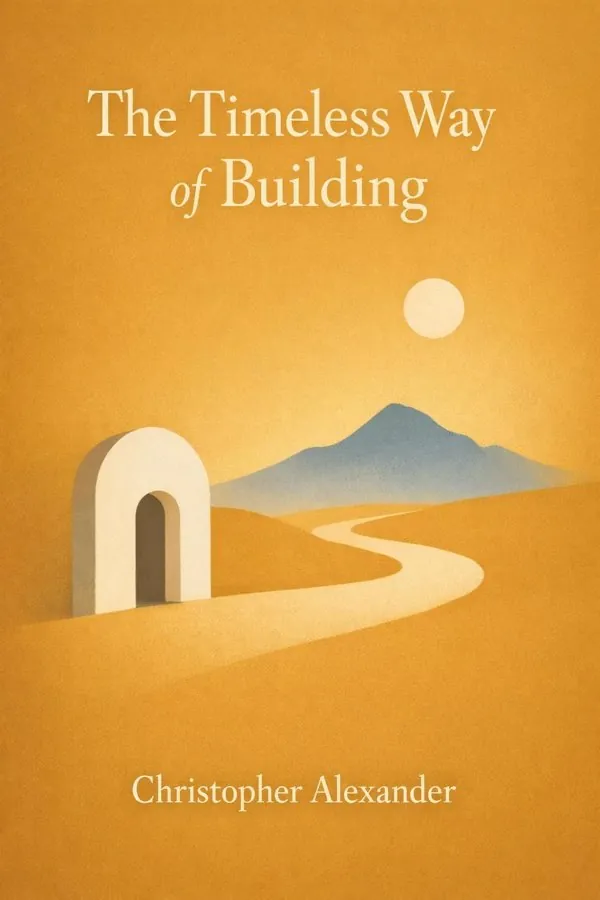
The Timeless Way of Building: Summary & Key Insights
 10 min9 chaptersAudio available
What Is The Timeless Way of Building About?
The Timeless Way of Building by Christopher Alexander is a design book spanning 9 pages. In this seminal work, Christopher Alexander explores the underlying principles that make buildings and towns feel alive and harmonious. He introduces the concept of the 'quality without a name'—a timeless quality that emerges when design follows natural, human-centered patterns. The book serves as both a philosophical and practical foundation for his later works, including 'A Pattern Language', emphasizing that good architecture arises from an organic process rather than rigid design rules.
This FizzRead summary covers all 9 key chapters of The Timeless Way of Building in approximately 10 minutes, distilling the most important ideas, arguments, and takeaways from Christopher Alexander's work. Also available as an audio summary and Key Quotes Podcast.
The Timeless Way of Building
In this seminal work, Christopher Alexander explores the underlying principles that make buildings and towns feel alive and harmonious. He introduces the concept of the 'quality without a name'—a timeless quality that emerges when design follows natural, human-centered patterns. The book serves as both a philosophical and practical foundation for his later works, including 'A Pattern Language', emphasizing that good architecture arises from an organic process rather than rigid design rules.
Who Should Read The Timeless Way of Building?
This book is perfect for anyone interested in design and looking to gain actionable insights in a short read. Whether you're a student, professional, or lifelong learner, the key ideas from The Timeless Way of Building by Christopher Alexander will help you think differently.
- ✓Readers who enjoy design and want practical takeaways
- ✓Professionals looking to apply new ideas to their work and life
- ✓Anyone who wants the core insights of The Timeless Way of Building in just 10 minutes
Want the full summary?
Get instant access to this book summary and 100K+ more with Fizz Moment.
Get Free SummaryAvailable on App Store • Free to download
Key Chapters
There is a profound mystery at the core of all living design: a presence that gives life its coherence. I call it 'the quality without a name' because any word we might use—beauty, harmony, comfort, order—falls short. This quality is not cosmetic; it is not achieved through refinement or decoration. It arises naturally when the builder or designer acts in complete alignment with the forces of life.
Imagine a wooden gate at the edge of a meadow. It stands simple and modest, yet somehow it feels absolutely right. You sense that it belongs—both to the meadow and to the person who placed it there. Now compare it with the gleaming facade of a modern glass building, perfect in geometry but strangely lifeless. The difference is not one of taste or technology, but of being. The wooden gate has the quality without a name because it was made as part of life itself. Its maker responded to the place, the need, and the moment. The glass tower, in contrast, was made from an abstraction, an idea imposed upon the world, rather than arising from it.
This ineffable quality can be recognized everywhere—from the curve of a path that bends to follow a stream, to the pattern of light falling through latticework in an old courtyard. It is what makes us feel at peace and connected, as if the building were not a thing separate from us, but part of the same living organism. Architecture, when practiced in this way, transcends craft. It becomes moral, spiritual, a way of living rightly within the world.
Once you begin to recognize the quality without a name, your sense of design changes forever. You start to look not for novelty but for wholeness. You begin to ask: does this place make me more alive? The answer becomes the only measure that truly matters.
Nature creates forms that are deeply coherent. Every leaf, every stone, every river shows the unity between part and whole. Human environments, at their best, follow the same principle. The most beloved towns and villages grow the way a forest does—organically, each part fitting naturally with the rest.
Living structure is not a metaphor but a real condition. In such places, every element reinforces and reflects others; there is a visible and felt wholeness. A street curve leads effortlessly into a square; the square opens gently into gardens; the gardens relate to surrounding homes in scale, material, and rhythm. Nothing stands in isolation. Every piece has a center, and these centers support one another like the cells of a living tissue.
But modern building often breaks this living order. We plan cities from above, like diagrams. We separate residential from commercial zones as if a town were a machine made of parts rather than a living community. In this fragmentation, life leaks away.
To recover living structure, we must build as nature builds—step by step, responding to context, letting form evolve through feedback. This is not a nostalgic return to the past; it is a reawakening of our own capacity to participate in the world's unfolding pattern. When we build with this awareness, we rejoin the great continuity of creation. Our buildings and towns once again become part of the web of life, not intrusions upon it.
+ 7 more chapters — available in the FizzRead app
All Chapters in The Timeless Way of Building
About the Author
Christopher Alexander (1936–2022) was a British-American architect and design theorist known for his pioneering work in architecture, urban design, and software design theory. He taught at the University of California, Berkeley, and authored influential books such as 'A Pattern Language' and 'The Nature of Order'. His ideas have profoundly influenced architecture, planning, and computer science.
Get This Summary in Your Preferred Format
Read or listen to the The Timeless Way of Building summary by Christopher Alexander anytime, anywhere. FizzRead offers multiple formats so you can learn on your terms — all free.
Available formats: App · Audio · PDF · EPUB — All included free with FizzRead
Download The Timeless Way of Building PDF and EPUB Summary
Key Quotes from The Timeless Way of Building
“There is a profound mystery at the core of all living design: a presence that gives life its coherence.”
“Nature creates forms that are deeply coherent.”
Frequently Asked Questions about The Timeless Way of Building
The Timeless Way of Building by Christopher Alexander is a design book that explores key ideas across 9 chapters. In this seminal work, Christopher Alexander explores the underlying principles that make buildings and towns feel alive and harmonious. He introduces the concept of the 'quality without a name'—a timeless quality that emerges when design follows natural, human-centered patterns. The book serves as both a philosophical and practical foundation for his later works, including 'A Pattern Language', emphasizing that good architecture arises from an organic process rather than rigid design rules.
More by Christopher Alexander
You Might Also Like

The Design of Everyday Things
Don Norman
10 min
The Better Angels of Our Nature
Steven Pinker
10 min
A Designer's Art
Paul Rand
10 min
Architects' Sketchbooks
Various Editors
10 min
Architectural Graphic Standards
The American Institute of Architects
10 min
Design Is Storytelling
Ellen Lupton
10 minBrowse by Category
Ready to read The Timeless Way of Building?
Get the full summary and 100K+ more books with Fizz Moment.