
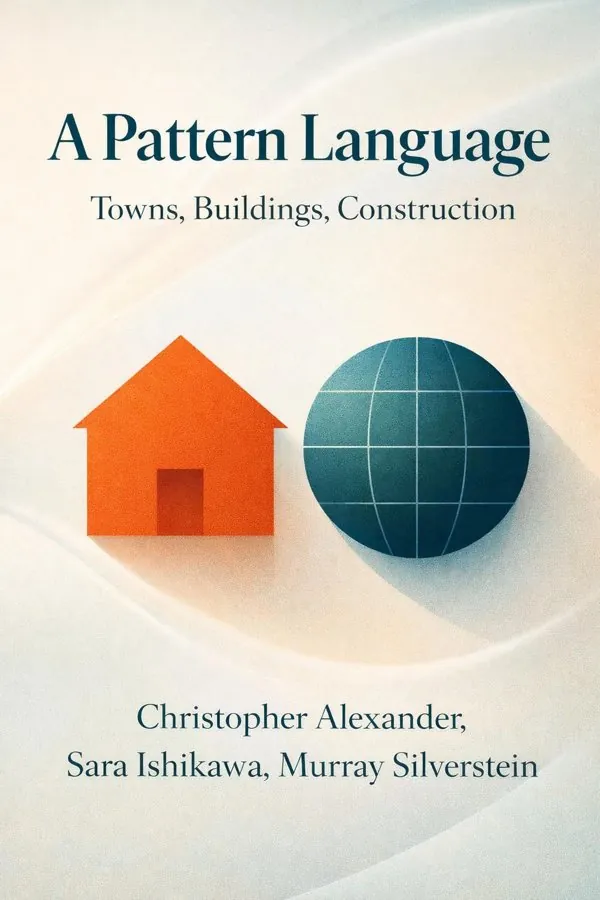
A Pattern Language: Towns, Buildings, Construction: Summary & Key Insights
by Christopher Alexander, Sara Ishikawa, Murray Silverstein
 10 min10 chaptersAudio available
What Is A Pattern Language: Towns, Buildings, Construction About?
A Pattern Language: Towns, Buildings, Construction by Christopher Alexander, Sara Ishikawa, Murray Silverstein is a design book spanning 10 pages. A Pattern Language presents a comprehensive system of design principles for creating human-centered environments. It introduces 253 interconnected 'patterns' that describe solutions to recurring problems in architecture, urban design, and community planning. Each pattern addresses a specific design issue—from the layout of cities to the details of individual rooms—emphasizing harmony, functionality, and the organic relationship between people and their surroundings.
This FizzRead summary covers all 10 key chapters of A Pattern Language: Towns, Buildings, Construction in approximately 10 minutes, distilling the most important ideas, arguments, and takeaways from Christopher Alexander, Sara Ishikawa, Murray Silverstein's work. Also available as an audio summary and Key Quotes Podcast.
A Pattern Language: Towns, Buildings, Construction
A Pattern Language presents a comprehensive system of design principles for creating human-centered environments. It introduces 253 interconnected 'patterns' that describe solutions to recurring problems in architecture, urban design, and community planning. Each pattern addresses a specific design issue—from the layout of cities to the details of individual rooms—emphasizing harmony, functionality, and the organic relationship between people and their surroundings.
Who Should Read A Pattern Language: Towns, Buildings, Construction?
This book is perfect for anyone interested in design and looking to gain actionable insights in a short read. Whether you're a student, professional, or lifelong learner, the key ideas from A Pattern Language: Towns, Buildings, Construction by Christopher Alexander, Sara Ishikawa, Murray Silverstein will help you think differently.
- ✓Readers who enjoy design and want practical takeaways
- ✓Professionals looking to apply new ideas to their work and life
- ✓Anyone who wants the core insights of A Pattern Language: Towns, Buildings, Construction in just 10 minutes
Want the full summary?
Get instant access to this book summary and 100K+ more with Fizz Moment.
Get Free SummaryAvailable on App Store • Free to download
Key Chapters
When I use the word "pattern," I refer to a relationship—a core configuration that recurs whenever people face a certain kind of problem in shaping their surroundings. Patterns are born from observation, distilled from experience. Imagine walking through an old town: every archway, every public square, every cozy alcove carries patterns refined over generations. People did not merely copy what was before; they responded to the same needs—protection, sunlight, contact, movement—and found time-tested solutions. That is what I call a pattern.
A pattern has three parts: first, a description of the problem; second, the context that makes the pattern useful; and third, the solution—the spatial arrangement that resolves the problem naturally. Any pattern exists only in relationship with others. For instance, a pattern called "Street Café" depends on patterns that define pedestrian zones, building fronts, and social spaces. Each pattern therefore sits within a web of relationships, echoing the organic connectedness of life itself.
Patterns are not mechanical instructions. They are living solutions that have proven to bring coherence and comfort to human places. You can use them as guides, as inspiration, and as practical steps, but they demand that you observe deeply and understand the spirit in which they were formed. They invite you into a process of creation that reflects your local culture, climate, and personal sense of belonging. They are timeless because they arise from humanity’s enduring dialogue with the world around us.
The 253 patterns in *A Pattern Language* form a hierarchical structure, much like a living tree. At the top level are patterns that shape vast regions and towns—concepts like the distribution of cities, the presence of natural boundaries, and the way communities relate to the landscape. Beneath these come patterns for neighborhoods and building groups, then patterns for individual buildings, and finally, the more intimate patterns that govern rooms, windows, and details.
This hierarchy is important because it reflects how design grows organically in reality. You cannot design a room well if you do not understand the building it belongs to; you cannot design a building well without understanding the neighborhood it serves. The patterns thus guide you to think from the whole toward the part, maintaining coherence at every scale.
Moreover, the structure allows for flexibility. You need not use every pattern; you select those that fit your project, letting each reveal the next as naturally as conversation. When applied together, the patterns form a language—a system of meaning where every part supports every other. Using the language feels like composing sentences that speak to the essence of human life. The difference is that these sentences are built environments—living, breathing, inhabitable realities.
+ 8 more chapters — available in the FizzRead app
All Chapters in A Pattern Language: Towns, Buildings, Construction
About the Authors
Christopher Alexander (1936–2022) was a British-American architect and design theorist known for his influential work on design patterns and the nature of order. Sara Ishikawa and Murray Silverstein were collaborators at the Center for Environmental Structure, contributing to the development of pattern-based design methodologies that have influenced architecture, software engineering, and systems thinking.
Get This Summary in Your Preferred Format
Read or listen to the A Pattern Language: Towns, Buildings, Construction summary by Christopher Alexander, Sara Ishikawa, Murray Silverstein anytime, anywhere. FizzRead offers multiple formats so you can learn on your terms — all free.
Available formats: App · Audio · PDF · EPUB — All included free with FizzRead
Download A Pattern Language: Towns, Buildings, Construction PDF and EPUB Summary
Key Quotes from A Pattern Language: Towns, Buildings, Construction
“When I use the word "pattern," I refer to a relationship—a core configuration that recurs whenever people face a certain kind of problem in shaping their surroundings.”
“The 253 patterns in *A Pattern Language* form a hierarchical structure, much like a living tree.”
Frequently Asked Questions about A Pattern Language: Towns, Buildings, Construction
A Pattern Language: Towns, Buildings, Construction by Christopher Alexander, Sara Ishikawa, Murray Silverstein is a design book that explores key ideas across 10 chapters. A Pattern Language presents a comprehensive system of design principles for creating human-centered environments. It introduces 253 interconnected 'patterns' that describe solutions to recurring problems in architecture, urban design, and community planning. Each pattern addresses a specific design issue—from the layout of cities to the details of individual rooms—emphasizing harmony, functionality, and the organic relationship between people and their surroundings.
You Might Also Like

The Design of Everyday Things
Don Norman
10 min
The Better Angels of Our Nature
Steven Pinker
10 min
A Designer's Art
Paul Rand
10 min
Architects' Sketchbooks
Various Editors
10 min
Architectural Graphic Standards
The American Institute of Architects
10 min
Design Is Storytelling
Ellen Lupton
10 minFeatured In
Browse by Category
Ready to read A Pattern Language: Towns, Buildings, Construction?
Get the full summary and 100K+ more books with Fizz Moment.