
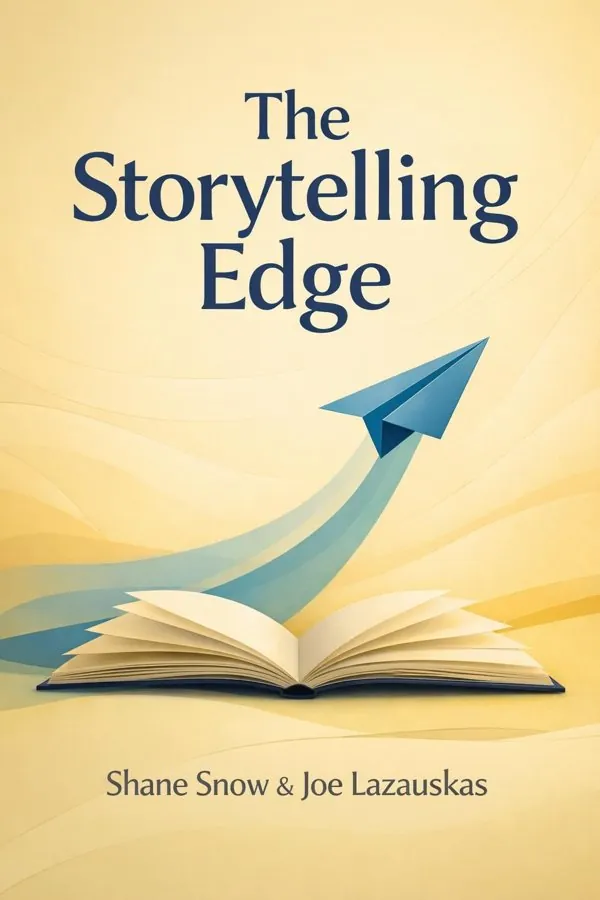
The Storytelling Edge: How to Transform Your Business, Stop Screaming into the Void, and Make People Love You: Summary & Key Insights
 10 min9 chaptersAudio available
Key Takeaways from The Storytelling Edge: How to Transform Your Business, Stop Screaming into the Void, and Make People Love You
People rarely make decisions from information alone; they make them from felt experience.
Long before there were logos, landing pages, and ad campaigns, there were stories.
A story without change is just description.
People do not remember the most detailed message; they remember the one that made them feel something.
One of the book’s most practical insights is that brands often misunderstand their role in stories.
What Is The Storytelling Edge: How to Transform Your Business, Stop Screaming into the Void, and Make People Love You About?
The Storytelling Edge: How to Transform Your Business, Stop Screaming into the Void, and Make People Love You by Shane Snow & Joe Lazauskas is a marketing book spanning 11 pages. In a world flooded with ads, emails, social posts, and brand promises, attention has become painfully hard to earn and even harder to keep. The Storytelling Edge argues that the answer is not more noise, more data, or more aggressive promotion. It is better storytelling. Shane Snow and Joe Lazauskas show that stories are not a soft extra added to marketing after the real work is done. They are one of the most powerful tools humans have for creating meaning, trust, memory, and action. Drawing from neuroscience, psychology, history, and contemporary brand case studies, the authors explain why stories move people in ways facts alone cannot. They also show how businesses can use narrative to make ideas resonate, build customer loyalty, and stand out in crowded markets. Snow, an award-winning journalist and entrepreneur, and Lazauskas, a seasoned content strategist and editor, bring both analytical rigor and practical experience to the subject. The result is a smart, persuasive guide for anyone who wants their message to matter.
This FizzRead summary covers all 9 key chapters of The Storytelling Edge: How to Transform Your Business, Stop Screaming into the Void, and Make People Love You in approximately 10 minutes, distilling the most important ideas, arguments, and takeaways from Shane Snow & Joe Lazauskas's work. Also available as an audio summary and Key Quotes Podcast.
The Storytelling Edge: How to Transform Your Business, Stop Screaming into the Void, and Make People Love You
In a world flooded with ads, emails, social posts, and brand promises, attention has become painfully hard to earn and even harder to keep. The Storytelling Edge argues that the answer is not more noise, more data, or more aggressive promotion. It is better storytelling. Shane Snow and Joe Lazauskas show that stories are not a soft extra added to marketing after the real work is done. They are one of the most powerful tools humans have for creating meaning, trust, memory, and action. Drawing from neuroscience, psychology, history, and contemporary brand case studies, the authors explain why stories move people in ways facts alone cannot. They also show how businesses can use narrative to make ideas resonate, build customer loyalty, and stand out in crowded markets. Snow, an award-winning journalist and entrepreneur, and Lazauskas, a seasoned content strategist and editor, bring both analytical rigor and practical experience to the subject. The result is a smart, persuasive guide for anyone who wants their message to matter.
Who Should Read The Storytelling Edge: How to Transform Your Business, Stop Screaming into the Void, and Make People Love You?
This book is perfect for anyone interested in marketing and looking to gain actionable insights in a short read. Whether you're a student, professional, or lifelong learner, the key ideas from The Storytelling Edge: How to Transform Your Business, Stop Screaming into the Void, and Make People Love You by Shane Snow & Joe Lazauskas will help you think differently.
- ✓Readers who enjoy marketing and want practical takeaways
- ✓Professionals looking to apply new ideas to their work and life
- ✓Anyone who wants the core insights of The Storytelling Edge: How to Transform Your Business, Stop Screaming into the Void, and Make People Love You in just 10 minutes
Want the full summary?
Get instant access to this book summary and 100K+ more with Fizz Moment.
Get Free SummaryAvailable on App Store • Free to download
Key Chapters
People rarely make decisions from information alone; they make them from felt experience. That is the starting point of The Storytelling Edge. The authors explain that storytelling works because the brain responds to narrative differently than it responds to isolated facts. When we hear statistics, language-processing regions may activate. But when we hear a vivid story, the brain simulates the experience. We imagine scenes, emotions, tension, and outcomes. This process increases attention, memory, and empathy. In business terms, that means a customer is far more likely to remember a story about how a product changed someone’s life than a list of technical features.
The authors connect this to neuroscience research showing that narratives can trigger emotional and sensory engagement, making ideas feel personally relevant. A brand that tells a compelling customer story is not merely transmitting information; it is creating a small lived experience in the mind of the audience. That is why the same message framed as a journey, challenge, or transformation often lands with more force than a polished corporate claim.
For example, a healthcare company could promote faster appointments and better outcomes. Or it could tell the story of a patient who spent years feeling ignored before finding care that restored her confidence and health. The second approach creates memory and meaning.
Actionable takeaway: Before sharing facts, ask what human experience those facts represent, then build your message around that lived transformation.
Long before there were logos, landing pages, and ad campaigns, there were stories. Snow and Lazauskas place storytelling in a deep historical context, arguing that narrative is one of humanity’s oldest tools for survival, cooperation, and social influence. Around fires and across generations, stories taught people what mattered, whom to trust, what to fear, and how to belong. In that sense, marketing did not invent storytelling. Marketing simply inherited the most powerful communication system humans ever created.
This matters because many modern businesses treat communication as a transaction: announce benefits, push messages, optimize conversions. But stories work on a deeper level. They give context to facts and shape identity. People often choose brands not only because of utility, but because those brands symbolize values, aspirations, or membership in a community. A company that understands this stops asking only, “What do we sell?” and starts asking, “What meaning do we help people create?”
Think about outdoor brands that do more than sell jackets or backpacks. Their most effective campaigns tell stories about adventure, resilience, stewardship, and freedom. The product becomes part of a larger identity story the customer wants to inhabit.
The book suggests that in an age of infinite content, old human instincts still govern attention. We are drawn to conflict, stakes, characters, and meaning because we always have been.
Actionable takeaway: Reframe your brand message from a product pitch into a cultural or personal story your audience wants to join.
A story without change is just description. One of the most useful lessons in the book is that strong business storytelling depends on the same structural elements that make novels, films, and speeches compelling: a character, a goal, an obstacle, rising tension, and transformation. Most corporate content fails because it skips directly to the solution. It says, in effect, “Here is our product, and here is why it is good.” But people pay attention when something is at stake.
The authors emphasize that conflict is not a flaw in a story; it is the engine. The obstacle could be a frustrated customer, a broken industry norm, an internal company struggle, or a broader social problem. What matters is that the story shows movement from one state to another. Before and after is more memorable than feature and benefit.
This can be used in nearly every part of marketing. A founder story becomes stronger when it includes what was broken in the world and why the founders cared enough to act. A customer testimonial becomes stronger when it shows the frustration, uncertainty, or cost of the old way before the new solution appears. Even internal communications improve when leaders frame change as a shared challenge rather than a dry update.
A software company, for instance, should not simply say its platform saves time. It should show a team drowning in repetitive tasks, missing opportunities, and feeling burned out, then reveal how their workflow changed.
Actionable takeaway: In every story you tell, identify the tension, the turning point, and the transformation.
People do not remember the most detailed message; they remember the one that made them feel something. The Storytelling Edge argues that emotion is not the opposite of reason in business communication. It is what gives ideas traction. Emotion helps audiences care, and empathy helps them see themselves in the story. Together, they make messages persuasive without making them manipulative.
The authors explore how stories create emotional alignment between storyteller and audience. When we encounter a relatable character facing a meaningful challenge, we instinctively imagine what it would feel like to be in that situation. This is why emotionally rich storytelling is so effective in marketing, leadership, fundraising, and sales. It turns abstract claims into personal relevance.
Importantly, the book does not suggest adding artificial sentiment. Instead, it argues for finding genuine emotional truth. A financial services company might assume its buyers care only about rates and returns. But a better story may focus on security, dignity, peace of mind, or the dream of sending a child to college. A B2B company might assume professionalism requires emotional neutrality, yet its buyers still experience fear, ambition, pride, and relief.
When emotion is grounded in authentic customer experience, it strengthens trust. When it is exaggerated or generic, it backfires. That is why empathy requires research, listening, and respect for the audience’s reality.
Actionable takeaway: Identify the core emotion behind your customer’s problem and desired outcome, then craft stories that reflect that emotional journey with honesty.
One of the book’s most practical insights is that brands often misunderstand their role in stories. They cast themselves as the hero, when in reality the customer should hold that role. Drawing on the familiar logic of the hero’s journey, Snow and Lazauskas show that businesses are most effective when they act as guides, mentors, or enablers of transformation. The audience wants to see itself overcoming a challenge, not sit through a self-congratulatory brand monologue.
This shift changes everything. Instead of asking, “How do we show how impressive we are?” a company asks, “How do we help our audience win?” The hero’s journey framework works because it mirrors lived human experience: uncertainty, challenge, discovery, support, action, and change. Great brand storytelling maps onto that arc. The product or service is important, but it is not the star. It is the tool, mentor, or bridge that helps the hero succeed.
For example, a fitness brand should not make its campaign about the brilliance of its app. It should tell the story of a person struggling to reclaim energy, confidence, or health, and show how the brand supports that journey. Likewise, a B2B consultant should frame services around the client’s transformation, such as becoming a more effective leader or building a stronger team.
This perspective also improves product design and customer experience because it forces organizations to prioritize user outcomes over internal vanity.
Actionable takeaway: Rewrite your core messaging so the customer is the protagonist and your brand is the trusted guide.
In the short term, polished messaging can attract clicks. In the long term, only authenticity earns loyalty. The Storytelling Edge stresses that storytelling is powerful precisely because people are sensitive to insincerity. If a story feels manufactured, self-serving, or disconnected from reality, it will not deepen trust. It will erode it. That is why the authors place authenticity at the center of effective brand narrative.
Authenticity does not mean sharing everything or appearing unpolished for its own sake. It means aligning stories with truth, values, and lived behavior. If a company tells stories about purpose while treating employees poorly, the narrative collapses. If a brand celebrates community while speaking in generic corporate clichés, audiences notice the gap. Trust is built when the story matches the experience.
The authors encourage organizations to uncover real stories rather than invent synthetic ones. These can come from customer journeys, employee experiences, founding struggles, product failures that led to improvement, or mission-driven decisions made under pressure. Vulnerability can be especially effective when it reveals learning, conviction, or humanity.
For example, a food company talking about sustainability should tell specific stories about sourcing choices, tradeoffs, and farmer relationships rather than broad claims about caring for the planet. Concrete truth beats vague virtue.
Actionable takeaway: Audit your storytelling for alignment by asking whether every major narrative you share is supported by visible actions, specific evidence, and real human experience.
Facts matter, but facts alone rarely travel far. One of the strongest contributions of the book is its insistence that data and storytelling are not rivals. They are partners. Data provides credibility, scale, and precision. Story provides meaning, context, and memorability. Put together, they create communication that feels both emotionally resonant and intellectually trustworthy.
Too many organizations choose one of two extremes. They either flood audiences with charts, metrics, and evidence that no one remembers, or they rely on emotional messaging that feels thin and unsubstantiated. Snow and Lazauskas argue that the sweet spot is narrative supported by proof. A story draws the audience in; data confirms that the story reflects a broader truth.
Imagine a nonprofit advocating for educational reform. A single student’s story can create empathy, but the impact multiplies when that story is paired with data showing how widespread the problem is and how effective the proposed solution can be. Likewise, a SaaS company can tell the story of a team overwhelmed by fragmented tools, then use adoption and productivity data to demonstrate measurable improvement.
The sequence matters too. Often, a relatable story opens the door, and the evidence helps people justify the interest or conviction they already feel. This is especially useful in executive communication, fundraising, product marketing, and thought leadership.
Actionable takeaway: Present one memorable human story first, then support it with a small set of carefully chosen data points that expand and validate its significance.
The internet did not kill storytelling; it made strong storytelling more necessary. In digital environments, people are overwhelmed by content and trained to ignore interruption. That means brands cannot rely on brute-force visibility alone. According to the authors, the companies that win online are not those that shout the loudest, but those that build narrative ecosystems people choose to engage with.
This requires understanding that every channel has its own storytelling grammar. A long-form article, a video, a podcast, an email sequence, and a social post should all serve the same narrative core while adapting to the medium. Storytelling in the digital age is not about repeating slogans. It is about creating connected experiences that reinforce identity, values, and usefulness over time.
The book also highlights the importance of consistency. When a brand tells one story in a TV ad, another in customer support, and a third in social media, trust weakens. But when all touchpoints express the same deeper narrative, audiences begin to recognize and remember the brand. This consistency should not produce sameness. Rather, it should create coherence.
A modern company might use customer stories on its website, founder reflections in newsletters, educational content on LinkedIn, and short-form video showing behind-the-scenes reality. Different formats, same strategic narrative.
Actionable takeaway: Define one central brand story and translate it into a channel-by-channel content system so every touchpoint strengthens the same message.
A powerful campaign can create momentum, but lasting advantage comes from culture. The Storytelling Edge argues that storytelling should not live only inside the marketing team. It should become a cross-functional capability embedded in how a company leads, sells, hires, trains, and innovates. When storytelling becomes a habit, organizations communicate more clearly and connect more deeply with every audience they serve.
This starts internally. Leaders who explain strategy through narrative help employees understand not just what is changing, but why it matters. Sales teams that tell stories about customer transformation become more persuasive. Recruiters who share real stories about mission and growth attract better-fit talent. Product teams that listen for user narratives design better experiences. In other words, storytelling is not decorative. It is operational.
The authors also point to practical ways organizations can build this muscle: collect customer stories systematically, train teams to identify narrative arcs, create editorial standards, and celebrate examples of authentic communication. Case studies and examples matter because they turn abstract principles into repeatable patterns. Over time, a storytelling culture creates alignment. People across the company begin to speak from the same values and toward the same customer-centered purpose.
This is especially important in moments of change or crisis, when facts alone may not reassure people. Stories help organizations make sense of uncertainty and maintain human connection.
Actionable takeaway: Build a repeatable storytelling practice by gathering real stories across the business and training every team to use narrative with clarity, empathy, and consistency.
All Chapters in The Storytelling Edge: How to Transform Your Business, Stop Screaming into the Void, and Make People Love You
About the Authors
Shane Snow is an award-winning journalist, entrepreneur, and bestselling author known for exploring innovation, human behavior, and the forces that shape success. He is the co-founder of Contently, a company that helped major brands rethink content marketing through stronger storytelling. Joe Lazauskas is a marketing strategist, writer, and former editor-in-chief at Contently, where he focused on helping businesses create more compelling, audience-centered narratives. Together, Snow and Lazauskas combine journalistic rigor, business insight, and deep experience in content strategy. Their work sits at the intersection of neuroscience, branding, media, and persuasion, making them especially well suited to explain why storytelling is not just a creative skill, but a competitive advantage for modern organizations.
Get This Summary in Your Preferred Format
Read or listen to the The Storytelling Edge: How to Transform Your Business, Stop Screaming into the Void, and Make People Love You summary by Shane Snow & Joe Lazauskas anytime, anywhere. FizzRead offers multiple formats so you can learn on your terms — all free.
Available formats: App · Audio · PDF · EPUB — All included free with FizzRead
Download The Storytelling Edge: How to Transform Your Business, Stop Screaming into the Void, and Make People Love You PDF and EPUB Summary
Key Quotes from The Storytelling Edge: How to Transform Your Business, Stop Screaming into the Void, and Make People Love You
“People rarely make decisions from information alone; they make them from felt experience.”
“Long before there were logos, landing pages, and ad campaigns, there were stories.”
“A story without change is just description.”
“People do not remember the most detailed message; they remember the one that made them feel something.”
“One of the book’s most practical insights is that brands often misunderstand their role in stories.”
Frequently Asked Questions about The Storytelling Edge: How to Transform Your Business, Stop Screaming into the Void, and Make People Love You
The Storytelling Edge: How to Transform Your Business, Stop Screaming into the Void, and Make People Love You by Shane Snow & Joe Lazauskas is a marketing book that explores key ideas across 9 chapters. In a world flooded with ads, emails, social posts, and brand promises, attention has become painfully hard to earn and even harder to keep. The Storytelling Edge argues that the answer is not more noise, more data, or more aggressive promotion. It is better storytelling. Shane Snow and Joe Lazauskas show that stories are not a soft extra added to marketing after the real work is done. They are one of the most powerful tools humans have for creating meaning, trust, memory, and action. Drawing from neuroscience, psychology, history, and contemporary brand case studies, the authors explain why stories move people in ways facts alone cannot. They also show how businesses can use narrative to make ideas resonate, build customer loyalty, and stand out in crowded markets. Snow, an award-winning journalist and entrepreneur, and Lazauskas, a seasoned content strategist and editor, bring both analytical rigor and practical experience to the subject. The result is a smart, persuasive guide for anyone who wants their message to matter.
You Might Also Like
Captivology: The Science of Capturing People's Attention
Ben Parr
10 min
Marketing 5.0: Technology for Humanity
Philip Kotler, Hermawan Kartajaya, Iwan Setiawan
10 min
Marketing Strategy
Paul Fifield
10 min
UnMarketing: Stop Marketing. Start Engaging.
Scott Stratten
10 min
$100M Leads: How to Get Strangers to Want to Buy Your Stuff
Alex Hormozi
10 min
80/20 Sales and Marketing: The Definitive Guide to Working Less and Making More
Perry Marshall
10 minBrowse by Category
Ready to read The Storytelling Edge: How to Transform Your Business, Stop Screaming into the Void, and Make People Love You?
Get the full summary and 100K+ more books with Fizz Moment.