
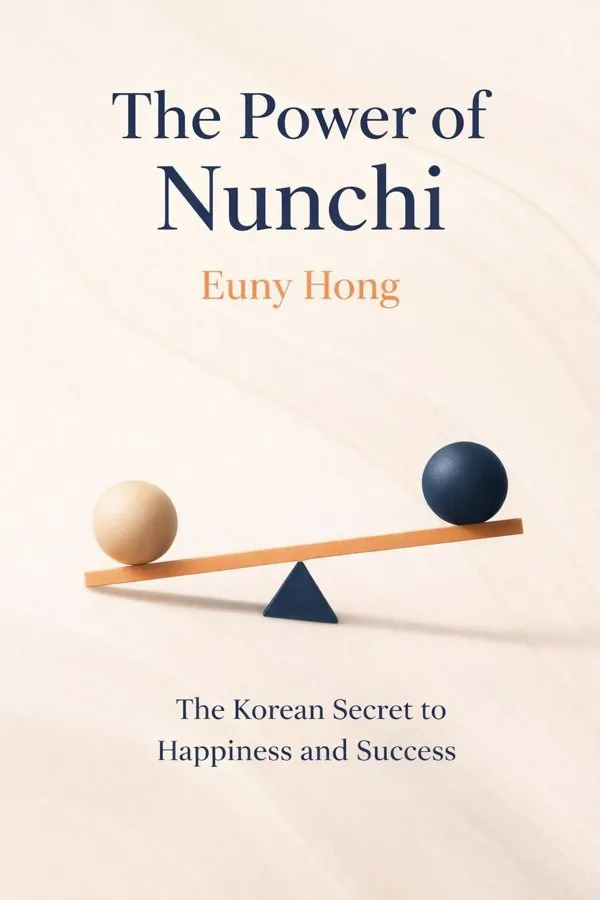
The Power of Nunchi: The Korean Secret to Happiness and Success: Summary & Key Insights
by Euny Hong
 10 min9 chaptersAudio available
Key Takeaways from The Power of Nunchi: The Korean Secret to Happiness and Success
Most people assume social success comes from charisma, confidence, or clever speech, but nunchi begins with something quieter: perception.
The difference between wisdom and awkwardness is often timing.
People often think they need to talk more to connect, yet Hong suggests that social insight begins by talking less.
Some people seem naturally gifted at reading a room, but Hong insists that nunchi is not magic.
Professional success often depends less on brilliance alone than on knowing how to work with people.
What Is The Power of Nunchi: The Korean Secret to Happiness and Success About?
The Power of Nunchi: The Korean Secret to Happiness and Success by Euny Hong is a self_awareness book spanning 5 pages. What if one of the most powerful tools for success is not speaking better, asserting yourself more forcefully, or mastering persuasion, but learning how to notice what others miss? In The Power of Nunchi, journalist and author Euny Hong introduces readers to a Korean concept that has shaped social life for centuries: nunchi, often translated as the art of reading the room. More than emotional intelligence, nunchi is the ability to quickly sense other people’s feelings, intentions, and social dynamics, then adjust your behavior with grace and precision. Hong argues that this subtle skill can improve relationships, sharpen judgment, reduce conflict, and open doors in both personal and professional life. Drawing on Korean culture, historical context, personal anecdotes, and practical observations, she shows how nunchi is not mystical or reserved for insiders. It is a learnable form of social awareness. In a noisy, fast, and often self-focused world, Hong makes a compelling case that paying closer attention to others may be one of the clearest paths to happiness, influence, and lasting success.
This FizzRead summary covers all 9 key chapters of The Power of Nunchi: The Korean Secret to Happiness and Success in approximately 10 minutes, distilling the most important ideas, arguments, and takeaways from Euny Hong's work. Also available as an audio summary and Key Quotes Podcast.
The Power of Nunchi: The Korean Secret to Happiness and Success
What if one of the most powerful tools for success is not speaking better, asserting yourself more forcefully, or mastering persuasion, but learning how to notice what others miss? In The Power of Nunchi, journalist and author Euny Hong introduces readers to a Korean concept that has shaped social life for centuries: nunchi, often translated as the art of reading the room. More than emotional intelligence, nunchi is the ability to quickly sense other people’s feelings, intentions, and social dynamics, then adjust your behavior with grace and precision. Hong argues that this subtle skill can improve relationships, sharpen judgment, reduce conflict, and open doors in both personal and professional life. Drawing on Korean culture, historical context, personal anecdotes, and practical observations, she shows how nunchi is not mystical or reserved for insiders. It is a learnable form of social awareness. In a noisy, fast, and often self-focused world, Hong makes a compelling case that paying closer attention to others may be one of the clearest paths to happiness, influence, and lasting success.
Who Should Read The Power of Nunchi: The Korean Secret to Happiness and Success?
This book is perfect for anyone interested in self_awareness and looking to gain actionable insights in a short read. Whether you're a student, professional, or lifelong learner, the key ideas from The Power of Nunchi: The Korean Secret to Happiness and Success by Euny Hong will help you think differently.
- ✓Readers who enjoy self_awareness and want practical takeaways
- ✓Professionals looking to apply new ideas to their work and life
- ✓Anyone who wants the core insights of The Power of Nunchi: The Korean Secret to Happiness and Success in just 10 minutes
Want the full summary?
Get instant access to this book summary and 100K+ more with Fizz Moment.
Get Free SummaryAvailable on App Store • Free to download
Key Chapters
Most people assume social success comes from charisma, confidence, or clever speech, but nunchi begins with something quieter: perception. Euny Hong explains that while emotional intelligence often emphasizes understanding and managing emotions, nunchi focuses on rapidly assessing a social environment and responding appropriately. It is less about what you feel and more about what is happening around you. In that sense, nunchi is intensely outward-facing. It asks you to observe the mood, hierarchy, tension, and unspoken expectations in a room before deciding how to act.
This distinction matters because many social mistakes happen when people lead with self-expression instead of awareness. Someone may enter a meeting eager to impress, only to ignore that the team is anxious after bad news. A dinner guest may dominate the conversation without noticing others are tired or uncomfortable. Nunchi trains you to gather silent information first. It encourages restraint, humility, and attentiveness.
Hong presents nunchi as a practical skill rather than a personality trait. Introverts can use it. Extroverts need it. Children in Korea are often taught early to notice whether others are busy, upset, or in need of help without being directly told. In adulthood, this becomes a powerful social advantage. The person with good nunchi knows when to speak, when to wait, when to comfort, and when to leave space.
A simple application is to pause before acting in any group setting. Notice who is speaking freely, who is holding back, what emotional tone dominates, and what is left unsaid. Actionable takeaway: before entering a conversation, ask yourself, “What does this moment need from me?” instead of “How do I want to appear?”
The difference between wisdom and awkwardness is often timing. According to Hong, nunchi rests on three connected principles: observation, timing, and context. Observation means paying close attention to people’s expressions, tone, posture, pace, and silence. Timing means understanding when an action will be welcomed and when it will backfire. Context means interpreting behavior within the wider situation instead of judging it in isolation.
These principles work together. Imagine a manager who notices that an employee is quieter than usual, avoids eye contact, and gives short answers. Observation alone tells you something is different. Context may reveal that a major project just failed or that layoffs are rumored. Timing then determines the best response: this may not be the moment for criticism, but for a private check-in. Without all three elements, your reading of the situation stays incomplete.
Hong emphasizes that people with strong nunchi do not rush to conclusions. They collect clues. They understand that the same words can mean different things depending on where, when, and to whom they are spoken. A joke among close friends may sound offensive in a formal meeting. Silence may signal respect in one setting and disapproval in another.
In everyday life, this means resisting knee-jerk reactions. If someone seems cold, ask what pressures might be shaping their behavior. If you have important news, consider whether the listener is emotionally available. Actionable takeaway: train yourself to do a quick three-part scan in social situations—what am I observing, what is the timing, and what is the context?
People often think they need to talk more to connect, yet Hong suggests that social insight begins by talking less. Good nunchi requires quiet attention: the discipline to stop centering your own thoughts long enough to accurately read the environment. This does not mean becoming passive or timid. It means understanding that information arrives before influence does.
One of the book’s most practical lessons is that first impressions are often built in silence. Before you say a word, others are already noticing how you enter a room, whether you interrupt, whether you seem rushed, and whether you sense the emotional tone. If you charge ahead with a prepared agenda, you risk missing what the moment is actually asking for. By contrast, someone with good nunchi takes in the atmosphere first and adapts naturally.
This skill is especially useful in family life, friendships, and work. A parent may sense that a child saying “I’m fine” is actually overwhelmed. A friend may realize that humor is masking embarrassment. A colleague may notice that a team’s hesitation means they need reassurance, not more data. In each case, attentive silence reveals what direct statements do not.
Hong also warns against distraction. Phones, rehearsed talking points, and internal chatter weaken nunchi because they disconnect you from the present moment. To develop stronger awareness, practice entering rooms without immediately filling space. Let others set the tone. Listen to cadence, not just words. Notice where energy rises or falls.
Actionable takeaway: in your next conversation, spend the first minute observing without trying to control the interaction, and let your response emerge from what you notice.
Some people seem naturally gifted at reading a room, but Hong insists that nunchi is not magic. It is a learnable habit of quick, accurate social assessment. In Korean culture, children absorb it early because they are expected to notice how their behavior affects others. Yet adults anywhere can cultivate the same skill by becoming more observant, less reactive, and more sensitive to patterns.
A core idea in the book is “fast nunchi,” the ability to size up a situation quickly. This does not mean stereotyping or making snap judgments based on surface impressions. It means noticing enough relevant signals to orient yourself intelligently. Who holds authority here? Is the atmosphere relaxed or tense? Are people being formal, playful, cautious, or guarded? Are there invisible rules already in operation?
For example, when joining a new workplace, a person with fast nunchi does not assume the official org chart tells the whole story. They notice who people defer to, whose opinion shifts the room, and what behavior is rewarded or punished. At a social gathering, they see whether guests are mingling freely or clustering carefully. They adapt accordingly.
Hong’s point is empowering: if you can improve observation, you can improve outcomes. The more accurately you read situations, the less likely you are to embarrass yourself, offend others, or miss opportunities. Like any skill, it strengthens through repeated practice.
Try building nunchi through deliberate exercises. In meetings, identify the emotional tone before speaking. In public places, observe interactions and infer dynamics without judging. Reflect afterward on whether your read was accurate. Actionable takeaway: make it a daily habit to pause, scan, and interpret the social environment before deciding how to participate.
Professional success often depends less on brilliance alone than on knowing how to work with people. Hong shows that nunchi can be a major advantage in the workplace because organizations run on formal structures and invisible emotional currents at the same time. Policies matter, but moods, loyalties, anxieties, and ego matter too. Employees and leaders who ignore these realities often create unnecessary friction.
A manager with nunchi knows that feedback should be shaped by the moment. Public praise may motivate one employee but embarrass another. A team may need calm confidence after a setback, not aggressive pressure. A junior employee with nunchi notices which meetings welcome challenge and which require diplomacy. They understand that competence is not enough if it is delivered in a way that threatens others or ignores group dynamics.
This does not mean becoming manipulative or fake. In Hong’s framing, nunchi is about social accuracy and mutual respect. It helps people navigate office politics without becoming cynical. It also supports better leadership because leaders with nunchi detect morale problems early, understand what remains unspoken, and create environments where others feel seen.
Practical examples abound. Before presenting an idea, assess whether decision-makers want innovation, reassurance, or detail. When conflict arises, listen for what each side needs emotionally, not just what they claim rationally. When entering a new role, learn the culture before trying to transform it.
Actionable takeaway: at work, stop treating every interaction as purely logical; before making a move, ask what emotional and relational factors are influencing the situation.
Many interpersonal problems come from one hidden source: too much attachment to our own perspective. Hong suggests that nunchi works because it softens ego. When you stop obsessing over how you are being perceived and start paying attention to what others are experiencing, you become easier to trust, kinder to be around, and more effective in resolving tension.
This shift has powerful consequences in relationships. Couples argue not only because they disagree, but because they fail to notice each other’s emotional state before speaking. Friends drift apart when one person repeatedly misses cues of discomfort or need. Family conflict escalates when everyone insists on being understood before trying to understand the room. Nunchi interrupts this pattern by asking you to widen your field of attention.
For example, if a loved one responds sharply, low nunchi might trigger immediate defensiveness. Higher nunchi asks: are they exhausted, ashamed, preoccupied, or hurt? That does not excuse bad behavior, but it creates space for wiser responses. Likewise, in social settings, noticing who feels excluded allows you to include them without fanfare. Such acts build trust quietly but deeply.
Hong’s version of social awareness is not self-erasure. You still have needs, opinions, and boundaries. But those are expressed with greater sensitivity because you understand how they land. The result is fewer unnecessary clashes and more mutually respectful connections.
Actionable takeaway: when tension appears in a relationship, delay self-defense for a moment and ask, “What might this person be feeling that they are not saying directly?”
All Chapters in The Power of Nunchi: The Korean Secret to Happiness and Success
About the Author
Euny Hong is a Korean American journalist, author, and cultural commentator known for writing about Korean society, identity, and global culture with wit and clarity. She is the author of The Birth of Korean Cool, which examined South Korea’s emergence as a major cultural force, and she has written for international publications on topics ranging from politics to pop culture. Having lived between the United States and South Korea, Hong brings a cross-cultural perspective that helps her explain Korean ideas to English-language readers without oversimplifying them. In The Power of Nunchi, she draws on personal experience, social observation, and cultural history to introduce one of Korea’s most distinctive concepts. Her work is valued for making complex cultural insights practical, readable, and relevant to everyday life.
Get This Summary in Your Preferred Format
Read or listen to the The Power of Nunchi: The Korean Secret to Happiness and Success summary by Euny Hong anytime, anywhere. FizzRead offers multiple formats so you can learn on your terms — all free.
Available formats: App · Audio · PDF · EPUB — All included free with FizzRead
Download The Power of Nunchi: The Korean Secret to Happiness and Success PDF and EPUB Summary
Key Quotes from The Power of Nunchi: The Korean Secret to Happiness and Success
“Most people assume social success comes from charisma, confidence, or clever speech, but nunchi begins with something quieter: perception.”
“The difference between wisdom and awkwardness is often timing.”
“People often think they need to talk more to connect, yet Hong suggests that social insight begins by talking less.”
“Some people seem naturally gifted at reading a room, but Hong insists that nunchi is not magic.”
“Professional success often depends less on brilliance alone than on knowing how to work with people.”
Frequently Asked Questions about The Power of Nunchi: The Korean Secret to Happiness and Success
The Power of Nunchi: The Korean Secret to Happiness and Success by Euny Hong is a self_awareness book that explores key ideas across 9 chapters. What if one of the most powerful tools for success is not speaking better, asserting yourself more forcefully, or mastering persuasion, but learning how to notice what others miss? In The Power of Nunchi, journalist and author Euny Hong introduces readers to a Korean concept that has shaped social life for centuries: nunchi, often translated as the art of reading the room. More than emotional intelligence, nunchi is the ability to quickly sense other people’s feelings, intentions, and social dynamics, then adjust your behavior with grace and precision. Hong argues that this subtle skill can improve relationships, sharpen judgment, reduce conflict, and open doors in both personal and professional life. Drawing on Korean culture, historical context, personal anecdotes, and practical observations, she shows how nunchi is not mystical or reserved for insiders. It is a learnable form of social awareness. In a noisy, fast, and often self-focused world, Hong makes a compelling case that paying closer attention to others may be one of the clearest paths to happiness, influence, and lasting success.
You Might Also Like

Rising Strong
Brené Brown
10 min
You Do You
Sarah Knight
10 min
Master Your Emotions: A Practical Guide to Overcome Negativity and Better Manage Your Feelings
Thibaut Meurisse
10 min
The Mountain Is You: Transforming Self-Sabotage Into Self-Mastery
Brianna Wiest
10 min
101 Essays That Will Change The Way You Think
Brianna Wiest
10 min
A Radical Awakening: Turn Pain into Power, Embrace Your Truth, Live Free
Shefali Tsabary
10 minBrowse by Category
Ready to read The Power of Nunchi: The Korean Secret to Happiness and Success?
Get the full summary and 100K+ more books with Fizz Moment.