
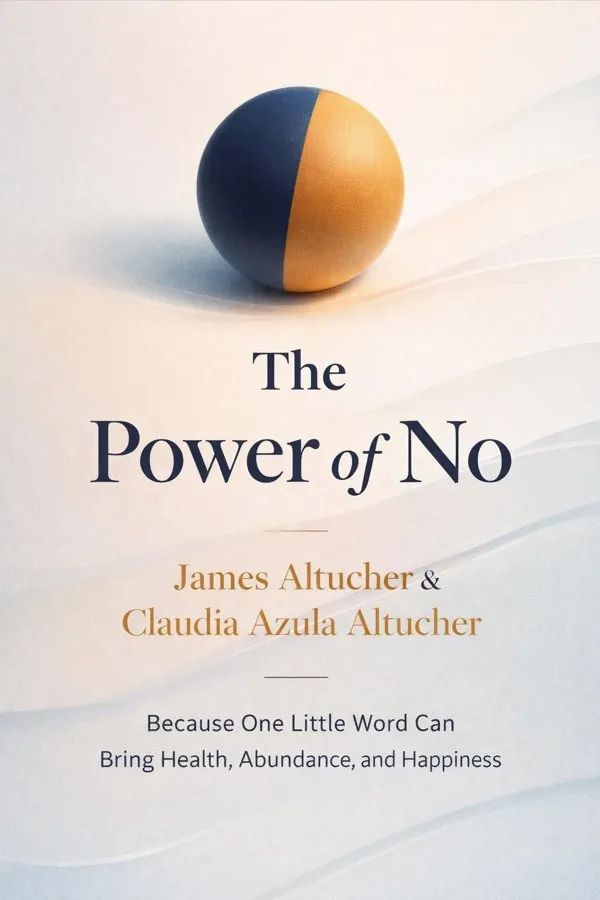
The Power of No: Because One Little Word Can Bring Health, Abundance, and Happiness: Summary & Key Insights
by James Altucher, Claudia Azula Altucher
 10 min9 chaptersAudio available
Key Takeaways from The Power of No: Because One Little Word Can Bring Health, Abundance, and Happiness
Every yes is a trade, whether you notice it or not.
No is not merely refusal; it is an act of design.
Some of the most damaging yeses are the ones we give to people who repeatedly diminish us.
A paycheck can hide a profound spiritual cost.
Distraction is not a minor inconvenience; it is one of the main ways people surrender their lives.
What Is The Power of No: Because One Little Word Can Bring Health, Abundance, and Happiness About?
The Power of No: Because One Little Word Can Bring Health, Abundance, and Happiness by James Altucher & Claudia Azula Altucher is a self_awareness book spanning 11 pages. Most people are taught that saying yes makes them generous, cooperative, ambitious, and likable. James Altucher and Claudia Azula Altucher challenge that assumption with a deceptively simple argument: many of our biggest struggles begin when we agree to what weakens us. The Power of No shows how one small word can protect health, restore time, sharpen creativity, and create a more honest life. Rather than treating “no” as rude or negative, the authors present it as a tool for self-respect, emotional clarity, and freedom. Drawing from entrepreneurship, personal reinvention, mindfulness, and lived experience, the Altuchers explore how overcommitment, toxic relationships, draining work, fear, distraction, and self-sabotage all feed on our inability to set boundaries. James brings the perspective of a serial entrepreneur and candid self-help writer who has rebuilt his life multiple times after failure. Claudia Azula contributes a grounding voice shaped by yoga, mindfulness, and inner discipline. Together, they argue that saying no is not about rejecting life; it is about rejecting what blocks a meaningful one. For anyone exhausted by pressure, people-pleasing, or inner chaos, this book offers a practical philosophy of selective living.
This FizzRead summary covers all 9 key chapters of The Power of No: Because One Little Word Can Bring Health, Abundance, and Happiness in approximately 10 minutes, distilling the most important ideas, arguments, and takeaways from James Altucher & Claudia Azula Altucher's work. Also available as an audio summary and Key Quotes Podcast.
The Power of No: Because One Little Word Can Bring Health, Abundance, and Happiness
Most people are taught that saying yes makes them generous, cooperative, ambitious, and likable. James Altucher and Claudia Azula Altucher challenge that assumption with a deceptively simple argument: many of our biggest struggles begin when we agree to what weakens us. The Power of No shows how one small word can protect health, restore time, sharpen creativity, and create a more honest life. Rather than treating “no” as rude or negative, the authors present it as a tool for self-respect, emotional clarity, and freedom.
Drawing from entrepreneurship, personal reinvention, mindfulness, and lived experience, the Altuchers explore how overcommitment, toxic relationships, draining work, fear, distraction, and self-sabotage all feed on our inability to set boundaries. James brings the perspective of a serial entrepreneur and candid self-help writer who has rebuilt his life multiple times after failure. Claudia Azula contributes a grounding voice shaped by yoga, mindfulness, and inner discipline. Together, they argue that saying no is not about rejecting life; it is about rejecting what blocks a meaningful one. For anyone exhausted by pressure, people-pleasing, or inner chaos, this book offers a practical philosophy of selective living.
Who Should Read The Power of No: Because One Little Word Can Bring Health, Abundance, and Happiness?
This book is perfect for anyone interested in self_awareness and looking to gain actionable insights in a short read. Whether you're a student, professional, or lifelong learner, the key ideas from The Power of No: Because One Little Word Can Bring Health, Abundance, and Happiness by James Altucher & Claudia Azula Altucher will help you think differently.
- ✓Readers who enjoy self_awareness and want practical takeaways
- ✓Professionals looking to apply new ideas to their work and life
- ✓Anyone who wants the core insights of The Power of No: Because One Little Word Can Bring Health, Abundance, and Happiness in just 10 minutes
Want the full summary?
Get instant access to this book summary and 100K+ more with Fizz Moment.
Get Free SummaryAvailable on App Store • Free to download
Key Chapters
No is not merely refusal; it is an act of design. One of the central insights of the book is that saying no is how people reclaim authorship over their lives. The Altuchers reject the idea that no is negative by nature. In their view, no is often the clearest expression of commitment to health, purpose, truth, and peace. It is not a withdrawal from life but a way of making room for a better one.
When you remove the unnecessary, the essential becomes visible. A calendar packed with obligations leaves no room for reflection. A mind crowded with other people’s demands cannot hear its own priorities. By saying no to low-value opportunities, shallow obligations, and constant noise, you create the conditions for creativity, recovery, and concentration. This is why no can feel liberating: it returns your energy to you.
The book also emphasizes that no can be compassionate. A false yes may please someone in the moment, but it often leads to half-hearted work, delayed resentment, or eventual withdrawal. A clear no, delivered honestly, is more respectful than a reluctant yes. In this way, boundaries improve relationships rather than damage them.
In practice, this might mean declining social plans when you need solitude, refusing projects that conflict with your values, or limiting access to your time. The goal is not rigid isolation but intentional availability. Your actionable takeaway: identify one area where your life feels overcrowded and practice one clean, guilt-free no this week to create breathing room.
Some of the most damaging yeses are the ones we give to people who repeatedly diminish us. The Altuchers argue that toxic relationships survive because we confuse tolerance with kindness. We keep saying yes to manipulation, criticism, emotional chaos, and one-sided dynamics because we hope people will change, or because we fear being alone, disloyal, or misunderstood. But every time we permit corrosive treatment, we teach ourselves that our peace is negotiable.
The book encourages readers to look closely at the emotional aftereffects of relationships. Do you feel expanded, calm, and more like yourself after spending time with someone, or depleted, tense, and confused? That emotional residue is information. Toxicity is not always dramatic. It can appear as chronic guilt, subtle disrespect, constant negativity, or relationships in which your needs are consistently secondary.
Saying no in this area may mean ending a relationship, reducing contact, declining invitations, or refusing to participate in familiar unhealthy patterns. It can also mean no longer explaining or defending every boundary. Not everyone will applaud your growth; some people benefited from your lack of limits.
This lesson applies to family, friendships, romance, and professional relationships alike. Protecting your emotional environment is not selfish. It is maintenance for your inner life. When healthier boundaries are established, you often gain energy for better connections.
A useful exercise is to list the people you interact with most and note whether each relationship energizes, neutralizes, or drains you. Your actionable takeaway: choose one draining relationship and set a specific boundary, such as less contact, a firmer response, or a refusal to engage in recurring dysfunction.
A paycheck can hide a profound spiritual cost. The Altuchers do not deny the realities of earning a living, but they warn against normalizing work that continuously destroys energy, dignity, and imagination. Many people say yes to jobs, clients, partnerships, and projects that leave them hollow because they assume survival requires self-betrayal. Over time, this creates a dangerous split between outer success and inner collapse.
The book does not promote reckless quitting. Instead, it asks a more important question: what happens when you repeatedly trade your aliveness for approval, money, or status? Depleting work erodes more than mood. It weakens creativity, relationships, physical health, and the ability to recognize meaningful opportunities. When you are drained all the time, even good possibilities feel impossible.
Saying no to this kind of work can take many forms. It may mean refusing a toxic client, renegotiating responsibilities, reducing unnecessary meetings, building a side path toward better work, or simply admitting that your current situation is unsustainable. The authors encourage readers to view energy as a business asset. If your work destroys the very capacities that make you effective, it is not a sustainable arrangement.
This lesson is especially powerful for ambitious people who mistake burnout for commitment. Productivity without vitality is fragile. The goal is not to avoid effort but to avoid soul-deadening effort that produces diminishing returns.
To apply this, write down the tasks, people, and obligations in your work life that most consistently drain you. Then identify what can be eliminated, delegated, limited, or replaced. Your actionable takeaway: say no to one recurring work demand that consumes energy without creating meaningful value.
Distraction is not a minor inconvenience; it is one of the main ways people surrender their lives. The Altuchers treat attention as a precious, nonrenewable resource. Every unnecessary notification, shallow obligation, gossip cycle, and compulsive habit fragments the mind. The problem is not just lost time. It is lost depth. A distracted person becomes reactive, scattered, and less capable of original thought.
The book suggests that many distractions are attractive because they help us avoid discomfort. It is easier to check messages than face uncertainty, easier to consume stimulation than sit quietly with anxiety, boredom, or the challenge of creating something meaningful. In this sense, distraction is often disguised escape. Saying no to distraction is therefore not merely a time-management strategy; it is a discipline of presence.
Practical examples include setting limits on email, turning off notifications, declining meetings without a clear purpose, reducing social media use, or creating uninterrupted blocks for thinking and creative work. The Altuchers imply that great work and inner peace require emptiness, not constant input. If every spare moment is filled, insight has no place to land.
This idea extends beyond technology. Mental distraction includes replaying old conversations, worrying about imagined futures, and constantly comparing yourself with others. Attention leaks in many directions unless deliberately guarded.
A helpful practice is to identify your top three recurring distractions and track when they show up, what emotion precedes them, and what they help you avoid. Your actionable takeaway: create one daily distraction-free window, even 30 minutes, and defend it as a non-negotiable space for focus, reflection, or creative work.
Fear rarely announces itself honestly. More often, it disguises itself as practicality, politeness, perfectionism, or caution. The Altuchers argue that many life-limiting yeses are really fear-based decisions. We agree to stay small because uncertainty feels dangerous. We accept mediocrity because change threatens the identity we know. We remain in familiar unhappiness because it seems safer than unfamiliar possibility.
The important distinction in the book is that fear itself is not the enemy. Fear is a natural signal. The problem begins when fear becomes the authority making our decisions. Saying no to fear means refusing to let it dictate your choices, your imagination, or your relationships. This does not require becoming fearless. It requires recognizing fear, naming it, and acting from values instead of panic.
For example, someone may avoid pitching an idea, leaving a dead-end role, starting therapy, or ending a draining relationship because fear generates endless reasons to wait. Yet each delay strengthens the fear’s credibility. By contrast, small acts of refusal weaken its control. When you say no to fear once, you gather evidence that discomfort is survivable.
The Altuchers’ broader message is that courage often begins with subtraction. Before you can build a better life, you may need to reject the narratives that keep you frozen: “I’m too late,” “I’ll fail,” “People will judge me,” or “This is just how life is.”
A practical exercise is to write down one important decision you are postponing and list the fears attached to it. Then separate actual risks from imagined catastrophes. Your actionable takeaway: take one small step this week that directly contradicts a fear-based story you have been obeying.
Not every harmful yes is spoken aloud. Some of the most consequential agreements happen internally, through repeated habits and recurring thought patterns. The Altuchers connect the power of no to everyday self-care: what you eat, how you sleep, how you move, what you consume mentally, and the stories you repeat about yourself. A person can say no to the outside world and still be ruled by inner sabotage.
Unhealthy habits often function as temporary relief. Overeating, doom-scrolling, substance use, overspending, and chronic avoidance may soothe discomfort in the short term while deepening it in the long term. The book invites readers to view these patterns without self-hatred. Shame rarely creates lasting change. Awareness does. If a habit repeatedly leaves you weaker, foggier, poorer, or more disconnected, it deserves a clear no.
The same is true for negative thinking. Thoughts such as “I always mess things up,” “Nobody cares,” or “It’s too late for me” can become internal commands. The Altuchers suggest that saying no to these thoughts means not feeding them with automatic belief. You may not control their arrival, but you can refuse them residence. Mindfulness, journaling, movement, and simple self-observation help create this distance.
This idea is practical, not abstract. Replacing one self-destructive pattern with one supportive routine can have compounding effects. Better sleep can improve mood, which supports better choices, which strengthens confidence.
Choose one habit and one recurring negative thought that most weaken your life right now. Your actionable takeaway: replace the habit with a specific healthier behavior and counter the thought with a written statement grounded in reality, not wishful thinking.
A meaningful no is sometimes directed at time itself. The Altuchers stress that many people do not live in the present because they are trapped between regret and anticipation. They replay old failures, old betrayals, old versions of themselves, or they obsess over future outcomes they cannot control. In both cases, attention is stolen from the only place where change is possible: now.
Saying no to the past does not mean denying it. It means refusing to let old pain become your permanent identity. Saying no to the future does not mean abandoning planning. It means rejecting compulsive worry and the fantasy that life becomes safe once everything is predictable. Both tendencies drain vitality and make real presence difficult.
This lesson is closely tied to others’ expectations and self-sabotage. People often shape their decisions around inherited scripts: be successful in a certain way, choose the respectable path, stay agreeable, avoid reinvention. These expectations may come from family, culture, peers, or your own internalized ideal. The result is a life built to satisfy judgment rather than truth. Self-sabotage then emerges when one part of you wants freedom and another still seeks permission.
The Altuchers encourage readers to become aware of these invisible loyalties. Ask whose voice is guiding your choices. Is it your own wisdom, or the echo of someone else’s fear? Presence and authenticity begin when you stop negotiating with every old script.
A practical exercise is to write two lists: one of past stories you still carry, and one of expectations you are trying to fulfill. Your actionable takeaway: choose one outdated story or inherited expectation and consciously decline it by making one present-focused decision that reflects who you are now.
Small boundaries can produce massive change. One of the most hopeful ideas in The Power of No is that saying no has a ripple effect beyond the immediate moment. A single refusal can restore hours of time, lower stress, improve sleep, strengthen self-respect, and create the courage for further change. What begins as one decision often becomes a new identity: a person who protects energy, values truth, and no longer volunteers for suffering.
The Altuchers show that no is not simply defensive. It is generative. By refusing what weakens you, you become more available for what strengthens you. Better boundaries lead to clearer thinking. Clearer thinking leads to better choices. Better choices improve relationships, work, health, and creativity. In this way, no is a foundational skill for abundance, not an obstacle to it.
This ripple effect is also social. When one person stops participating in dysfunctional patterns, systems change. Families shift when one member ends people-pleasing. Teams improve when someone refuses useless work. Friendships become more honest when one person tells the truth about their limits. Healthy noes give others permission to become more honest too.
Perhaps the deepest contribution of the book is that it reconnects freedom with responsibility. You cannot control every circumstance, but you can become more conscious about what you allow, encourage, and repeat. No becomes a practice of self-leadership.
To make this concrete, think of one area where life feels chronically heavy. Trace that heaviness back to a pattern of permission. What have you been allowing? Your actionable takeaway: choose one strategic no today and treat it not as an isolated act, but as the first move in reshaping your life.
All Chapters in The Power of No: Because One Little Word Can Bring Health, Abundance, and Happiness
About the Authors
James Altucher is an American entrepreneur, investor, podcast host, and bestselling author known for his candid writing on failure, reinvention, business, and self-improvement. His work often draws from personal setbacks and comebacks, giving his advice an unusually direct and lived-in quality. Claudia Azula Altucher is a writer, speaker, and yoga and mindfulness teacher whose work emphasizes awareness, inner clarity, and intentional living. She brings a contemplative perspective shaped by spiritual practice and emotional discipline. Together, they have collaborated on books that blend practical life strategy with mindfulness and self-inquiry. In The Power of No, their combined voices create a distinctive approach: James contributes hard-earned realism about ambition and survival, while Claudia offers insight into presence, boundaries, and inner peace.
Get This Summary in Your Preferred Format
Read or listen to the The Power of No: Because One Little Word Can Bring Health, Abundance, and Happiness summary by James Altucher & Claudia Azula Altucher anytime, anywhere. FizzRead offers multiple formats so you can learn on your terms — all free.
Available formats: App · Audio · PDF · EPUB — All included free with FizzRead
Download The Power of No: Because One Little Word Can Bring Health, Abundance, and Happiness PDF and EPUB Summary
Key Quotes from The Power of No: Because One Little Word Can Bring Health, Abundance, and Happiness
“Every yes is a trade, whether you notice it or not.”
“No is not merely refusal; it is an act of design.”
“Some of the most damaging yeses are the ones we give to people who repeatedly diminish us.”
“A paycheck can hide a profound spiritual cost.”
“Distraction is not a minor inconvenience; it is one of the main ways people surrender their lives.”
Frequently Asked Questions about The Power of No: Because One Little Word Can Bring Health, Abundance, and Happiness
The Power of No: Because One Little Word Can Bring Health, Abundance, and Happiness by James Altucher & Claudia Azula Altucher is a self_awareness book that explores key ideas across 9 chapters. Most people are taught that saying yes makes them generous, cooperative, ambitious, and likable. James Altucher and Claudia Azula Altucher challenge that assumption with a deceptively simple argument: many of our biggest struggles begin when we agree to what weakens us. The Power of No shows how one small word can protect health, restore time, sharpen creativity, and create a more honest life. Rather than treating “no” as rude or negative, the authors present it as a tool for self-respect, emotional clarity, and freedom. Drawing from entrepreneurship, personal reinvention, mindfulness, and lived experience, the Altuchers explore how overcommitment, toxic relationships, draining work, fear, distraction, and self-sabotage all feed on our inability to set boundaries. James brings the perspective of a serial entrepreneur and candid self-help writer who has rebuilt his life multiple times after failure. Claudia Azula contributes a grounding voice shaped by yoga, mindfulness, and inner discipline. Together, they argue that saying no is not about rejecting life; it is about rejecting what blocks a meaningful one. For anyone exhausted by pressure, people-pleasing, or inner chaos, this book offers a practical philosophy of selective living.
You Might Also Like
Rising Strong
Brené Brown
10 min
You Do You
Sarah Knight
10 min
Master Your Emotions: A Practical Guide to Overcome Negativity and Better Manage Your Feelings
Thibaut Meurisse
10 min
The Mountain Is You: Transforming Self-Sabotage Into Self-Mastery
Brianna Wiest
10 min
101 Essays That Will Change The Way You Think
Brianna Wiest
10 min
A Radical Awakening: Turn Pain into Power, Embrace Your Truth, Live Free
Shefali Tsabary
10 minBrowse by Category
Ready to read The Power of No: Because One Little Word Can Bring Health, Abundance, and Happiness?
Get the full summary and 100K+ more books with Fizz Moment.