
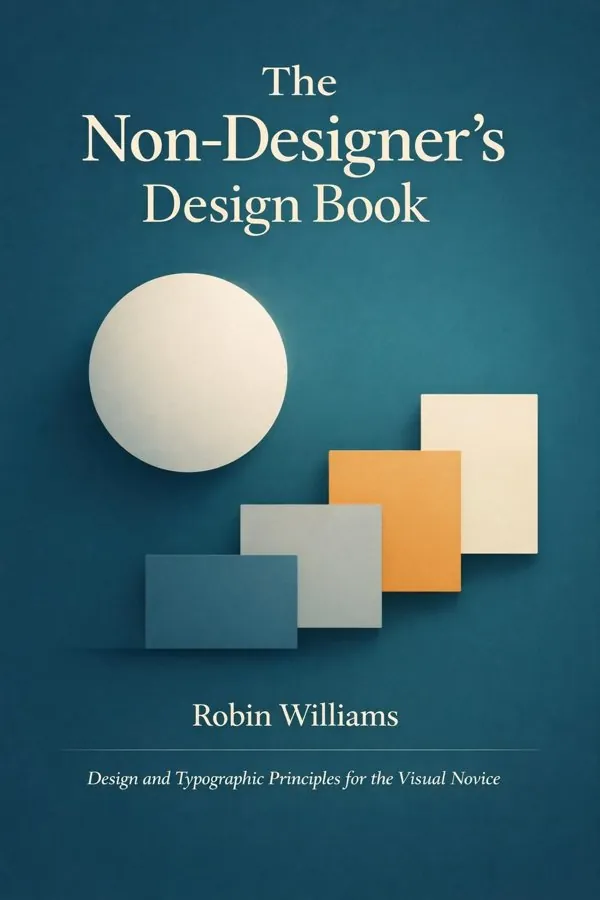
The Non-Designer’s Design Book: Design and Typographic Principles for the Visual Novice: Summary & Key Insights
 10 min9 chaptersAudio available
Key Takeaways from The Non-Designer’s Design Book: Design and Typographic Principles for the Visual Novice
Once you understand a handful of principles, design becomes less like guessing and more like solving a problem.
If everything on a page looks similar, nothing feels important.
A design feels professional when its parts look like they belong together.
Nothing should be placed on a page arbitrarily.
People understand relationships visually before they read details.
What Is The Non-Designer’s Design Book: Design and Typographic Principles for the Visual Novice About?
The Non-Designer’s Design Book: Design and Typographic Principles for the Visual Novice by Robin Williams is a design book spanning 11 pages. Design often feels intimidating because people confuse it with talent, taste, or artistic instinct. Robin Williams dismantles that myth. In The Non-Designer’s Design Book, she argues that strong visual communication is not mysterious at all: it is built on a small set of clear, repeatable principles that anyone can learn. Written for people without formal training, the book turns everyday design tasks—flyers, newsletters, resumes, presentations, websites, invitations, and business materials—into manageable problems with practical solutions. What makes the book so enduring is its rare combination of simplicity and depth. Williams does not drown readers in jargon or theory. Instead, she shows how a few visual choices can instantly make a page feel cluttered or professional, confusing or inviting. Her famous four principles—contrast, repetition, alignment, and proximity—give readers a memorable framework for evaluating and improving almost any layout. She also extends that foundation into typography, hierarchy, and visual judgment. As a longtime designer, teacher, and author, Robin Williams has helped generations of non-designers gain confidence. This book matters because in a world saturated with visual messages, knowing how to communicate clearly is no longer optional—it is a practical advantage.
This FizzRead summary covers all 9 key chapters of The Non-Designer’s Design Book: Design and Typographic Principles for the Visual Novice in approximately 10 minutes, distilling the most important ideas, arguments, and takeaways from Robin Williams's work. Also available as an audio summary and Key Quotes Podcast.
The Non-Designer’s Design Book: Design and Typographic Principles for the Visual Novice
Design often feels intimidating because people confuse it with talent, taste, or artistic instinct. Robin Williams dismantles that myth. In The Non-Designer’s Design Book, she argues that strong visual communication is not mysterious at all: it is built on a small set of clear, repeatable principles that anyone can learn. Written for people without formal training, the book turns everyday design tasks—flyers, newsletters, resumes, presentations, websites, invitations, and business materials—into manageable problems with practical solutions.
What makes the book so enduring is its rare combination of simplicity and depth. Williams does not drown readers in jargon or theory. Instead, she shows how a few visual choices can instantly make a page feel cluttered or professional, confusing or inviting. Her famous four principles—contrast, repetition, alignment, and proximity—give readers a memorable framework for evaluating and improving almost any layout. She also extends that foundation into typography, hierarchy, and visual judgment.
As a longtime designer, teacher, and author, Robin Williams has helped generations of non-designers gain confidence. This book matters because in a world saturated with visual messages, knowing how to communicate clearly is no longer optional—it is a practical advantage.
Who Should Read The Non-Designer’s Design Book: Design and Typographic Principles for the Visual Novice?
This book is perfect for anyone interested in design and looking to gain actionable insights in a short read. Whether you're a student, professional, or lifelong learner, the key ideas from The Non-Designer’s Design Book: Design and Typographic Principles for the Visual Novice by Robin Williams will help you think differently.
- ✓Readers who enjoy design and want practical takeaways
- ✓Professionals looking to apply new ideas to their work and life
- ✓Anyone who wants the core insights of The Non-Designer’s Design Book: Design and Typographic Principles for the Visual Novice in just 10 minutes
Want the full summary?
Get instant access to this book summary and 100K+ more with Fizz Moment.
Get Free SummaryAvailable on App Store • Free to download
Key Chapters
Many people believe bad design is the result of not being “creative enough,” but Williams begins with a more liberating idea: most weak layouts come from not knowing what to look for. Once you understand a handful of principles, design becomes less like guessing and more like solving a problem. That shift matters because fear disappears when a process appears.
The book is written for visual novices, yet its core claim is surprisingly powerful: good design is not decoration. It is communication. A page, poster, slide, or brochure succeeds when it guides the viewer’s eye, creates relationships among elements, and makes the message easier to understand. When people arrange text and images randomly, the result feels amateurish even if the content is good. But when they apply structure deliberately, the exact same content can feel polished and persuasive.
Williams repeatedly shows that design quality often depends on intention. A centered headline, scattered spacing, or mixed typefaces may seem harmless, but together they produce confusion. By contrast, strong contrast, consistent repetition, precise alignment, and meaningful grouping immediately create order. The reader does not need advanced software skills to improve; they need awareness.
This idea is especially useful for teachers making handouts, entrepreneurs designing marketing materials, students creating presentations, or office workers formatting reports. Instead of asking, “Do I have design talent?” they can ask, “What principle is missing here?” That question is actionable.
Takeaway: Stop treating design as a mysterious gift and start treating it as a set of learnable decisions you can practice every time you create a visual document.
If everything on a page looks similar, nothing feels important. Williams treats contrast as one of the fastest ways to bring life and clarity to a design. Contrast means difference—large versus small, bold versus light, serif versus sans serif, dark versus light, formal versus casual. The point is not minor variation but meaningful distinction.
Weak layouts often suffer from timid contrast. A slightly larger heading, a barely darker color, or a font change that is too subtle creates visual tension without clarity. It looks accidental rather than intentional. Williams urges readers to be bold: if two elements are meant to be different, make them obviously different. This helps establish hierarchy, so viewers know where to look first, second, and third.
In practice, contrast can improve almost any visual communication. A resume becomes easier to scan when section titles are significantly larger and bolder than body text. A flyer gains attention when the headline dominates the page instead of blending into supporting details. A website becomes more readable when buttons, links, and calls to action visibly stand apart from surrounding text. Contrast can also create mood. Elegant contrast might rely on whitespace and restrained typography, while playful contrast might use vibrant color and scale shifts.
Importantly, contrast is not limited to typography. It also applies to space, shape, texture, and imagery. A dense block of text beside an open margin creates breathing room. A circular image among rectangular text blocks creates visual interest. Contrasting elements pull the eye and guide attention.
Takeaway: When you want viewers to notice, understand, or remember something, increase the differences between key elements instead of letting everything compete at the same visual volume.
A design feels professional when its parts look like they belong together. Williams explains that repetition is what creates that sense of cohesion. By repeating visual elements—fonts, colors, line styles, shapes, spacing patterns, bullets, or layout structures—you transform a collection of separate items into a unified system.
Repetition is often misunderstood as monotony, but in good design it creates rhythm, recognition, and consistency. Think of a newsletter in which every headline uses the same typeface and size, every sidebar follows the same shape, and every page uses the same margin structure. The repeated patterns reassure the reader. They reduce friction because the audience does not need to relearn the design language on every page.
This principle is especially important for branding. A business card, invoice, website, social media graphic, and presentation deck may contain different content, yet if they repeat the same visual cues, they build a recognizable identity. Even in small personal projects, repetition helps. A wedding invitation suite can feel elegant when typography, decorative rules, and spacing are carried across invitation, RSVP card, and details insert. A slide deck becomes more persuasive when each slide uses consistent title placement and visual treatment.
Williams also shows that repetition can be introduced deliberately to strengthen a weak design. If a page has one bold rule line, perhaps that line style can be repeated elsewhere. If a pull quote uses a particular accent color, maybe section dividers can echo it. These echoes knit the page together.
Takeaway: Choose a small number of visual elements and repeat them intentionally so your design feels coherent, memorable, and easier for people to navigate.
Nothing should be placed on a page arbitrarily. That is one of Williams’s most practical lessons, and it sits at the heart of alignment. Every element—headline, paragraph, image, caption, logo, page number—should have a visual connection to something else. When items align with one another, the page feels organized; when they float independently, it feels messy even if the viewer cannot explain why.
Beginners often center everything because centered layouts feel safe. But overuse of centering creates a static, formal, and often weak composition. Williams encourages readers to align elements with purpose, often through strong left or right edges. A consistent edge gives the eye a path to follow and creates invisible lines that hold the design together.
Alignment is not just about neatness. It directly affects credibility. A brochure with uneven text boxes, drifting headings, and images that do not line up can make the organization behind it seem careless. By contrast, a simple page with strong alignment can appear trustworthy and refined. This is why alignment matters in resumes, reports, menus, pitch decks, and online interfaces.
Good alignment also improves usability. In a schedule, dates, times, and descriptions should line up predictably. In a form, labels and fields should follow a consistent structure. In a poster, event details should be aligned so they can be scanned quickly. Even small changes—lining up image edges or matching text baselines—can dramatically improve the result.
Takeaway: Before finalizing any design, check whether every element is visually connected through a clear line or edge, and remove anything that appears placed “just anywhere.”
People understand relationships visually before they read details. Williams uses the principle of proximity to show how simple spacing choices can make information instantly clearer. Items that belong together should be placed near one another; items that are unrelated should be separated. This sounds obvious, yet many confusing layouts fail precisely because they ignore it.
When elements are scattered evenly across a page, viewers must work to determine what connects to what. Is that caption linked to the image above or below? Does that phone number belong to the main contact or the event venue? Uniform spacing often creates ambiguity. Proximity solves this by using spatial grouping to communicate structure at a glance.
This principle is essential in practical documents. On a business card, the name, title, and company should form one group, while contact details form another. On a restaurant menu, each dish should sit close to its description and price, rather than forcing the reader’s eye to hunt. In a presentation slide, a graph and its interpretation should sit together, not at opposite ends of the screen. On web pages, related navigation links, product details, and action buttons should be clustered in intuitive ways.
Proximity also reduces clutter. Instead of drawing boxes around every item or inserting decorative lines everywhere, you can often improve clarity simply by adjusting spacing. Grouping creates cleaner pages because the structure emerges naturally.
Williams’s larger point is that whitespace is not wasted space. It is one of the strongest tools for organizing meaning. Space tells the viewer where to pause, what to connect, and what to treat as separate.
Takeaway: Use spacing to show relationships clearly—tighten the distance between related items and increase the distance between unrelated ones until the structure is obvious at a glance.
Any one principle can improve a design, but the real transformation happens when contrast, repetition, alignment, and proximity work together. Williams emphasizes that effective layouts are rarely the result of one clever choice. They emerge from the interaction of multiple principles reinforcing one another.
Consider a flyer for a community event. Contrast makes the event name prominent. Repetition ties together the heading style, accent color, and icons. Alignment creates clean edges that make the information look intentional. Proximity groups the date, time, and location so no one misses practical details. If one principle is missing, the design weakens. The flyer may be readable but uninspiring, or attractive but confusing.
This combined approach helps readers diagnose problems more intelligently. If a page feels dull, perhaps contrast is too weak. If it feels chaotic, alignment or proximity may be failing. If it feels inconsistent, repetition may be missing. Instead of relying on vague impressions, Williams gives a usable vocabulary for critique.
The same framework applies across media. A website landing page, annual report, social media post, invitation, or educational handout all benefit from these four principles. Even minimalist designs depend on them. In fact, the fewer elements a layout contains, the more important each principle becomes.
One of the book’s strongest contributions is that it teaches readers to revise, not just create. Good design often comes from editing. Increase contrast. Simplify repeated elements. Snap objects to a stronger alignment. Regroup related information. Small changes can have a compounding effect.
Takeaway: Evaluate every design through all four principles together, because polished communication comes from a coordinated system, not isolated visual tricks.
People often think typography is simply choosing a nice font, but Williams shows that type is one of the most influential design tools we have. Typography affects mood, hierarchy, pace, legibility, and trust. Before someone fully reads your words, they respond to how those words look.
A central lesson in the book is that typefaces carry personalities. A serif font may feel traditional, literary, or authoritative. A sans serif may feel modern, clean, or direct. A script may feel elegant, personal, or ceremonial. Problems arise when designers pick fonts based only on novelty or personal preference rather than purpose. A playful font on a legal notice confuses expectations; a stiff corporate font on a birthday invitation feels emotionally off.
Williams also guides readers toward restraint. Too many fonts create noise. Pairing one or two complementary typefaces is usually stronger than mixing several unrelated ones. Size, weight, spacing, capitalization, and line length matter just as much as font choice. A beautifully chosen typeface can still become unreadable if lines are too long, text is too cramped, or hierarchy is weak.
Typography is especially important in long-form reading materials such as newsletters, reports, brochures, and websites. Body text needs comfort and clarity. Headings need distinction. Subheadings, captions, and pull quotes need to support navigation. Even simple changes—more leading, stronger headline sizes, or cleaner paragraph structure—can dramatically improve comprehension.
Williams teaches typography as both an aesthetic and functional discipline. Good type does not merely decorate content; it makes content easier to absorb and more appropriate to its audience.
Takeaway: Choose typography based on message, audience, and readability, then use a limited, consistent type system to create both clarity and personality.
A design is not effective because it includes color or images; it is effective when those elements support the message. Williams treats visual elements as communicators, not ornaments. Color can direct attention, create mood, signal categories, and reinforce brand identity. Images can clarify ideas, create emotional tone, and make information more memorable. But if used randomly, both can distract more than they help.
One of the most useful ideas here is hierarchy. Every design needs a clear order of importance. What should the viewer notice first? What should they understand next? What action should they take? Color and imagery can strengthen that sequence. A bright accent color might highlight a call to action. A large, relevant image might introduce the topic faster than text alone. A muted palette can let content breathe, while a high-energy palette can make an event poster feel urgent or festive.
The same principle applies to image selection. Decorative stock photos often add visual clutter without adding meaning. Strong images either inform or reinforce the message. For example, a nonprofit brochure might use authentic photography to build trust, while an instructional handout might use diagrams that simplify a process. Cropping, placement, and scale matter as much as the image itself.
Williams’s approach helps non-designers avoid a common mistake: adding more elements to make a page “interesting.” Often the better solution is to choose fewer, stronger elements and use them purposefully. A restrained color palette and one meaningful image can outperform a page full of competing graphics.
Takeaway: Use color and images to establish hierarchy and reinforce meaning, and remove anything that attracts attention without improving communication.
Perhaps the book’s deepest lesson is that design improvement begins with seeing. Williams trains readers to analyze existing layouts, notice why they succeed or fail, and make targeted changes. This habit turns design from a mysterious act of inspiration into an ongoing practice of observation and revision.
She encourages readers to look at brochures, advertisements, book covers, menus, newsletters, and signs with fresh eyes. Where is the contrast weak? What repetition could unify the page? Are elements aligned to a strong edge? Are related items grouped properly? This kind of visual diagnosis sharpens judgment quickly. You begin to understand that many “before” examples look poor not because they lack effort, but because they lack principles.
The book also addresses common mistakes: using too many fonts, centering everything, crowding the page, creating weak contrast, scattering related information, and decorating without purpose. Importantly, Williams does not merely criticize these errors—she shows how to fix them. Strengthen the hierarchy. Remove unnecessary lines and boxes. Introduce whitespace. Simplify the type palette. Establish cleaner alignment. Once readers experience how dramatically these changes improve a page, confidence grows.
This mindset extends beyond print. In digital products, presentation slides, classroom materials, and social media graphics, the same habits apply. Good designers are not people who never make mistakes; they are people who know how to recognize and correct them.
Ultimately, Williams invites readers to become intentional visual communicators. That means asking not “Do I like this?” but “Does this communicate clearly and effectively?” That question changes everything.
Takeaway: Build your design eye by regularly critiquing real-world layouts and revising your own work through clear principles instead of personal guesswork.
All Chapters in The Non-Designer’s Design Book: Design and Typographic Principles for the Visual Novice
About the Author
Robin Williams is an American designer, educator, and bestselling author known for making design and typography understandable for beginners. She became especially influential through books that translate professional visual principles into practical lessons for everyday users. Rather than speaking only to trained designers, Williams writes for students, office professionals, teachers, small business owners, and anyone who needs to communicate visually with clarity and confidence. Her teaching style is direct, accessible, and example-driven, which has made her work enduringly popular across generations of readers. Best known for introducing the memorable framework of contrast, repetition, alignment, and proximity, she has helped countless non-designers improve documents, presentations, and printed materials. Her books remain foundational because they combine simplicity, usability, and deep respect for the reader’s ability to learn.
Get This Summary in Your Preferred Format
Read or listen to the The Non-Designer’s Design Book: Design and Typographic Principles for the Visual Novice summary by Robin Williams anytime, anywhere. FizzRead offers multiple formats so you can learn on your terms — all free.
Available formats: App · Audio · PDF · EPUB — All included free with FizzRead
Download The Non-Designer’s Design Book: Design and Typographic Principles for the Visual Novice PDF and EPUB Summary
Key Quotes from The Non-Designer’s Design Book: Design and Typographic Principles for the Visual Novice
“Many people believe bad design is the result of not being “creative enough,” but Williams begins with a more liberating idea: most weak layouts come from not knowing what to look for.”
“If everything on a page looks similar, nothing feels important.”
“A design feels professional when its parts look like they belong together.”
“Nothing should be placed on a page arbitrarily.”
“People understand relationships visually before they read details.”
Frequently Asked Questions about The Non-Designer’s Design Book: Design and Typographic Principles for the Visual Novice
The Non-Designer’s Design Book: Design and Typographic Principles for the Visual Novice by Robin Williams is a design book that explores key ideas across 9 chapters. Design often feels intimidating because people confuse it with talent, taste, or artistic instinct. Robin Williams dismantles that myth. In The Non-Designer’s Design Book, she argues that strong visual communication is not mysterious at all: it is built on a small set of clear, repeatable principles that anyone can learn. Written for people without formal training, the book turns everyday design tasks—flyers, newsletters, resumes, presentations, websites, invitations, and business materials—into manageable problems with practical solutions. What makes the book so enduring is its rare combination of simplicity and depth. Williams does not drown readers in jargon or theory. Instead, she shows how a few visual choices can instantly make a page feel cluttered or professional, confusing or inviting. Her famous four principles—contrast, repetition, alignment, and proximity—give readers a memorable framework for evaluating and improving almost any layout. She also extends that foundation into typography, hierarchy, and visual judgment. As a longtime designer, teacher, and author, Robin Williams has helped generations of non-designers gain confidence. This book matters because in a world saturated with visual messages, knowing how to communicate clearly is no longer optional—it is a practical advantage.
You Might Also Like
The Design of Everyday Things
Don Norman
10 min
The Better Angels of Our Nature
Steven Pinker
10 min
A Designer's Art
Paul Rand
10 min
Architects' Sketchbooks
Various Editors
10 min
Architectural Graphic Standards
The American Institute of Architects
10 min
Design Is Storytelling
Ellen Lupton
10 minBrowse by Category
Ready to read The Non-Designer’s Design Book: Design and Typographic Principles for the Visual Novice?
Get the full summary and 100K+ more books with Fizz Moment.