
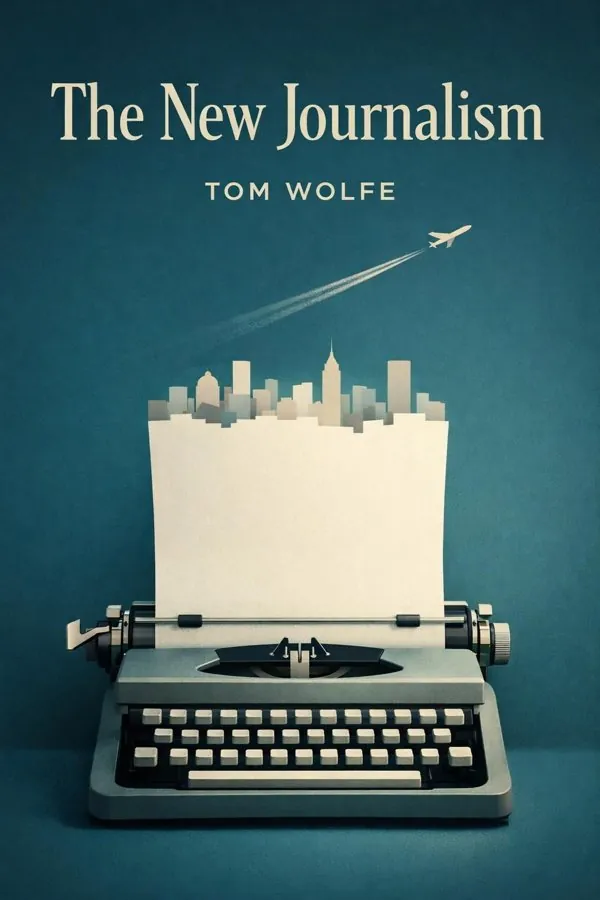
The New Journalism: Summary & Key Insights
by Tom Wolfe
 10 min6 chaptersAudio available
What Is The New Journalism About?
The New Journalism by Tom Wolfe is a journalism book spanning 6 pages. An anthology edited by Tom Wolfe and E. W. Johnson, 'The New Journalism' collects landmark works that defined the literary movement of the 1960s and 1970s, blending factual reporting with narrative techniques of fiction. The book includes essays and reportage by writers such as Truman Capote, Hunter S. Thompson, Joan Didion, and Norman Mailer, illustrating how journalism evolved into a more personal, stylistically daring form of storytelling.
This FizzRead summary covers all 6 key chapters of The New Journalism in approximately 10 minutes, distilling the most important ideas, arguments, and takeaways from Tom Wolfe's work. Also available as an audio summary and Key Quotes Podcast.
The New Journalism
An anthology edited by Tom Wolfe and E. W. Johnson, 'The New Journalism' collects landmark works that defined the literary movement of the 1960s and 1970s, blending factual reporting with narrative techniques of fiction. The book includes essays and reportage by writers such as Truman Capote, Hunter S. Thompson, Joan Didion, and Norman Mailer, illustrating how journalism evolved into a more personal, stylistically daring form of storytelling.
Who Should Read The New Journalism?
This book is perfect for anyone interested in journalism and looking to gain actionable insights in a short read. Whether you're a student, professional, or lifelong learner, the key ideas from The New Journalism by Tom Wolfe will help you think differently.
- ✓Readers who enjoy journalism and want practical takeaways
- ✓Professionals looking to apply new ideas to their work and life
- ✓Anyone who wants the core insights of The New Journalism in just 10 minutes
Want the full summary?
Get instant access to this book summary and 100K+ more with Fizz Moment.
Get Free SummaryAvailable on App Store • Free to download
Key Chapters
The seeds of what I called the New Journalism were planted in the fertile confusion of postwar America. By the late 1950s, journalism’s old confidence in objectivity had started to crack. Newspapers still spoke in the same flat voice, purporting to deliver truth from a neutral vantage. But how could that voice make sense of a country in upheaval—civil rights marches, psychedelic subcultures, youth revolution, political assassinations? There was an emotional volatility in the air that wire copy and five-paragraph reports simply couldn’t convey. A new generation of reporters began to move in closer, to report not just what people said and did, but how it felt and what it meant. In that shift lay the germ of the New Journalism.
What these writers discovered was that the techniques of fiction—the scene, the dialogue, the point of view—could serve reportage with uncanny precision. Instead of summarizing, we constructed moments scene by scene. Instead of “quoting sources,” we recorded speech in its full texture, rhythm, and idiosyncrasy. Instead of pretending to omniscient neutrality, we made stance explicit, acknowledging that every observer shapes the story he sees. It wasn’t a retreat from truth; it was a richer, more layered truth, one that captured the tensions and contradictions of reality itself.
This development didn’t occur in a vacuum. The rise of magazines like *Esquire*, *Harper’s*, and *The New Yorker* provided space for long-form, stylistically ambitious reportage. Editors began to let writers experiment, to follow their subjects deeply and at length. The reporter was suddenly allowed to use the full range of literary craft—structure, mood, irony—without surrendering factual integrity. What emerged was something new yet ancient: storytelling grounded in real life, journalism that read like art.
Truman Capote’s *In Cold Blood* stands as a cornerstone of New Journalism. When Capote learned of the 1959 murder of the Clutter family in Holcomb, Kansas, he saw an opportunity to craft a work that blurred no lines yet defied all categories. He spent six years interviewing, observing, and assembling the details of the case. What he produced was a book as engrossing as a thriller but entirely factual—a “nonfiction novel.”
Capote’s genius lay in inhabiting every mind within the story. We see the tragedy unfold through multiple points of view: the victims, the killers, the townspeople. He reconstructed dialogue, scenes, and inner monologues with meticulous verification, insisting that nothing was invented. Yet his style orchestrated these facts into drama. The omniscient narration, the psychological depth, the careful pacing—all of it borrowed from fictional craftsmanship. The result showed the world that reportage could have the breadth of Dostoevsky and the precision of documentary.
For us who followed, Capote’s achievement legitimated the idea that journalism could aspire to literature’s emotional truth without betraying factual truth. The nonfiction novel wasn’t an escape from journalism; it was journalism reaching its highest expressive potential.
+ 4 more chapters — available in the FizzRead app
All Chapters in The New Journalism
About the Author
Get This Summary in Your Preferred Format
Read or listen to the The New Journalism summary by Tom Wolfe anytime, anywhere. FizzRead offers multiple formats so you can learn on your terms — all free.
Available formats: App · Audio · PDF · EPUB — All included free with FizzRead
Download The New Journalism PDF and EPUB Summary
Key Quotes from The New Journalism
“The seeds of what I called the New Journalism were planted in the fertile confusion of postwar America.”
“Truman Capote’s *In Cold Blood* stands as a cornerstone of New Journalism.”
Frequently Asked Questions about The New Journalism
The New Journalism by Tom Wolfe is a journalism book that explores key ideas across 6 chapters. An anthology edited by Tom Wolfe and E. W. Johnson, 'The New Journalism' collects landmark works that defined the literary movement of the 1960s and 1970s, blending factual reporting with narrative techniques of fiction. The book includes essays and reportage by writers such as Truman Capote, Hunter S. Thompson, Joan Didion, and Norman Mailer, illustrating how journalism evolved into a more personal, stylistically daring form of storytelling.
You Might Also Like

Flat Earth News: An Award-Winning Reporter Exposes Falsehood, Distortion and Propaganda in the Global Media
Nick Davies
10 min
She Said: Breaking the Sexual Harassment Story That Helped Ignite a Movement
Jodi Kantor, Megan Twohey
10 min
The Elements of Journalism: What Newspeople Should Know and the Public Should Expect
Bill Kovach, Tom Rosenstiel
10 minBrowse by Category
Ready to read The New Journalism?
Get the full summary and 100K+ more books with Fizz Moment.