
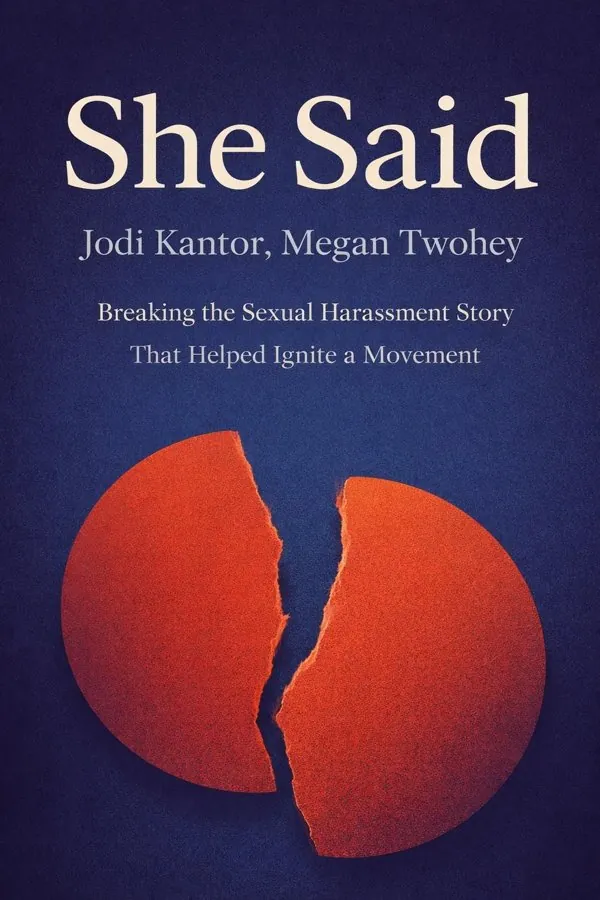
She Said: Breaking the Sexual Harassment Story That Helped Ignite a Movement: Summary & Key Insights
 10 min9 chaptersAudio available
Key Takeaways from She Said: Breaking the Sexual Harassment Story That Helped Ignite a Movement
One of the book’s most unsettling insights is that sexual harassment often survives not because nobody knows, but because many people know only in fragments.
Major stories rarely begin with a neat stack of evidence.
The book makes clear that the most important asset in difficult reporting is not access, prestige, or speed.
A central theme of She Said is that powerful people are rarely protected by charisma alone.
The turning point in the Weinstein investigation did not come from one dramatic revelation alone.
What Is She Said: Breaking the Sexual Harassment Story That Helped Ignite a Movement About?
She Said: Breaking the Sexual Harassment Story That Helped Ignite a Movement by Jodi Kantor, Megan Twohey is a journalism book spanning 13 pages. She Said is a gripping work of investigative journalism that reconstructs how New York Times reporters Jodi Kantor and Megan Twohey uncovered decades of sexual harassment and abuse allegations against Hollywood producer Harvey Weinstein. But the book is about far more than one powerful man. It reveals how systems of fear, silence, legal intimidation, and institutional protection allow abuse to persist in workplaces that prize reputation over accountability. Through interviews, reporting notes, and the reporters’ own reflections, the book shows what it actually takes to turn rumors into verified public truth. What makes the book especially important is its timing and impact. The Weinstein investigation did not simply expose an individual scandal; it helped catalyze the broader #MeToo movement, emboldening women around the world to describe experiences that had long been minimized or buried. Kantor and Twohey write with the authority of Pulitzer Prize-winning journalists who were at the center of one of the most consequential news stories of the decade. Their account is both a behind-the-scenes reporting narrative and a powerful study of courage, evidence, and the social cost of staying silent.
This FizzRead summary covers all 9 key chapters of She Said: Breaking the Sexual Harassment Story That Helped Ignite a Movement in approximately 10 minutes, distilling the most important ideas, arguments, and takeaways from Jodi Kantor, Megan Twohey's work. Also available as an audio summary and Key Quotes Podcast.
She Said: Breaking the Sexual Harassment Story That Helped Ignite a Movement
She Said is a gripping work of investigative journalism that reconstructs how New York Times reporters Jodi Kantor and Megan Twohey uncovered decades of sexual harassment and abuse allegations against Hollywood producer Harvey Weinstein. But the book is about far more than one powerful man. It reveals how systems of fear, silence, legal intimidation, and institutional protection allow abuse to persist in workplaces that prize reputation over accountability. Through interviews, reporting notes, and the reporters’ own reflections, the book shows what it actually takes to turn rumors into verified public truth.
What makes the book especially important is its timing and impact. The Weinstein investigation did not simply expose an individual scandal; it helped catalyze the broader #MeToo movement, emboldening women around the world to describe experiences that had long been minimized or buried. Kantor and Twohey write with the authority of Pulitzer Prize-winning journalists who were at the center of one of the most consequential news stories of the decade. Their account is both a behind-the-scenes reporting narrative and a powerful study of courage, evidence, and the social cost of staying silent.
Who Should Read She Said: Breaking the Sexual Harassment Story That Helped Ignite a Movement?
This book is perfect for anyone interested in journalism and looking to gain actionable insights in a short read. Whether you're a student, professional, or lifelong learner, the key ideas from She Said: Breaking the Sexual Harassment Story That Helped Ignite a Movement by Jodi Kantor, Megan Twohey will help you think differently.
- ✓Readers who enjoy journalism and want practical takeaways
- ✓Professionals looking to apply new ideas to their work and life
- ✓Anyone who wants the core insights of She Said: Breaking the Sexual Harassment Story That Helped Ignite a Movement in just 10 minutes
Want the full summary?
Get instant access to this book summary and 100K+ more with Fizz Moment.
Get Free SummaryAvailable on App Store • Free to download
Key Chapters
One of the book’s most unsettling insights is that sexual harassment often survives not because nobody knows, but because many people know only in fragments. Before the Weinstein investigation gained momentum, harassment in elite workplaces was frequently treated as an unfortunate side issue rather than a structural abuse of power. Complaints were softened into euphemisms, buried in confidential settlements, or dismissed as personality conflicts. This made the behavior seem isolated when it was actually patterned.
Kantor and Twohey show that the problem was never simply individual misconduct. It was the machinery surrounding misconduct: lawyers who negotiated secrecy, executives who looked away, assistants who learned what topics were unsafe, and industries that rewarded men who generated money and prestige. In that environment, women were left to calculate the personal cost of speaking. Many feared career ruin, public humiliation, disbelief, or retaliation. Silence became rational, even when it was painful.
The wider lesson extends beyond Hollywood. Any organization can normalize harmful behavior when its members treat whispers as inevitable but unspeakable. Human resources policies, legal compliance programs, and public statements mean little if people believe that reporting abuse will damage them more than it will stop the offender. The book therefore invites readers to examine how culture is built through everyday signals: who gets protected, whose discomfort is minimized, and what truths are considered too inconvenient to confront.
Actionable takeaway: In any workplace or institution, pay attention to recurring rumors, coded warnings, and patterns of avoidance. They may be signs not of isolated incidents, but of a system teaching people to stay quiet.
Major stories rarely begin with a neat stack of evidence. More often, they start with uneasy comments, incomplete recollections, and the feeling that scattered facts may point to something larger. That is how the Weinstein investigation began. Kantor heard troubling references from people in and around the film world, while Twohey brought deep experience reporting on abuse, secrecy, and women’s rights. What they had at first was not a publishable case, but a pattern of signals serious enough to pursue.
The book captures the discipline required at this stage. Investigative reporting is not rumor amplification; it is the slow work of testing whether rumors reflect reality. The reporters had to identify possible victims, former employees, agents, lawyers, and executives, then determine who might talk and what could be independently confirmed. Each lead had to be checked without tipping off powerful interests too early. Every conversation could open a door or cause it to slam shut.
This part of the story matters because it shows how truth emerges from attention. In many fields, people ignore weak signals because they are inconvenient or ambiguous. Kantor and Twohey demonstrate the value of treating ambiguity not as a reason to stop, but as a reason to investigate carefully. Whether in journalism, management, or personal decision-making, important problems often announce themselves subtly before they become undeniable.
Actionable takeaway: When multiple small warnings point in the same direction, do not dismiss them because each one alone seems incomplete. Gather information methodically and look for patterns before deciding what is true.
The book makes clear that the most important asset in difficult reporting is not access, prestige, or speed. It is trust. Many of the women connected to Weinstein had spent years protecting themselves by staying silent. Some had signed settlements. Some feared career consequences. Others had told only a few friends or family members. For them, speaking to reporters was not just an interview. It was a profound risk.
Kantor and Twohey earned trust through patience, persistence, and honesty about what publication would involve. They listened carefully, revisited conversations, answered questions, and gave sources room to decide. Rather than pushing people toward dramatic disclosures, they worked to understand the full context of each person’s experience. That approach helped women feel they were being treated as witnesses to truth rather than instruments in a headline.
The book also shows that trust is built through accuracy. Survivors needed to know that their stories would not be sensationalized, simplified, or carelessly handled. The reporters had to check memories against records, travel documents, emails, calendars, and other corroboration. This protected the integrity of the story and signaled respect for the women involved.
The broader lesson is relevant well beyond journalism. People reveal difficult truths when they believe they will be heard seriously, treated fairly, and not manipulated. In leadership, counseling, law, and everyday relationships, trust grows when patience and rigor work together.
Actionable takeaway: If you want someone to share something difficult, create safety through consistency. Listen without rushing, clarify what will happen next, and show through your actions that accuracy and respect matter more than quick results.
A central theme of She Said is that powerful people are rarely protected by charisma alone. They are protected by systems. Weinstein’s influence was reinforced by legal agreements, corporate concerns, personal loyalty, fear of retaliation, and the assumption that a successful man’s reputation was too valuable to endanger. The reporters were not facing just one subject. They were confronting a network designed to obscure evidence and discourage disclosure.
Non-disclosure agreements and confidential settlements played a major role in this architecture. While such agreements may be presented as neutral legal tools, the book shows how they can function as silence machines, isolating victims from one another and preventing patterns from becoming visible. Institutional gatekeepers often compounded the problem by treating allegations as liabilities to contain rather than truths to confront.
Kantor and Twohey also reveal how power shapes behavior indirectly. Sources worried about calls from lawyers, pressure from employers, blacklisting, or being portrayed as unreliable. Even before anyone explicitly threatened them, many people understood the risks of challenging a man with influence in Hollywood, politics, and media. This is one reason abuses can last for decades in plain sight.
The practical lesson is that accountability requires more than moral outrage. It requires structures that make concealment harder and reporting safer. Organizations need transparent processes, independent review, and clear limits on how confidentiality can be used in harassment cases. Without structural reform, abusive power simply changes form.
Actionable takeaway: When evaluating any institution, ask not only whether misconduct occurs, but how secrecy is maintained. Real accountability begins by identifying the systems that make people afraid to speak.
The turning point in the Weinstein investigation did not come from one dramatic revelation alone. It came when individual acts of courage became mutually reinforcing through corroboration. Women who had long believed they were isolated began to see that others had experienced similar behavior. Journalistic evidence transformed private pain into a documented public pattern.
The book highlights how difficult these breakthrough interviews were. Some women spoke on the record; others provided background, records, or context. Each contribution mattered. An account that might once have been dismissed as anecdotal became stronger when supported by contemporaneous notes, confidants, assistants, travel records, settlement details, and testimony from others. Investigative reporting, in this sense, is cumulative. It builds a structure sturdy enough to carry truths that individuals alone were not allowed to hold in public.
One of the most powerful aspects of the story is how the reporters honored the difference between bravery and readiness. Not everyone who had been harmed was prepared to be named. The investigation moved forward because enough women decided that speaking, despite the risk, might prevent further harm. Their decisions were personal, costly, and morally significant.
This offers an important lesson for anyone trying to address wrongdoing. Change often depends on moving from isolated experience to shared evidence. Whether exposing misconduct at work or advocating for policy reform, credible documentation and collective testimony are far more powerful than outrage alone.
Actionable takeaway: If you are confronting a serious pattern of wrongdoing, preserve records and look for corroboration. Individual stories matter deeply, but documented patterns are often what make institutions and the public finally pay attention.
A story does not change the world merely by being true. It changes the world when truth is reported rigorously enough, timed carefully enough, and presented clearly enough that institutions and the public can no longer look away. The publication of the Weinstein story was one of those rare moments. After months of reporting, verification, legal review, and urgent last-minute work, the article appeared and triggered an immediate shockwave.
She Said captures the tension surrounding publication: concerns about whether sources would hold firm, whether competing outlets would publish first, whether Weinstein’s team would derail the story, and whether the final article would be strong enough to withstand attack. These details matter because they show journalism as a craft of disciplined judgment, not just revelation. The goal was not to release a claim, but to publish a defensible account capable of surviving scrutiny from lawyers, editors, readers, and history.
The aftermath demonstrated how public documentation can alter what is socially thinkable. Once allegations were on the record in a respected outlet, more women came forward. Other institutions began reassessing what they had ignored. The story created permission: permission for victims to speak, for audiences to believe them, and for organizations to act. It did not solve the problem, but it made denial more difficult.
In any field, there is value in understanding the difference between private knowledge and public fact. Change often accelerates when evidence crosses that threshold.
Actionable takeaway: If you want to drive meaningful accountability, focus not just on discovering truth but on presenting it in a credible, durable form that others can act on.
Although Harvey Weinstein is the book’s central subject, She Said insists on a broader truth: the story mattered because it revealed a widespread social pattern, not a singular monster. After the article ran, women across industries began sharing experiences of harassment, coercion, retaliation, and disbelief. The hashtag #MeToo became a global expression of collective recognition. Suddenly, what many had considered private shame was visible as a systemic condition.
Kantor and Twohey are careful not to present this as a tidy victory. Public reckoning brought new possibilities, but also new tensions. Some organizations moved quickly to signal concern without changing underlying practices. Some people treated #MeToo as a media moment rather than a structural challenge. Others worried about backlash, due process debates, and whether cultural attention would be sustained. The book recognizes both the power and the fragility of movements.
Its larger contribution is to show how narratives shape accountability. When abuse is framed as a series of isolated incidents, institutions can contain it. When it is recognized as a pattern of power abuse embedded in workplaces, industries, and legal systems, society is forced to ask harder questions. Who gets believed? Who bears the cost of reporting? What reforms would actually reduce harm?
For readers, this means resisting the temptation to personalize systemic problems too narrowly. Removing one offender matters, but it does not automatically repair the conditions that enabled him.
Actionable takeaway: When confronting injustice, look past individual cases and ask what recurring structures, incentives, and silences made those cases possible. Lasting change depends on targeting the system, not only the symbol.
One of the strongest messages in the book is that exposing abuse is not a one-day event. It is a continuing process. After the Weinstein story broke, Kantor and Twohey kept reporting on the aftermath, the reactions of institutions, and related cases involving power, gender, and credibility. This included further investigations and, notably, attention to the cultural and political climate surrounding Christine Blasey Ford’s testimony during Brett Kavanaugh’s Supreme Court confirmation process.
By connecting these episodes, the book shows that accountability is fragile. A dramatic revelation may produce outrage, but outrage fades quickly unless reinforced by documentation, follow-up, and public memory. Institutions often try to absorb scandal without transforming themselves. They may issue statements, remove one person, or launch limited reviews while leaving deeper hierarchies untouched. Journalism therefore serves not only to expose but to monitor.
The inclusion of later reporting widens the book’s significance. It becomes not just the story of one investigation, but a study of how societies process allegations of abuse. The same questions recur: what counts as proof, how trauma affects memory, why some voices are doubted, and how partisan or corporate interests shape responses. These are enduring civic questions, not temporary controversies.
This idea applies broadly. Whether in public policy, business ethics, or personal advocacy, initial action matters less if there is no sustained attention to implementation and consequences. Real reform requires endurance.
Actionable takeaway: After any major wrongdoing is exposed, keep asking what changed afterward. Track policies, leadership decisions, and outcomes over time. Without follow-up, accountability often becomes performance.
She Said is also a book about the practice of journalism itself. Kantor and Twohey portray reporting as demanding, emotionally taxing, and morally complex. They had to manage confidential sources, legal pressure, editorial standards, family life, and the psychological weight of hearing painful testimony. The book demystifies investigative work by showing its daily reality: unanswered calls, cautious sourcing, repeated verification, strategic decision-making, and the constant possibility that a story might collapse.
Yet the book does not romanticize journalism. It acknowledges that reporters are not saviors and that publication alone cannot heal trauma. Their role is narrower but vital: to verify, contextualize, and bring hidden facts into public view. What gives the work moral force is not self-importance, but fidelity to evidence and care for the people whose experiences are at stake.
This is one reason the book resonates beyond media circles. It argues implicitly for professional courage in any field. Stamina matters when truths are difficult, when resistance is strong, and when progress is uncertain. So does moral clarity: the ability to remember why the work matters even when procedures are exhausting and outcomes are not guaranteed.
For readers, the book offers a model of principled persistence. It suggests that serious work often looks unglamorous from the inside. Breakthroughs are built from preparation, integrity, and the willingness to continue after setbacks.
Actionable takeaway: In your own work, separate impact from drama. Focus on steady, evidence-based effort, especially when the issue is important and resistance is high. Enduring change is usually made through disciplined persistence, not sudden inspiration.
All Chapters in She Said: Breaking the Sexual Harassment Story That Helped Ignite a Movement
About the Authors
Jodi Kantor and Megan Twohey are Pulitzer Prize-winning investigative reporters for The New York Times whose work has shaped public understanding of power, gender, and institutional abuse. Together, they led the groundbreaking reporting on Harvey Weinstein that helped ignite the global #MeToo movement. Kantor is also the author of The Obamas and has reported extensively on politics, culture, and women’s lives. Twohey has built a distinguished career investigating sexual misconduct, exploitation, and failures of accountability across powerful systems. Both are known for rigorous sourcing, narrative clarity, and a deep commitment to public-interest journalism. In She Said, they combine their reporting skill and firsthand experience to document one of the most consequential investigations of the twenty-first century.
Get This Summary in Your Preferred Format
Read or listen to the She Said: Breaking the Sexual Harassment Story That Helped Ignite a Movement summary by Jodi Kantor, Megan Twohey anytime, anywhere. FizzRead offers multiple formats so you can learn on your terms — all free.
Available formats: App · Audio · PDF · EPUB — All included free with FizzRead
Download She Said: Breaking the Sexual Harassment Story That Helped Ignite a Movement PDF and EPUB Summary
Key Quotes from She Said: Breaking the Sexual Harassment Story That Helped Ignite a Movement
“One of the book’s most unsettling insights is that sexual harassment often survives not because nobody knows, but because many people know only in fragments.”
“Major stories rarely begin with a neat stack of evidence.”
“The book makes clear that the most important asset in difficult reporting is not access, prestige, or speed.”
“A central theme of She Said is that powerful people are rarely protected by charisma alone.”
“The turning point in the Weinstein investigation did not come from one dramatic revelation alone.”
Frequently Asked Questions about She Said: Breaking the Sexual Harassment Story That Helped Ignite a Movement
She Said: Breaking the Sexual Harassment Story That Helped Ignite a Movement by Jodi Kantor, Megan Twohey is a journalism book that explores key ideas across 9 chapters. She Said is a gripping work of investigative journalism that reconstructs how New York Times reporters Jodi Kantor and Megan Twohey uncovered decades of sexual harassment and abuse allegations against Hollywood producer Harvey Weinstein. But the book is about far more than one powerful man. It reveals how systems of fear, silence, legal intimidation, and institutional protection allow abuse to persist in workplaces that prize reputation over accountability. Through interviews, reporting notes, and the reporters’ own reflections, the book shows what it actually takes to turn rumors into verified public truth. What makes the book especially important is its timing and impact. The Weinstein investigation did not simply expose an individual scandal; it helped catalyze the broader #MeToo movement, emboldening women around the world to describe experiences that had long been minimized or buried. Kantor and Twohey write with the authority of Pulitzer Prize-winning journalists who were at the center of one of the most consequential news stories of the decade. Their account is both a behind-the-scenes reporting narrative and a powerful study of courage, evidence, and the social cost of staying silent.
You Might Also Like

Flat Earth News: An Award-Winning Reporter Exposes Falsehood, Distortion and Propaganda in the Global Media
Nick Davies
10 min
The Elements of Journalism: What Newspeople Should Know and the Public Should Expect
Bill Kovach, Tom Rosenstiel
10 min
The New Journalism
Tom Wolfe
10 minBrowse by Category
Ready to read She Said: Breaking the Sexual Harassment Story That Helped Ignite a Movement?
Get the full summary and 100K+ more books with Fizz Moment.