
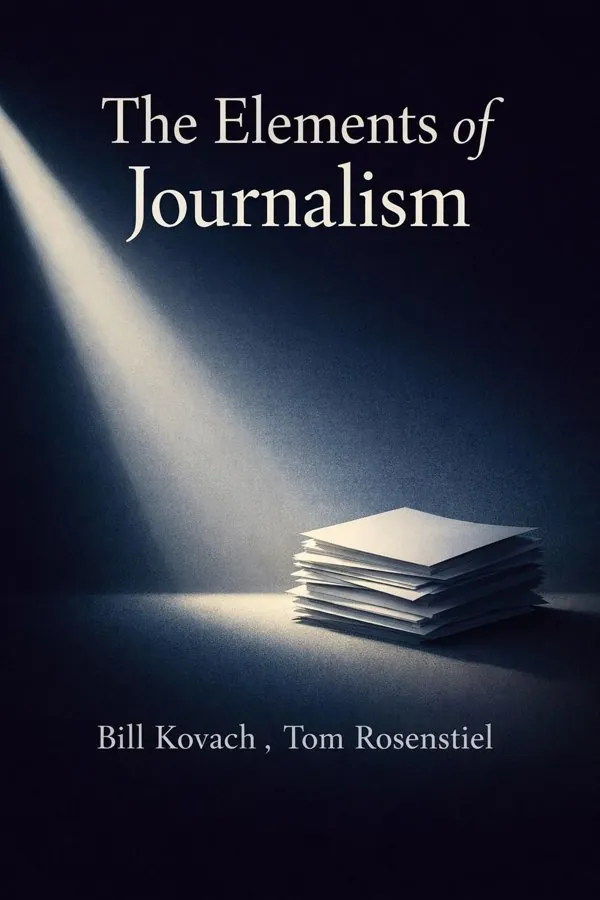
The Elements of Journalism: What Newspeople Should Know and the Public Should Expect: Summary & Key Insights
by Bill Kovach, Tom Rosenstiel
 10 min10 chaptersAudio available
What Is The Elements of Journalism: What Newspeople Should Know and the Public Should Expect About?
The Elements of Journalism: What Newspeople Should Know and the Public Should Expect by Bill Kovach, Tom Rosenstiel is a journalism book spanning 10 pages. The Elements of Journalism defines the core principles and enduring values of journalism in a democratic society. Bill Kovach and Tom Rosenstiel outline the essential elements that distinguish journalism from other forms of communication, emphasizing truth, verification, independence, and the obligation to serve citizens. The book has become a foundational text for journalists, educators, and readers seeking to understand the role of the press in public life.
This FizzRead summary covers all 10 key chapters of The Elements of Journalism: What Newspeople Should Know and the Public Should Expect in approximately 10 minutes, distilling the most important ideas, arguments, and takeaways from Bill Kovach, Tom Rosenstiel's work. Also available as an audio summary and Key Quotes Podcast.
The Elements of Journalism: What Newspeople Should Know and the Public Should Expect
The Elements of Journalism defines the core principles and enduring values of journalism in a democratic society. Bill Kovach and Tom Rosenstiel outline the essential elements that distinguish journalism from other forms of communication, emphasizing truth, verification, independence, and the obligation to serve citizens. The book has become a foundational text for journalists, educators, and readers seeking to understand the role of the press in public life.
Who Should Read The Elements of Journalism: What Newspeople Should Know and the Public Should Expect?
This book is perfect for anyone interested in journalism and looking to gain actionable insights in a short read. Whether you're a student, professional, or lifelong learner, the key ideas from The Elements of Journalism: What Newspeople Should Know and the Public Should Expect by Bill Kovach, Tom Rosenstiel will help you think differently.
- ✓Readers who enjoy journalism and want practical takeaways
- ✓Professionals looking to apply new ideas to their work and life
- ✓Anyone who wants the core insights of The Elements of Journalism: What Newspeople Should Know and the Public Should Expect in just 10 minutes
Want the full summary?
Get instant access to this book summary and 100K+ more with Fizz Moment.
Get Free SummaryAvailable on App Store • Free to download
Key Chapters
From our earliest days in the newsroom, journalists are told to ‘get the facts right.’ But what does truth mean in a world of constant change, conflicting narratives, and hidden agendas? For us, truth in journalism is not a final, perfect state; it is a process—a journey toward understanding. Our obligation is to seek a practical and functional truth that citizens can rely upon to make decisions about their lives.
This pursuit begins with the humble act of verification. It requires skepticism, persistence, and humility. The first drafts of reality are always incomplete, so we refine them, correct them, and admit our limits. Accuracy is the foundation, but truthfulness goes beyond precision—it demands context, proportion, and honesty about what we know and what we don’t.
In today’s digital sphere, truth has become contested territory. Speed often trumps accuracy, and emotion overtakes evidence. But when we rush to be first instead of striving to be right, we abandon the very reason the public entrusts us with attention. Journalism’s credibility rests not on flawless performance, but on transparent process. When we show our work—how we know what we know—we invite citizens to judge our reliability. That openness creates trust, and trust is journalism’s currency.
Verification is journalism’s ethical muscle. It distinguishes news from rumor, fact from fiction, and accountability from speculation. When we investigated how journalists worked, we discovered that the best practitioners shared a quiet but powerful discipline: they tested everything. No assertion was accepted at face value; every claim was weighed against evidence and corroborated by multiple sources.
Verification requires humility because the world resists simplification. It compels us to ask uncomfortable questions: Who benefits from this information? What do we actually know? What must we still confirm? To verify is to care enough about truth to hesitate. And that hesitation—often invisible to the audience—is what protects journalism from becoming manipulation.
The internet age complicates this process. Social media accelerates rumor, and algorithms reward outrage. But the core discipline does not change. A journalist’s job is not to echo popular sentiment but to interrogate it. We must slow down, check our assumptions, and admit when we are uncertain. The act of verification is not a constraint; it is freedom from distortion. It ensures that when citizens read our work, they can trust that it was crafted in good faith, anchored in verifiable reality, and open to correction.
+ 8 more chapters — available in the FizzRead app
All Chapters in The Elements of Journalism: What Newspeople Should Know and the Public Should Expect
About the Authors
Bill Kovach is a veteran journalist who served as Washington bureau chief of The New York Times and curator of the Nieman Foundation for Journalism at Harvard University. Tom Rosenstiel is an author, journalist, and founder of the American Press Institute, known for his work on media ethics and the future of news.
Get This Summary in Your Preferred Format
Read or listen to the The Elements of Journalism: What Newspeople Should Know and the Public Should Expect summary by Bill Kovach, Tom Rosenstiel anytime, anywhere. FizzRead offers multiple formats so you can learn on your terms — all free.
Available formats: App · Audio · PDF · EPUB — All included free with FizzRead
Download The Elements of Journalism: What Newspeople Should Know and the Public Should Expect PDF and EPUB Summary
Key Quotes from The Elements of Journalism: What Newspeople Should Know and the Public Should Expect
“From our earliest days in the newsroom, journalists are told to ‘get the facts right.”
“Verification is journalism’s ethical muscle.”
Frequently Asked Questions about The Elements of Journalism: What Newspeople Should Know and the Public Should Expect
The Elements of Journalism: What Newspeople Should Know and the Public Should Expect by Bill Kovach, Tom Rosenstiel is a journalism book that explores key ideas across 10 chapters. The Elements of Journalism defines the core principles and enduring values of journalism in a democratic society. Bill Kovach and Tom Rosenstiel outline the essential elements that distinguish journalism from other forms of communication, emphasizing truth, verification, independence, and the obligation to serve citizens. The book has become a foundational text for journalists, educators, and readers seeking to understand the role of the press in public life.
You Might Also Like



Browse by Category
Ready to read The Elements of Journalism: What Newspeople Should Know and the Public Should Expect?
Get the full summary and 100K+ more books with Fizz Moment.