
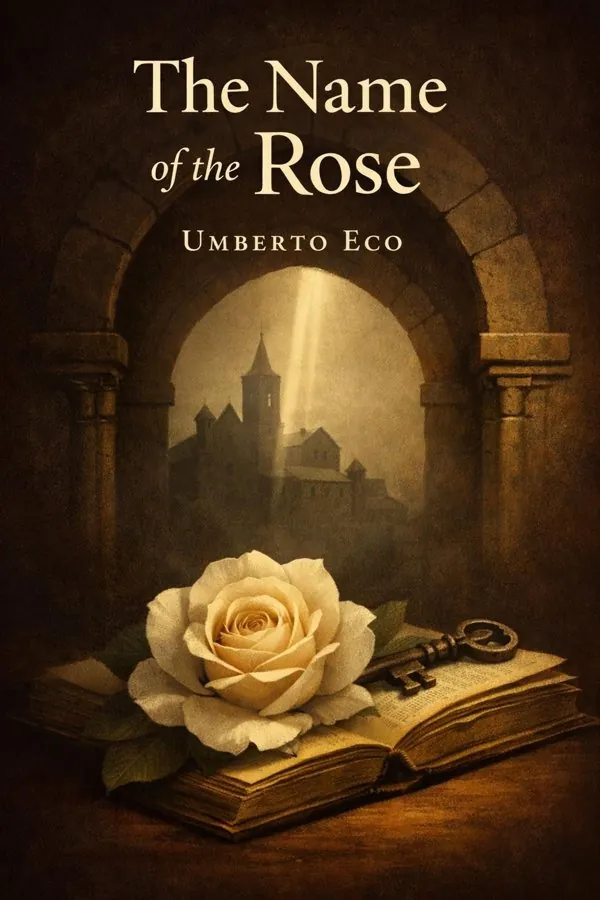
The Name of the Rose: Summary & Key Insights
by Umberto Eco
 10 min9 chaptersAudio available
Key Takeaways from The Name of the Rose
Memory is never a neutral archive; it is a reconstruction shaped by age, longing, and loss.
In an atmosphere ruled by superstition and panic, careful observation becomes a moral act.
Knowledge is never merely stored; it is organized, restricted, guarded, and used.
Coming of age often begins when inherited certainty collides with lived experience.
Religious conflict in the novel is never only spiritual; it is also political, economic, and institutional.
What Is The Name of the Rose About?
The Name of the Rose by Umberto Eco is a classics book spanning 6 pages. Set in an isolated Benedictine abbey in northern Italy in 1327, The Name of the Rose begins as a murder mystery and unfolds into something far richer: a meditation on truth, power, interpretation, and the dangerous allure of forbidden knowledge. The novel follows the sharp-minded Franciscan friar William of Baskerville and his young novice, Adso of Melk, as they arrive at the monastery for a theological dispute and are drawn into a chain of eerie deaths. What appears to be a criminal investigation soon becomes an exploration of how institutions control ideas, how fear distorts belief, and how human beings search for meaning in a world of signs. What makes the book enduring is its extraordinary range. Umberto Eco combines the suspense of a detective story with philosophy, medieval theology, semiotics, and historical debate, creating a novel that rewards both casual readers and serious thinkers. Eco was not only a novelist but one of the twentieth century’s leading scholars of signs, language, and interpretation. That intellectual depth gives the story unusual authority. The Name of the Rose matters because it asks timeless questions: who gets to define truth, what is the cost of suppressing knowledge, and can reason survive in a culture ruled by fear?
This FizzRead summary covers all 9 key chapters of The Name of the Rose in approximately 10 minutes, distilling the most important ideas, arguments, and takeaways from Umberto Eco's work. Also available as an audio summary and Key Quotes Podcast.
The Name of the Rose
Set in an isolated Benedictine abbey in northern Italy in 1327, The Name of the Rose begins as a murder mystery and unfolds into something far richer: a meditation on truth, power, interpretation, and the dangerous allure of forbidden knowledge. The novel follows the sharp-minded Franciscan friar William of Baskerville and his young novice, Adso of Melk, as they arrive at the monastery for a theological dispute and are drawn into a chain of eerie deaths. What appears to be a criminal investigation soon becomes an exploration of how institutions control ideas, how fear distorts belief, and how human beings search for meaning in a world of signs.
What makes the book enduring is its extraordinary range. Umberto Eco combines the suspense of a detective story with philosophy, medieval theology, semiotics, and historical debate, creating a novel that rewards both casual readers and serious thinkers. Eco was not only a novelist but one of the twentieth century’s leading scholars of signs, language, and interpretation. That intellectual depth gives the story unusual authority. The Name of the Rose matters because it asks timeless questions: who gets to define truth, what is the cost of suppressing knowledge, and can reason survive in a culture ruled by fear?
Who Should Read The Name of the Rose?
This book is perfect for anyone interested in classics and looking to gain actionable insights in a short read. Whether you're a student, professional, or lifelong learner, the key ideas from The Name of the Rose by Umberto Eco will help you think differently.
- ✓Readers who enjoy classics and want practical takeaways
- ✓Professionals looking to apply new ideas to their work and life
- ✓Anyone who wants the core insights of The Name of the Rose in just 10 minutes
Want the full summary?
Get instant access to this book summary and 100K+ more with Fizz Moment.
Get Free SummaryAvailable on App Store • Free to download
Key Chapters
Memory is never a neutral archive; it is a reconstruction shaped by age, longing, and loss. The Name of the Rose begins with an old Adso of Melk looking back on the extraordinary days of his youth, when he traveled with William of Baskerville to a remote abbey and witnessed a sequence of murders, debates, temptations, and revelations. This framing device matters because it reminds us from the first page that the story is not simply about what happened, but about how events are remembered and interpreted.
Adso is both participant and narrator. As a young novice, he is intelligent but inexperienced, eager to learn from William yet still deeply impressionable. As an old man, he understands more than he did then, but he also knows how much escaped him. This combination gives the novel its emotional texture. We experience the intensity of youth and the humility of hindsight at the same time.
Eco uses Adso’s recollection to show that history is always filtered. Facts do not arrive untouched; they come to us through witnesses, documents, institutions, and fading memory. That insight applies well beyond the novel. In everyday life, we often treat first-person accounts, family stories, workplace narratives, or public histories as complete when they are partial. The book encourages readers to ask: what is being remembered, what is being forgotten, and who benefits from each version?
A practical application is to approach any complex event with interpretive humility. Whether reading the news, reviewing a conflict at work, or thinking about your own past, distinguish between the event itself and the story told about it. Ask what perspective is missing and what emotions may be shaping the account.
Actionable takeaway: when evaluating any narrative, begin by asking not just “What happened?” but “Who is telling this, and how does their position shape the truth I receive?”
In an atmosphere ruled by superstition and panic, careful observation becomes a moral act. William of Baskerville stands out in the abbey because he refuses to explain mystery through hysteria, prophecy, or demonic fantasy. Instead, he studies clues: footprints in snow, stains on manuscripts, the behavior of monks, the timing of deaths, the architecture of hidden spaces. He treats the world as readable, not magical, and believes that truth emerges through disciplined interpretation.
William’s method gives the novel its detective structure, but it also embodies one of Eco’s deepest themes: reason is not cold detachment but a way of resisting fear. In the abbey, unexplained deaths quickly become signs of apocalypse. People grasp for symbolic certainty because fear demands closure. William resists that impulse. He knows signs can be misleading, that patterns can seduce us, and that conclusions must remain provisional until evidence supports them.
This lesson remains strikingly modern. Today, panic spreads through rumors, social media, ideological certainty, and emotional reactions masquerading as fact. In moments of confusion, people still prefer dramatic explanations to patient inquiry. William models a different response: gather evidence, compare interpretations, revise hypotheses, and remain aware that intelligence can still fail.
A practical example is decision-making under pressure. In a workplace crisis, a family misunderstanding, or a public controversy, it is tempting to jump to the most emotionally satisfying explanation. William’s approach suggests slowing down, identifying verifiable details, and testing assumptions before acting.
Eco also avoids idealizing reason as omnipotent. William is brilliant, but he does not solve everything in time. That limitation is important. Rational inquiry is necessary, yet human knowledge remains incomplete.
Actionable takeaway: when fear pushes you toward certainty, pause and build your judgment from observable evidence rather than from the explanation that feels most dramatic or comforting.
Knowledge is never merely stored; it is organized, restricted, guarded, and used. The abbey’s library is one of the most memorable settings in modern fiction because it is more than a collection of books. It is a labyrinth, a fortress, and a symbol of the human desire to possess truth while controlling who may access it. To William and Adso, it is irresistible. To the abbey’s authorities, it is sacred and dangerous. To Eco, it is the physical embodiment of intellectual power.
The library contains texts from across traditions and centuries, but access is tightly regulated. Books are not treated as tools for open inquiry; they are objects of custody. This reveals a central tension in the novel: institutions often praise wisdom while fearing the consequences of free thought. The more valuable the knowledge, the stronger the urge to monopolize it.
The library’s maze-like design also reflects the experience of interpretation itself. Readers move through fragments, symbols, codes, and misleading paths. Finding a book becomes analogous to seeking truth: one must navigate confusion, authority, secrecy, and one’s own desire. Eco suggests that knowledge can elevate the mind, but its pursuit can also become obsession, vanity, or domination.
This idea applies powerfully today. Replace the medieval library with archives, universities, digital platforms, proprietary data, or algorithmic systems. Access to information still shapes power. People and institutions still decide what is searchable, visible, permissible, or hidden. The novel prompts us to ask whether knowledge is being shared for understanding or controlled for leverage.
A practical application is to examine the systems through which you learn. Who curates your sources? What information is difficult to access? What expertise is gatekept by jargon, bureaucracy, or technology? Becoming aware of those structures is part of becoming intellectually free.
Actionable takeaway: seek knowledge actively, but also question who controls access to it and what interests are served when important information is hidden, restricted, or made unnecessarily obscure.
Coming of age often begins when inherited certainty collides with lived experience. Amid the murders and theological disputes, Adso undergoes a deeply personal initiation. His encounter with a nameless peasant girl introduces him to desire, tenderness, shame, and confusion all at once. For a young novice shaped by religious discipline and abstract instruction, this episode is not a distraction from the novel’s larger themes; it is one of the ways Eco shows that human beings cannot be reduced to doctrine.
Adso’s awakening matters because it complicates the world he has been taught to see in fixed categories: holy and sinful, pure and corrupt, reason and passion. His experience is intense, fleeting, and difficult to name. He does not possess the language or maturity to integrate it easily, and that gap between feeling and understanding becomes part of his formation.
Eco uses this moment to reveal the limitations of systems that aim to classify everything. Desire does not fit neatly into theological formulae. Human beings are embodied, vulnerable, hungry, affectionate, fearful, and contradictory. The novel’s intellectual disputes are therefore mirrored in Adso’s inner life: interpretation is not only about books and signs but about the self.
This has practical relevance because many people still inherit rigid frameworks for understanding emotion, sexuality, or moral identity. When real experience disrupts those frameworks, the result is often guilt or fragmentation. Adso’s struggle suggests the importance of compassionate reflection rather than immediate self-condemnation.
A modern application is learning to hold complexity without rushing to simplistic labels. A difficult attraction, a morally ambiguous choice, or a conflicting desire does not always demand instant certainty. It may require reflection, honesty, and deeper self-knowledge.
Actionable takeaway: when experience unsettles your inherited beliefs, resist the urge to collapse into shame or denial; instead, examine what the experience reveals about your humanity and your need for wiser, more compassionate understanding.
Religious conflict in the novel is never only spiritual; it is also political, economic, and institutional. William and Adso arrive at the abbey partly because it is hosting a dispute over apostolic poverty, a heated controversy in the medieval Church. At stake is a deceptively simple question: should the Church, if it follows Christ, embrace material poverty? Behind that question lies a struggle over legitimacy, authority, and control.
Eco shows that theological arguments often conceal battles over power. For some, the ideal of poverty is a sincere spiritual commitment and a protest against corruption. For others, it threatens the wealth and hierarchy on which ecclesiastical authority rests. The debate therefore becomes dangerous. Ideas about Christ’s life are not abstract scholarly matters; they challenge institutions, property, prestige, and political alliances.
William occupies a complex position in this world. He is a friar committed to inquiry and moderation, yet he understands that noble principles can be weaponized by factions. Meanwhile, figures linked to the Inquisition exploit fear of heresy to discipline dissent. The novel reveals how institutions preserve themselves not only through doctrine but through accusation, spectacle, and the moral labeling of opponents.
This theme remains highly relevant. In modern organizations, governments, and even nonprofits, disputes over values often mask deeper questions: who controls resources, whose voice counts, and what narratives justify authority? A company’s “culture debate,” for example, may actually be about status or control. Public moral language can still function as a cover for political interests.
The practical lesson is to listen for material realities beneath ideological language. When a group claims to defend principle, ask what structures of power are also being defended. This does not mean cynically dismissing all conviction; it means recognizing that ideas operate within institutions.
Actionable takeaway: when confronted with moral or ideological conflict, examine not just the stated beliefs but also the underlying incentives, resources, and power arrangements shaping the debate.
What a culture forbids often reveals what it fears most. One of the novel’s most famous and provocative ideas concerns laughter. At the center of the mystery lies a lost book associated with Aristotle’s reflections on comedy, and the possibility of that text’s circulation terrifies those who believe laughter undermines authority. This is not a minor literary flourish. For Eco, laughter represents a destabilizing force that can expose solemn power as fragile, contingent, and human.
The fear is easy to understand. Authority often depends on ritual seriousness. If people learn to laugh at what claims to be unquestionable, reverence weakens. Dogma can no longer rely on automatic obedience. In the abbey, therefore, the suppression of a book about comedy becomes part of a broader attempt to control interpretation and preserve fear as a tool of order.
Eco does not present laughter as mere entertainment. It is linked to freedom of mind, skepticism, and resistance to absolutism. To laugh is not necessarily to reject faith; it may instead mean refusing idolatry toward human institutions. William, with his irony and intellectual flexibility, intuitively grasps this. His opponents understand it too, which is why they find laughter dangerous.
This insight has clear modern applications. Satire, humor, parody, and irreverence continue to challenge political and cultural power. Regimes, corporations, and rigid communities often react defensively when mocked because ridicule can puncture their aura more effectively than formal critique.
Practically, the theme invites readers to value humor not as triviality but as a way of preserving perspective. In workplaces, communities, and public life, people should be wary of systems that cannot tolerate questioning, irony, or self-awareness.
Actionable takeaway: pay attention to what authorities declare untouchable; the inability to endure honest humor often signals a deeper fear of scrutiny, pluralism, and intellectual freedom.
Human beings do not encounter reality directly; we move through signs, clues, language, and interpretation. This semiotic insight lies at the heart of The Name of the Rose. William reads the world like a text, but Eco repeatedly shows how difficult and unstable that reading can be. A footprint suggests one thing, a manuscript another, a biblical reference something else. Meaning emerges through interpretation, yet interpretation is always vulnerable to error.
This makes the novel more than a conventional whodunit. It becomes an exploration of how people make sense of the world. Some characters impose preexisting patterns on events and see divine punishment everywhere. William seeks empirical coherence, but even he can mistake patterns for certainty. Eco’s point is not that truth does not exist. Rather, truth is approached through signs that require judgment, comparison, and humility.
The novel therefore warns against two opposite mistakes. The first is credulity: assuming that every sign transparently points to a single meaning. The second is cynicism: assuming that because interpretation is difficult, all meanings are equally false. Eco avoids both extremes. Meaning matters, but it must be pursued with discipline and awareness of one’s limits.
This lesson is especially relevant in an age of information overload. Headlines, statistics, images, and viral claims all function as signs demanding interpretation. A screenshot may mislead, a quote may be decontextualized, and a pattern may be coincidence. Good judgment requires more than intelligence; it requires method.
A practical application is media literacy. Before accepting a narrative, ask: what is the source, what context is missing, what alternative interpretations exist, and what evidence would change my mind? That habit mirrors William’s best qualities.
Actionable takeaway: treat meaning as something to be earned through careful interpretation, not seized through instant certainty or abandoned through lazy relativism.
Systems of fear do not need truth to function; they need confession, spectacle, and obedience. The arrival of the inquisitor Bernard Gui intensifies the novel by shifting the search for truth into a machinery of accusation. Bernard does not investigate in order to understand. He investigates in order to identify culprits, reinforce authority, and display power. In his hands, procedure becomes theater, and guilt is something produced rather than discovered.
Eco’s portrait of the Inquisition is chilling because it shows how institutional violence often operates through certainty. Bernard interprets ambiguity as proof, vulnerability as guilt, and social marginality as suspicion. Those least able to defend themselves become easiest to condemn. The process rewards predetermined conclusions rather than honest inquiry.
William’s method and Bernard’s method therefore stand in stark opposition. Both read signs, but one reads to understand complexity while the other reads to confirm ideology. This contrast gives the novel enduring force. It dramatizes the difference between justice and persecution, between interpretation as inquiry and interpretation as domination.
The theme extends far beyond medieval religion. Modern organizations and societies still create climates in which accusations spread faster than evidence, and institutional actors seek visible punishment more than truth. In a workplace scandal, media frenzy, or polarized political environment, reputations can be destroyed through narratives that satisfy collective emotion before facts are established.
A practical lesson is to be alert when due process is replaced by moral excitement. When institutions seem more invested in displaying righteousness than in determining facts, danger is near. This does not mean abandoning accountability; it means insisting that accountability without fairness becomes another form of abuse.
Actionable takeaway: whenever guilt is being assigned quickly and publicly, ask whether the process is designed to uncover truth or to stage power through fear, conformity, and symbolic punishment.
Civilization can burn faster than it can build. The novel’s devastating climax, in which the library is consumed by fire, is not merely a dramatic ending to the murder plot. It is Eco’s stark reminder that knowledge is fragile, and that the destruction of books is also the destruction of memory, possibility, and dialogue across time. The abbey’s library gathered centuries of thought, yet secrecy, fanaticism, and human error turn it into ashes.
This loss has multiple meanings. On one level, it is the tragic consequence of the attempt to control knowledge too tightly. What is hoarded, hidden, and fetishized becomes vulnerable to catastrophic ruin. On another level, the fire symbolizes the limits of all human attempts to preserve total meaning. No archive is complete, no institution eternal, and no system of knowledge immune from contingency.
Adso’s later recollection of salvaged fragments is especially poignant. He cannot restore the whole, but he can preserve remnants. That image captures a central truth about cultural life: much of what we inherit comes to us damaged, incomplete, and mediated by chance. Yet fragments still matter. They allow memory to continue, even if imperfectly.
This idea has practical relevance in the digital era. We often assume knowledge is permanently preserved because it is searchable or stored electronically. But data can disappear, platforms can collapse, archives can be censored, and cultural memory can still be manipulated or erased. Preservation requires intention.
A practical application is to value and protect repositories of knowledge: libraries, open archives, independent scholarship, careful documentation, and even your own notes and records. Communities that neglect preservation become vulnerable to amnesia and control.
Actionable takeaway: do not assume important knowledge will survive on its own; preserve what matters, share it widely, and support institutions that keep memory accessible rather than hidden or disposable.
All Chapters in The Name of the Rose
About the Author
Umberto Eco (1932–2016) was an Italian novelist, philosopher, literary critic, and professor of semiotics at the University of Bologna. Trained in medieval philosophy, he became one of the world’s leading thinkers on signs, language, interpretation, and mass communication. His scholarly work gave him an unusually deep command of symbolism, history, and textual analysis, all of which shaped his fiction. Eco achieved international fame with The Name of the Rose, a novel that fused medieval history, detective fiction, and philosophical reflection. He later wrote other acclaimed novels, including Foucault’s Pendulum, and numerous essays on culture and media. Eco’s writing is known for blending rigorous intellect with wit, narrative invention, and a fascination with how human beings search for meaning in texts, images, and institutions.
Get This Summary in Your Preferred Format
Read or listen to the The Name of the Rose summary by Umberto Eco anytime, anywhere. FizzRead offers multiple formats so you can learn on your terms — all free.
Available formats: App · Audio · PDF · EPUB — All included free with FizzRead
Download The Name of the Rose PDF and EPUB Summary
Key Quotes from The Name of the Rose
“Memory is never a neutral archive; it is a reconstruction shaped by age, longing, and loss.”
“In an atmosphere ruled by superstition and panic, careful observation becomes a moral act.”
“Knowledge is never merely stored; it is organized, restricted, guarded, and used.”
“Coming of age often begins when inherited certainty collides with lived experience.”
“Religious conflict in the novel is never only spiritual; it is also political, economic, and institutional.”
Frequently Asked Questions about The Name of the Rose
The Name of the Rose by Umberto Eco is a classics book that explores key ideas across 9 chapters. Set in an isolated Benedictine abbey in northern Italy in 1327, The Name of the Rose begins as a murder mystery and unfolds into something far richer: a meditation on truth, power, interpretation, and the dangerous allure of forbidden knowledge. The novel follows the sharp-minded Franciscan friar William of Baskerville and his young novice, Adso of Melk, as they arrive at the monastery for a theological dispute and are drawn into a chain of eerie deaths. What appears to be a criminal investigation soon becomes an exploration of how institutions control ideas, how fear distorts belief, and how human beings search for meaning in a world of signs. What makes the book enduring is its extraordinary range. Umberto Eco combines the suspense of a detective story with philosophy, medieval theology, semiotics, and historical debate, creating a novel that rewards both casual readers and serious thinkers. Eco was not only a novelist but one of the twentieth century’s leading scholars of signs, language, and interpretation. That intellectual depth gives the story unusual authority. The Name of the Rose matters because it asks timeless questions: who gets to define truth, what is the cost of suppressing knowledge, and can reason survive in a culture ruled by fear?
You Might Also Like



Browse by Category
Ready to read The Name of the Rose?
Get the full summary and 100K+ more books with Fizz Moment.